惯性聚合 高效追踪和阅读你感兴趣的博客、新闻、科技资讯
阅读原文 在惯性聚合中打开

推荐订阅源

宝玉的分享
宝玉的分享
J
Java Code Geeks
S
SegmentFault 最新的问题
L
LangChain Blog
M
MIT News - Artificial intelligence
Stack Overflow Blog
Stack Overflow Blog
IT之家
IT之家
量子位
奇客Solidot–传递最新科技情报
奇客Solidot–传递最新科技情报
雷峰网
雷峰网
OSCHINA 社区最新新闻
OSCHINA 社区最新新闻
The Cloudflare Blog
MongoDB | Blog
MongoDB | Blog
Microsoft Security Blog
腾讯CDC
H
Help Net Security
阮一峰的网络日志
阮一峰的网络日志
Jina AI
Jina AI
N
Netflix TechBlog - Medium
A
About on SuperTechFans
博客园 - 叶小钗
美团技术团队
人人都是产品经理
人人都是产品经理
D
DataBreaches.Net

Keep the gradient flowing

Policy Gradients Part 1: The REINFORCE Estimator On the Link Between Optimization and Polynomials, Part 6. Optimization Nuggets: Stochastic Polyak Step-size, Part 2 Optimization Nuggets: Stochastic Polyak Step-size On the Convergence of the Unadjusted Langevin Algorithm The Russian Roulette: An Unbiased Estimator of the Limit Notes on the Frank-Wolfe Algorithm, Part III: backtracking line-search On the Link Between Optimization and Polynomials, Part 5 Optimization Nuggets: Implicit Bias of Gradient-based Methods Optimization Nuggets: Exponential Convergence of SGD On the Link Between Optimization and Polynomials, Part 4 On the Link Between Optimization and Polynomials, Part 3 On the Link Between Optimization and Polynomials, Part 2 On the Link Between Polynomials and Optimization, Part 1 How to Evaluate the Logistic Loss and not NaN trying Notes on the Frank-Wolfe Algorithm, Part II: A Primal-dual Analysis Three Operator Splitting Notes on the Frank-Wolfe Algorithm, Part I Optimization inequalities cheatsheet A fully asynchronous variant of the SAGA algorithm Hyperparameter optimization with approximate gradient Lightning v0.1 scikit-learn-contrib, an umbrella for scikit-learn related projects. SAGA algorithm in the lightning library On the consistency of ordinal regression methods Holdout cross-validation generator IPython/Jupyter notebook gallery PyData Paris - April 2015 Data-driven hemodynamic response function estimation Plot memory usage as a function of time
solve triangular matrices using scipy.linalg
Fabian Pedregosa · 2010-10-30 · via Keep the gradient flowing

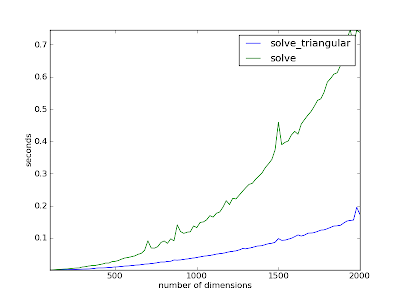
For some time now I've been missing a function in scipy that exploits the triangular structure of a matrix to efficiently solve the associated system, so I decided to implement it by binding the LAPACK method "trtrs", which also checks for singularities and is capable handling several right-hand sides. Contrary to what I expected, binding Fortran code with f2py is pretty straightforward, even for someone like me who has never programmed in that language: I took a similar example, modified it's parameters and it worked! Also, thanks to Pauli Virtanen the review process was really fast and the patch was committed within a few hours. The high level interface for LAPACK's trtrs is linalg.solve_triangular, which accepts roughly the same arguments as linalg.solve, but assumes the first argument is a triangular matrix: [cc lang="python"] In [1]: from scipy import linalg In [2]: linalg.solve_triangular([[1, 1], [0, 1]], [0, 1]) Out[2]: array([-1., 1.]) [/cc] Simple benchmarks lets us clearly appreciate the complexity gap between both methods : solving an (n, n) triangular system is an O(n^2) operation, while solving a full one is at least a O(n^3):