






Why the final Full Moon of the month is also the smallest of the year.
There’s nothing like a random celestial coincidence, turned good internet meme. In this case, the chance event is this weekend’s Full Moon, which also happens to be the second Full Moon of May, and is also the most distant and the visually smallest Full Moon of the year.
We’re already seeing the hype around the curious pairing of the two occurrences. Granted, what you’ll see is a rising near Full Moon on Saturday night May 30th going into Sunday, May 31st. Would you know anything unique was afoot during this May Flower Moon for 2026, if you didn’t know any better?
Here are the specifics: The Moon reaches Full on May 31st at 8:47 Universal Time (UT), 19 hours before apogee on June 1st at 4:34 UT. At 406,368 kilometers distant, this only misses being the most distant apogee of the year by just 52 kilometers.
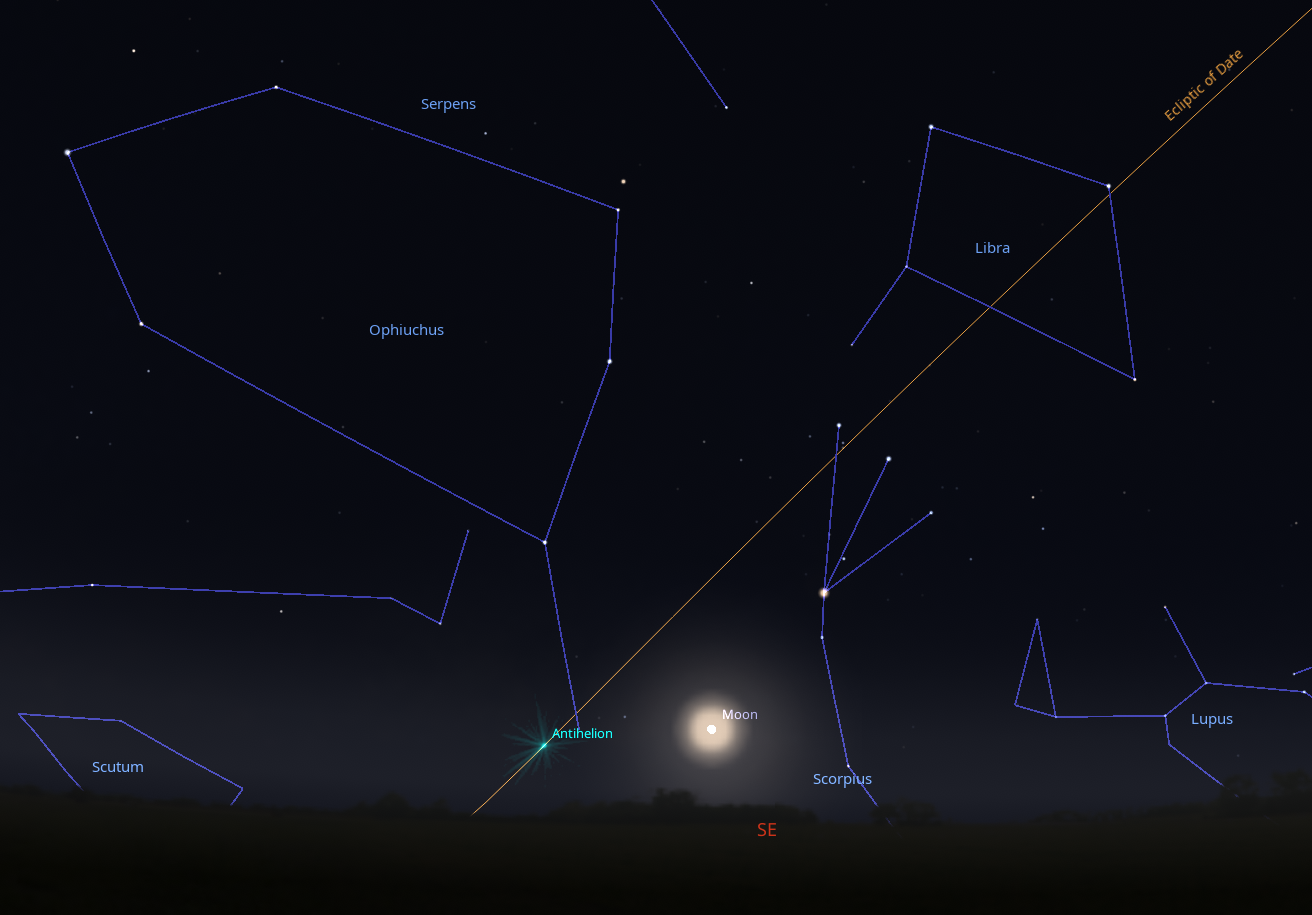 Looking eastward at the rising Moon just past Full on the night of May 31st. Credit: Stellarium.
Blue Moon Blues
Now, this is the second Full Moon of May 2026, making it a ‘Blue Moon’ in the modern sense. But don’t expect the Moon to actually appear blue in color. This term actually stems from an error published in Sky &; Telescope in 1946, referring to the superfluous second Moon of a calendar month. That definition actually comes down from the now defunct Maine Farmer’s Almanac, which used the even more Byzantine distinction of the ‘third Full Moon, in an astronomical season with four.’ Legend has it, they denoted the extra Moon with blue ink.
Moreover, second Full Moons in a month aren’t all that rare, and occur roughly once every 2-3 years.
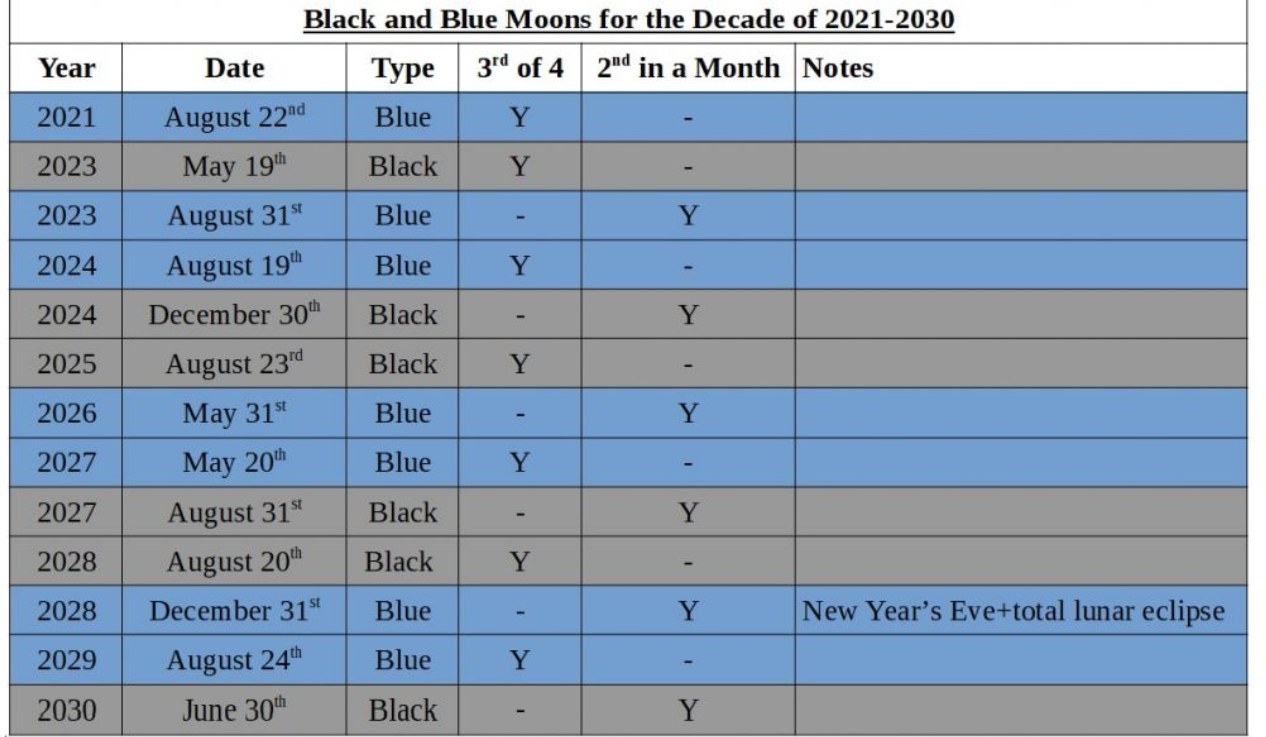 Blue and Black Moons for the current decade. Credit: Dave Dickinson.
On very rare occasions, the Moon can physically appear Blue, as happened on the night of September 23rd, 1950 over eastern North America, when the Moon seen to take on a bluish cast. This was due to muskeg fires in far to the west in Alberta, Canada, suspending ash and debris high in the atmosphere. This acted as a natural airborne filter. Ironically, the Moon was at waxing gibbous and two days from Full at the time.
Next, the May 31st Full Moon is the Minimoon for 2026, in the sense that it’s the visually smallest of the year. This you can actually see, if you compare it to the perigee (Super) Moon on the night of August 30th/31st later this summer. The Moon’s path is slightly elliptical, taking it from a near perigee of around 363,300 kilometers, to an apogee of 405,500 kilometers once per orbit.
This means that the Moon can appear anywhere from 29.3’ to 34.1’ across. When a solar eclipse occurs near lunar apogee, the Moon appears too small to cover the Sun, and an annular eclipse occurs.
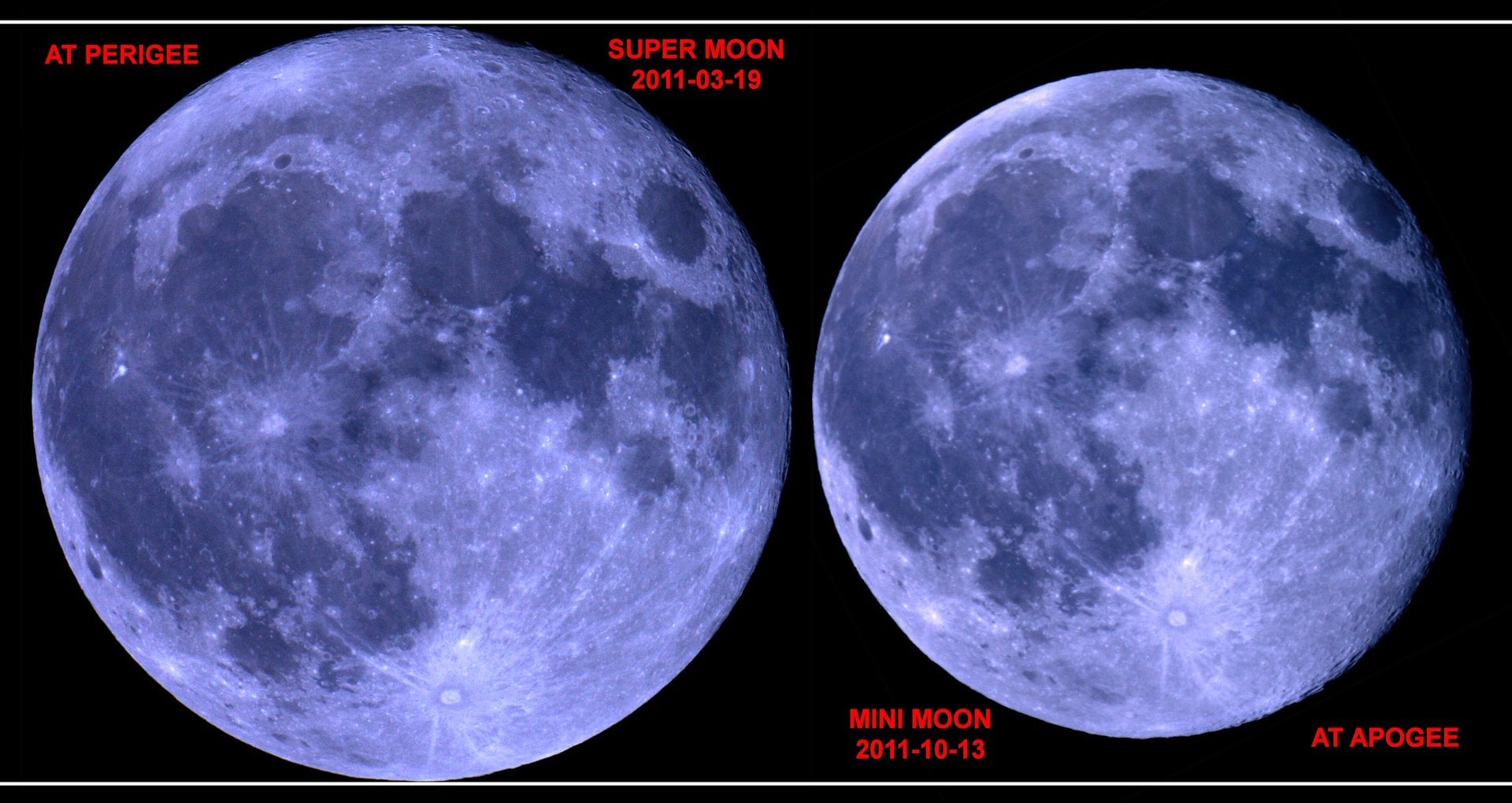 The Super vs. Minimoon. Credit: Ken Lord.
But how rare is a Minimoon, with a Full Moon less than 24 hours from apogee… and a Blue Moon? Well, the last time this occurred was on October 30th, 2020 (-20 hours apart), and the next won’t happen until (mark your calendars) July 31st, 2080 (18 hours apart). To give you some sense how rare that is, the final Blue Minimoon for the 21st century is on January 31st 2094 (less than an hour apart!)
You can play with Fourmilab’s Lunar Perigee and Apogee calculator to see how these line up by year. Incidentally, Google’s AI gets these 21st century dates wrong, telling me I still have a job in astro-forecasting anomalous events, at least for now.
How about a Blue Minimoon, with a lunar eclipse? Scanning though the calendar, there are none in the 21st century, though there was a Super (Perigee) Blood Moon total lunar eclipse on Jan 31st, 2018. They’re pretty rare, indeed.
It’s also worth noting that said Full Blue Minimoon occults the bright star Antares for eastern Australia, New Zealand, the South Pacific and the southern tip of South America on May 31st, just an hour after passing Full. The rest of us see a close pairing of the two worldwide.
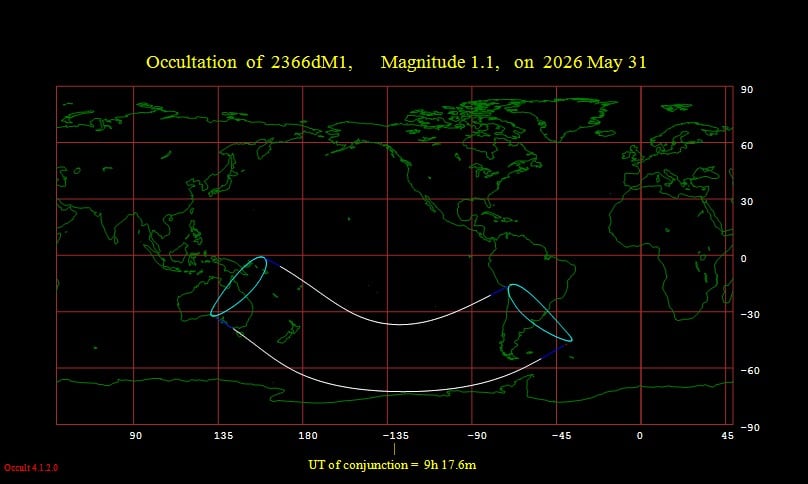 The Antares lunar occultation footprint. Credit: Occult 4.2.
Clouded out this weekend? You can actually watch the Blue Minimoon Live online, courtesy of astronomer Gianluca Masi and the Virtual Telescope Project:
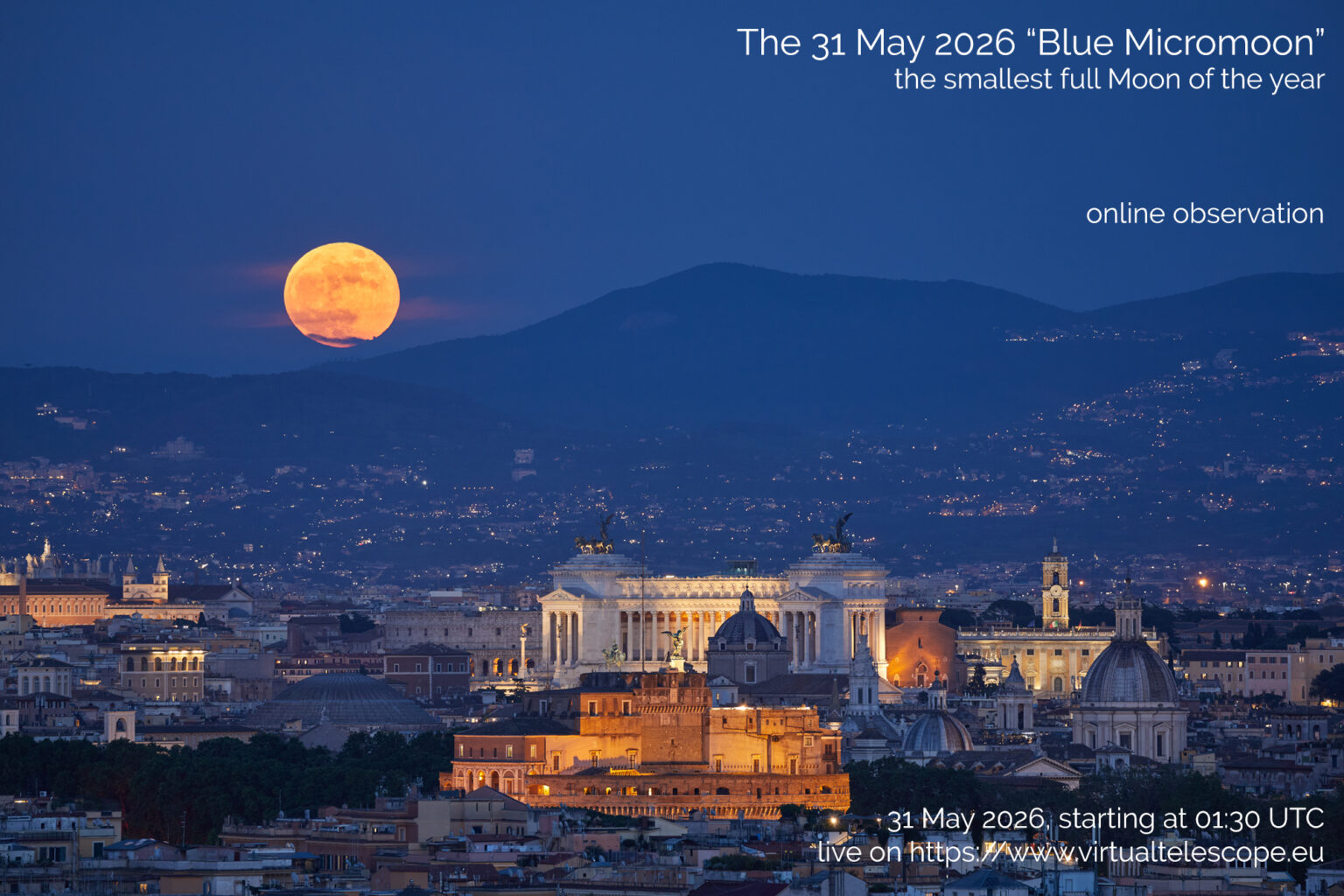 Don't miss the show! Credit: Gianluca Masi.
And the cosmic gears of the sky turn on. If skies are clear, be sure to catch this weekend’s last in a generation Blue Minimoon rising at dusk.
此内容由惯性聚合(RSS阅读器)自动聚合整理,仅供阅读参考。 原文来自 — 版权归原作者所有。