


惯性聚合 高效追踪和阅读你感兴趣的博客、新闻、科技资讯
阅读原文 在惯性聚合中打开

推荐订阅源

小众软件
小众软件
让小产品的独立变现更简单 - ezindie.com
WordPress大学
WordPress大学
月光博客
月光博客
Hugging Face - Blog
Hugging Face - Blog
博客园 - 聂微东
博客园 - 【当耐特】
博客园_首页
The Cloudflare Blog
freeCodeCamp Programming Tutorials: Python, JavaScript, Git & More
Apple Machine Learning Research
Last Week in AI
Last Week in AI
酷 壳 – CoolShell
酷 壳 – CoolShell
大猫的无限游戏
大猫的无限游戏
雷峰网
雷峰网
量子位
钛媒体:引领未来商业与生活新知
钛媒体:引领未来商业与生活新知
T
Tailwind CSS Blog
IT之家
IT之家
OSCHINA 社区最新新闻
OSCHINA 社区最新新闻
GbyAI
GbyAI
V
Visual Studio Blog
F
Fortinet All Blogs
Martin Fowler
Martin Fowler

Help Net Security

Police arrest 10 suspected members of Black Axe cybercrime gang ShinyHunters claims it stole 1.4 million records from Udemy Sevii unveils Cyber Swarm Defense Mode to stop AI-driven attacks at scale Alleged Chinese hacker extradited to US over cyberattacks targeting COVID-19 research Cequence Agent Personas bring granular control and governance to enterprise AI agents NowSecure MARI gives enterprises evidence-based visibility into third-party mobile app risk The metrics killing your SOC, and what to use instead US state privacy fines reached $3.425 billion in 2025 Canada’s first SMS blaster case leads to three arrests Linux storage management tool Stratis 3.9.0 adds online encryption and cache-less pool startup TLS Connect gives SMBs a right-sized automated tool to manage TLS certificates Aptori expands its platform with autonomous offensive testing to reduce security bottlenecks Your IAM was built for humans, AI agents don’t care The AI criminal mastermind is already hiring on gig platforms 25 open-source cybersecurity tools that don’t care about your budget Product showcase: LuLu reveals unauthorized outbound connections from Mac apps Week in review: Claude Mythos finds 271 Firefox flaws, Vercel breach Users advised to drop passwords and make room for passkeys - Help Net Security Indirect prompt injection is taking hold in the wild - Help Net Security Compromised everyday devices power Chinese cyber espionage operations - Help Net Security New Cisco firewall malware can only be killed by pulling the plug - Help Net Security Meta is overhauling how you sign in, manage settings, and protect your accounts - Help Net Security Ubuntu 26.04 LTS delivers memory-safe system tools and live patching for Arm servers - Help Net Security OpenAI’s GPT-5.5 is out with expanded cybersecurity safeguards - Help Net Security AI is speeding up nation-state cyber programs - Help Net Security A study of 1,000 Android apps finds a privacy policy logging gap - Help Net Security IT spending to hit $6.31 trillion record, thanks to AI - Help Net Security Where AI in CI/CD is working for engineering teams - Help Net Security With AI's help, North Korean hackers stumbled into a near-undetectable attack - Help Net Security Hacker with a special interest in breaching sports institutions ends behind bars - Help Net Security
Warp open sources its AI terminal client
Anamarija Po · 2026-04-30 · via Help Net Security

Warp, the AI-centric terminal used by close to a million developers, has released the source code for its client on GitHub under the AGPL license, with OpenAI signed on as the founding sponsor of the repository.
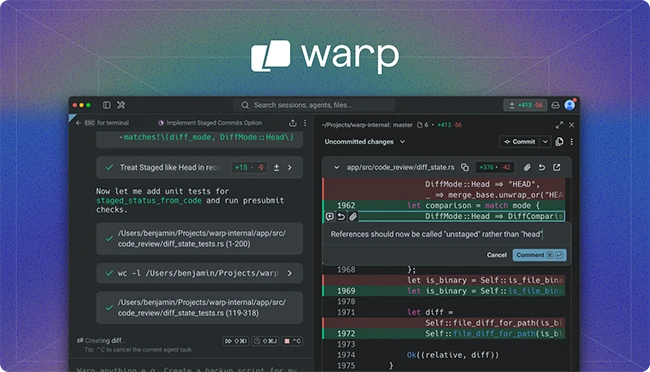
Warp open sources

An agent-first contribution model

Warp is steering contributions through Oz, its cloud agent orchestration platform. Agents handle the bulk of implementation work, including coding, planning, and testing, and human contributors focus on ideas, direction, and verification of agent output. The Warp team retains responsibility for guiding what gets built and when.

Contributors can use other coding agents to submit changes, with Oz set as the preferred path because it carries Warp’s rules, context, and verification loops. The agent workflows in the repository run on OpenAI’s GPT models.

“Open source has long been central to how developers learn, build, and push the field forward. We’re excited to support experiments that explore how AI can help maintainers and contributors collaborate more effectively at scale,” Thibault Sottiaux, Engineering Lead, OpenAI, explained.

Product changes shipping with the release

Warp paired the licensing change with three product updates. The first is wider support for open-source models, including Kimi, MiniMax, and Qwen, along with a new “auto (open)” routing option that selects an open model based on the task.

The second is a layered customization model for the application itself. Users can run Warp as a basic terminal, as a terminal with a small set of agentic features such as a diff view and file tree, or as a complete agentic development environment with built-in agents.

The third addition is a settings file, giving users and agents programmatic control over configuration and portability across machines.

Open roadmap and business rationale

Public GitHub issues will serve as the system of record for feature tracking going forward, and Warp plans to publish its roadmap for the agentic development environment and hold technical and product discussions in public.

Warp chief executive Zach Lloyd cited competitive pressure from well-funded closed-source rivals as a driver of the decision. Warp does not plan to compete on price or subsidize usage, and is betting that an active community paired with agent orchestration will let the company ship features faster than an internal team alone.

Warp is available for free on GitHub.

Must read:

Subscribe to the Help Net Security ad-free monthly newsletter to stay informed on the essential open-source cybersecurity tools. Subscribe here!