
惯性聚合 高效追踪和阅读你感兴趣的博客、新闻、科技资讯
阅读原文 在惯性聚合中打开

推荐订阅源

Hugging Face - Blog
Hugging Face - Blog
GbyAI
GbyAI
Engineering at Meta
Engineering at Meta
有赞技术团队
有赞技术团队
博客园 - 【当耐特】
H
Hackread – Cybersecurity News, Data Breaches, AI and More
WordPress大学
WordPress大学
博客园_首页
美团技术团队
H
Help Net Security
MongoDB | Blog
MongoDB | Blog
宝玉的分享
宝玉的分享
大猫的无限游戏
大猫的无限游戏
小众软件
小众软件
J
Java Code Geeks
A
About on SuperTechFans
让小产品的独立变现更简单 - ezindie.com
IT之家
IT之家
T
The Blog of Author Tim Ferriss
Microsoft Azure Blog
OSCHINA 社区最新新闻
OSCHINA 社区最新新闻
B
Blog
雷峰网
雷峰网
爱范儿
爱范儿

Help Net Security

Police arrest 10 suspected members of Black Axe cybercrime gang ShinyHunters claims it stole 1.4 million records from Udemy Sevii unveils Cyber Swarm Defense Mode to stop AI-driven attacks at scale Alleged Chinese hacker extradited to US over cyberattacks targeting COVID-19 research Cequence Agent Personas bring granular control and governance to enterprise AI agents NowSecure MARI gives enterprises evidence-based visibility into third-party mobile app risk The metrics killing your SOC, and what to use instead US state privacy fines reached $3.425 billion in 2025 Canada’s first SMS blaster case leads to three arrests Linux storage management tool Stratis 3.9.0 adds online encryption and cache-less pool startup TLS Connect gives SMBs a right-sized automated tool to manage TLS certificates Aptori expands its platform with autonomous offensive testing to reduce security bottlenecks Your IAM was built for humans, AI agents don’t care The AI criminal mastermind is already hiring on gig platforms 25 open-source cybersecurity tools that don’t care about your budget Product showcase: LuLu reveals unauthorized outbound connections from Mac apps Week in review: Claude Mythos finds 271 Firefox flaws, Vercel breach Users advised to drop passwords and make room for passkeys - Help Net Security Indirect prompt injection is taking hold in the wild - Help Net Security Compromised everyday devices power Chinese cyber espionage operations - Help Net Security New Cisco firewall malware can only be killed by pulling the plug - Help Net Security Meta is overhauling how you sign in, manage settings, and protect your accounts - Help Net Security Ubuntu 26.04 LTS delivers memory-safe system tools and live patching for Arm servers - Help Net Security OpenAI’s GPT-5.5 is out with expanded cybersecurity safeguards - Help Net Security AI is speeding up nation-state cyber programs - Help Net Security A study of 1,000 Android apps finds a privacy policy logging gap - Help Net Security IT spending to hit $6.31 trillion record, thanks to AI - Help Net Security Where AI in CI/CD is working for engineering teams - Help Net Security With AI's help, North Korean hackers stumbled into a near-undetectable attack - Help Net Security Hacker with a special interest in breaching sports institutions ends behind bars - Help Net Security
Legit Security brings agentic AI to AppSec remediation an...
Industry News · 2026-06-17 · via Help Net Security

Legit Security has launched new remediation agents that independently prioritize issues, generate fixes, open pull requests, and confirm results using context learned from each organization’s distinct codebase.
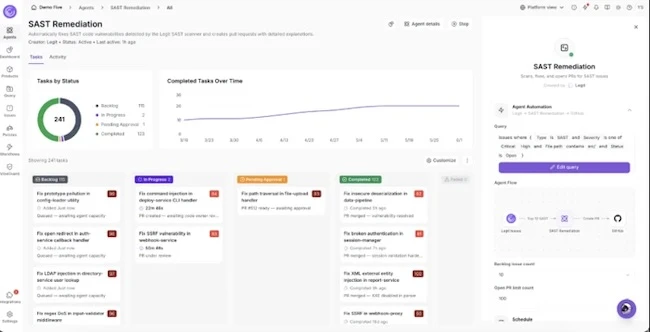
Legit Security remediation agents

As AI allows attackers to exploit vulnerabilities faster than ever, rapid remediation becomes critical. As part of Legit’s agentic AppSec platform, these agents offer parallel remediation across code bases, critical when a common authentication bypass vulnerability is introduced through reused code and propagated across multiple services, along with using business context to prioritize the real threats, and create the right fix, regardless of which AppSec testing tools are deployed.

AI-first development has fundamentally changed the math on application security, necessitating an entirely new approach to AppSec. Consider:

  • AI coding agents account for most of the committed code
  • AI generated code contains 2.74 times more vulnerabilities than human-written code
  • The median time to remediate a vulnerability is 252 days, nearly six times longer than attackers need to move from disclosure to exploitation
  • Attackers equipped with new frontier models exploit new vulnerabilities within minutes of deployments

The bottom line: the faster teams ship with AI, the faster risk compounds – and the faster attackers execute exploitation campaigns. These trends collide to create enormous risk that must be solved with automated, intelligent, agentic tools

“Security teams aren’t losing the war because they lack talent. They’re losing because the model has changed completely, but AppSec testing tools have stayed the same,” said Roni Fuchs, CEO at Legit. “Legit’s new remediation agents were built for this reality by offering AI-speed remediation centered on the context of your business and codebase, so you can trust them.”

Key features: Legit Remediation agents

Unlike general-use AI coding tools like Cursor, Claude Code and GitHub Copilot, Legit’s agents have the security knowledge and business context to generate production fixes, rather than patches. In addition, Legit’s remediation agents:

  • Unified risk posture: Legit’s stores the full risk posture of your codebases and apps, created from continuous scanning across the SDLC and the ingestion of risk signal from 3rd party tools. LLMs and coding agents do not have native access to this data.
  • Know what really matters: Legacy AppSec tools find volumes of issues without clear prioritization. Legit’s agents are informed by each customer’s distinct environment so only issues that really matter, prioritized by factors such as reachability, exploitability and production status, reach the remediation queue.
  • Close complete attack surface gaps: Vulnerabilities rarely live in a single repo; a critical CVE can exist across dozens of services simultaneously. Legit’s agents open pull requests across every affected repo in parallel, to close every gap in the attack surface.
  • Validate before opening a PR: Legit’s agents run tests, confirm the remediation held, and then create the PR with a plain-language explanation of what was fixed and why.
  • Create auditable records of agent activity: Legit records every action its remediation agents take – from the original finding to the PR, the validated fix, and what engineering did with it, providing a complete, auditable record of activity.

“Security teams tell us they’ve tried pointing AI coding tools at their vulnerability backlogs, but the results are thousands of patches that lack context and aren’t validated, some even try to fix false positives, which wastes a lot of time,” said Yoav Stahl, vice president of product at Legit. “Legit’s agents know your codebase, your risk profile, and your organizational policies, so when we deliver a fix, we know it works for you.”