


惯性聚合 高效追踪和阅读你感兴趣的博客、新闻、科技资讯
阅读原文 在惯性聚合中打开

推荐订阅源

爱范儿
爱范儿
MyScale Blog
MyScale Blog
Recent Announcements
N
Netflix TechBlog - Medium
GbyAI
GbyAI
Vercel News
Vercel News
The GitHub Blog
The GitHub Blog
阮一峰的网络日志
阮一峰的网络日志
奇客Solidot–传递最新科技情报
奇客Solidot–传递最新科技情报
V
Visual Studio Blog
Martin Fowler
Martin Fowler
腾讯CDC
大猫的无限游戏
大猫的无限游戏
aimingoo的专栏
aimingoo的专栏
云风的 BLOG
云风的 BLOG
J
Java Code Geeks
WordPress大学
WordPress大学
P
Proofpoint News Feed
雷峰网
雷峰网
酷 壳 – CoolShell
酷 壳 – CoolShell
有赞技术团队
有赞技术团队
人人都是产品经理
人人都是产品经理
OSCHINA 社区最新新闻
OSCHINA 社区最新新闻
Y
Y Combinator Blog

Help Net Security

Police arrest 10 suspected members of Black Axe cybercrime gang ShinyHunters claims it stole 1.4 million records from Udemy Sevii unveils Cyber Swarm Defense Mode to stop AI-driven attacks at scale Alleged Chinese hacker extradited to US over cyberattacks targeting COVID-19 research Cequence Agent Personas bring granular control and governance to enterprise AI agents NowSecure MARI gives enterprises evidence-based visibility into third-party mobile app risk The metrics killing your SOC, and what to use instead US state privacy fines reached $3.425 billion in 2025 Canada’s first SMS blaster case leads to three arrests Linux storage management tool Stratis 3.9.0 adds online encryption and cache-less pool startup TLS Connect gives SMBs a right-sized automated tool to manage TLS certificates Aptori expands its platform with autonomous offensive testing to reduce security bottlenecks Your IAM was built for humans, AI agents don’t care The AI criminal mastermind is already hiring on gig platforms 25 open-source cybersecurity tools that don’t care about your budget Product showcase: LuLu reveals unauthorized outbound connections from Mac apps Week in review: Claude Mythos finds 271 Firefox flaws, Vercel breach Users advised to drop passwords and make room for passkeys - Help Net Security Indirect prompt injection is taking hold in the wild - Help Net Security Compromised everyday devices power Chinese cyber espionage operations - Help Net Security New Cisco firewall malware can only be killed by pulling the plug - Help Net Security Meta is overhauling how you sign in, manage settings, and protect your accounts - Help Net Security Ubuntu 26.04 LTS delivers memory-safe system tools and live patching for Arm servers - Help Net Security OpenAI’s GPT-5.5 is out with expanded cybersecurity safeguards - Help Net Security AI is speeding up nation-state cyber programs - Help Net Security A study of 1,000 Android apps finds a privacy policy logging gap - Help Net Security IT spending to hit $6.31 trillion record, thanks to AI - Help Net Security Where AI in CI/CD is working for engineering teams - Help Net Security With AI's help, North Korean hackers stumbled into a near-undetectable attack - Help Net Security Hacker with a special interest in breaching sports institutions ends behind bars - Help Net Security
New Secure Code Warrior framework helps CISOs govern AI-d...
Industry News · 2026-06-24 · via Help Net Security

Secure Code Warrior has introduced its new SCW AI Adoption Model, a practical framework that maps the progression of AI use in software development, from minimal AI assistance to fully autonomous agentic orchestration. The framework helps CISOs assess their organization’s level of AI adoption, identify the training developers need at each stage, and determine the governance controls required as autonomy increases, answering the question every security leader is asking: Where do we start?
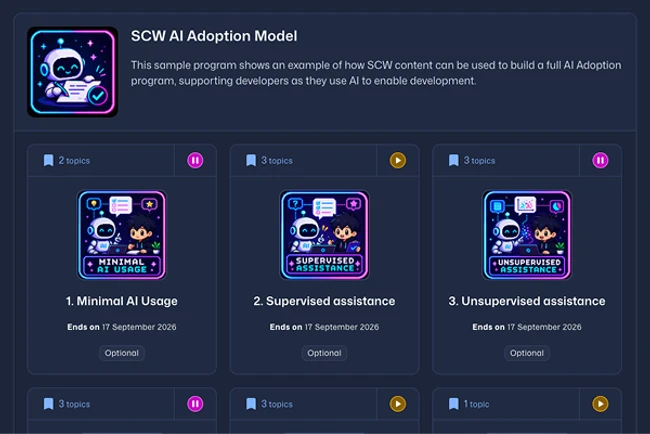
Secure Code Warrior AI Adoption Model

Gartner’s 2026 Hype Cycle for Secure Software Engineering warns that AI-augmented development is ‘expanding the attack surface faster than traditional controls can scale,’ and that AI coding tools are making secure coding skills more important than ever. AI adoption is no longer confined to engineering: non-developer employees building applications with no-code and vibe coding tools still contribute to an organization’s risk profile.

The SCW AI Adoption Model organizes AI development into three phases: AI-Assisted, AI Native, and Agentic. Each phase carries distinct risk levels, developer skills requirements, and governance controls, giving CISOs a clear way to connect AI usage, developer capability, and software risk signals. This allows security leadership to measure, reduce, and govern risk while demonstrating progress in securing the Software Development Lifecycle (SDLC) as it transitions to the more relevant Agentic Development Lifecycle (ADLC).

“In our current AI-powered development, writing lines of code is almost free, but developers are still on the hook for secure outcomes. Their security skills need to evolve from code writer to creator & orchestrator,” said Pieter Danhieux, Secure Code Warrior CEO.

“CISOs need an approach to ADLC governance that is as modern as the methodology itself, one that follows an adoption model designed for agentic AI’s evolving, adaptive approach to software development. We’ve built this framework to help organizations turn secure AI adoption and AI governance from a reactive exercise into a measurable, scalable discipline.”

As security leaders need data-driven insights to inform their AI cost decision-making, this new framework provides organizations the insight needed to safely address risk correlation. With the SCW AI Adoption Model, organizations can:

  • Identify their current AI adoption stage: Not all AI use carries the same risk. The model gives organizations a clear map to help them identify where they are, what training is required, and what governance controls need to be in place at that stage.
  • Deliver training that meets developers where they are: Not every developer has the same skill level or uses AI the same way. SCW maps capability, risk, and training to each adoption phase, giving developers the specific AI security skills that apply to how they actually work.
  • Demonstrate governance ROI: Gartner predicts that by 2027, more than 40% of agentic AI projects will be abandoned because of uncontrolled costs and poor risk controls. The answer isn’t more AI catching AI mistakes, it’s training developers to use AI correctly from the start, producing secure code, avoiding repeated vulnerabilities, and using AI efficiently enough to keep costs under control. SCW provides the tools and training to prove that behavior change is making an impact.