









VIAVI Solutions has announced the launch of its next-generation CyberFlood CF1000 Appliance, a native 400G security and application performance test platform for the validation of multi-terabit security and AI data center infrastructures at scale.
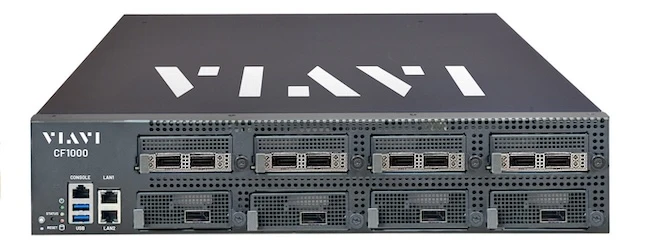
Developed for network equipment vendors, hyperscale data center operators and service providers, the CyberFlood CF1000 enables OSI Layer 4-7 validation of critical infrastructure under real-world encrypted and dynamic mixed traffic conditions including Next-Generation Firewalls (NGFWs), Application Delivery Controllers (ADCs), DDoS mitigation systems, VPN gateways, zero-trust architectures and AI inference fabrics.
By bringing together massive-scale encrypted traffic generation, continuous threat vector emulation, quantum-safe cryptography validation and AI inference workload emulation on a single platform, CF1000 eliminates the validation gaps inherent in traditional test systems.
Dell’Oro Group projects the global network security market to exceed $30B in 2026, with growth driven by zero trust initiatives, AI workloads and continuing cloud expansion. While software-delivered security is growing fastest, high-capacity physical platforms remain critical for validating performance limits before deployment.
“As networks move toward 400G and higher speeds, the combination of encrypted traffic, AI‑driven workloads and distributed cloud architectures is raising the bar for security performance validation. Platforms that can realistically test security and application infrastructure at scale are becoming an essential part of how vendors and operators reduce risk and confidently deploy next‑generation networks,” said Mauricio Sanchez, Senior Director, Enterprise Security and Networking, Dell’Oro Group.
“The move to ultra high-speed, highly secure AI networks has fundamentally changed the way security and performance must be validated,” said Sashi Jeyaretnam, Senior Director, Security Product Management, VIAVI.
“The challenge has intensified as organizations build infrastructure to enable the agentic era, which require that quantum security, AI inference workloads and AI-enabled security policies all work seamlessly together. CF1000 delivers the performance and realism customers need to validate modern data center infrastructure and security architectures, while helping them reduce validation timelines, optimize infrastructure decisions and accelerate deployments,” Jeyaretnam continued.
The CF1000 Appliance delivers native 400G security testing in a compact 2RU form factor, with support for four 400G OSFP ports and eight 100G QSFP28 ports, enabling up to 1.2Tbps of real‑world application traffic testing without the need for an external switching infrastructure.
Designed to validate encrypted traffic demands at scale and help organizations prepare for increasingly encrypted networks and emerging quantum-era threats, the platform provides Transport Layer Security (TLS) performance, supporting more than 500Gbps of encrypted throughput and up to 800,000 TLS v1.3 connections per second.
In addition, CF1000 extends CyberFlood’s capabilities with highly scalable AI inference traffic emulation, enabling realistic testing of large language model (LLM) performance and AI‑driven application workloads at terabit scale. This allows customers to evaluate end-to-end AI inference infrastructure and LLM application performance, and to assess critical trade-offs between cost efficiency and user experience.
此内容由惯性聚合(RSS阅读器)自动聚合整理,仅供阅读参考。 原文来自 — 版权归原作者所有。