
惯性聚合 高效追踪和阅读你感兴趣的博客、新闻、科技资讯
阅读原文 在惯性聚合中打开

推荐订阅源

Apple Machine Learning Research
爱范儿
爱范儿
博客园_首页
博客园 - 【当耐特】
V
Visual Studio Blog
博客园 - 叶小钗
月光博客
月光博客
美团技术团队
J
Java Code Geeks
小众软件
小众软件
Y
Y Combinator Blog
博客园 - Franky
Martin Fowler
Martin Fowler
博客园 - 聂微东
Microsoft Azure Blog
IT之家
IT之家
MyScale Blog
MyScale Blog
人人都是产品经理
人人都是产品经理
Microsoft Security Blog
OSCHINA 社区最新新闻
OSCHINA 社区最新新闻
阮一峰的网络日志
阮一峰的网络日志
酷 壳 – CoolShell
酷 壳 – CoolShell
钛媒体:引领未来商业与生活新知
钛媒体:引领未来商业与生活新知
云风的 BLOG
云风的 BLOG

Help Net Security

Police arrest 10 suspected members of Black Axe cybercrime gang ShinyHunters claims it stole 1.4 million records from Udemy Sevii unveils Cyber Swarm Defense Mode to stop AI-driven attacks at scale Alleged Chinese hacker extradited to US over cyberattacks targeting COVID-19 research Cequence Agent Personas bring granular control and governance to enterprise AI agents NowSecure MARI gives enterprises evidence-based visibility into third-party mobile app risk The metrics killing your SOC, and what to use instead US state privacy fines reached $3.425 billion in 2025 Canada’s first SMS blaster case leads to three arrests Linux storage management tool Stratis 3.9.0 adds online encryption and cache-less pool startup TLS Connect gives SMBs a right-sized automated tool to manage TLS certificates Aptori expands its platform with autonomous offensive testing to reduce security bottlenecks Your IAM was built for humans, AI agents don’t care The AI criminal mastermind is already hiring on gig platforms 25 open-source cybersecurity tools that don’t care about your budget Product showcase: LuLu reveals unauthorized outbound connections from Mac apps Week in review: Claude Mythos finds 271 Firefox flaws, Vercel breach Users advised to drop passwords and make room for passkeys - Help Net Security Indirect prompt injection is taking hold in the wild - Help Net Security Compromised everyday devices power Chinese cyber espionage operations - Help Net Security New Cisco firewall malware can only be killed by pulling the plug - Help Net Security Meta is overhauling how you sign in, manage settings, and protect your accounts - Help Net Security Ubuntu 26.04 LTS delivers memory-safe system tools and live patching for Arm servers - Help Net Security OpenAI’s GPT-5.5 is out with expanded cybersecurity safeguards - Help Net Security AI is speeding up nation-state cyber programs - Help Net Security A study of 1,000 Android apps finds a privacy policy logging gap - Help Net Security IT spending to hit $6.31 trillion record, thanks to AI - Help Net Security Where AI in CI/CD is working for engineering teams - Help Net Security With AI's help, North Korean hackers stumbled into a near-undetectable attack - Help Net Security Hacker with a special interest in breaching sports institutions ends behind bars - Help Net Security
Meta tries to get ahead of scammers before the World Cup ...
Sinisa Markovic · 2026-06-02 · via Help Net Security

Football fans are counting down the days until the FIFA World Cup begins, and scammers are doing the same.

Last week, the FBI warned that cybercriminals are spoofing FIFA websites to steal personal information, sell fake tickets, and promote fraudulent hospitality packages ahead of the tournament.

With millions of supporters expected to travel to the United States, Canada, and Mexico for the 2026 World Cup, fraudsters are likely to target demand for tickets, accommodation, and travel services.

Meta is responding with a series of measures aimed at combating scams and reducing online abuse targeting fans and players during the tournament.

“Scammers are constantly evolving their tactics and so are we,” Meta said.

“That’s why we recently announced new investments in advanced AI, tools for people to spot and avoid scams, and partnerships with law enforcement and industry peers to take action and hold scammers accountable.”

Meta notes that scammers rarely operate on a single platform, prompting the company to work with industry partners through intelligence-sharing initiatives designed to identify and disrupt fraud campaigns.

One example involved a collaboration with Visa that led to the disruption of a scam network using FIFA World Cup 2026 branding. Intelligence shared by Visa’s Scam Disruption team helped identify Facebook-linked pages directing users to fraudulent gambling websites.

The sites advertised unusually high winning rates and attempted to persuade visitors to hand over personal and financial information.

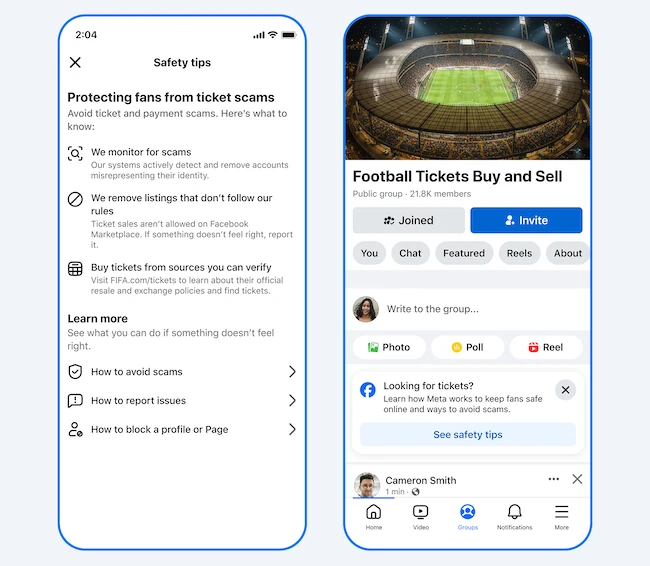
Meta also plans to display warnings to users searching for World Cup tickets on Facebook or visiting related Groups. The alerts are intended to help users identify fraudulent offers and avoid scams tied to ticket sales.
OPIS

World Cup ticket scam safety tips on Facebook (Source: Meta)

The company is preparing for an increase in online abuse targeting players, teams, officials, and public figures during the tournament. Major sporting events often trigger spikes in harassment following controversial incidents and match results.

Meta states that it uses AI systems and user reports to identify content that violates its policies on bullying, harassment, violent threats, and hateful conduct.

“We regularly speak to players, teams, and associations around the world to make sure they know about our latest safety policies and features, and we continue to listen carefully to their feedback,” they added.

Meta claims it removed 2.6 million pieces of hateful content from Facebook and Instagram between October and December 2025, with more than 74% detected before users reported it.