







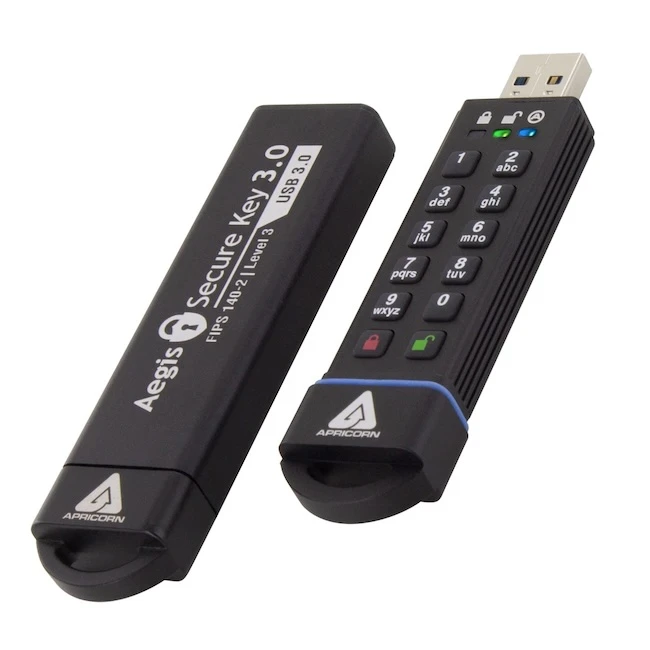
Apricorn has announced enhancements to its Aegis Secure Key 3.0 (ASK3), delivering faster performance and new environmental protection capabilities designed to secure the device and its data in the most demanding physical circumstances.
The ASK3 was updated to meet and exceed the latest NIST Cryptographic Module Validation Program (CMVP) for FIPS 140-3 Level 3 validation, for which it has formally been submitted. This positions the ASK3 for use by government, defence contractors, and organisations across healthcare, finance, legal digital forensics, and other regulated industries.
“With our submission of the ASK3 for FIPS 140-3 Level 3 validation, we’re reinforcing a design that was built from the start to meet and exceed these requirements,” said Jeanclaude Toma, CEO at Apricorn. “We engineer all of our products to deliver consistent, real-world security under the conditions our customers actually face. In the near term we will see FIPS 140-3 validation across our diverse product lines, positioning Apricorn as the only AS9100 certified provider of FIPS-based security offerings.”
The latest generation of ASK3 builds on Apricorn’s reputation for rugged, secure data storage with a mini solid-state drive (SSD) architecture within a USB flash key form factor. This design enables higher capacities of up to 2TB, exceeding the limits of traditional flash-based USB drives by nearly 4X, while maintaining the portability and ease of use that customers need.
With a new bridge controller chip and its SSD design, Apricorn has improved the product’s performance. The ASK3 now delivers speed improvements of up to 31% (up to 210 MB/s) and speed increases of up to 16% (reaching 220 MB/s). These gains support faster data transfers for organisations moving large volumes of sensitive data across endpoints, remote environments and air-gapped systems.
A key advancement in the ASK3 is its environmental protection design, which goes beyond standard testing requirements. As part of the current FIPS 140-3 guideline requirements, removable storage devices must undergo environmental failure testing to ensure they can operate reliably within defined thresholds, including temperature ranges between 0°C and 70°C and amperage spikes of up to 10 percent. While these tests validate resilience, extreme conditions can still lead to device failure and data inaccessibility.
To address this, Apricorn has implemented an environmental protection circuit within the ASK3 that actively prevents damage by shutting the device down when conditions fall outside safe operating ranges. Once conditions normalise, the device can be brought back online, preserving both the hardware and the data it protects. This proactive approach reflects a broader design philosophy focused not just on meeting compliance standards, but on preventing failure scenarios altogether.
Apricorn’s ASK3 was engineered to meet and, in key areas, exceed FIPS 140-3 Level 3 requirements prior to submission. This includes enhancements aligned with evolving guidance around environmental resilience, the highest levels of entropy and physical security. Rather than designing to the minimum threshold, Apricorn focused on real-world operating conditions, ensuring the device not only satisfies validation criteria, but performs reliably in the environments where sensitive data is actually handled.
The ASK3 also maintains Apricorn’s hallmark physical and logical security features, including hardware-based encryption, tamper-resistant construction and software-free authentication. Its hardened design is built for use in harsh environments where data must remain secure regardless of physical or operational stress.
此内容由惯性聚合(RSS阅读器)自动聚合整理,仅供阅读参考。 原文来自 — 版权归原作者所有。