



惯性聚合 高效追踪和阅读你感兴趣的博客、新闻、科技资讯
阅读原文 在惯性聚合中打开

推荐订阅源

Hugging Face - Blog
Hugging Face - Blog
Recent Announcements
V
Visual Studio Blog
博客园 - 叶小钗
H
Help Net Security
aimingoo的专栏
aimingoo的专栏
宝玉的分享
宝玉的分享
U
Unit 42
钛媒体:引领未来商业与生活新知
钛媒体:引领未来商业与生活新知
F
Fortinet All Blogs
V
V2EX
Stack Overflow Blog
Stack Overflow Blog
WordPress大学
WordPress大学
D
DataBreaches.Net
J
Java Code Geeks
H
Hackread – Cybersecurity News, Data Breaches, AI and More
A
About on SuperTechFans
酷 壳 – CoolShell
酷 壳 – CoolShell
量子位
C
Check Point Blog
奇客Solidot–传递最新科技情报
奇客Solidot–传递最新科技情报
小众软件
小众软件
Microsoft Azure Blog
M
MIT News - Artificial intelligence

Help Net Security

FIDO Alliance wants to keep AI agents from going rogue on online payments Police arrest 10 suspected members of Black Axe cybercrime gang ShinyHunters claims it stole 1.4 million records from Udemy Sevii unveils Cyber Swarm Defense Mode to stop AI-driven attacks at scale Alleged Chinese hacker extradited to US over cyberattacks targeting COVID-19 research Cequence Agent Personas bring granular control and governance to enterprise AI agents NowSecure MARI gives enterprises evidence-based visibility into third-party mobile app risk The metrics killing your SOC, and what to use instead US state privacy fines reached $3.425 billion in 2025 Canada’s first SMS blaster case leads to three arrests Linux storage management tool Stratis 3.9.0 adds online encryption and cache-less pool startup TLS Connect gives SMBs a right-sized automated tool to manage TLS certificates Aptori expands its platform with autonomous offensive testing to reduce security bottlenecks Your IAM was built for humans, AI agents don’t care The AI criminal mastermind is already hiring on gig platforms 25 open-source cybersecurity tools that don’t care about your budget Product showcase: LuLu reveals unauthorized outbound connections from Mac apps Week in review: Claude Mythos finds 271 Firefox flaws, Vercel breach Users advised to drop passwords and make room for passkeys - Help Net Security Indirect prompt injection is taking hold in the wild - Help Net Security Compromised everyday devices power Chinese cyber espionage operations - Help Net Security New Cisco firewall malware can only be killed by pulling the plug - Help Net Security Meta is overhauling how you sign in, manage settings, and protect your accounts - Help Net Security Ubuntu 26.04 LTS delivers memory-safe system tools and live patching for Arm servers - Help Net Security OpenAI’s GPT-5.5 is out with expanded cybersecurity safeguards - Help Net Security AI is speeding up nation-state cyber programs - Help Net Security A study of 1,000 Android apps finds a privacy policy logging gap - Help Net Security IT spending to hit $6.31 trillion record, thanks to AI - Help Net Security Where AI in CI/CD is working for engineering teams - Help Net Security With AI's help, North Korean hackers stumbled into a near-undetectable attack - Help Net Security
ClickFix campaign delivers Mac malware via fake Apple page
Zeljka Zorz · 2026-04-10 · via Help Net Security

Security researchers at Jamf have uncovered a new ClickFix-style attack targeting Mac users via a fake Apple-themed webpage offering instructions on how to “reclaim disk space on your Mac”.
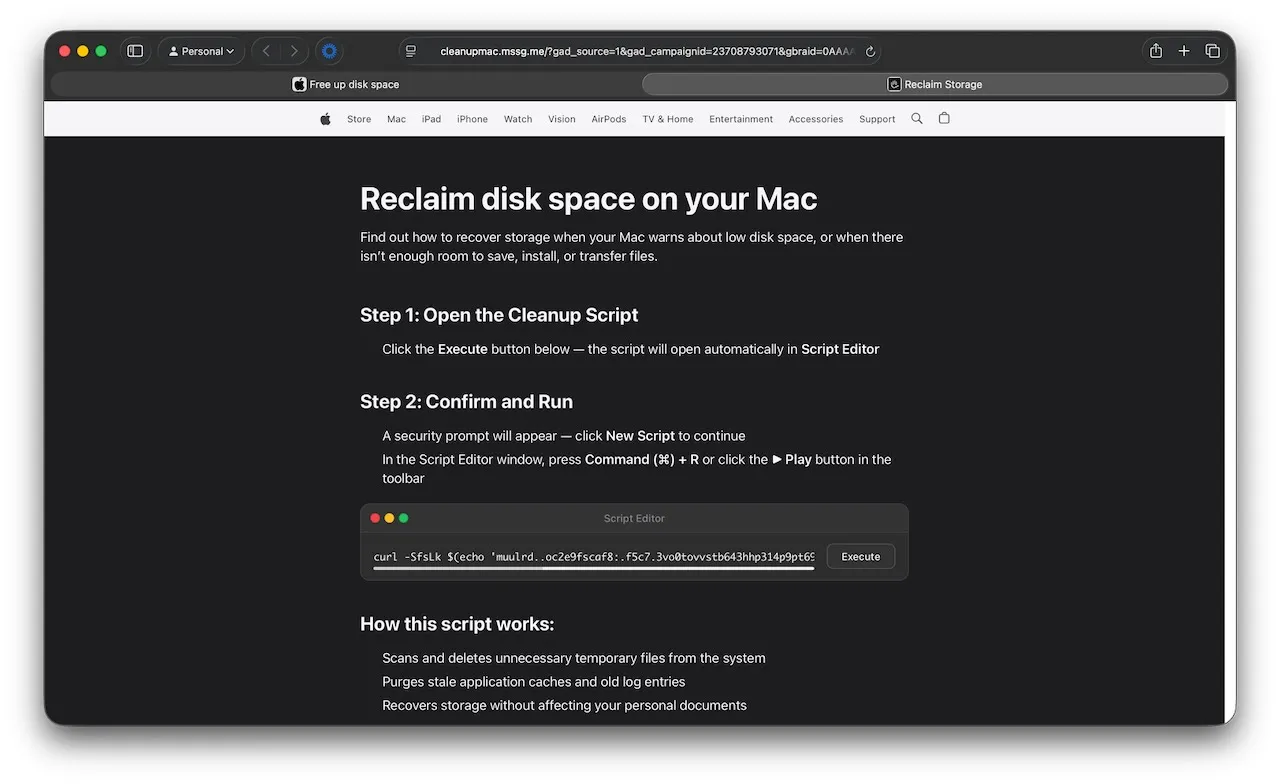
ClickFix Mac Script Editor

The malicious page (Source: Jamf)

ClickFix for everybody

ClickFix is a social engineering technique that cons victims into running malicious commands on their own machine, usually by pretending the commands are needed to fix a problem or perform routine upkeep.

This technique was initially aimed at Windows users, but in time, macOS and Linux users also started getting targeted.

“The go-to approach for ClickFix [macOS] techniques has long been convincing users to copy and paste malicious commands into Terminal under the guise of troubleshooting or routine system maintenance. Apple took direct aim at this in macOS 26.4, introducing a security feature that scans commands pasted into Terminal before they’re executed,” Jamf researchers noted.

For that reason, attackers have switched to using a browser-triggered workflow to launch Script Editor, a code editor for the AppleScript and Javascript for Automation scripting languages. (Both Terminal and Script Editor are installed by default on macOS.)

The lure and the end result

From the victims’ point of view, the attack looks like this:

  • They visit the malicious page and follow the instructions
  • They click the provided “Execute” button
  • The page shows a prompt asking them to allow the website to open Script Editor
  • The Script Editor is opened and is pre-populated with the attackers’ script
  • Depending on the macOS version they use, they may or may not see an additional warning against running the script
  • If they ignore the warning and allow the script to be saved on the disk and executed, the script will covertly download an Atomic Stealer (aka AMOS) variant and execute it.

Atomic Stealer is a subscription product, sold to criminals who then deploy it however they like. It’s capable of collecting system information, stealing data stored in Keychain (Apple’s built-in password management system), autofill data, passwords, cookies, and credit card information from browsers, cryptocurrency wallets, and more.

Jamf researchers have shared indicators of compromise related to this malware delivery campaign.

Subscribe to our breaking news e-mail alert to never miss out on the latest breaches, vulnerabilities and cybersecurity threats. Subscribe here!