


惯性聚合 高效追踪和阅读你感兴趣的博客、新闻、科技资讯
阅读原文 在惯性聚合中打开

推荐订阅源

博客园_首页
B
Blog RSS Feed
Microsoft Azure Blog
J
Java Code Geeks
Cyber Security Advisories - MS-ISAC
Google DeepMind News
F
Fortinet All Blogs
V
V2EX
freeCodeCamp Programming Tutorials: Python, JavaScript, Git & More
Engineering at Meta
Engineering at Meta
月光博客
月光博客
阮一峰的网络日志
阮一峰的网络日志
M
MIT News - Artificial intelligence
IT之家
IT之家
博客园 - 【当耐特】
U
Unit 42
云风的 BLOG
云风的 BLOG
L
LangChain Blog
小众软件
小众软件
Microsoft Security Blog
B
Blog
H
Hackread – Cybersecurity News, Data Breaches, AI and More
宝玉的分享
宝玉的分享
N
Netflix TechBlog - Medium

Help Net Security

Police arrest 10 suspected members of Black Axe cybercrime gang ShinyHunters claims it stole 1.4 million records from Udemy Sevii unveils Cyber Swarm Defense Mode to stop AI-driven attacks at scale Alleged Chinese hacker extradited to US over cyberattacks targeting COVID-19 research Cequence Agent Personas bring granular control and governance to enterprise AI agents NowSecure MARI gives enterprises evidence-based visibility into third-party mobile app risk The metrics killing your SOC, and what to use instead US state privacy fines reached $3.425 billion in 2025 Canada’s first SMS blaster case leads to three arrests Linux storage management tool Stratis 3.9.0 adds online encryption and cache-less pool startup TLS Connect gives SMBs a right-sized automated tool to manage TLS certificates Aptori expands its platform with autonomous offensive testing to reduce security bottlenecks Your IAM was built for humans, AI agents don’t care The AI criminal mastermind is already hiring on gig platforms 25 open-source cybersecurity tools that don’t care about your budget Product showcase: LuLu reveals unauthorized outbound connections from Mac apps Week in review: Claude Mythos finds 271 Firefox flaws, Vercel breach Users advised to drop passwords and make room for passkeys - Help Net Security Indirect prompt injection is taking hold in the wild - Help Net Security Compromised everyday devices power Chinese cyber espionage operations - Help Net Security New Cisco firewall malware can only be killed by pulling the plug - Help Net Security Meta is overhauling how you sign in, manage settings, and protect your accounts - Help Net Security Ubuntu 26.04 LTS delivers memory-safe system tools and live patching for Arm servers - Help Net Security OpenAI’s GPT-5.5 is out with expanded cybersecurity safeguards - Help Net Security AI is speeding up nation-state cyber programs - Help Net Security A study of 1,000 Android apps finds a privacy policy logging gap - Help Net Security IT spending to hit $6.31 trillion record, thanks to AI - Help Net Security Where AI in CI/CD is working for engineering teams - Help Net Security With AI's help, North Korean hackers stumbled into a near-undetectable attack - Help Net Security Hacker with a special interest in breaching sports institutions ends behind bars - Help Net Security
ASAPP expands adversarial testing for enterprise AI systems
Industry New · 2026-05-21 · via Help Net Security

ASAPP has launches Continuous Red Teaming, a new capability that integrates adversarial AI testing directly into ASAPP’s model evaluation framework. The new capability is built on Promptfoo, an AI security platform that helps enterprises detect and address vulnerabilities in AI systems during development.

Promptfoo continuously runs automated tests across ASAPP’s AI systems, screening for more than 50 vulnerability types to give enterprise customers the real-time data they need to trust their AI in production.
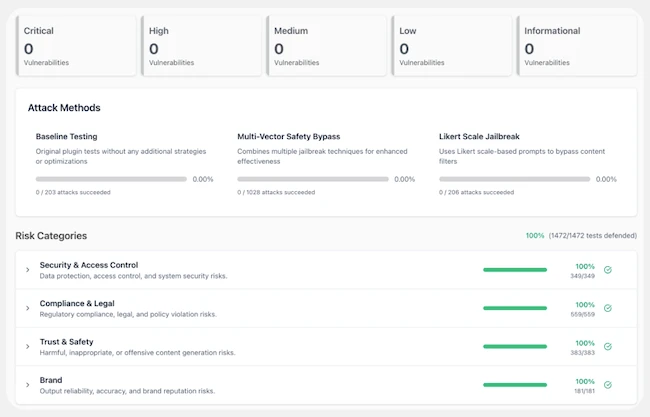
ASAPP Continuous Red Teaming

As AI agents shift from answering questions to taking actions, the potential for security threats increases. Static safety filters and one-time audits are no longer enough. Adversarial techniques have advanced, exploiting the same reasoning skills that make large language models effective. Enterprises using AI at scale are being asked to trust systems they can’t continuously verify. ASAPP’s Continuous Red Teaming is designed to bridge that gap.

“Enterprise AI builds trust through proven results at scale,” stated Priya Vijayarajendran, CEO of ASAPP. “Organizations using AI for essential customer interactions deserve solid proof, not just promises. Our dedication to Continuous Red Teaming guarantees we meet and exceed that commitment every single day.”

The capability operates across three critical security domains:

  • Core model integrity & control: ASAPP’s agentic platform continuously tests against adversarial jailbreaking techniques, including many-shot attacks and character-level obfuscations, as well as system override attempts and probes for hallucinated authority, where a model might be coerced into making unauthorized legal or business commitments.
  • Data privacy & knowledge base security: In RAG-driven deployments, retrieved data is as vulnerable as the model itself. ASAPP tests against indirect prompt injection via poisoned documents, knowledge base exfiltration, and cross-session PII leakage to ensure that sensitive data never bleeds across sessions or tenants.
  • Agentic & operational security: As AI moves from conversation to action, ASAPP validates that its agents cannot be manipulated into unauthorized data access, cannot be used as proxies for internal network reconnaissance, and cannot expose underlying system architecture through tool-calling exploitation.

The core capability features a risk benchmarking framework where ASAPP tracks the Attack Success Rate (ASR) for each model update. It uses automated graders to minimize human bias in safety evaluations and aligns results with the OWASP Top 10 for LLMs and the NIST AI Risk Management Framework, ensuring audit-ready safety metrics from day one.

“CISOs and procurement teams looking at enterprise AI need more than a vendor’s word that their systems are safe,” said Khash Kiani, CISO of ASAPP. “Trust has to be earned through specific metrics, a clear approach, and a regular reporting system to share with their boards. We have created a safety architecture that automatically identifies and fixes weaknesses in real time. This is the standard that enterprise AI should aim for, and we are committed to leading the way.”