
惯性聚合 高效追踪和阅读你感兴趣的博客、新闻、科技资讯
阅读原文 在惯性聚合中打开

推荐订阅源

Microsoft Azure Blog
aimingoo的专栏
aimingoo的专栏
F
Fortinet All Blogs
Blog — PlanetScale
Blog — PlanetScale
GbyAI
GbyAI
MongoDB | Blog
MongoDB | Blog
月光博客
月光博客
The Cloudflare Blog
量子位
T
Tailwind CSS Blog
Cyber Security Advisories - MS-ISAC
B
Blog
MyScale Blog
MyScale Blog
T
The Blog of Author Tim Ferriss
The GitHub Blog
The GitHub Blog
G
Google Developers Blog
D
DataBreaches.Net
V
Visual Studio Blog
奇客Solidot–传递最新科技情报
奇客Solidot–传递最新科技情报
Last Week in AI
Last Week in AI
U
Unit 42
博客园 - 聂微东
有赞技术团队
有赞技术团队
A
About on SuperTechFans

Help Net Security

FIDO Alliance wants to keep AI agents from going rogue on online payments Police arrest 10 suspected members of Black Axe cybercrime gang ShinyHunters claims it stole 1.4 million records from Udemy Sevii unveils Cyber Swarm Defense Mode to stop AI-driven attacks at scale Alleged Chinese hacker extradited to US over cyberattacks targeting COVID-19 research Cequence Agent Personas bring granular control and governance to enterprise AI agents NowSecure MARI gives enterprises evidence-based visibility into third-party mobile app risk The metrics killing your SOC, and what to use instead US state privacy fines reached $3.425 billion in 2025 Canada’s first SMS blaster case leads to three arrests Linux storage management tool Stratis 3.9.0 adds online encryption and cache-less pool startup TLS Connect gives SMBs a right-sized automated tool to manage TLS certificates Aptori expands its platform with autonomous offensive testing to reduce security bottlenecks Your IAM was built for humans, AI agents don’t care The AI criminal mastermind is already hiring on gig platforms 25 open-source cybersecurity tools that don’t care about your budget Product showcase: LuLu reveals unauthorized outbound connections from Mac apps Week in review: Claude Mythos finds 271 Firefox flaws, Vercel breach Users advised to drop passwords and make room for passkeys - Help Net Security Indirect prompt injection is taking hold in the wild - Help Net Security Compromised everyday devices power Chinese cyber espionage operations - Help Net Security New Cisco firewall malware can only be killed by pulling the plug - Help Net Security Meta is overhauling how you sign in, manage settings, and protect your accounts - Help Net Security Ubuntu 26.04 LTS delivers memory-safe system tools and live patching for Arm servers - Help Net Security OpenAI’s GPT-5.5 is out with expanded cybersecurity safeguards - Help Net Security AI is speeding up nation-state cyber programs - Help Net Security A study of 1,000 Android apps finds a privacy policy logging gap - Help Net Security IT spending to hit $6.31 trillion record, thanks to AI - Help Net Security Where AI in CI/CD is working for engineering teams - Help Net Security With AI's help, North Korean hackers stumbled into a near-undetectable attack - Help Net Security
Google Play is changing how Android apps access your cont...
Anamarija Pogorelec · 2026-04-16 · via Help Net Security

Google’s new set of Google Play policy updates and account transfer feature strengthen user privacy and protect businesses from fraud. Google is also expanding features for managing new contact and location policy changes to support a smoother, more predictable app review experience.

By October, Play policy insights in Android Studio can help developers identify if their apps should use new features and will guide them on the steps to take. From October 27, new pre-review checks in the Play Console will flag potential contact or location permission policy issues so they can be fixed before the app is submitted for review.

Accessing contacts with Contact Picker

Android Contact Picker is the new standard for accessing contact information that lets users share only the specific contacts they want to.
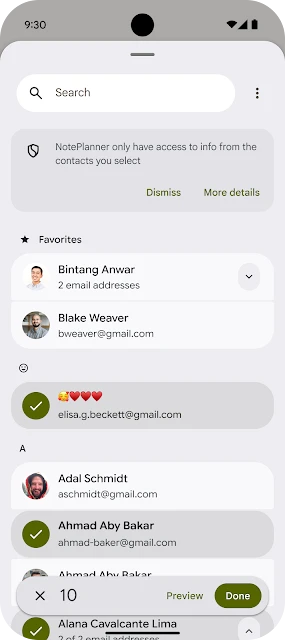
Google Play policy updates

“Alongside this tool, we are updating our policy to require that all applicable apps use the picker, or other privacy-focused alternatives like Sharesheet, as the primary way to access users’ contacts. READ_CONTACTS will be reserved for apps that can’t function without it,” Bennet Manuel, Group Product Manager, App & Ecosystem Trust, explained.

Apps that request access to contacts for features like sharing or inviting should update their code to use the picker and remove the READ_CONTACTS permission when targeting Android 17 and above.

Apps that require ongoing access to a user’s contact list must submit a Play Developer Declaration in the Play Console to justify the need.

Location button for precise location

To make requesting precise location data easier for one-time actions, like finding a store or tagging a photo, Android is introducing a streamlined location button. It helps users choose how much information they share and for how long. Updated policy requires apps to use this button for one-time precise location access. Apps that require always-on location access can continue to request it.

To ensure that they are requesting the minimum amount of location data needed for the app to work, developers should review their apps’ location usage. They should add the onlyForLocationButton flag in their manifest if the app uses precise location for temporary actions and targets Android 17 and above.

If an app requires persistent precise location to function, a Play Developer Declaration in the Play Console must be submitted.

Account transfers in Play Console

Play Console gets an official account transfer feature that supports ownership transfers during sales and mergers while protecting businesses from fraud. This feature must be used from May 27. Unofficial transfers such as sharing login credentials or buying and selling accounts on third-party marketplaces are not permitted.

Through the “Users and permissions” page in the Play Console, developers should initiate any future account owner changes. Every transfer includes a mandatory 7-day security cool-down period to give teams time to spot and cancel any unauthorized account takeover attempts.