
惯性聚合 高效追踪和阅读你感兴趣的博客、新闻、科技资讯
阅读原文 在惯性聚合中打开

推荐订阅源

aimingoo的专栏
aimingoo的专栏
腾讯CDC
Y
Y Combinator Blog
L
LangChain Blog
B
Blog
U
Unit 42
P
Proofpoint News Feed
G
Google Developers Blog
奇客Solidot–传递最新科技情报
奇客Solidot–传递最新科技情报
博客园 - 【当耐特】
WordPress大学
WordPress大学
月光博客
月光博客
Vercel News
Vercel News
雷峰网
雷峰网
T
The Blog of Author Tim Ferriss
MyScale Blog
MyScale Blog
大猫的无限游戏
大猫的无限游戏
钛媒体:引领未来商业与生活新知
钛媒体:引领未来商业与生活新知
酷 壳 – CoolShell
酷 壳 – CoolShell
Blog — PlanetScale
Blog — PlanetScale
博客园 - 司徒正美
云风的 BLOG
云风的 BLOG
freeCodeCamp Programming Tutorials: Python, JavaScript, Git & More
博客园 - 叶小钗

Help Net Security

Police arrest 10 suspected members of Black Axe cybercrime gang ShinyHunters claims it stole 1.4 million records from Udemy Sevii unveils Cyber Swarm Defense Mode to stop AI-driven attacks at scale Alleged Chinese hacker extradited to US over cyberattacks targeting COVID-19 research Cequence Agent Personas bring granular control and governance to enterprise AI agents NowSecure MARI gives enterprises evidence-based visibility into third-party mobile app risk The metrics killing your SOC, and what to use instead US state privacy fines reached $3.425 billion in 2025 Canada’s first SMS blaster case leads to three arrests Linux storage management tool Stratis 3.9.0 adds online encryption and cache-less pool startup TLS Connect gives SMBs a right-sized automated tool to manage TLS certificates Aptori expands its platform with autonomous offensive testing to reduce security bottlenecks Your IAM was built for humans, AI agents don’t care The AI criminal mastermind is already hiring on gig platforms 25 open-source cybersecurity tools that don’t care about your budget Product showcase: LuLu reveals unauthorized outbound connections from Mac apps Week in review: Claude Mythos finds 271 Firefox flaws, Vercel breach Users advised to drop passwords and make room for passkeys - Help Net Security Indirect prompt injection is taking hold in the wild - Help Net Security Compromised everyday devices power Chinese cyber espionage operations - Help Net Security New Cisco firewall malware can only be killed by pulling the plug - Help Net Security Meta is overhauling how you sign in, manage settings, and protect your accounts - Help Net Security Ubuntu 26.04 LTS delivers memory-safe system tools and live patching for Arm servers - Help Net Security OpenAI’s GPT-5.5 is out with expanded cybersecurity safeguards - Help Net Security AI is speeding up nation-state cyber programs - Help Net Security A study of 1,000 Android apps finds a privacy policy logging gap - Help Net Security IT spending to hit $6.31 trillion record, thanks to AI - Help Net Security Where AI in CI/CD is working for engineering teams - Help Net Security With AI's help, North Korean hackers stumbled into a near-undetectable attack - Help Net Security Hacker with a special interest in breaching sports institutions ends behind bars - Help Net Security
Asimily turns device risk into automated network policy
Industry News · 2026-06-01 · via Help Net Security

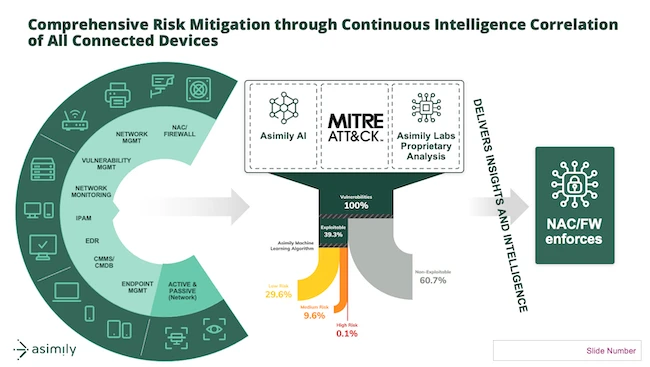
Asimily has launched Segmentation Orchestration, enabling connected-device risk intelligence to flow directly into enforceable network policy without manual translation. No other platform combines full asset visibility, vulnerability prioritization, and segmentation orchestration in a single system.
Asimily Segmentation Orchestration

“AI has exploded the volume and sophistication of network attacks against connected devices, and security teams are discovering that visibility tools and manual policies cannot keep pace,” said Shankar Somasundaram, CEO, Asimily.

“Attackers are exploiting the space between what organizations can see and what their network policies actually enforce. While network segmentation is one of the most effective controls against lateral movement, implementing it at scale across heterogeneous IoT, OT, IoMT, and IT asset environments has required significant manual effort and a high risk of device disruption. Asimily’s Segmentation Orchestration removes those obstacles by automating the full journey from device discovery through dynamic policy deployment.”

Integrated within the complete Asimily platform, Segmentation Orchestration operates continuously rather than as a static, quickly-outdated configuration exercise. This addresses the core reason most segmentation projects stall: organizations can write the policies but lack the intelligence layer to validate, deploy, and continuously maintain them without breaking operations.

Before any segmentation policy is written and executed, Asimily discovers every device, maps how every device communicates across the network, including which ports and protocols are utilized, which services a device depends on, and whether those network connections are expected or anomalous. Segmentation recommendations are grounded in actual device behavior rather than assumptions.

Eight components are core to Asimily’s Segmentation Orchestration:

  • Visibility & Inventory uses AI, deep packet inspection and integrations across the ecosystem to build a comprehensive device inventory.
  • Vulnerability Prioritization pinpoints vulnerabilities that are critical to a network based on attack Path analysis along with detailed prioritization.
  • Policy Auto-Recommendation generates specific, automated network segmentation policies ranked by risk impact.
  • Policy Simulation enables security and networking teams to model policy change effects before deployment; the capability is particularly critical in healthcare and manufacturing environments where misconfigured policy can disrupt patient monitoring systems or halt production lines.
  • Policy Creation creates policies from risk-aware insights in the format and language native to the NAC or Firewall.
  • Policy Application leverages APIs and capabilities built with the NAC or Firewall vendor to apply the policies directly on the NAC or Firewall.
  • Continuous Segmentation ensures policies adapt dynamically as device parameters, configurations, and network topology evolve, avoiding static IP range lock-in or VLANs that become outdated the moment something changes.
  • Intelligent Policy Engine continuously evaluates existing policies for errors and inconsistencies, enacting policy replacements whenever required.

“Most connected device security programs start with visibility. While that foundation matters, visibility that doesn’t connect to action is merely just a dashboard,” said Constancio Fernandes, SVP of Engineering, Asimily.

“Modern AI driven attack vectors don’t wait for security teams to manually translate what they see. We built Segmentation Orchestration because our customers needed a platform that automatically and continuously transforms device context into enforced policy. Complete cyber asset risk mitigation is always the goal, and it’s what we continue building toward across every part of the Asimily platform,” Fernandes continued.

Segmentation Orchestration extends Asimily’s existing foundation of deep device inventory and classification, behavioral analysis of network traffic, automated device patching, and AI-driven vulnerability prioritization based on actual exploitability in a given environment. Unlike generic CVSS-based scoring, Asimily’s proprietary ATT&CK analysis maps vulnerabilities to real-world exploit paths so prioritization reflects what attackers can actually do in each customer’s specific environment, not theoretical severity scores.

The capability integrates with customers’ existing NACs and firewalls allowing organizations across industries to get more out of infrastructure they’ve already deployed. Asimily was recently named the #1 solution in Gartner Peer Insights and earned the 2026 Global InfoSec Award in OT Security from Cyber Defense Magazine.

“Buyers in this space should be paying close attention to who is building product and who is navigating acquisition integration,” said Somasundaram. “Asimily remains focused on one thing, which is delivering complete cyber asset risk mitigation capabilities that evolve with what our customers actually need.”