


SuperOps and Guardz are bundling PSA, RMM, MDM, and agentic SecOps into one offering for MSPs. In this Help Net Security Q&A, SuperOps CEO Arvind Parthiban and Guardz CEO Dor Eisner explain how a connected stack cuts the time and context lost to tool-switching, lowers costs against multi-vendor setups, and helps close the gap between average MSP margins of 8% and the 18% top performers reach. They also discuss what makes a platform AI-native, and why they treat security readiness and AI readiness as one conversation.
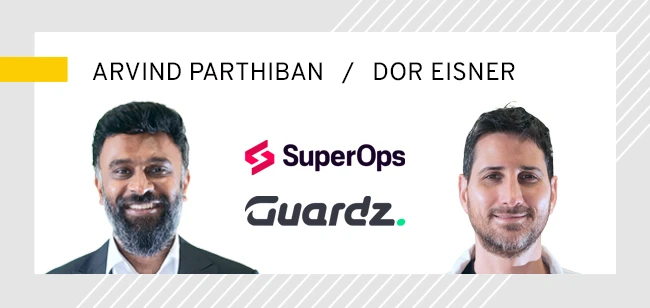
Arvind Parthiban, CEO, SuperOps:
The 25% figure understates the real cost because it only measures time. What it doesn’t capture is the context loss that happens every time a technician moves between systems. When your PSA doesn’t talk to your RMM, and neither talks to your security platform, you’re not just losing time, you’re losing momentum and accuracy. A technician resolving a ticket has to mentally reconstruct what happened across three or four tools before they can act. That’s where mistakes happen and where response times stretch.
Consolidation addresses this by making context persistent. When operations and security data live in one system, a technician sees the full picture without moving. The time saving is real, but the bigger gain is decision quality: fewer missed signals, faster resolution, and less cognitive overhead on every single interaction.
This also becomes the foundation for agentic IT. AI agents depend on connected, real-time context to act autonomously: to triage a ticket, correlate a security signal, or trigger a remediation workflow without waiting for a human to connect the dots. When that context is fragmented across disconnected tools, AI can’t function at its potential. A unified stack isn’t just an efficiency play, it’s the prerequisite for AI to move from automation to autonomy. That’s the shift we’re building toward.
Arvind Parthiban, CEO, SuperOps:
The most straightforward way for an MSP to verify this is to add up what they’re currently paying across their PSA, RMM, MDM, and security vendors, then factor in the hidden costs that don’t appear on those invoices. Integration maintenance, staff time spent on tool administration, and the support overhead of managing multiple vendor relationships all carry real costs that most MSPs don’t formally track.
The bundle replaces multiple line items with one. We’re confident that for the vast majority of MSPs running a comparable multi-vendor stack, the total cost comparison will be favorable. We’d encourage any MSP to run that calculation against their own numbers. We’re not asking anyone to take our word for it.
Arvind Parthiban, CEO, SuperOps:
The stack is a significant contributor but it’s not the whole story. Top-performing MSPs have made a structural decision to stop adding tools and start building leverage. A connected stack is part of that. It reduces the operational overhead that quietly erodes margin on every ticket, every escalation, every onboarding. When your tools share context, your team spends less time administering systems and more time delivering outcomes.
But the other factors matter too. Pricing strategy, service packaging, customer mix, and how effectively an MSP has automated routine work all play a role. What we’d say is this: you cannot close the margin gap without addressing the stack, but closing the stack problem alone won’t get you to better margins. The best operators have done both; they’ve simplified the foundation and built a business model on top of it that reflects the value they actually deliver.
Dor Eisner, CEO, Guardz:
Ask three questions. First: does the AI have access to connected, real-time data, or is it working from isolated data sets within a single tool? AI that can only see part of the picture will always produce partial answers. Second: how does the vendor handle the security and governance of the AI itself? What data does it access, how are decisions logged, and who is accountable when it acts autonomously? Third: can the vendor show you where AI is creating measurable outcomes in production environments today, not in a demo? In our own platform, that means identity, endpoint, and email signals correlate in one data fabric, with human-led MDR accountable for what the AI surfaces.
AI-native should mean the platform was designed from the ground up for AI to operate within it, with the data architecture, the security model, and the automation layer built to support agentic workflows. If a vendor has added an AI feature to a legacy platform, that’s not AI-native. The distinction matters because MSPs will be held accountable by their customers for how AI performs in their environment. The foundation has to be real.
Dor Eisner, CEO, Guardz:
Honestly, it’s both. For the leading edge of the market; the MSPs who are already in strategic conversations with their customers about AI adoption, this is a live reality. They’re being asked to govern AI deployments, advise on risk, and ensure that the data AI relies on is trustworthy and protected. For them, security and AI readiness collapsed into the same conversation some time ago.
For the majority of the market, there’s still a gap. Many MSPs are still treating security as a separate service line and AI as something they’ll figure out later. What we’re saying is that ‘later’ is arriving faster than most people expect, and the MSPs who wait until their customers force the conversation will be playing catch-up. The pairing isn’t a prediction; it’s a description of where the market is heading. We’re launching this partnership now because we believe being early matters.
此内容由惯性聚合(RSS阅读器)自动聚合整理,仅供阅读参考。 原文来自 — 版权归原作者所有。