



惯性聚合 高效追踪和阅读你感兴趣的博客、新闻、科技资讯
阅读原文 在惯性聚合中打开

推荐订阅源

The GitHub Blog
The GitHub Blog
A
About on SuperTechFans
The Cloudflare Blog
G
Google Developers Blog
博客园_首页
Martin Fowler
Martin Fowler
Apple Machine Learning Research
L
LangChain Blog
D
Docker
C
Check Point Blog
T
Tailwind CSS Blog
博客园 - 司徒正美
奇客Solidot–传递最新科技情报
奇客Solidot–传递最新科技情报
Hugging Face - Blog
Hugging Face - Blog
Microsoft Security Blog
V
V2EX
博客园 - 叶小钗
T
The Blog of Author Tim Ferriss
酷 壳 – CoolShell
酷 壳 – CoolShell
IT之家
IT之家
M
MIT News - Artificial intelligence
Microsoft Azure Blog
博客园 - 【当耐特】
GbyAI
GbyAI

Help Net Security

Police arrest 10 suspected members of Black Axe cybercrime gang ShinyHunters claims it stole 1.4 million records from Udemy Sevii unveils Cyber Swarm Defense Mode to stop AI-driven attacks at scale Alleged Chinese hacker extradited to US over cyberattacks targeting COVID-19 research Cequence Agent Personas bring granular control and governance to enterprise AI agents NowSecure MARI gives enterprises evidence-based visibility into third-party mobile app risk The metrics killing your SOC, and what to use instead US state privacy fines reached $3.425 billion in 2025 Canada’s first SMS blaster case leads to three arrests Linux storage management tool Stratis 3.9.0 adds online encryption and cache-less pool startup TLS Connect gives SMBs a right-sized automated tool to manage TLS certificates Aptori expands its platform with autonomous offensive testing to reduce security bottlenecks Your IAM was built for humans, AI agents don’t care The AI criminal mastermind is already hiring on gig platforms 25 open-source cybersecurity tools that don’t care about your budget Product showcase: LuLu reveals unauthorized outbound connections from Mac apps Week in review: Claude Mythos finds 271 Firefox flaws, Vercel breach Users advised to drop passwords and make room for passkeys - Help Net Security Indirect prompt injection is taking hold in the wild - Help Net Security Compromised everyday devices power Chinese cyber espionage operations - Help Net Security New Cisco firewall malware can only be killed by pulling the plug - Help Net Security Meta is overhauling how you sign in, manage settings, and protect your accounts - Help Net Security Ubuntu 26.04 LTS delivers memory-safe system tools and live patching for Arm servers - Help Net Security OpenAI’s GPT-5.5 is out with expanded cybersecurity safeguards - Help Net Security AI is speeding up nation-state cyber programs - Help Net Security A study of 1,000 Android apps finds a privacy policy logging gap - Help Net Security IT spending to hit $6.31 trillion record, thanks to AI - Help Net Security Where AI in CI/CD is working for engineering teams - Help Net Security With AI's help, North Korean hackers stumbled into a near-undetectable attack - Help Net Security Hacker with a special interest in breaching sports institutions ends behind bars - Help Net Security
Operant AI Endpoint Protector secures AI agents and MCP t...
Industry News · 2026-05-04 · via Help Net Security

Operant AI has launched Operant Endpoint Protector, a new addition to its AI Defense Platform that enables enterprise IT and security teams to discover, detect, and defend against threats across every AI tool, coding agent, and Model Context Protocol (MCP)-connected workflow used by employees, directly at the endpoint where most consequential AI activity takes place.
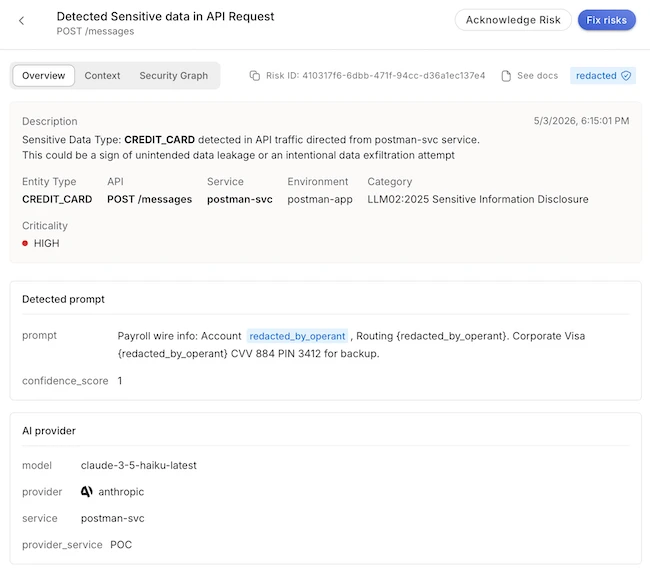
Operant AI Endpoint Protector

Securing the endpoint

Across every enterprise, employees in HR, finance, legal, customer service, engineering, and operations are interacting with AI assistants, coding agents, and MCP-connected tools that touch personnel records, financial systems, customer data, source code, and proprietary workflows. Most of these tools are sanctioned, many are not. Either way, they are reading, writing, and acting on the most sensitive information in the business, and CIOs and CISOs increasingly have no way to find, see, or stop any of it.

Shadow AI has moved from accessing AI in a browser tab to native applications everyone depends on every day. AI IDEs and coding agents are accelerating engineering velocity while introducing new vectors for code injection, secrets leakage, and data exfiltration. MCP lets agents invoke tools, call services, and take real-world actions, often across trusted, encrypted channels that traditional security tooling was never designed to inspect.

“Security leaders are waking up to the reality that their AI exposure doesn’t live in one place — it lives everywhere their employees and agents do,” said Vrajesh Bhavsar, CEO of Operant AI. “The endpoint is where AI actually meets the workforce. It’s been the largest blind spot in the enterprise security stack — and it’s the gap we built the Operant Endpoint Protector to close.”

Enterprise security stack was built to monitor processes, packets, and SaaS traffic, leaving it blind to the semantic layer where AI agents reason and act inside trusted applications over encrypted protocols. No incumbent category can discover every AI tool and MCP client in use, detect threats inside the agent loop, or stop exfiltration inline, creating a critical blind spot precisely where employees and agents handle the most sensitive work.

Introducing Operant Endpoint Protector

Operant Endpoint Protector is the solution purpose-built to discover, detect, and defend in real time across every AI prompt, MCP server, skill, tool, and plugin in the enterprise, directly at the endpoint, regardless of where it lives.

Endpoint Protector is delivered as a native workstation application for macOS, Windows, and Linux, built for enterprise-scale rollout. Security and IT teams deploy it across thousands of endpoints through standard MDM and JAMF workflows, and it integrates directly with the enterprise identity provider (IdP) to bring contextual IAM and agentic identity enforcement to every user, role, and AI interaction, aligning AI governance with the provisioning, access, and lifecycle controls organizations already trust.

For organizations in regulated and critical industries, Endpoint Protector also supports private-mode, including hybrid architectures where sensitive prompts, agent traces, and detected data remain inside the customer’s environment, and private-SaaS options with full data residency. This makes Operant deployable in financial services, healthcare, government, and critical infrastructure environments where sovereignty and data control are non-negotiable.

Operant’s 3D Protection, purpose-built for the AI and agentic ecosystem, powers Endpoint Protector’s suite of real-time defense capabilities, giving security teams full discovery and control across every AI tool, MCP server, skill, and agent in use:

  • Enterprise AI & MCP registry — A single source of truth cataloging every sanctioned and shadow AI tool, MCP server, skill, plugin, and client, with reputation scoring, AuthNZ support, and usage telemetry across local and remote environments.
  • Agent loop tracing & real-time detections — Continuous monitoring aligned to the OWASP Top 10 for LLM Applications and Agentic AI, catching shadow AI, prompt injection, 0-click attacks, agentic drift, identity anomalies, and PII exfiltration inside the encrypted channels EDR and network tools can’t inspect.
  • Data exfiltration defense — Multi-dimensional PII, PCI, and PHI policies enforced inline within prompts, agent loops, and MCP traffic, with auto-redaction for secrets and keys in motion.
  • Access & execution governance — Runtime RBAC for MCP clients, servers, and tools, plus Intent and Scope Guards and model segmentation that keep every agent within its authorized perimeter.
  • Endpoint-native CodeInjectionGuard — Runtime defense against package and shell execution attacks, with rate limiting, token throttling, and customizable guardrails.