
惯性聚合 高效追踪和阅读你感兴趣的博客、新闻、科技资讯
阅读原文 在惯性聚合中打开

推荐订阅源

D
Docker
IT之家
IT之家
Microsoft Security Blog
博客园 - 司徒正美
云风的 BLOG
云风的 BLOG
P
Proofpoint News Feed
D
DataBreaches.Net
B
Blog RSS Feed
博客园_首页
The GitHub Blog
The GitHub Blog
I
InfoQ
L
LangChain Blog
G
Google Developers Blog
M
MIT News - Artificial intelligence
美团技术团队
腾讯CDC
V
Visual Studio Blog
aimingoo的专栏
aimingoo的专栏
博客园 - 聂微东
Cyber Security Advisories - MS-ISAC
Apple Machine Learning Research
A
About on SuperTechFans
博客园 - 三生石上(FineUI控件)
博客园 - 叶小钗

Help Net Security

Police arrest 10 suspected members of Black Axe cybercrime gang ShinyHunters claims it stole 1.4 million records from Udemy Sevii unveils Cyber Swarm Defense Mode to stop AI-driven attacks at scale Alleged Chinese hacker extradited to US over cyberattacks targeting COVID-19 research Cequence Agent Personas bring granular control and governance to enterprise AI agents NowSecure MARI gives enterprises evidence-based visibility into third-party mobile app risk The metrics killing your SOC, and what to use instead US state privacy fines reached $3.425 billion in 2025 Canada’s first SMS blaster case leads to three arrests Linux storage management tool Stratis 3.9.0 adds online encryption and cache-less pool startup TLS Connect gives SMBs a right-sized automated tool to manage TLS certificates Aptori expands its platform with autonomous offensive testing to reduce security bottlenecks Your IAM was built for humans, AI agents don’t care The AI criminal mastermind is already hiring on gig platforms 25 open-source cybersecurity tools that don’t care about your budget Product showcase: LuLu reveals unauthorized outbound connections from Mac apps Week in review: Claude Mythos finds 271 Firefox flaws, Vercel breach Users advised to drop passwords and make room for passkeys - Help Net Security Indirect prompt injection is taking hold in the wild - Help Net Security Compromised everyday devices power Chinese cyber espionage operations - Help Net Security New Cisco firewall malware can only be killed by pulling the plug - Help Net Security Meta is overhauling how you sign in, manage settings, and protect your accounts - Help Net Security Ubuntu 26.04 LTS delivers memory-safe system tools and live patching for Arm servers - Help Net Security OpenAI’s GPT-5.5 is out with expanded cybersecurity safeguards - Help Net Security AI is speeding up nation-state cyber programs - Help Net Security A study of 1,000 Android apps finds a privacy policy logging gap - Help Net Security IT spending to hit $6.31 trillion record, thanks to AI - Help Net Security Where AI in CI/CD is working for engineering teams - Help Net Security With AI's help, North Korean hackers stumbled into a near-undetectable attack - Help Net Security Hacker with a special interest in breaching sports institutions ends behind bars - Help Net Security
ChatGPT advanced account security adds passkeys and hardw...
Anamarija Po · 2026-05-04 · via Help Net Security

Journalists, elected officials, researchers, and political dissidents have spent years adapting their accounts to phishing-resistant authentication on consumer platforms. ChatGPT now joins that list. OpenAI has introduced Advanced Account Security, an opt-in setting that strips password-based sign-in from ChatGPT and Codex accounts and replaces it with passkeys or physical security keys.
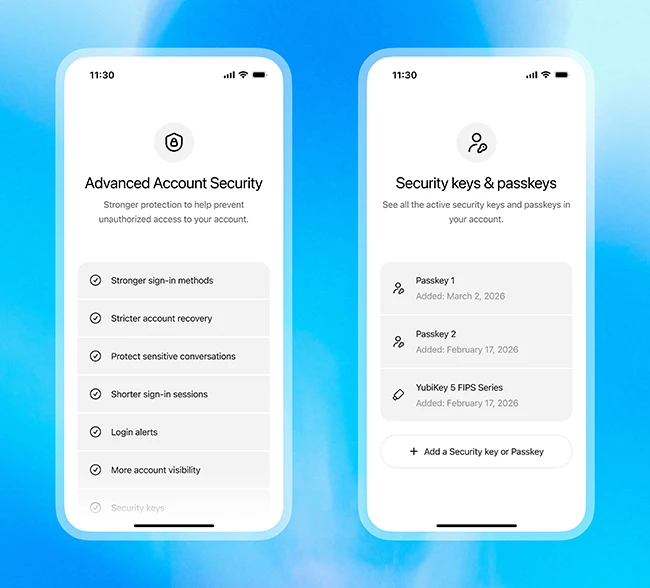
ChatGPT advanced account security

What enrollment changes

Enrolled accounts use passkeys or hardware security keys for sign-in, with password login disabled. Email and SMS account recovery are removed, closing a path attackers commonly exploit when a victim’s phone number or inbox has been compromised. Recovery is limited to backup passkeys, security keys, and recovery keys held by the user. Once a user enrolls, OpenAI Support cannot assist with recovery, placing responsibility for backup credentials on the account holder.

Sign-in sessions are shortened to limit exposure if a device or active session is compromised. The setting covers ChatGPT and Codex under the same login, so a single enrollment carries across both products.

Conversations from accounts with the setting enabled are excluded from model training automatically. The default opt-out targets users handling sensitive personal or professional material who want assurance that their inputs stay out of training data without managing the preference manually.

Yubico partnership and FIDO support

OpenAI has partnered with Yubico to offer preferred pricing on a bundle of two YubiKeys aimed at the new security setting. The bundle includes the YubiKey C Nano, designed to remain seated in a laptop port for daily authentication, and the YubiKey C NFC for backup and cross-device use across laptops and mobile devices.

Users are free to use any FIDO-compliant security key or software-based passkeys. The setting follows the same standards already adopted by Google, Microsoft, GitHub, and other vendors that built phishing-resistant authentication around the FIDO2 and WebAuthn specifications.

Mandatory enrollment for Trusted Access for Cyber

“Individual members of Trusted Access for Cyber accessing our most cyber capable and permissive models will be required to enable Advanced Account Security beginning June 1, 2026. Organizations with trusted access can, as an alternative, attest that they have phishing resistant authentication as part of their single sign-on workflow,” OpenAI explained.

Download: Automating Pentest Delivery Guide