


惯性聚合 高效追踪和阅读你感兴趣的博客、新闻、科技资讯
阅读原文 在惯性聚合中打开

推荐订阅源

J
Java Code Geeks
G
Google Developers Blog
Blog — PlanetScale
Blog — PlanetScale
U
Unit 42
A
About on SuperTechFans
Vercel News
Vercel News
B
Blog
Martin Fowler
Martin Fowler
MyScale Blog
MyScale Blog
Cyber Security Advisories - MS-ISAC
腾讯CDC
D
Docker
V
Visual Studio Blog
博客园 - 叶小钗
The Cloudflare Blog
Jina AI
Jina AI
B
Blog RSS Feed
钛媒体:引领未来商业与生活新知
钛媒体:引领未来商业与生活新知
WordPress大学
WordPress大学
T
Tailwind CSS Blog
MongoDB | Blog
MongoDB | Blog
D
DataBreaches.Net
月光博客
月光博客
大猫的无限游戏
大猫的无限游戏

Help Net Security

FIDO Alliance wants to keep AI agents from going rogue on online payments Police arrest 10 suspected members of Black Axe cybercrime gang ShinyHunters claims it stole 1.4 million records from Udemy Sevii unveils Cyber Swarm Defense Mode to stop AI-driven attacks at scale Alleged Chinese hacker extradited to US over cyberattacks targeting COVID-19 research Cequence Agent Personas bring granular control and governance to enterprise AI agents NowSecure MARI gives enterprises evidence-based visibility into third-party mobile app risk The metrics killing your SOC, and what to use instead US state privacy fines reached $3.425 billion in 2025 Canada’s first SMS blaster case leads to three arrests Linux storage management tool Stratis 3.9.0 adds online encryption and cache-less pool startup TLS Connect gives SMBs a right-sized automated tool to manage TLS certificates Aptori expands its platform with autonomous offensive testing to reduce security bottlenecks Your IAM was built for humans, AI agents don’t care The AI criminal mastermind is already hiring on gig platforms 25 open-source cybersecurity tools that don’t care about your budget Product showcase: LuLu reveals unauthorized outbound connections from Mac apps Week in review: Claude Mythos finds 271 Firefox flaws, Vercel breach Users advised to drop passwords and make room for passkeys - Help Net Security Indirect prompt injection is taking hold in the wild - Help Net Security Compromised everyday devices power Chinese cyber espionage operations - Help Net Security New Cisco firewall malware can only be killed by pulling the plug - Help Net Security Meta is overhauling how you sign in, manage settings, and protect your accounts - Help Net Security Ubuntu 26.04 LTS delivers memory-safe system tools and live patching for Arm servers - Help Net Security OpenAI’s GPT-5.5 is out with expanded cybersecurity safeguards - Help Net Security AI is speeding up nation-state cyber programs - Help Net Security A study of 1,000 Android apps finds a privacy policy logging gap - Help Net Security IT spending to hit $6.31 trillion record, thanks to AI - Help Net Security Where AI in CI/CD is working for engineering teams - Help Net Security With AI's help, North Korean hackers stumbled into a near-undetectable attack - Help Net Security
SmokedMeat: Open-source tool shows what attackers do insi...
Mirko Zorz · 2026-04-20 · via Help Net Security

Boost Security has released SmokedMeat, an open-source framework that runs attack chains against CI/CD infrastructure so engineering and security teams can see what an attacker would do in their specific environment.
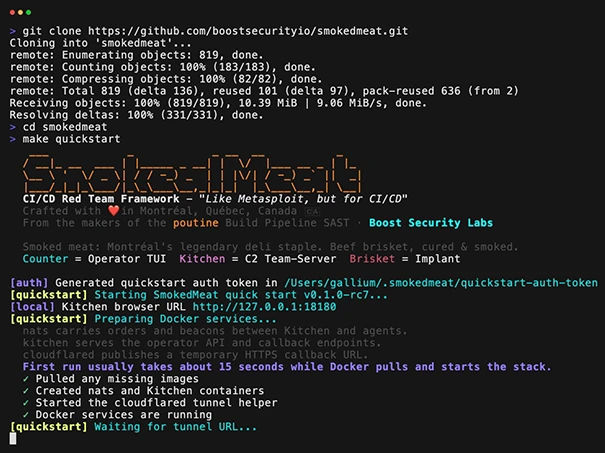
SmokedMeat

What the tool does

SmokedMeat takes a flagged pipeline vulnerability and executes a live demonstration against a team’s own infrastructure. Starting from a single vulnerability, it deploys a payload, compromises the runner, harvests credentials from process memory, exchanges those credentials for cloud access, exposes private repositories, and maps the blast radius of the attack.

Zaid Al Hamami, CEO of Boost Security, described the scope: “This tool is showing what attackers can do; they can find a vulnerability in an open source repo, craft an exploit payload, steal credentials in that repo, and use those credentials to pivot to other areas, insert malware, infect developers working on those repos.”

The TeamPCP attack that changed the conversation

In March 2026, a coordinated campaign known as TeamPCP compromised Trivy, Checkmarx, LiteLLM, and dozens of npm packages. The attack used techniques that Boost Labs had documented in prior research. Boost’s open-source scanner, Poutine, had flagged vulnerabilities in Trivy’s pipeline months before the attack. Those findings went unpatched. Al Hamami described the campaign as the largest cascade supply chain attack to date.

The backlog problem

Boost Labs had been publishing research on CI/CD attack techniques for years, documenting how attackers move through build pipelines, steal credentials, and pivot into cloud environments. A static scan result that flags “workflow injection possible” does not convey what an attacker can do with that injection in a matter of seconds. Without a concrete demonstration, remediation work tends to stay deprioritized.

SmokedMeat is designed to close that gap by running the attack scenario against real infrastructure, giving security teams and engineering leaders a concrete view of what exploitation looks like in their own environment.

SmokedMeat is available for free on GitHub.

Must read:

Subscribe to the Help Net Security ad-free monthly newsletter to stay informed on the essential open-source cybersecurity tools. Subscribe here!