


惯性聚合 高效追踪和阅读你感兴趣的博客、新闻、科技资讯
阅读原文 在惯性聚合中打开

推荐订阅源

Microsoft Azure Blog
博客园_首页
Forbes - Security
Forbes - Security
WordPress大学
WordPress大学
P
Proofpoint News Feed
T
Threat Research - Cisco Blogs
L
LINUX DO - 热门话题
L
Lohrmann on Cybersecurity
Spread Privacy
Spread Privacy
D
Darknet – Hacking Tools, Hacker News & Cyber Security
大猫的无限游戏
大猫的无限游戏
博客园 - 三生石上(FineUI控件)
P
Privacy International News Feed
A
About on SuperTechFans
T
Tailwind CSS Blog
I
InfoQ
S
Securelist
云风的 BLOG
云风的 BLOG
罗磊的独立博客
Recent Announcements
T
The Exploit Database - CXSecurity.com
B
Blog RSS Feed
V
Visual Studio Blog
Know Your Adversary
Know Your Adversary
The GitHub Blog
The GitHub Blog
Jina AI
Jina AI
腾讯CDC
Cyberwarzone
Cyberwarzone
有赞技术团队
有赞技术团队
AWS News Blog
AWS News Blog
博客园 - 【当耐特】
cs.AI updates on arXiv.org
F
Full Disclosure
S
Secure Thoughts
博客园 - 司徒正美
J
Java Code Geeks
Y
Y Combinator Blog
Google Online Security Blog
GbyAI
GbyAI
N
News and Events Feed by Topic
Help Net Security
Help Net Security
freeCodeCamp Programming Tutorials: Python, JavaScript, Git & More
Project Zero
Project Zero
T
Tenable Blog
cs.CV updates on arXiv.org
T
Tor Project blog
MyScale Blog
MyScale Blog
Scott Helme
Scott Helme
小众软件
小众软件
K
Kaspersky official blog

Help Net Security

FIDO Alliance wants to keep AI agents from going rogue on online payments Police arrest 10 suspected members of Black Axe cybercrime gang ShinyHunters claims it stole 1.4 million records from Udemy Sevii unveils Cyber Swarm Defense Mode to stop AI-driven attacks at scale Alleged Chinese hacker extradited to US over cyberattacks targeting COVID-19 research Cequence Agent Personas bring granular control and governance to enterprise AI agents NowSecure MARI gives enterprises evidence-based visibility into third-party mobile app risk The metrics killing your SOC, and what to use instead US state privacy fines reached $3.425 billion in 2025 Canada’s first SMS blaster case leads to three arrests Linux storage management tool Stratis 3.9.0 adds online encryption and cache-less pool startup TLS Connect gives SMBs a right-sized automated tool to manage TLS certificates Aptori expands its platform with autonomous offensive testing to reduce security bottlenecks Your IAM was built for humans, AI agents don’t care The AI criminal mastermind is already hiring on gig platforms 25 open-source cybersecurity tools that don’t care about your budget Product showcase: LuLu reveals unauthorized outbound connections from Mac apps Week in review: Claude Mythos finds 271 Firefox flaws, Vercel breach Users advised to drop passwords and make room for passkeys - Help Net Security Indirect prompt injection is taking hold in the wild - Help Net Security Compromised everyday devices power Chinese cyber espionage operations - Help Net Security New Cisco firewall malware can only be killed by pulling the plug - Help Net Security Meta is overhauling how you sign in, manage settings, and protect your accounts - Help Net Security Ubuntu 26.04 LTS delivers memory-safe system tools and live patching for Arm servers - Help Net Security OpenAI’s GPT-5.5 is out with expanded cybersecurity safeguards - Help Net Security AI is speeding up nation-state cyber programs - Help Net Security A study of 1,000 Android apps finds a privacy policy logging gap - Help Net Security IT spending to hit $6.31 trillion record, thanks to AI - Help Net Security Where AI in CI/CD is working for engineering teams - Help Net Security With AI's help, North Korean hackers stumbled into a near-undetectable attack - Help Net Security Hacker with a special interest in breaching sports institutions ends behind bars - Help Net Security IP Fabric MCP server adds governance and control to enterprise AIOps workflows - Help Net Security Aqua Compass MCP server enables real-time investigation and containment of runtime threats - Help Net Security Google brings instant email verification to Android, no OTP needed - Help Net Security If cyber espionage via HDMI worries you, NCSC built a device to stop it - Help Net Security Apple fixes iPhone bug that let FBI retrieve deleted Signal messages(CVE-2026-28950) - Help Net Security GopherWhisper APT group hides command and control traffic in Slack and Discord - Help Net Security OpenAI tackles a bad habit people have when interacting with AI - Help Net Security A year in, Zoom's CISO reflects on balancing security and business - Help Net Security Scenario: Open-source framework for automated AI app red-teaming - Help Net Security GDPR works, but only where someone enforces it - Help Net Security Ransomware, fraud, and lawsuits drive cyber insurance claims to new peaks - Help Net Security Google’s Workspace Intelligence promises privacy while running on your data - Help Net Security Cyberattack on French government agency triggers phishing alert - Help Net Security Claude Mythos finds 271 Firefox flaws, Mozilla believes zero-days are numbered - Help Net Security Prove Identity Platform connects verification, authentication, and fraud prevention - Help Net Security New Mirai variants target routers and DVRs in parallel campaigns - Help Net Security Acronis GenAI Protection gives MSPs control over AI usage and data risks - Help Net Security Elastic MCP Apps bring security and observability workflows into AI tools - Help Net Security Progress Software fixes sneaky WAF bypass vulnerability (CVE-2026-21876) - Help Net Security Tencent's QClaw AI agent app arrives on Windows and macOS - Help Net Security Phishing reclaims the top initial access spot, attackers experiment with AI tools - Help Net Security OneDrive updates focus on AI, access control, and compliance - Help Net Security PentAGI: Open-source autonomous AI penetration testing system - Help Net Security Apple Intelligence flaw kept stolen tokens reusable on another device - Help Net Security Shadow AI, deepfakes, and supply chain compromise are rewriting the financial sector threat playbook - Help Net Security Thunderbird 150 arrives with encrypted message search and OpenPGP improvements - Help Net Security VirtualBox 7.2.8 is out with Linux kernel 7.0 support and crash fixes - Help Net Security Ransomware negotiator admits role in attacks he was hired to resolve - Help Net Security Scattered Spider hacker pleads guilty to stealing $8 million in cryptocurrency Meta and PortSwigger drive offensive security further to find what others miss - Help Net Security EU pushes for stronger cloud sovereignty, awards €180 million to four providers - Help Net Security SmokedMeat: Open-source tool shows what attackers do inside CI/CD pipelines - Help Net Security How to spot a North Korean fake in a job interview - Help Net Security Product showcase: Syncthing for secure, private file synchronization - Help Net Security Week in review: Acrobat Reader flaw exploited, Claude Mythos offensive capabilities and limits Google wipes out 602 million scam ads with Gemini on duty Researcher drops two more Microsoft Defender zero-days, all three now exploited in the wild GitLab 18.11 brings agentic AI to security fixes, CI pipelines, and delivery analytics Liongard upgrades LiongardIQ with AI access, live asset data, and deeper discovery Mozilla challenges enterprise AI providers with Thunderbolt, open-source AI client under your control Codex can now operate between apps. Where are the boundaries? Android 17 Beta 4 arrives with post-quantum cryptography and new memory limits Apple AirTag tracking can be misled by replayed Bluetooth signals Social media bans might steer kids into riskier corners of the internet Workplace stress in 2026 is still worse than before the pandemic New infosec products of the week: April 17, 2026 - Help Net Security ImmuniWeb brings AI upgrades, post-quantum detection and more in Q1 2026 Anthropic releases Claude Opus 4.7 with automated cybersecurity safeguards - Help Net Security Fortinet fixes critical FortiSandbox vulnerabilities (CVE-2026-39813, CVE-2026-39808) - Help Net Security Google Play is changing how Android apps access your contacts and location Tails 7.6.2 patches vulnerability that could expose saved files Cargo theft malware actor spent a month inside a decoy network before researchers pulled the plug OpenAI updates Agents SDK, adds sandbox for safer code execution Anthropic tests user trust with ID and selfie checks for Claude GitHub lays out copyright liability changes and upcoming DMCA review for developers EU cybersecurity standards are at risk if supplier ban passes Command integrity breaks in the LLM routing layer The fully free Linux OS Trisquel gets a major update with version 12.0 Ecne Week in review: Windows zero-day exploit leaked, Patch Tuesday forecast ClickFix campaign delivers Mac malware via fake Apple page Poisoned “Office 365” search results lead to stolen paychecks Gmail’s end-to-end encryption comes to mobile, no extra apps required To counter cookie theft, Chrome ships device-bound session credentials Product showcase: Session, a messenger without phone numbers or metadata Little Snitch for Linux shows what your apps are connecting to - Help Net Security Apiiro CLI turns AI coding assistants into full-stack security engineers - Help Net Security April 2026 Patch Tuesday forecast: Spring-cleaning of a preview - Help Net Security What vibe hunting gets right about AI threat hunting, and where it breaks down - Help Net Security Health insurance lead sites sell personal data within seconds of form submission - Help Net Security
NIST admits defeat on NVD backlog, will enrich only highest-risk CVEs going forward
Zeljka Zorz · 2026-04-17 · via Help Net Security

NIST is overhauling how it manages the National Vulnerability Database (NVD) and switching to a risk-based model that prioritizes “enrichment” of only the most critical CVE-numbered security vulnerabilities.

“This change is driven by a surge in CVE submissions, which increased 263% between 2020 and 2025,” the National Institute of Standards and Technology said. “We don’t expect this trend to let up anytime soon.”

OPIS

A two-year struggle and a new approach

NIST has been struggling to update NVD’s CVE entries with relevant information – descriptions, severity (CVSS) scores, known affected software configurations, etc. – for over two years.

The problem was acknowledged in early 2024 and despite occasional optimistic updates, it’s now become clear that the veritable onslaught of CVE-numbered security issues is too much for NVD’s analysts to tackle.

“We are working faster than ever. We enriched nearly 42,000 CVEs in 2025 — 45% more than any prior year. But this increased productivity is not enough to keep up with growing submissions. Therefore, we are instituting a new approach,” NIST announced.

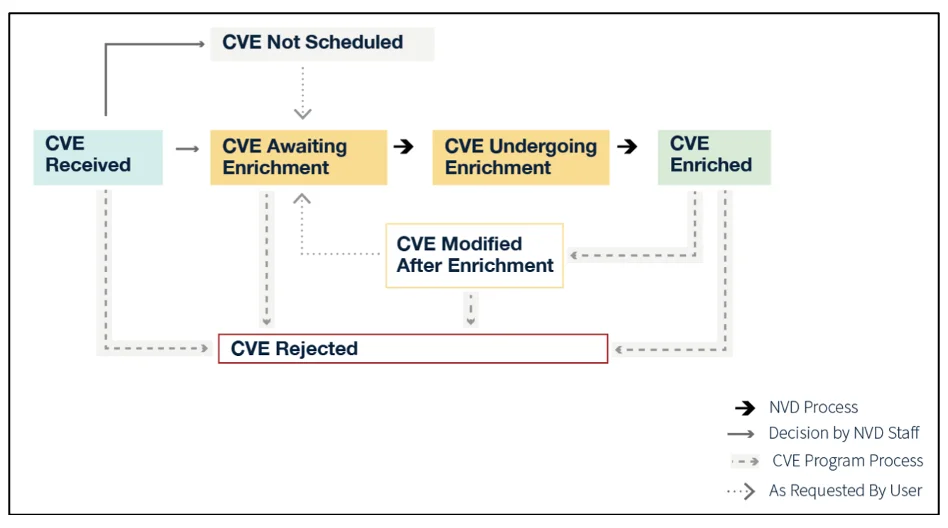
“All submitted CVEs will still be added to the NVD. However, those that do not meet the criteria above will be categorized as ‘Not Scheduled.’ This will allow us to focus on CVEs with the greatest potential for widespread impact.”
OPIS

The new NVD CVE processing workflow (Source: NIST)

From now on, the CVE entries that will be prioritized for enrichment will fall into one of three categories:

  • They’ve already been added to the Cybersecurity and Infrastructure Security Agency’s Known Exploited Vulnerabilities catalog
  • Affect software used within the (US) federal government
  • Affect critical software (as defined by Executive Order 14028):
    • Identity, credential, and access management (ICAM) systems
    • Operating systems, hypervisors, and container environments
    • Web browsers
    • Endpoint security software
    • Network control software
    • Network protection products
    • Network monitoring and configuration tools
    • Operational monitoring and analysis software
    • Remote scanning software
    • Remote access and configuration management tools
    • Backup/recovery and remote storage software
    • Open source and government-developed software that falls into one of the above categories
    • In specific cases, libraries, packages, and modules that are integrated into and necessary for the operation of the software that falls into one of the above categories

NIST will also stop routinely adding their own separated severity score to the entries and will rely on the one provided by CVE Numbering Authorities, and will not enrich CVEs with an NVD publish date earlier than March 1, 2026.

Users will be able to ask, via email, that NIST’s analysts enrich specific high-impact unscheduled CVEs or provide a separate severity score, but it remains to be seen how quickly these requests will be reviewed and acted upon.

With LLMs increasingly being used for vulnerability discovery and Anthropic and OpenAI sharing Claude Mythos and GPT-5.4-Cyber with vetted security researchers and teams, the flood of CVE submissions will only grow stronger.

By taking some of the pressure off its analysts, NIST hopes to buy itself time to build better automated tools that can handle that volume.

CVE Program’s problems

NIST’s announcement comes amid renewed uncertainty around the CVE Program, which is the foundation on which the NVD is built.

Run by MITRE and largely funded by the US Department of Homeland Security, nearly collapsed last year when its federal funding contract was about to expire, prompting CISA to step in at the last minute and triggering efforts to establish an independent CVE Foundation.

CVE Program board member Katie Noble recently warned that the surge in AI-fueled vulnerability reports is straining the program, and that it needs to evolve to keep up and continue to be relevant.

Nuno Rodrigues Carvalho, Head of Sector for Incident and Vulnerability Services at EU’s cybersecurity agency ENISA, told Help Net Security that a global common good service of this importance should not depend excessively on a potential “single point of failure,” whether financial, institutional, or operational, and that a stronger model would preserve the integrity of the shared CVE backbone while distributing responsibilities across trusted actors that can contribute capacity, services, and operational support.

ENISA, he said, is ready to contribute to the program while continuing to build European vulnerability services capacity in parallel.

The agency is currently in the process of becoming a top-level root CVE Numbering Authority for the CVE Program, which will allow it to influence its operation and evolution.

Subscribe to our breaking news e-mail alert to never miss out on the latest breaches, vulnerabilities and cybersecurity threats. Subscribe here!