

惯性聚合 高效追踪和阅读你感兴趣的博客、新闻、科技资讯
阅读原文 在惯性聚合中打开

推荐订阅源

A
About on SuperTechFans
Cloudbric
Cloudbric
C
CERT Recently Published Vulnerability Notes
G
GRAHAM CLULEY
V
Vulnerabilities – Threatpost
C
Cisco Blogs
T
Tenable Blog
P
Privacy International News Feed
T
The Exploit Database - CXSecurity.com
I
Intezer
AWS News Blog
AWS News Blog
IT之家
IT之家
博客园 - 司徒正美
C
Cybersecurity and Infrastructure Security Agency CISA
博客园 - 【当耐特】
The Hacker News
The Hacker News
奇客Solidot–传递最新科技情报
奇客Solidot–传递最新科技情报
Spread Privacy
Spread Privacy
S
SegmentFault 最新的问题
博客园 - Franky
人人都是产品经理
人人都是产品经理
cs.CV updates on arXiv.org
V
Visual Studio Blog
C
CXSECURITY Database RSS Feed - CXSecurity.com
H
Hacker News: Front Page
Latest news
Latest news
Scott Helme
Scott Helme
腾讯CDC
宝玉的分享
宝玉的分享
大猫的无限游戏
大猫的无限游戏
cs.AI updates on arXiv.org
A
Arctic Wolf
S
Securelist
雷峰网
雷峰网
The GitHub Blog
The GitHub Blog
Project Zero
Project Zero
Google DeepMind News
P
Palo Alto Networks Blog
F
Fortinet All Blogs
Schneier on Security
云风的 BLOG
云风的 BLOG
Security Archives - TechRepublic
The Last Watchdog
The Last Watchdog
WordPress大学
WordPress大学
MongoDB | Blog
MongoDB | Blog
L
LINUX DO - 最新话题
S
Schneier on Security
NISL@THU
NISL@THU
Jina AI
Jina AI
M
MIT News - Artificial intelligence

Help Net Security

Police arrest 10 suspected members of Black Axe cybercrime gang ShinyHunters claims it stole 1.4 million records from Udemy Sevii unveils Cyber Swarm Defense Mode to stop AI-driven attacks at scale Alleged Chinese hacker extradited to US over cyberattacks targeting COVID-19 research Cequence Agent Personas bring granular control and governance to enterprise AI agents NowSecure MARI gives enterprises evidence-based visibility into third-party mobile app risk The metrics killing your SOC, and what to use instead US state privacy fines reached $3.425 billion in 2025 Canada’s first SMS blaster case leads to three arrests Linux storage management tool Stratis 3.9.0 adds online encryption and cache-less pool startup TLS Connect gives SMBs a right-sized automated tool to manage TLS certificates Aptori expands its platform with autonomous offensive testing to reduce security bottlenecks Your IAM was built for humans, AI agents don’t care The AI criminal mastermind is already hiring on gig platforms 25 open-source cybersecurity tools that don’t care about your budget Product showcase: LuLu reveals unauthorized outbound connections from Mac apps Week in review: Claude Mythos finds 271 Firefox flaws, Vercel breach Users advised to drop passwords and make room for passkeys - Help Net Security Indirect prompt injection is taking hold in the wild - Help Net Security Compromised everyday devices power Chinese cyber espionage operations - Help Net Security New Cisco firewall malware can only be killed by pulling the plug - Help Net Security Meta is overhauling how you sign in, manage settings, and protect your accounts - Help Net Security Ubuntu 26.04 LTS delivers memory-safe system tools and live patching for Arm servers - Help Net Security OpenAI’s GPT-5.5 is out with expanded cybersecurity safeguards - Help Net Security AI is speeding up nation-state cyber programs - Help Net Security A study of 1,000 Android apps finds a privacy policy logging gap - Help Net Security IT spending to hit $6.31 trillion record, thanks to AI - Help Net Security Where AI in CI/CD is working for engineering teams - Help Net Security With AI's help, North Korean hackers stumbled into a near-undetectable attack - Help Net Security Hacker with a special interest in breaching sports institutions ends behind bars - Help Net Security IP Fabric MCP server adds governance and control to enterprise AIOps workflows - Help Net Security Aqua Compass MCP server enables real-time investigation and containment of runtime threats - Help Net Security Google brings instant email verification to Android, no OTP needed - Help Net Security If cyber espionage via HDMI worries you, NCSC built a device to stop it - Help Net Security Apple fixes iPhone bug that let FBI retrieve deleted Signal messages(CVE-2026-28950) - Help Net Security GopherWhisper APT group hides command and control traffic in Slack and Discord - Help Net Security OpenAI tackles a bad habit people have when interacting with AI - Help Net Security A year in, Zoom's CISO reflects on balancing security and business - Help Net Security Scenario: Open-source framework for automated AI app red-teaming - Help Net Security GDPR works, but only where someone enforces it - Help Net Security Ransomware, fraud, and lawsuits drive cyber insurance claims to new peaks - Help Net Security Google’s Workspace Intelligence promises privacy while running on your data - Help Net Security Cyberattack on French government agency triggers phishing alert - Help Net Security Claude Mythos finds 271 Firefox flaws, Mozilla believes zero-days are numbered - Help Net Security Prove Identity Platform connects verification, authentication, and fraud prevention - Help Net Security New Mirai variants target routers and DVRs in parallel campaigns - Help Net Security Acronis GenAI Protection gives MSPs control over AI usage and data risks - Help Net Security Elastic MCP Apps bring security and observability workflows into AI tools - Help Net Security Progress Software fixes sneaky WAF bypass vulnerability (CVE-2026-21876) - Help Net Security Tencent's QClaw AI agent app arrives on Windows and macOS - Help Net Security Phishing reclaims the top initial access spot, attackers experiment with AI tools - Help Net Security OneDrive updates focus on AI, access control, and compliance - Help Net Security PentAGI: Open-source autonomous AI penetration testing system - Help Net Security Apple Intelligence flaw kept stolen tokens reusable on another device - Help Net Security Shadow AI, deepfakes, and supply chain compromise are rewriting the financial sector threat playbook - Help Net Security Thunderbird 150 arrives with encrypted message search and OpenPGP improvements - Help Net Security VirtualBox 7.2.8 is out with Linux kernel 7.0 support and crash fixes - Help Net Security Ransomware negotiator admits role in attacks he was hired to resolve - Help Net Security Scattered Spider hacker pleads guilty to stealing $8 million in cryptocurrency Meta and PortSwigger drive offensive security further to find what others miss - Help Net Security EU pushes for stronger cloud sovereignty, awards €180 million to four providers - Help Net Security SmokedMeat: Open-source tool shows what attackers do inside CI/CD pipelines - Help Net Security How to spot a North Korean fake in a job interview - Help Net Security Product showcase: Syncthing for secure, private file synchronization - Help Net Security Week in review: Acrobat Reader flaw exploited, Claude Mythos offensive capabilities and limits Google wipes out 602 million scam ads with Gemini on duty Researcher drops two more Microsoft Defender zero-days, all three now exploited in the wild GitLab 18.11 brings agentic AI to security fixes, CI pipelines, and delivery analytics Liongard upgrades LiongardIQ with AI access, live asset data, and deeper discovery Mozilla challenges enterprise AI providers with Thunderbolt, open-source AI client under your control Codex can now operate between apps. Where are the boundaries? Android 17 Beta 4 arrives with post-quantum cryptography and new memory limits Apple AirTag tracking can be misled by replayed Bluetooth signals Social media bans might steer kids into riskier corners of the internet Workplace stress in 2026 is still worse than before the pandemic New infosec products of the week: April 17, 2026 - Help Net Security ImmuniWeb brings AI upgrades, post-quantum detection and more in Q1 2026 NIST admits defeat on NVD backlog, will enrich only highest-risk CVEs going forward Anthropic releases Claude Opus 4.7 with automated cybersecurity safeguards - Help Net Security Fortinet fixes critical FortiSandbox vulnerabilities (CVE-2026-39813, CVE-2026-39808) - Help Net Security Google Play is changing how Android apps access your contacts and location Tails 7.6.2 patches vulnerability that could expose saved files Cargo theft malware actor spent a month inside a decoy network before researchers pulled the plug OpenAI updates Agents SDK, adds sandbox for safer code execution Anthropic tests user trust with ID and selfie checks for Claude GitHub lays out copyright liability changes and upcoming DMCA review for developers EU cybersecurity standards are at risk if supplier ban passes Command integrity breaks in the LLM routing layer The fully free Linux OS Trisquel gets a major update with version 12.0 Ecne Week in review: Windows zero-day exploit leaked, Patch Tuesday forecast ClickFix campaign delivers Mac malware via fake Apple page Poisoned “Office 365” search results lead to stolen paychecks Gmail’s end-to-end encryption comes to mobile, no extra apps required To counter cookie theft, Chrome ships device-bound session credentials Product showcase: Session, a messenger without phone numbers or metadata Little Snitch for Linux shows what your apps are connecting to - Help Net Security Apiiro CLI turns AI coding assistants into full-stack security engineers - Help Net Security April 2026 Patch Tuesday forecast: Spring-cleaning of a preview - Help Net Security What vibe hunting gets right about AI threat hunting, and where it breaks down - Help Net Security Health insurance lead sites sell personal data within seconds of form submission - Help Net Security
Cisco releases open-source toolkit for verifying AI model lineage
Mirko Zorz · 2026-04-30 · via Help Net Security

Enterprises pulling models from Hugging Face and other open repositories rarely keep records of how those models are altered after download, leaving organizations with little ability to confirm what they are running in production. The State of AI Security 2026 from Cisco places this level of access inside a growing pattern of AI-driven operations that connect directly to core business systems, and identifies AI supply chain exposure as a recurring risk.

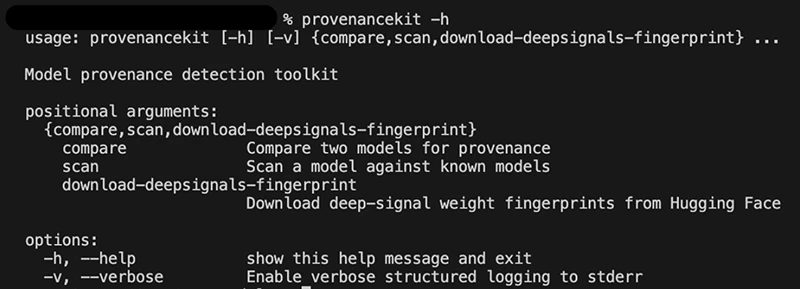
Cisco has published the Model Provenance Kit, an open-source Python toolkit and command-line interface that determines whether two transformer models share a common origin by examining architecture metadata, tokenizer structure, and the learned weights themselves.

Why model lineage has become difficult to verify

Hugging Face hosts more than 2 million models. Documentation on open repositories can be falsified, metadata can be stripped or edited, and a model card claiming a model was trained from scratch may describe a modified copy of another model. Many repositories provide limited cryptographic assurance regarding model origin, training data, or modification history, and unsanctioned use of external models has expanded the software supply chain beyond traditional package managers. Recent product releases illustrate the layering involved: Cursor’s Composer 2 was partly built on Kimi 2.5, which was developed by a Chinese startup, and similar dependencies run through much of the industry.

Modern model families compound the verification problem because they share identical architectures. Models from Meta, Alibaba, DeepSeek, and Mistral use the same building blocks, including grouped-query attention, rotary positional embeddings, and Root Mean Square Normalization. A configuration file describes the architecture, which says nothing about whether the weights were copied from another model or trained independently.

Without provenance information, organizations have limited visibility into poisoned or vulnerable models that may propagate inherited flaws into chatbots, agent applications, and customer-facing tools. Provenance also bears on regulatory exposure. The European Union AI Act requires documentation of training data, characteristics of training methodology, and risk assessments for high-risk systems. The NIST AI Risk Management Framework identifies third-party AI component risks as a governance area. AI components shift constantly across the supply chain while existing security controls assume static assets, creating blind spots that complicate downstream compliance.

Some open weight models carry restrictive licenses, and a model that turns out to be a derivative of one trained in a jurisdiction subject to export controls can introduce additional legal considerations. Incident response also suffers when a model’s lineage is unknown, since responders cannot determine whether an issue originates in the model, a related model, a parent, or fine-tuning steps.
AI model provenance

Model Provenance Kit’s command line interface (Source: Cisco)

How the kit works

Model Provenance Kit operates in two stages. Stage 1 performs an architectural screening that compares model configurations and structural metadata before any weights are loaded. Pairs sharing identical architecture specifications are classified as related at this stage, which resolves a large portion of cases.

When metadata is ambiguous, the pipeline progresses to Stage 2, which extracts five complementary signals from the model weights:

  • Embedding Anchor Similarity (EAS) compares the geometric relationships between token embeddings, a structure unique to a training run that survives fine-tuning.
  • Embedding Norm Distribution (END) analyzes the distribution of embedding magnitudes, which encode word frequency patterns from training.
  • Norm Layer Fingerprint (NLF) reads the small normalization layers, which remain stable across fine-tuning.
  • Layer Energy Profile (LEP) compares normalized energy curve distributions across the depth of the network. Different training runs produce different energy distributions even when the architecture is identical.
  • Weight-Value Cosine (WVC) directly compares weight values between a subsample of corresponding layers. Independently trained models show essentially zero correlation here.

The signals are combined into a single identity score using empirically calibrated weights. When a signal cannot be computed, for example when models have different layer counts, it is excluded and the remaining signals compensate.

Tokenizer signals, including vocabulary overlap analysis and tokenizer feature vector, are computed for diagnostic purposes and excluded from the provenance score. Many independently trained models share tokenizers. StableLM and Pythia both use the GPT-NeoX tokenizer and would score as similar despite having no weight lineage, which would generate false positives if tokenizer signals influenced the final score.

The kit ships with two modes. Compare mode produces a detailed similarity breakdown for any two models drawn from Hugging Face or local checkpoints. Scan mode matches a single model against a database of known fingerprints to surface lineage candidates, treating provenance as a search problem. Cisco has released an initial fingerprint database covering roughly 150 base models across 45 families and 20 publishers, ranging from 135 million to more than 70 billion parameters.

Benchmark results

Cisco evaluated the kit against a 111-pair benchmark composed of 55 similar pairs and 56 dissimilar pairs. The benchmark included aggressive distillation, quantization across formats, cross-organization fine-tuning, LoRA merging, continued pretraining with vocabulary extension, same-tokenizer traps, and independent reproductions of popular architectures. At a 0.70 threshold on a 0-to-1 scale, the kit recorded an F1 score of 0.963, accuracy of 96.4%, precision of 98.1%, and recall of 94.6%.

The kit identified standard derivatives such as fine-tuning, quantization, and alignment with 100% recall, and matched cross-organization derivatives at 100% recall. Same-tokenizer traps were handled at 100% specificity, and independent reproductions such as open_llama and Llama-2 were correctly identified as unrelated.

Four of 111 pairs were misclassified. Each involved an extreme architectural transformation, such as distilling a 12-layer model with 768 hidden dimensions down to 4 layers with halved hidden dimensions, or rebuilding a vocabulary for domain-specific continued pretraining. Cisco describes these as fundamental limits of pairwise weight comparison.

Deployment

The pipeline runs on CPU and scales with model size. Architectural matches resolve in milliseconds, and extracted features are cached for reuse across comparisons. The kit works on any transformer model with downloadable weights.

The repository is on GitHub, and the fingerprint dataset is at Hugging Face.

25 open-source cybersecurity tools that don’t care about your budget