




惯性聚合 高效追踪和阅读你感兴趣的博客、新闻、科技资讯
阅读原文 在惯性聚合中打开

推荐订阅源

MyScale Blog
MyScale Blog
人人都是产品经理
人人都是产品经理
云风的 BLOG
云风的 BLOG
小众软件
小众软件
F
Fortinet All Blogs
爱范儿
爱范儿
WordPress大学
WordPress大学
N
Netflix TechBlog - Medium
Recent Announcements
Google DeepMind News
C
Check Point Blog
博客园 - 聂微东
D
Docker
OSCHINA 社区最新新闻
OSCHINA 社区最新新闻
aimingoo的专栏
aimingoo的专栏
Vercel News
Vercel News
钛媒体:引领未来商业与生活新知
钛媒体:引领未来商业与生活新知
A
About on SuperTechFans
博客园 - 【当耐特】
Microsoft Azure Blog
B
Blog
宝玉的分享
宝玉的分享
Jina AI
Jina AI
H
Hackread – Cybersecurity News, Data Breaches, AI and More

Help Net Security

Police arrest 10 suspected members of Black Axe cybercrime gang ShinyHunters claims it stole 1.4 million records from Udemy Sevii unveils Cyber Swarm Defense Mode to stop AI-driven attacks at scale Alleged Chinese hacker extradited to US over cyberattacks targeting COVID-19 research Cequence Agent Personas bring granular control and governance to enterprise AI agents NowSecure MARI gives enterprises evidence-based visibility into third-party mobile app risk The metrics killing your SOC, and what to use instead US state privacy fines reached $3.425 billion in 2025 Canada’s first SMS blaster case leads to three arrests Linux storage management tool Stratis 3.9.0 adds online encryption and cache-less pool startup TLS Connect gives SMBs a right-sized automated tool to manage TLS certificates Aptori expands its platform with autonomous offensive testing to reduce security bottlenecks Your IAM was built for humans, AI agents don’t care The AI criminal mastermind is already hiring on gig platforms 25 open-source cybersecurity tools that don’t care about your budget Product showcase: LuLu reveals unauthorized outbound connections from Mac apps Week in review: Claude Mythos finds 271 Firefox flaws, Vercel breach Users advised to drop passwords and make room for passkeys - Help Net Security Indirect prompt injection is taking hold in the wild - Help Net Security Compromised everyday devices power Chinese cyber espionage operations - Help Net Security New Cisco firewall malware can only be killed by pulling the plug - Help Net Security Meta is overhauling how you sign in, manage settings, and protect your accounts - Help Net Security Ubuntu 26.04 LTS delivers memory-safe system tools and live patching for Arm servers - Help Net Security OpenAI’s GPT-5.5 is out with expanded cybersecurity safeguards - Help Net Security AI is speeding up nation-state cyber programs - Help Net Security A study of 1,000 Android apps finds a privacy policy logging gap - Help Net Security IT spending to hit $6.31 trillion record, thanks to AI - Help Net Security Where AI in CI/CD is working for engineering teams - Help Net Security With AI's help, North Korean hackers stumbled into a near-undetectable attack - Help Net Security Hacker with a special interest in breaching sports institutions ends behind bars - Help Net Security
FBI: $388 million lost in crypto ATM scams in 2026
Anamarija Po · 2026-05-20 · via Help Net Security

Americans lost more than $388 million to crypto kiosk scams in 2025, with the FBI warning that criminals are increasingly directing victims to transfer funds through these machines.

Cryptocurrency kiosks, popularly known as Bitcoin ATMs, are physical automated teller machines that allow users to buy cryptocurrencies with cash or card, and some also let users sell digital assets for cash. Like regular ATMs, they are commonly located in public places with high foot traffic.

“In typical [Internet Crime Complaint Center] complaints involving cryptocurrency kiosks, criminals give detailed instructions to individuals, including how to withdraw cash from their bank, how to locate a kiosk, and how to deposit and send funds using the kiosk,” the FBI said.

In 2025, IC3 received more than 13,400 complaints tied to these machines, with losses exceeding $388 million. More than half involved individuals over 50, who reported losses exceeding $302 million.
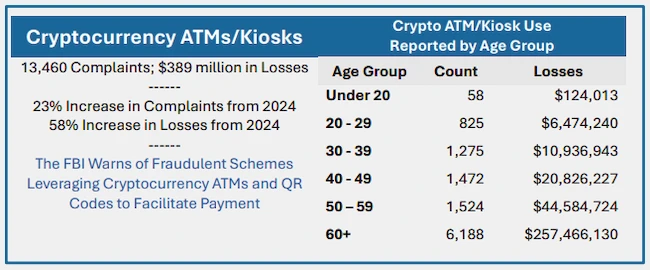
US crypto ATM scams

Cryptocurrency fraud trends (Source: FBI)

The IC3 received a total of 1,008,597 complaints in 2025, and the FBI says that cyber-enabled fraud complaints resulted in losses exceeding $17.7 billion.

Crypto ATMs bans

Over the years, regulations for Bitcoin ATM operators have become stricter, introducing new compliance requirements and transaction limits.

More recently, the machines have been banned in Indiana, Tennessee, and Minnesota.

Bitcoin Depot, one of the largest US crypto ATM operators, announced on Monday that it has filed for Chapter 11 bankruptcy protection “to effect an orderly wind-down of the Company’s operations and facilitate a sale of its assets.”

They cited the aforementioned regulatory limitations and state-wide bans for making the company’s business model unsustainable.

Advice for users

The FBI advises users not to send money to individuals they only know through online interactions, or follow instructions from unknown parties to scan QR codes or transfer funds through cryptocurrency kiosks.

Requests for cryptocurrency payments from individuals claiming to represent companies, government agencies, law enforcement, legal offices, or utility providers should be verified directly with the organization through official contact channels.

“No legitimate law enforcement or government official will call to demand payment via a cryptocurrency kiosk,” the FBI warned.

People using cryptocurrency kiosks should pay attention to fraud warnings displayed by the kiosk or warning from kiosk operators, and stop or cancel a transaction if they see/receive it.