
惯性聚合 高效追踪和阅读你感兴趣的博客、新闻、科技资讯
阅读原文 在惯性聚合中打开

推荐订阅源

V
Visual Studio Blog
Engineering at Meta
Engineering at Meta
月光博客
月光博客
钛媒体:引领未来商业与生活新知
钛媒体:引领未来商业与生活新知
T
Tailwind CSS Blog
博客园 - Franky
The GitHub Blog
The GitHub Blog
大猫的无限游戏
大猫的无限游戏
The Cloudflare Blog
B
Blog RSS Feed
云风的 BLOG
云风的 BLOG
小众软件
小众软件
罗磊的独立博客
Microsoft Azure Blog
I
InfoQ
美团技术团队
H
Hackread – Cybersecurity News, Data Breaches, AI and More
OSCHINA 社区最新新闻
OSCHINA 社区最新新闻
V
V2EX
C
Check Point Blog
WordPress大学
WordPress大学
博客园 - 【当耐特】
博客园 - 司徒正美
D
Docker

Help Net Security

Police arrest 10 suspected members of Black Axe cybercrime gang ShinyHunters claims it stole 1.4 million records from Udemy Sevii unveils Cyber Swarm Defense Mode to stop AI-driven attacks at scale Alleged Chinese hacker extradited to US over cyberattacks targeting COVID-19 research Cequence Agent Personas bring granular control and governance to enterprise AI agents NowSecure MARI gives enterprises evidence-based visibility into third-party mobile app risk The metrics killing your SOC, and what to use instead US state privacy fines reached $3.425 billion in 2025 Canada’s first SMS blaster case leads to three arrests Linux storage management tool Stratis 3.9.0 adds online encryption and cache-less pool startup TLS Connect gives SMBs a right-sized automated tool to manage TLS certificates Aptori expands its platform with autonomous offensive testing to reduce security bottlenecks Your IAM was built for humans, AI agents don’t care The AI criminal mastermind is already hiring on gig platforms 25 open-source cybersecurity tools that don’t care about your budget Product showcase: LuLu reveals unauthorized outbound connections from Mac apps Week in review: Claude Mythos finds 271 Firefox flaws, Vercel breach Users advised to drop passwords and make room for passkeys - Help Net Security Indirect prompt injection is taking hold in the wild - Help Net Security Compromised everyday devices power Chinese cyber espionage operations - Help Net Security New Cisco firewall malware can only be killed by pulling the plug - Help Net Security Meta is overhauling how you sign in, manage settings, and protect your accounts - Help Net Security Ubuntu 26.04 LTS delivers memory-safe system tools and live patching for Arm servers - Help Net Security OpenAI’s GPT-5.5 is out with expanded cybersecurity safeguards - Help Net Security AI is speeding up nation-state cyber programs - Help Net Security A study of 1,000 Android apps finds a privacy policy logging gap - Help Net Security IT spending to hit $6.31 trillion record, thanks to AI - Help Net Security Where AI in CI/CD is working for engineering teams - Help Net Security With AI's help, North Korean hackers stumbled into a near-undetectable attack - Help Net Security Hacker with a special interest in breaching sports institutions ends behind bars - Help Net Security
Google sets timeline for Android developer verification e...
Anamarija Pogorelec · 2026-06-19 · via Help Net Security

Android’s developer verification protections will take effect on September 30, 2026, starting with users in Brazil, Indonesia, Singapore, and Thailand. Developers distributing apps through participating stores in those markets must complete the verification process by the deadline. Google Play, HONOR App Market, OPPO App Market, Galaxy Store, Palm Store, V-Appstore, and GetApps will begin verifying app installations, with expansion to certified Android devices globally planned for 2027.
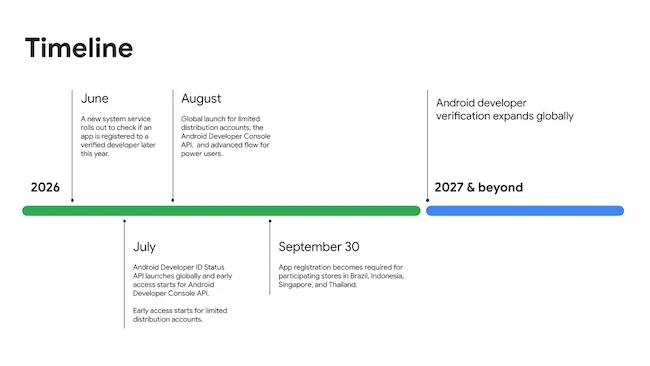
Android developer verification rollout

Google introduced Android developer verification last year and launched app registration in March, linking apps to verified identities. The initiative makes it harder for malicious actors to distribute harmful apps anonymously.

New APIs streamline app registration

Google is launching a suite of developer-requested APIs to help developers register apps in bulk or directly through CI/CD pipelines.

“The Android Developer ID Status API will let you check if a package name has already been registered, and the Android Developer Console API will let you register and manage package names directly within your development environment,” Matthew Forsythe, Director of Product Management, Android App Safety, said.

Both APIs support OAuth delegation, allowing third-party platforms, such as Android app stores, to perform these operations on behalf of developers. Google plans to roll out the APIs over the coming months.

What’s next

Starting this month, Google is rolling out a new system service that will be automatically installed on most Android devices. It will be used later this year to verify developer registration.

The Android Developer ID Status API will launch globally in July 2026, while early access for the Android Developer Console API will begin the same month. Google will open early access to limited distribution accounts in Android Developer Console. This new type of Android developer account is designed for students, hobbyists, and learners, allowing them to share apps with up to 20 devices without a government-issued ID or a fee.

Limited distribution accounts and the Android Developer Console API will launch globally in August 2026. Google will introduce an advanced flow for installing apps from unverified developers. It includes security checkpoints designed to resist coercion scams while allowing power users to continue sideloading apps from unverified developers.

Under the new requirements, only apps registered by verified developers can be installed and updated on certified Android devices from September 30, 2026. Unregistered apps can still be sideloaded through Android Debug Bridge (adb) or the advanced flow.

Google said most Play developers have already completed verification, and more than 99% of apps have been registered. They can check their verification status in Play Console and register any apps that were not automatically registered.