


AI coding agents such as Claude Code, Codex CLI, Cursor, and Claude Cowork run on developer laptops, CI jobs, cloud environments, where they edit files, run commands, and call outside tools. Beacon, an open-source project from Asymptote Labs, configures telemetry for those runtimes and writes a normalized record of what each agent does across local, CI, and cloud-agent surfaces.
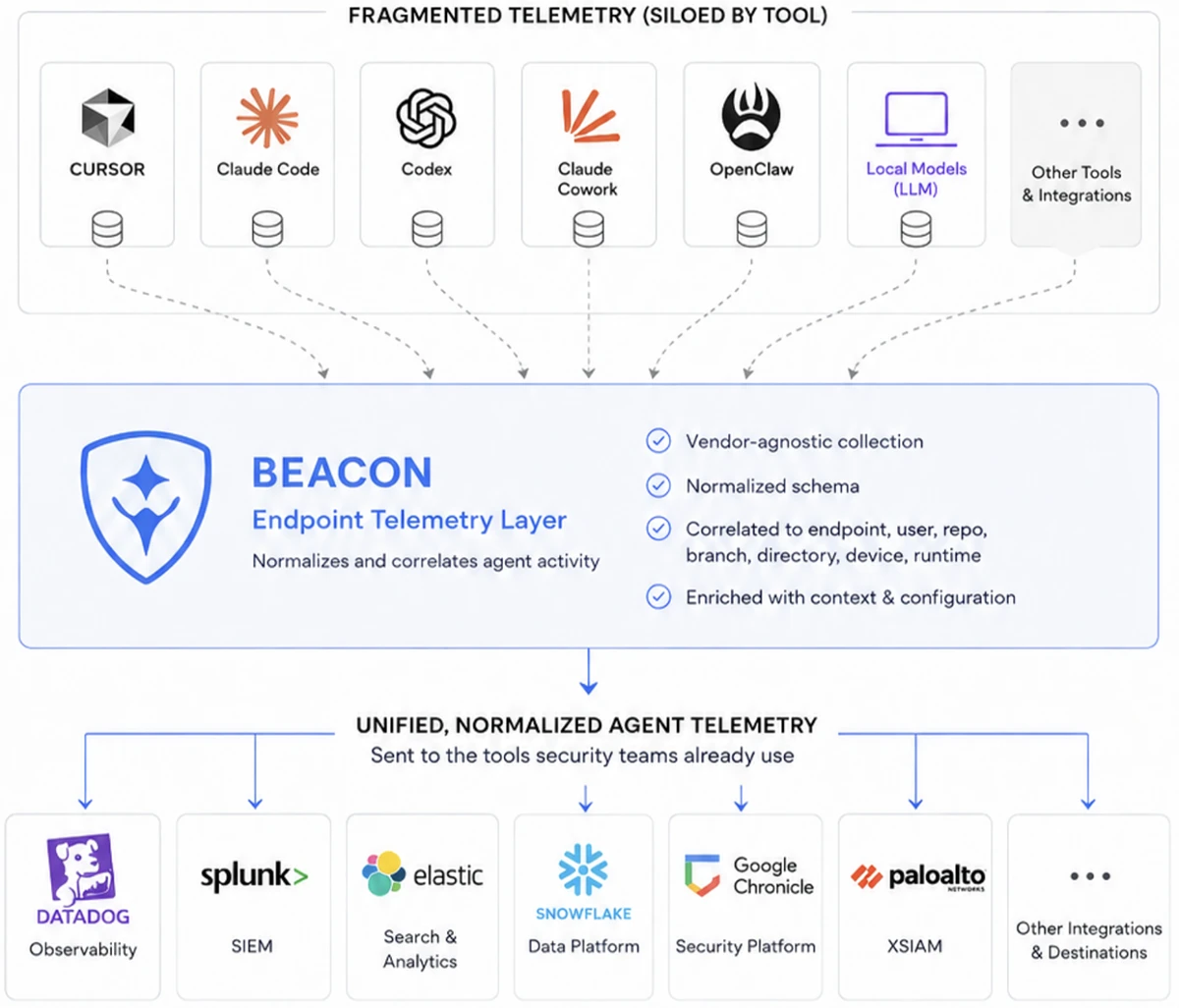
Beacon discovers supported local runtimes on a host and configures data collection for them, while also supporting additional CI and cloud-agent telemetry paths. It configures supported runtimes such as Claude Code and Codex CLI to export OpenTelemetry data to a collector running on localhost. For Cursor, it installs hooks that emit local endpoint events covering sessions, prompt submission, tool use, command execution, MCP-like tool activity, approval decisions, and file edits where Cursor exposes those payloads. A bundled collector converts the OpenTelemetry logs and hook events into a normalized JSON event log, and a local dashboard reads that log for inspection. Teams can also forward the data into supported customer-managed SIEMs.
The software runs locally and works without an Asymptote account. It records full telemetry by default, with configurable retention modes for leaving out prompt text, raw attributes, command output, and raw diffs. Two added retention modes exist: a redacted mode that includes configured content fields after local redaction and size limits, and a third mode that keeps configured content fields in local or customer-controlled logs, subject to event size limits. The dashboard binds to loopback and reads the runtime log.
Written mostly in Go and released under the MIT license, Beacon installs on macOS through a Homebrew tap. Claude Cowork support requires OpenTelemetry export configured by a Team or Enterprise admin in the Claude admin console, with an OTLP endpoint reachable over the public internet.
Asymptote Labs calls Beacon the world’s first open-source telemetry layer for AI agents wherever they run (locally, in CI, or in the cloud), and its aim reaches past observation.
CEO Justin D’Souza wants agent activity to become observable, understandable, and eventually governable across an enterprise, with the visibility layer coming first. “The precondition for governance is a visibility layer built on a normalized schema of agent activity across local + CI + cloud agent harnesses,” D’Souza told Help Net Security. “We believe we are the first to do this in a comprehensive way, significantly extending OpenTelemetry genAI standards.”
D’Souza laid out the work ahead: “In practice, the governance layer builds on our open source foundation. It requires 3 key ingredients: 1) a detection rule standard to codify suspicious agent activity, 2) a policy layer for enforcing controls and gating agent actions in real time and 3) infrastructure scaffolding designed around a streaming-first architecture, so agent actions can be ingested and evaluated in near real time across enterprise environments.” He said a detection rule standard remains an open problem, which he ties to the industry’s lack of a normalized schema for agent activity. “This is what we’re pushing for, and what we think will differentiate our approach,” D’Souza said.
D’Souza sees a gap in what endpoint detection and response tools collect. “Existing EDR tools miss understanding agent behaviour, e.g. what the agent is trying to do, what tools it invokes, what context it uses, and how those actions map to a broader task a user is trying to accomplish,” he said.
He named CrowdStrike’s EDR and AIDR products as an example. “We’re currently working with early design partners who already use CrowdStrike EDR and Falcon in their security stack,” D’Souza said. “They’re using Agent Beacon as this missing agent visibility layer. That early signal gave us conviction to keep going in this direction.”
Recording prompt text and agent commands raises questions about developer privacy. D’Souza said security teams need visibility into agent activity “to do their job and protect the enterprise from catastrophic loss,” and that “developers need to trust that this visibility is being used responsibly.”
He plans to give organizations control over how telemetry gets collected and used, including “redaction and policy-based controls for sensitive data fields like prompts” and limits on which user groups can reach that data. His goal for Beacon, D’Souza said, is “for developers and enterprises to feel safer about adopting AI.”
The current public build supports agent runtimes across local endpoint, CI, and cloud-agent telemetry paths. It omits kernel and process monitoring, shell history collection, broad browser and SaaS telemetry, and general-purpose credential-use attribution.
Agent Beacon is available for free on GitHub.

Must read:

Subscribe to the Help Net Security ad-free monthly newsletter to stay informed on the essential open-source cybersecurity tools. Subscribe here!
此内容由惯性聚合(RSS阅读器)自动聚合整理,仅供阅读参考。 原文来自 — 版权归原作者所有。