



惯性聚合 高效追踪和阅读你感兴趣的博客、新闻、科技资讯
阅读原文 在惯性聚合中打开

推荐订阅源

J
Java Code Geeks
小众软件
小众软件
博客园 - 叶小钗
宝玉的分享
宝玉的分享
博客园_首页
Hugging Face - Blog
Hugging Face - Blog
人人都是产品经理
人人都是产品经理
钛媒体:引领未来商业与生活新知
钛媒体:引领未来商业与生活新知
S
SegmentFault 最新的问题
B
Blog RSS Feed
Engineering at Meta
Engineering at Meta
N
Netflix TechBlog - Medium
Google DeepMind News
U
Unit 42
F
Fortinet All Blogs
IT之家
IT之家
Y
Y Combinator Blog
Martin Fowler
Martin Fowler
T
The Blog of Author Tim Ferriss
奇客Solidot–传递最新科技情报
奇客Solidot–传递最新科技情报
The GitHub Blog
The GitHub Blog
Stack Overflow Blog
Stack Overflow Blog
Blog — PlanetScale
Blog — PlanetScale
酷 壳 – CoolShell
酷 壳 – CoolShell

Help Net Security

FIDO Alliance wants to keep AI agents from going rogue on online payments Police arrest 10 suspected members of Black Axe cybercrime gang ShinyHunters claims it stole 1.4 million records from Udemy Sevii unveils Cyber Swarm Defense Mode to stop AI-driven attacks at scale Alleged Chinese hacker extradited to US over cyberattacks targeting COVID-19 research Cequence Agent Personas bring granular control and governance to enterprise AI agents NowSecure MARI gives enterprises evidence-based visibility into third-party mobile app risk The metrics killing your SOC, and what to use instead US state privacy fines reached $3.425 billion in 2025 Canada’s first SMS blaster case leads to three arrests Linux storage management tool Stratis 3.9.0 adds online encryption and cache-less pool startup TLS Connect gives SMBs a right-sized automated tool to manage TLS certificates Aptori expands its platform with autonomous offensive testing to reduce security bottlenecks Your IAM was built for humans, AI agents don’t care The AI criminal mastermind is already hiring on gig platforms 25 open-source cybersecurity tools that don’t care about your budget Product showcase: LuLu reveals unauthorized outbound connections from Mac apps Week in review: Claude Mythos finds 271 Firefox flaws, Vercel breach Users advised to drop passwords and make room for passkeys - Help Net Security Indirect prompt injection is taking hold in the wild - Help Net Security Compromised everyday devices power Chinese cyber espionage operations - Help Net Security New Cisco firewall malware can only be killed by pulling the plug - Help Net Security Meta is overhauling how you sign in, manage settings, and protect your accounts - Help Net Security Ubuntu 26.04 LTS delivers memory-safe system tools and live patching for Arm servers - Help Net Security OpenAI’s GPT-5.5 is out with expanded cybersecurity safeguards - Help Net Security AI is speeding up nation-state cyber programs - Help Net Security A study of 1,000 Android apps finds a privacy policy logging gap - Help Net Security IT spending to hit $6.31 trillion record, thanks to AI - Help Net Security Where AI in CI/CD is working for engineering teams - Help Net Security With AI's help, North Korean hackers stumbled into a near-undetectable attack - Help Net Security
Google brings instant email verification to Android, no O...
Anamarija Po · 2026-04-23 · via Help Net Security

Google has introduced cryptographically verified email credentials for Android through the Credential Manager API. This API aligns with the W3C Digital Credential API standard. It provides a unified way for apps to request and retrieve user credentials for authentication and authorization.

“By integrating the new verified email via the Credential Manager API, you can reduce onboarding friction and provide a more streamlined and secure authentication flow. This reflects a shift toward a future where verification becomes a seamless part of the native mobile experience,” Niharika Arora, Senior Developer Relations Engineer, and Jean-Pierre Pralle, Product Manager for Credential Manager at Google, explained.

The feature is limited to personal Google Accounts and excludes Workspace and supervised accounts. It is supported on Android 9 (API level 28) and above, including phones, tablets, and foldables, and requires Google Play services version 25.49.x or later.

Users do not need to verify their email through external channels such as one-time passwords or email links. Developers receive verified email claims directly, which can be used for account creation, account recovery, or step-up authentication flows.

The verified email credential is sourced from the user’s Google Account on the device. The underlying Digital Credentials API is issuer-agnostic and allows different providers to issue credentials with their own policies that apps can request and verify.

How it works

When a credential is returned through the Credential Manager API and includes a verified claim, the issuer indicates that it has verified that data. The app must decide whether it trusts the issuer.
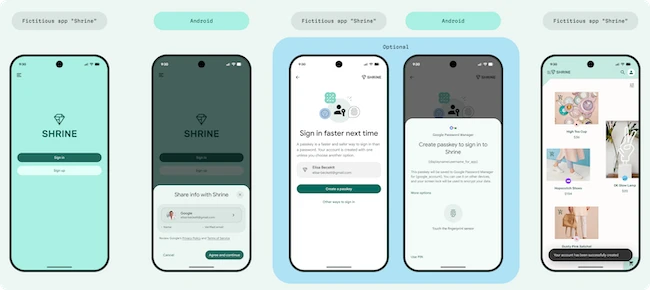
Android verified email credentials

Email verification during sign up (Source: Google)

When a user focuses on an email input field or taps a “Sign up” or “Recover account” button that triggers the Credential Manager API, a native Android bottom sheet appears showing the requested data, such as a verified email address. The user reviews the request and taps “Agree and continue” to share the data. After consent, the app receives the information immediately.

Google recommends prompting users to create a passkey during sign-up to simplify future sign-ins.

Key considerations

Only the email address is verified by Google. Apps may request additional profile information such as name or profile picture, but these fields are not verified.

The company recommends automatically verifying @gmail.com users and routing users with custom domains through existing verification flows to maintain access for domains not managed by Google.

The verified email credential feature complements Sign in with Google. Developers should use Sign in with Google when creating a federated login session. Verified Email is suited for flows where users authenticate with a username and password or passkey and require email verification.