

惯性聚合 高效追踪和阅读你感兴趣的博客、新闻、科技资讯
阅读原文 在惯性聚合中打开

推荐订阅源

Google DeepMind News
C
Check Point Blog
J
Java Code Geeks
腾讯CDC
Martin Fowler
Martin Fowler
MongoDB | Blog
MongoDB | Blog
H
Hackread – Cybersecurity News, Data Breaches, AI and More
博客园 - 三生石上(FineUI控件)
Apple Machine Learning Research
大猫的无限游戏
大猫的无限游戏
Engineering at Meta
Engineering at Meta
罗磊的独立博客
Last Week in AI
Last Week in AI
B
Blog
IT之家
IT之家
S
SegmentFault 最新的问题
D
DataBreaches.Net
Cyber Security Advisories - MS-ISAC
GbyAI
GbyAI
博客园 - 聂微东
U
Unit 42
有赞技术团队
有赞技术团队
Y
Y Combinator Blog
MyScale Blog
MyScale Blog

Help Net Security

FIDO Alliance wants to keep AI agents from going rogue on online payments Police arrest 10 suspected members of Black Axe cybercrime gang ShinyHunters claims it stole 1.4 million records from Udemy Sevii unveils Cyber Swarm Defense Mode to stop AI-driven attacks at scale Alleged Chinese hacker extradited to US over cyberattacks targeting COVID-19 research Cequence Agent Personas bring granular control and governance to enterprise AI agents NowSecure MARI gives enterprises evidence-based visibility into third-party mobile app risk The metrics killing your SOC, and what to use instead US state privacy fines reached $3.425 billion in 2025 Canada’s first SMS blaster case leads to three arrests Linux storage management tool Stratis 3.9.0 adds online encryption and cache-less pool startup TLS Connect gives SMBs a right-sized automated tool to manage TLS certificates Aptori expands its platform with autonomous offensive testing to reduce security bottlenecks Your IAM was built for humans, AI agents don’t care The AI criminal mastermind is already hiring on gig platforms 25 open-source cybersecurity tools that don’t care about your budget Product showcase: LuLu reveals unauthorized outbound connections from Mac apps Week in review: Claude Mythos finds 271 Firefox flaws, Vercel breach Users advised to drop passwords and make room for passkeys - Help Net Security Indirect prompt injection is taking hold in the wild - Help Net Security Compromised everyday devices power Chinese cyber espionage operations - Help Net Security New Cisco firewall malware can only be killed by pulling the plug - Help Net Security Meta is overhauling how you sign in, manage settings, and protect your accounts - Help Net Security Ubuntu 26.04 LTS delivers memory-safe system tools and live patching for Arm servers - Help Net Security OpenAI’s GPT-5.5 is out with expanded cybersecurity safeguards - Help Net Security AI is speeding up nation-state cyber programs - Help Net Security A study of 1,000 Android apps finds a privacy policy logging gap - Help Net Security IT spending to hit $6.31 trillion record, thanks to AI - Help Net Security Where AI in CI/CD is working for engineering teams - Help Net Security With AI's help, North Korean hackers stumbled into a near-undetectable attack - Help Net Security
Tencent's QClaw AI agent app arrives on Windows and macOS...
Sinisa Marko · 2026-04-22 · via Help Net Security

Tencent has opened an international beta of QClaw, an AI agent application aimed at consumers in Canada, Japan, Singapore, South Korea, and the United States. The first wave is capped at 20,000 users. Additional markets are scheduled to follow.
Tencent QClaw AI agent

QClaw runs on Windows and MacOS. Setup takes about three minutes and involves downloading the application, registering an account, and scanning a QR code. The software is built on OpenClaw, the open-source personal AI assistant project.

QClaw ships with pre-integrated access to several leading international large language models, and users can add other models by supplying API keys. The application connects to messaging services including WhatsApp and Telegram, letting users send prompts and commands from a smartphone that sync to the desktop client for execution. These integration patterns match the core design of the upstream OpenClaw project, which supports WhatsApp, Telegram, Discord, Slack, Signal, and iMessage.

Tencent has packaged QClaw around three pre-configured agent sets. It handles repetitive tasks such as trip planning, tax filing, and ticket purchases. QClaw Daily builds and prompts routines across fitness, beauty, sleep, and health. QClaw Up targets work tasks including marketing, social media engagement, and job applications.

“The key appeal of OpenClaw lies in its ability to develop AI agents that understands user needs better over time through continuous interaction,” Tencent explained.

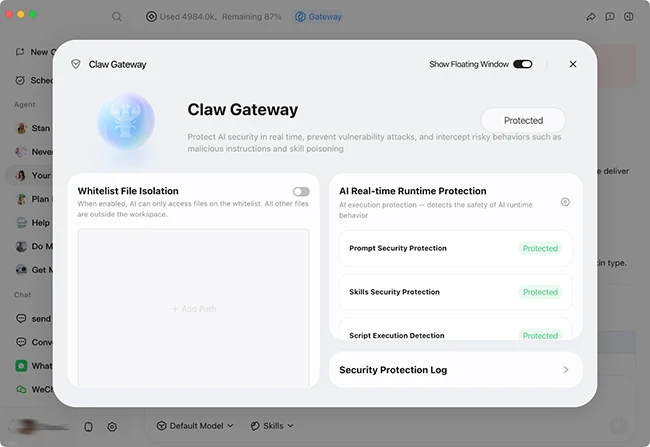
QClaw runs on the user’s device, and Tencent says all data is processed within the user environment. A security component called Claw Gateway provides end-to-end protection for agent operations, with real-time detection of malicious instructions and skill poisoning risks.

QClaw first launched as a public beta in Mainland China. Tencent reports more than 80 feature iterations in the first month of that release.