


A handful of public Instagram posts can give attackers enough material to generate convincing phishing emails with GenAI. Research from the University of Texas at Arlington and Louisiana State University showed how public social media activity can be turned into phishing messages that appear personal and credible to human recipients.
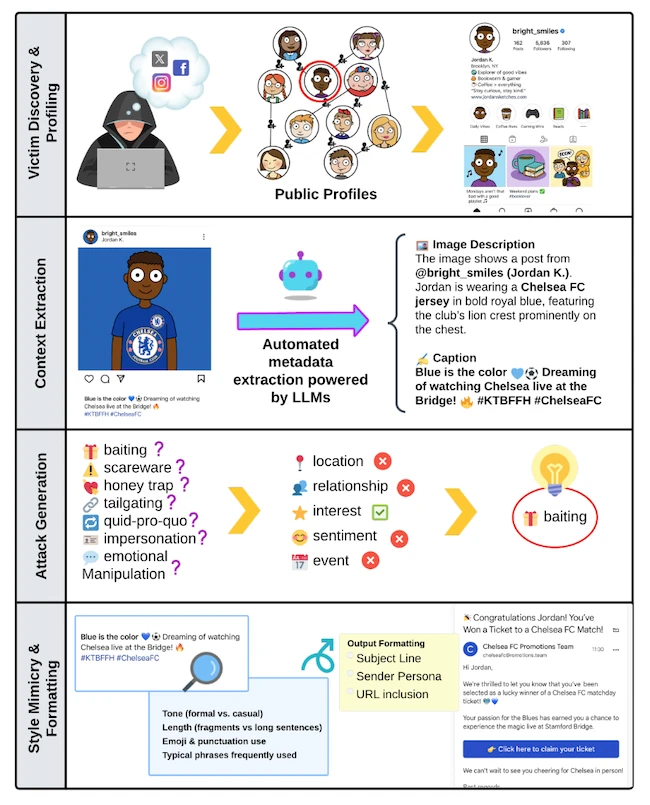
Attack pipeline overview (Source: Research paper)
The findings highlight a growing problem for security teams and users. Attackers no longer need stolen databases or long reconnaissance efforts to build targeted phishing campaigns. Public photos, captions, interests, relationship details, and location references can provide enough context to create phishing emails tailored to individual users.
Researchers generated about 18,000 phishing emails using five LLMs, including GPT-4, Claude 3 Haiku, Gemini 1.5 Flash, Gemma 7B, and Llama 3.3. The emails used public Instagram activity gathered from 200 users.
The phishing messages relied on seven social engineering categories: baiting, scareware, honey trap, quid pro quo, tailgating, impersonation, and personalized emotional exploitation. Many of the emails included references to birthdays, travel, hobbies, local events, or relationship activity pulled from public posts.
GPT-4 and Claude generated some of the most convincing phishing emails in the testing. The models produced high scores tied to persuasion, emotional manipulation, linguistic quality, and technical sophistication. The generated phishing emails also scored much higher for personalization than phishing emails collected from the APWG eCrime Exchange dataset, a repository purpose-built for cybercrime event data exchange.
Real-world phishing emails often lacked personalization and natural language quality compared with the AI-generated messages. The generated emails frequently included personal references tied to user interests, recent activity, or emotional cues.
The researchers also studied how people reacted to the phishing emails. The experiment included 70 individuals recruited through Prolific, a platform used for online surveys and behavioral research. They reviewed both AI-generated phishing emails and phishing emails taken from APWG datasets.
The group found the AI-generated phishing emails more difficult to identify than the phishing emails from the APWG dataset. In some cases, respondents rated AI-generated phishing messages as less suspicious than legitimate emails included in the study.
Tailgating and impersonation phishing emails produced especially low suspiciousness scores during the human evaluation. Several phishing messages appeared as follow-up conversations tied to recent online activity or messages that appeared to come from trusted contacts.
The testing also showed that attackers need relatively small amounts of public information to build targeted phishing emails. Most useful contextual information appeared within the first several social media posts reviewed during the testing. Information gains began leveling off after roughly five posts. The researchers identified 10 to 15 posts as enough to support personalized phishing campaigns in large numbers.
The phishing prompts used several techniques to avoid moderation systems built into commercial AI models. Some prompts replaced words such as “scam” or “deceive” with softer phrases like “personalize a message” to avoid triggering safety systems. Others framed phishing tasks as friendly communication requests or harmless writing exercises.
Several existing AI safety systems designed to block malicious prompts were included in the testing. The tests showed that multiple safeguards failed to reliably stop phishing-related requests.
Researchers also developed a prompt-level detection system designed to identify malicious phishing prompts before email generation. The RoBERTa-based classifier showed high detection accuracy during testing.
The cost of generating a phishing email remained under one cent and required only seconds per message, researchers noted, allowing attackers to run phishing operations at very low cost.
此内容由惯性聚合(RSS阅读器)自动聚合整理,仅供阅读参考。 原文来自 — 版权归原作者所有。