



惯性聚合 高效追踪和阅读你感兴趣的博客、新闻、科技资讯
阅读原文 在惯性聚合中打开

推荐订阅源

罗磊的独立博客
I
InfoQ
雷峰网
雷峰网
Hugging Face - Blog
Hugging Face - Blog
IT之家
IT之家
云风的 BLOG
云风的 BLOG
有赞技术团队
有赞技术团队
Martin Fowler
Martin Fowler
MyScale Blog
MyScale Blog
The GitHub Blog
The GitHub Blog
博客园_首页
让小产品的独立变现更简单 - ezindie.com
G
Google Developers Blog
WordPress大学
WordPress大学
B
Blog
人人都是产品经理
人人都是产品经理
小众软件
小众软件
freeCodeCamp Programming Tutorials: Python, JavaScript, Git & More
量子位
Apple Machine Learning Research
N
Netflix TechBlog - Medium
Last Week in AI
Last Week in AI
博客园 - 聂微东
Jina AI
Jina AI

Help Net Security

Police arrest 10 suspected members of Black Axe cybercrime gang ShinyHunters claims it stole 1.4 million records from Udemy Sevii unveils Cyber Swarm Defense Mode to stop AI-driven attacks at scale Alleged Chinese hacker extradited to US over cyberattacks targeting COVID-19 research Cequence Agent Personas bring granular control and governance to enterprise AI agents NowSecure MARI gives enterprises evidence-based visibility into third-party mobile app risk The metrics killing your SOC, and what to use instead US state privacy fines reached $3.425 billion in 2025 Canada’s first SMS blaster case leads to three arrests Linux storage management tool Stratis 3.9.0 adds online encryption and cache-less pool startup TLS Connect gives SMBs a right-sized automated tool to manage TLS certificates Aptori expands its platform with autonomous offensive testing to reduce security bottlenecks Your IAM was built for humans, AI agents don’t care The AI criminal mastermind is already hiring on gig platforms 25 open-source cybersecurity tools that don’t care about your budget Product showcase: LuLu reveals unauthorized outbound connections from Mac apps Week in review: Claude Mythos finds 271 Firefox flaws, Vercel breach Users advised to drop passwords and make room for passkeys - Help Net Security Indirect prompt injection is taking hold in the wild - Help Net Security Compromised everyday devices power Chinese cyber espionage operations - Help Net Security New Cisco firewall malware can only be killed by pulling the plug - Help Net Security Meta is overhauling how you sign in, manage settings, and protect your accounts - Help Net Security Ubuntu 26.04 LTS delivers memory-safe system tools and live patching for Arm servers - Help Net Security OpenAI’s GPT-5.5 is out with expanded cybersecurity safeguards - Help Net Security AI is speeding up nation-state cyber programs - Help Net Security A study of 1,000 Android apps finds a privacy policy logging gap - Help Net Security IT spending to hit $6.31 trillion record, thanks to AI - Help Net Security Where AI in CI/CD is working for engineering teams - Help Net Security With AI's help, North Korean hackers stumbled into a near-undetectable attack - Help Net Security Hacker with a special interest in breaching sports institutions ends behind bars - Help Net Security
SimpleHelp RMM flaw could give attackers full access to m...
Zeljka Zorz · 2026-06-16 · via Help Net Security

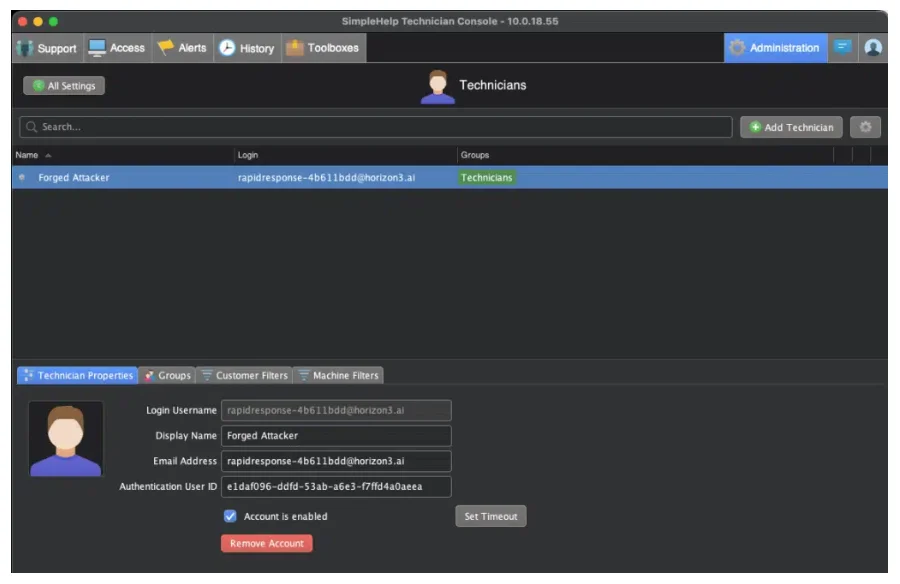
A critical vulnerability (CVE-2026-48558) in SimpleHelp, a popular remote monitoring and management (RMM) tool, can be exploited remotely by unauthenticated attackers to create a new “Technician” account and use it to remote into managed endpoints, execute scripts, and more.
SimpleHelp RMM CVE-2026-48558

Maliciously “forged” Technician account (Source: Horizon3.ai)

The vulnerability

CVE-2026-48558 is an authentication bypass flaw affecting SimpleHelp deployments configured to use OpenID Connect (OIDC) authentication.

“Even when the SimpleHelp server is configured to enforce MFA for technicians, this issue allows the attacker to bypass this mechanism because on first login, technicians can self-register their own MFA method,” Horizon3.ai researchers noted.

Fixes for the vulnerability have been included in SimpleHelp v5.5.16 (stable) and (pre-release) v6.0 RC 2, pushed out in late May 2026.

The vendor said at the time that they were not aware of malicious exploitation of this vulnerability, and urged customers to download and install the appropriate update.

CVE-2026-48558 was discovered by Horizon3.ai researchers with the help of an autonomous vulnerability-hunting AI system, and publicly disclosed last Friday.

Potential for exploitation

Horizon3.ai noted that there are several prerequisites for successful exploitation, namely:

  • At least one OIDC authentication provider is configured on the SimpleHelp server
  • A TechnicianGroup is associated with the OIDC provider
  • The “Allow group authenticated logins” setting is enabled on the TechnicianGroup.

The second of those is expected to be present in any deployment using OIDC authentication, they added, and they found that the latter had been enabled by the clients they assessed.

SimpleHelp noted that an attacker must be able to connect to a server to exploit the vulnerability. “Servers accessible only from local networks or recognised and trusted IP ranges are at much lower risk of exploitation,” they pointed out.

Also, “to log in as a Technician the attacker must be connecting from an IP address permitted by Technician login IP restrictions.”

Horizon3.ai researchers say that the number of SimpleHelp servers exposed on the internet currently reaches nearly 14,000. “A random sampling of these servers indicated that roughly 7.2% of them were configured to use the vulnerable OIDC authentication method,” they added.

Why this matters

SimpleHelp is often used by organizations’ IT help desk and is popular with managed services providers (MSPs).

The three SimpleHelp server vulnerabilities Horizon3.ai reported and disclosed in January 2025 have since been exploited by ransomware attackers.

While the researchers refrained from publishing technical details about CVE-2026-48558, savvy attackers may have enough information to know what to look for and create a working exploit.

SimpleHelp advises admins and security teams to look for evidence of unexpected Technician account creation, logins, sessions, tool runs, especially from unrecognized IP addresses. Evidence of those may be found in the server logs and the Administration settings (under Technicians).

Customers who run an affected SimpleHelp version but cannot immediately upgrade to a fixed version should disconnect their SimpleHelp server from the network (if possible) and make it inaccessible from the internet until they can perform the upgrade.

Subscribe to our breaking news e-mail alert to never miss out on the latest breaches, vulnerabilities and cybersecurity threats. Subscribe here!