




惯性聚合 高效追踪和阅读你感兴趣的博客、新闻、科技资讯
阅读原文 在惯性聚合中打开

推荐订阅源

F
Full Disclosure
Recorded Future
Recorded Future
T
Tenable Blog
S
Securelist
C
CERT Recently Published Vulnerability Notes
T
Threatpost
S
Schneier on Security
A
Arctic Wolf
The Hacker News
The Hacker News
C
CXSECURITY Database RSS Feed - CXSecurity.com
Know Your Adversary
Know Your Adversary
P
Privacy International News Feed
Threat Intelligence Blog | Flashpoint
The Register - Security
Cisco Talos Blog
Cisco Talos Blog
AWS News Blog
AWS News Blog
K
Kaspersky official blog
T
True Tiger Recordings
T
Threat Research - Cisco Blogs
V
Vulnerabilities – Threatpost
P
Palo Alto Networks Blog
T
The Exploit Database - CXSecurity.com
小众软件
小众软件
B
Blog
Cyber Security Advisories - MS-ISAC
Microsoft Azure Blog
Cyberwarzone
Cyberwarzone
C
Cybersecurity and Infrastructure Security Agency CISA
T
Tor Project blog
Spread Privacy
Spread Privacy
Malwarebytes
Malwarebytes
P
Proofpoint News Feed
F
Fox-IT International blog
F
Fortinet All Blogs
P
Privacy & Cybersecurity Law Blog
G
GRAHAM CLULEY
量子位
Latest news
Latest news
OSCHINA 社区最新新闻
OSCHINA 社区最新新闻
博客园 - 叶小钗
Project Zero
Project Zero
T
Tailwind CSS Blog
N
Netflix TechBlog - Medium
Martin Fowler
Martin Fowler
IntelliJ IDEA : IntelliJ IDEA – the Leading IDE for Professional Development in Java and Kotlin | The JetBrains Blog
I
Intezer
博客园_首页
腾讯CDC
H
Hackread – Cybersecurity News, Data Breaches, AI and More
D
Darknet – Hacking Tools, Hacker News & Cyber Security

Help Net Security

Franklin Access adds three-layer security system to Wi-Fi routers Jetico expands BestCrypt Data Shelter with zero-trust file access controls AppOmni’s Marlin AI automates SaaS threat analysis, triage, and remediation at scale Novee’s Agentic Fix turns validated exploits into fixes through AI coding agents Coinflow CISO on crypto payments security under AI pressure Vigolium: Open-source vulnerability scanner The alert economy is driving security analyst burnout European AI adoption hits 99% with regulated data driving most policy violations Anthropic: Claude Mythos identified 10,000+ software flaws Chinese phishing gangs grow into a force to be reckoned with Detectify brings AppSec automation to AI agents with MCP Server and continuous testing Actively exploited Trend Micro Apex One flaw gets CISA warning (CVE-2026-34926) Conifers rolls out AI-powered SOC for unified security operations and automated response Personal information of 185,000 people exposed after cyberattack on 7-Eleven Tamnoon introduces skill-based AI orchestration for autonomous cloud defense High-severity SharePoint RCE bug patched by Microsoft (CVE-2026-45659) What happens when security teams inherit identity Product showcase: F-Secure Internet Security blocks phishing sites, fake stores, and SMS scams Manage machine identities: The hidden privileged access layer you need to manage Cybersecurity jobs available right now: May 26, 2026 Anthropic adds 28 security and compliance integrations for Claude Cisco refines its risk-based vulnerability disclosure for the AI era Authorities seize 800 servers used for cyberattacks and disinformation US states step up cyber defenses to protect local communities Lessons for organizations from the Verizon 2026 Data Breach Investigations Report OpenHack: Open-source AI-powered vulnerability research Boards want cyber risk in dollars, not CVE counts Turns out the C-suite loves shadow AI Week in review: GitHub breached via poisoned VS Code extension, critical NGINX flaw exploited $20 per zero-day is already the WordPress plugin reality Deleted Google API keys keep working for up to 23 minutes, researchers warn Kore.ai unveils AI-native platform for enterprise multiagent systems Suspected KimWolf botnet admin arrested over DDoS-for-hire operation Versa extends zero trust principles to AI agents and MCP workflows GitLab 19.0 adds AI workflows, secrets management, and self-hosted model support Proton Pass adds monitored credential sharing for AI agents Keepnet contributes voice and SMS phishing data to the 2026 Verizon DBIR CISA’s new KEV nomination form opens reporting to vendors and researchers Microsoft 365 users targeted by new phishing threat that bypasses MFA Meet Fractal, an OS made for microarchitecture reverse engineering Downtime has become a $600 billion business problem The new economics of fraud: Cheaper, faster, more convincing New infosec products of the week: May 22, 2026 Microsoft open-sources tools for designing and testing AI agents Authorities dismantle First VPN, used by ransomware actors GitHub, Grafana Labs breaches traced back to TanStack supply chain compromise Microsoft Defender vulnerabilities exploited in the wild (CVE-2026-41091, CVE-2026-45498) Virtru centers file collaboration around data-level protection ASAPP expands adversarial testing for enterprise AI systems Tenable Hexa AI automates remediation across attack surfaces Riverbed introduces new Aternity tools for autonomous IT operations Forward launches Predict to test network changes before deployment CTERA brings AI insights and automation for unstructured data Terra adds continuous network exploitation validation to its platform Why AI changed the threat model for travel technology Most dark web activity revolves around a handful of topics AI red teaming agents change how LLMs get tested Product showcase: Bitdefender Mobile Security for iOS protects privacy where scams begin Cyber threats push SMBs to spend more on security Webworm APT targets European government organizations with new backdoors Verizon DBIR: Vulnerability exploitation is the dominant initial access vector NanoCo lands $12 million seed funding, launches enterprise assistant built on NanoClaw FBI: $388 million lost in crypto ATM scams in 2026 ArmorCode gives security teams AI workers for exposure and remediation Novata uses AI to map risk across portfolios and supply chains TeamPCP breached GitHub’s internal codebase via poisoned VS Code extension Trust3 AI focuses on AI agent risks with MCP Security layer Encryption Consulting launches CertSecure Manager v3.3 with zero-touch certificate renewals Darwinium updates mobile SDKs to detect remote access scam activity Microsoft provides mitigation for “YellowKey” BitLocker bypass flaw (CVE-2026-45585) Communicating cyber risk in dollars boards understand CVE Lite CLI: Open-source dependency vulnerability scanner When your AI assistant has the keys to production 7 hard truths security pros should know: 2026 DevOps Threats Report What happens when your identity provider becomes the kill chain PureLogs infostealer is stealing credentials worldwide Selector extends AI-driven observability into multi-cloud environments LaunchDarkly adds real-time controls for AI agents in production Canonical ships Ubuntu Core 26 with 15 years of security maintenance New macOS infostealer impersonates Apple, Microsoft, and Google in a single attack chain The end of unencrypted Discord calls is here Babel Street targets AI-driven threats with new agentic investigation capabilities iProov brings identity verification to video meetings to reduce fraud risks Egnyte unveils Email Capture and AI features to unify fragmented data Public Instagram posts provide raw material for AI phishing campaigns Earbud sensors can authenticate users by their heartbeat, study finds AI infrastructure is cracking under sovereignty demands Cybersecurity jobs available right now: May 19, 2026 AI is drowning software maintainers in junk security reports Game over for 74 suspected scammers after Dutch cops plastered their faces on billboards Attackers are exploiting critical NGINX vulnerability (CVE-2026-42945) SmartBear expands ReadyAPI with AI-powered API testing capabilities Attackers accessed, downloaded code from Grafana Labs’ GitHub 201 arrested in INTERPOL disruption of phishing and fraud networks The AI backdoor your security stack is not built to see Lyrie: Open-source autonomous pentesting agent AI shrinks vulnerability exploitation window to hours Product showcase: McAfee + ChatGPT integration turns doubt into a scam check When ransomware hits, confidence doesn’t restore endpoints Debian 13.5 point release lands with security fixes, bug patches
Apple makes its quantum-resistant encryption open source
Anamarija Po · 2026-05-27 · via Help Net Security

Apple has published its post-quantum cryptography implementations in corecrypto, together with mathematical proofs and verification tools for independent expert evaluation, allowing external researchers to review the work and reproduce the company’s analysis.

Post-quantum cryptography is designed to protect encrypted data from future quantum computers that could break widely used public-key encryption algorithms.
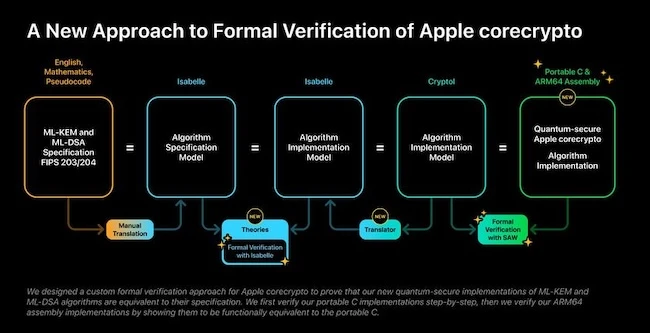
Apple encryption open source

A new approach to formal verification of Apple corecrypto (Source: Apple)

Corecrypto, the cryptography library used throughout Apple operating systems and services, provides encryption, hashing, random number generation, and digital signatures on more than 2.5 billion active devices. The company added post-quantum cryptography support to the library in 2024 for applications that handle encrypted communications and sensitive data, including iMessage, VPNs, and TLS networking.

“A critical bug in corecrypto has the potential to compromise the security and reliability of every app and feature that depends on it, so we are conservative when adding new code to the library and make exceptional efforts to be comprehensive in our testing,” Apple said.

Because the library runs on different Apple devices and chips, Apple writes its cryptographic code in portable C to ensure consistent behavior on all platforms. The company said it applies protections against timing attacks and may randomize some internal computations to make attacks harder.

How the verification system works

Formal verification uses mathematical methods to prove that software behaves as intended under defined conditions.

ML-KEM and ML-DSA, post-quantum algorithms standardized by NIST, were selected for their security, performance, compact key and ciphertext sizes, and functional correctness. The implementations were validated through conventional testing, simulation, independent review, and formal verification.

After evaluating existing verification tools and verified implementations, Apple built a custom system that supports multiple programming languages, codebases, and existing developer workflows.

The framework combines existing and newly developed tools to verify the implementations against official FIPS standards. Galois, a research and engineering company specializing in formal verification, collaborated with Apple to develop a tool that generates Isabelle theories from Cryptol models and connects portable C with Cryptol. Apple also developed Isabelle libraries and hand-optimized ARM64 assembly subroutines.

The Cryptol-to-Isabelle translator allows Cryptol models to be recreated in Isabelle for independent analysis.

The verification process identified issues that conventional testing would likely not have detected. One issue involved a missing step in an early ML-DSA implementation that, in rare cases, could cause inputs to exceed the expected range and produce incorrect output. The flaw was identified and fixed before deployment.

“We believe that the strongest assurance possible comes from combining formal verification with conventional methods and critically evaluating the end-to-end results,” the company added.