

惯性聚合 高效追踪和阅读你感兴趣的博客、新闻、科技资讯
阅读原文 在惯性聚合中打开

推荐订阅源

F
Fortinet All Blogs
Recent Announcements
H
Help Net Security
Y
Y Combinator Blog
酷 壳 – CoolShell
酷 壳 – CoolShell
有赞技术团队
有赞技术团队
小众软件
小众软件
Last Week in AI
Last Week in AI
U
Unit 42
Google DeepMind News
博客园 - 司徒正美
H
Hackread – Cybersecurity News, Data Breaches, AI and More
J
Java Code Geeks
Microsoft Security Blog
G
Google Developers Blog
N
Netflix TechBlog - Medium
Blog — PlanetScale
Blog — PlanetScale
云风的 BLOG
云风的 BLOG
V
V2EX
博客园 - 聂微东
人人都是产品经理
人人都是产品经理
博客园 - 三生石上(FineUI控件)
阮一峰的网络日志
阮一峰的网络日志
爱范儿
爱范儿

Help Net Security

Police arrest 10 suspected members of Black Axe cybercrime gang ShinyHunters claims it stole 1.4 million records from Udemy Sevii unveils Cyber Swarm Defense Mode to stop AI-driven attacks at scale Alleged Chinese hacker extradited to US over cyberattacks targeting COVID-19 research Cequence Agent Personas bring granular control and governance to enterprise AI agents NowSecure MARI gives enterprises evidence-based visibility into third-party mobile app risk The metrics killing your SOC, and what to use instead US state privacy fines reached $3.425 billion in 2025 Canada’s first SMS blaster case leads to three arrests Linux storage management tool Stratis 3.9.0 adds online encryption and cache-less pool startup TLS Connect gives SMBs a right-sized automated tool to manage TLS certificates Aptori expands its platform with autonomous offensive testing to reduce security bottlenecks Your IAM was built for humans, AI agents don’t care The AI criminal mastermind is already hiring on gig platforms 25 open-source cybersecurity tools that don’t care about your budget Product showcase: LuLu reveals unauthorized outbound connections from Mac apps Week in review: Claude Mythos finds 271 Firefox flaws, Vercel breach Users advised to drop passwords and make room for passkeys - Help Net Security Indirect prompt injection is taking hold in the wild - Help Net Security Compromised everyday devices power Chinese cyber espionage operations - Help Net Security New Cisco firewall malware can only be killed by pulling the plug - Help Net Security Meta is overhauling how you sign in, manage settings, and protect your accounts - Help Net Security Ubuntu 26.04 LTS delivers memory-safe system tools and live patching for Arm servers - Help Net Security OpenAI’s GPT-5.5 is out with expanded cybersecurity safeguards - Help Net Security AI is speeding up nation-state cyber programs - Help Net Security A study of 1,000 Android apps finds a privacy policy logging gap - Help Net Security IT spending to hit $6.31 trillion record, thanks to AI - Help Net Security Where AI in CI/CD is working for engineering teams - Help Net Security With AI's help, North Korean hackers stumbled into a near-undetectable attack - Help Net Security Hacker with a special interest in breaching sports institutions ends behind bars - Help Net Security
Product showcase: SimpleX Chat removes user identifiers f...
Anamarija Po · 2026-04-29 · via Help Net Security

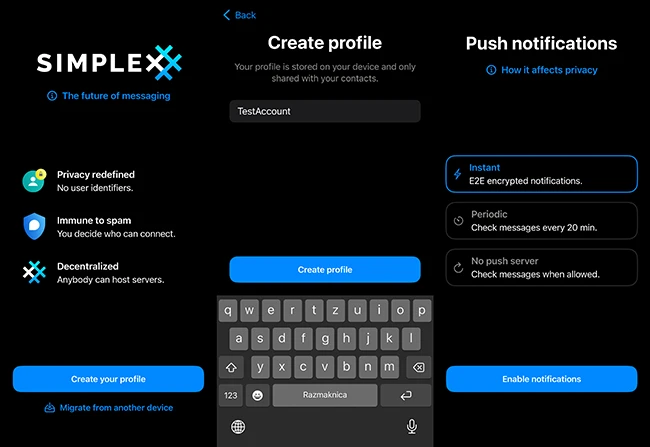
SimpleX Chat is a free, private, open-source messenger that uses encryption and does not require user identifiers. It is available on mobile and desktop platforms, including iOS, Android, Windows, macOS, and Linux. After downloading the app, the user creates a profile by entering a display name. The profile is stored locally on the device.
SimpleX Chat

After setup, the app prompts users to choose a notification mode. On first use, it also asks them to enable system protection or set a passcode to secure access. Once an authentication method is selected, the app is ready to use.

Adding contacts

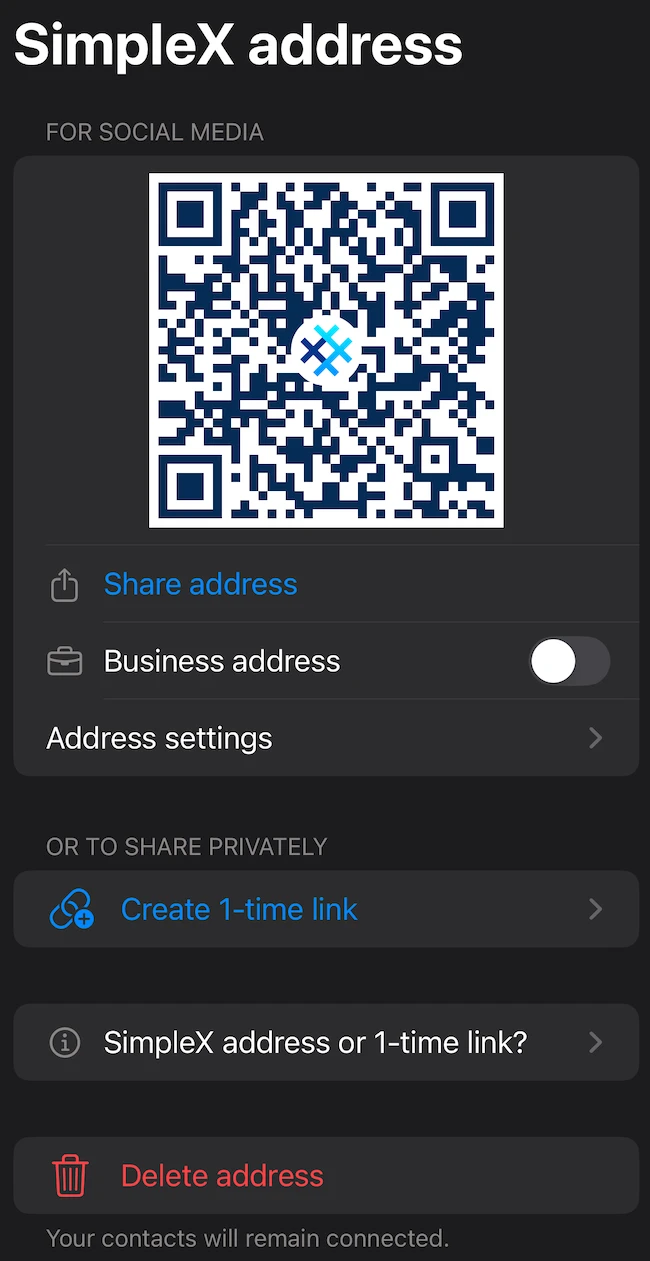
To start chatting, users invite others through a one-time link or a temporary QR code. An optional long-term address can be created for repeated use. When someone uses this address, a connection request is sent and can be accepted or rejected. The address can be set to accept requests automatically. If shared in a profile, group members can connect, and contacts can pass it on to others. The long-term address can be removed at any time without affecting existing connections.
SimpleX Chat

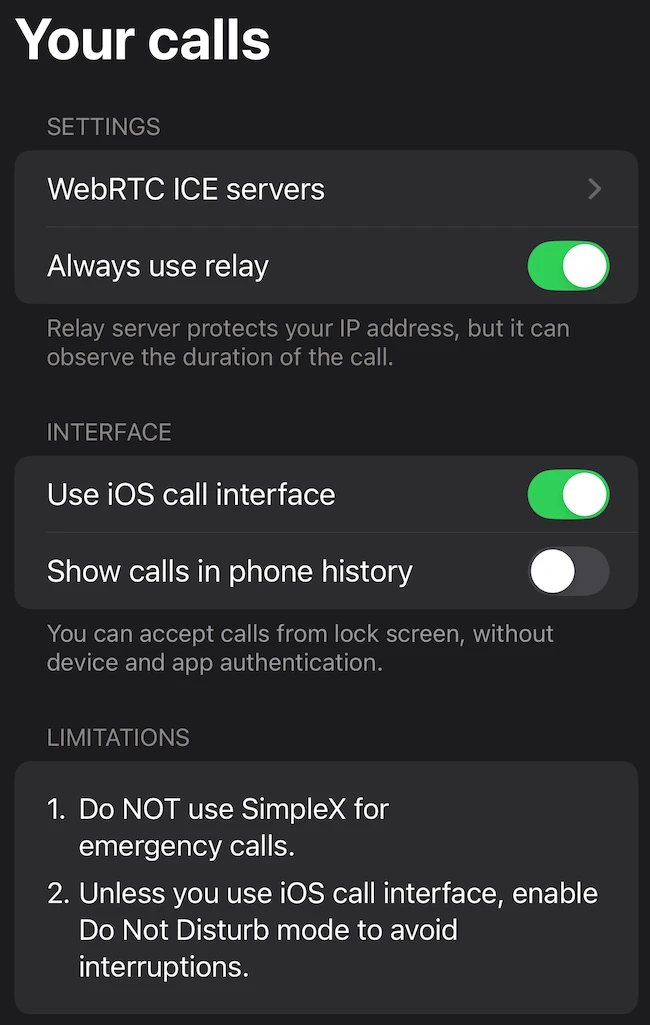
SimpleX Chat supports end-to-end encrypted audio and video calls using WebRTC. Incoming calls can be accepted, rejected, or ignored.

By default, incoming calls appear on the device’s lock screen. This setting can be changed in the app.

SimpleX Chat uses a relay server to keep the IP address hidden during calls. The server can see call duration but not content. Users can choose their own WebRTC relay servers for more control. This setup is stored on the device and must be configured again on a new one

Data management

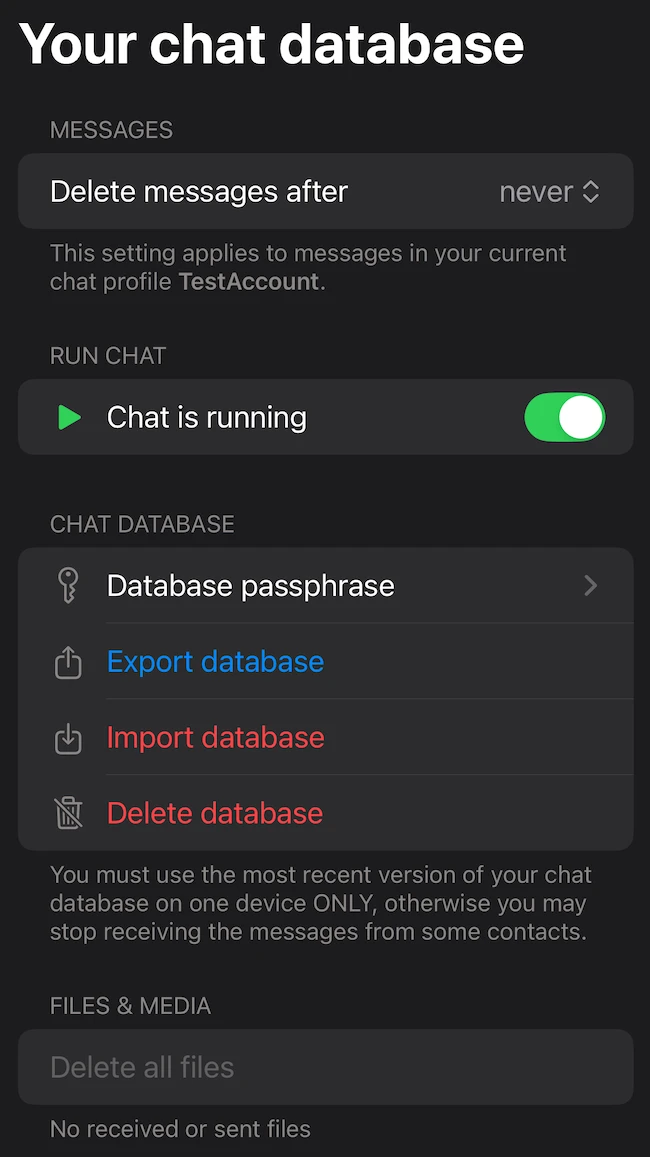
In the app settings under “Database passphrase and export,” users can choose when messages are deleted. This setting applies only to their device and does not affect other participants.
SimpleX Chat

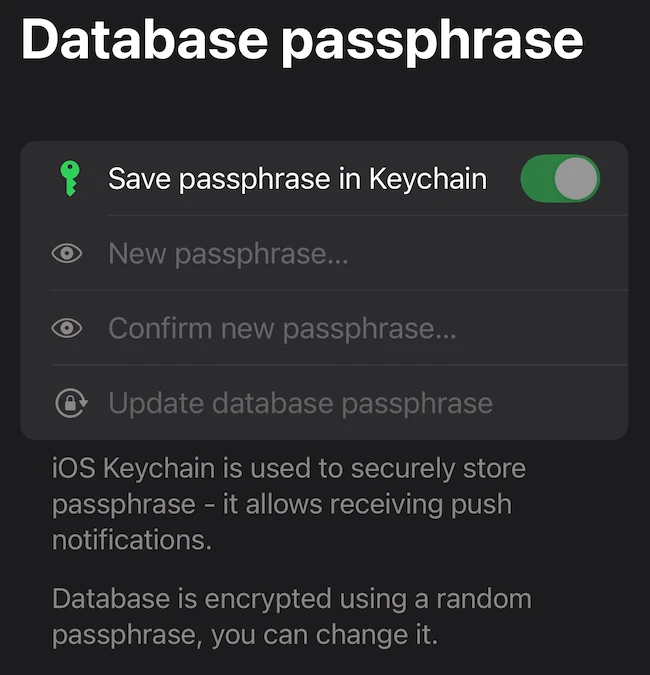
To back up chats, a passphrase must be set before export. Deleting the chat database removes all messages unless they have been exported.
SimpleX Chat

Files and media stored in the app can be deleted using the “Delete files & media” option without removing messages.

Privacy and security

SimpleX Chat reduces the risk of man-in-the-middle attacks by requiring invitation links to be shared through another channel. That channel can still be compromised, so sharing a QR code during a video call is safer, as it is harder to replace.
SimpleX Chat

Users can verify a connection by comparing a security code with a contact. If both apps show the same code, the connection is trusted. This can be done by scanning, visual comparison, or reading the code during a call.

This check is useful when connecting through group members, since those connections rely on third parties. Verifying the code confirms the connection is secure.

Conclusion

SimpleX Chat is a privacy-focused messaging app that eliminates user identifiers and stores data locally. It protects both message content and metadata, including communication relationships. Users control their data, configure relay servers, and verify connections. It suits those who want secure communication without accounts, phone numbers, or centralized control, while retaining essential messaging features.