

惯性聚合 高效追踪和阅读你感兴趣的博客、新闻、科技资讯
阅读原文 在惯性聚合中打开

推荐订阅源

L
LINUX DO - 最新话题
C
Cyber Attacks, Cyber Crime and Cyber Security
G
GRAHAM CLULEY
T
Tenable Blog
T
Threatpost
C
CXSECURITY Database RSS Feed - CXSecurity.com
I
Intezer
cs.CL updates on arXiv.org
D
Darknet – Hacking Tools, Hacker News & Cyber Security
K
Kaspersky official blog
Security Latest
Security Latest
P
Privacy & Cybersecurity Law Blog
Google Online Security Blog
SecWiki News
SecWiki News
P
Palo Alto Networks Blog
TaoSecurity Blog
TaoSecurity Blog
Webroot Blog
Webroot Blog
Spread Privacy
Spread Privacy
O
OpenAI News
The Last Watchdog
The Last Watchdog
P
Proofpoint News Feed
C
Check Point Blog
cs.CV updates on arXiv.org
人人都是产品经理
人人都是产品经理
S
Security @ Cisco Blogs
Scott Helme
Scott Helme
OSCHINA 社区最新新闻
OSCHINA 社区最新新闻
cs.AI updates on arXiv.org
月光博客
月光博客
S
Securelist
酷 壳 – CoolShell
酷 壳 – CoolShell
V
V2EX
T
Troy Hunt's Blog
W
WeLiveSecurity
GbyAI
GbyAI
N
News | PayPal Newsroom
Y
Y Combinator Blog
C
Cisco Blogs
H
Help Net Security
The GitHub Blog
The GitHub Blog
Threat Intelligence Blog | Flashpoint
博客园 - 【当耐特】
Jina AI
Jina AI
MongoDB | Blog
MongoDB | Blog
P
Proofpoint News Feed
让小产品的独立变现更简单 - ezindie.com
CTFtime.org: upcoming CTF events
云风的 BLOG
云风的 BLOG
小众软件
小众软件
N
News and Events Feed by Topic

Help Net Security

Police arrest 10 suspected members of Black Axe cybercrime gang ShinyHunters claims it stole 1.4 million records from Udemy Sevii unveils Cyber Swarm Defense Mode to stop AI-driven attacks at scale Alleged Chinese hacker extradited to US over cyberattacks targeting COVID-19 research Cequence Agent Personas bring granular control and governance to enterprise AI agents NowSecure MARI gives enterprises evidence-based visibility into third-party mobile app risk The metrics killing your SOC, and what to use instead US state privacy fines reached $3.425 billion in 2025 Canada’s first SMS blaster case leads to three arrests Linux storage management tool Stratis 3.9.0 adds online encryption and cache-less pool startup TLS Connect gives SMBs a right-sized automated tool to manage TLS certificates Aptori expands its platform with autonomous offensive testing to reduce security bottlenecks Your IAM was built for humans, AI agents don’t care The AI criminal mastermind is already hiring on gig platforms 25 open-source cybersecurity tools that don’t care about your budget Product showcase: LuLu reveals unauthorized outbound connections from Mac apps Week in review: Claude Mythos finds 271 Firefox flaws, Vercel breach Users advised to drop passwords and make room for passkeys - Help Net Security Indirect prompt injection is taking hold in the wild - Help Net Security Compromised everyday devices power Chinese cyber espionage operations - Help Net Security New Cisco firewall malware can only be killed by pulling the plug - Help Net Security Meta is overhauling how you sign in, manage settings, and protect your accounts - Help Net Security Ubuntu 26.04 LTS delivers memory-safe system tools and live patching for Arm servers - Help Net Security OpenAI’s GPT-5.5 is out with expanded cybersecurity safeguards - Help Net Security AI is speeding up nation-state cyber programs - Help Net Security A study of 1,000 Android apps finds a privacy policy logging gap - Help Net Security IT spending to hit $6.31 trillion record, thanks to AI - Help Net Security Where AI in CI/CD is working for engineering teams - Help Net Security With AI's help, North Korean hackers stumbled into a near-undetectable attack - Help Net Security Hacker with a special interest in breaching sports institutions ends behind bars - Help Net Security IP Fabric MCP server adds governance and control to enterprise AIOps workflows - Help Net Security Aqua Compass MCP server enables real-time investigation and containment of runtime threats - Help Net Security Google brings instant email verification to Android, no OTP needed - Help Net Security If cyber espionage via HDMI worries you, NCSC built a device to stop it - Help Net Security Apple fixes iPhone bug that let FBI retrieve deleted Signal messages(CVE-2026-28950) - Help Net Security GopherWhisper APT group hides command and control traffic in Slack and Discord - Help Net Security OpenAI tackles a bad habit people have when interacting with AI - Help Net Security A year in, Zoom's CISO reflects on balancing security and business - Help Net Security Scenario: Open-source framework for automated AI app red-teaming - Help Net Security GDPR works, but only where someone enforces it - Help Net Security Ransomware, fraud, and lawsuits drive cyber insurance claims to new peaks - Help Net Security Google’s Workspace Intelligence promises privacy while running on your data - Help Net Security Cyberattack on French government agency triggers phishing alert - Help Net Security Claude Mythos finds 271 Firefox flaws, Mozilla believes zero-days are numbered - Help Net Security Prove Identity Platform connects verification, authentication, and fraud prevention - Help Net Security New Mirai variants target routers and DVRs in parallel campaigns - Help Net Security Acronis GenAI Protection gives MSPs control over AI usage and data risks - Help Net Security Elastic MCP Apps bring security and observability workflows into AI tools - Help Net Security Progress Software fixes sneaky WAF bypass vulnerability (CVE-2026-21876) - Help Net Security Tencent's QClaw AI agent app arrives on Windows and macOS - Help Net Security Phishing reclaims the top initial access spot, attackers experiment with AI tools - Help Net Security OneDrive updates focus on AI, access control, and compliance - Help Net Security PentAGI: Open-source autonomous AI penetration testing system - Help Net Security Apple Intelligence flaw kept stolen tokens reusable on another device - Help Net Security Shadow AI, deepfakes, and supply chain compromise are rewriting the financial sector threat playbook - Help Net Security Thunderbird 150 arrives with encrypted message search and OpenPGP improvements - Help Net Security VirtualBox 7.2.8 is out with Linux kernel 7.0 support and crash fixes - Help Net Security Ransomware negotiator admits role in attacks he was hired to resolve - Help Net Security Scattered Spider hacker pleads guilty to stealing $8 million in cryptocurrency Meta and PortSwigger drive offensive security further to find what others miss - Help Net Security EU pushes for stronger cloud sovereignty, awards €180 million to four providers - Help Net Security SmokedMeat: Open-source tool shows what attackers do inside CI/CD pipelines - Help Net Security How to spot a North Korean fake in a job interview - Help Net Security Product showcase: Syncthing for secure, private file synchronization - Help Net Security Week in review: Acrobat Reader flaw exploited, Claude Mythos offensive capabilities and limits Google wipes out 602 million scam ads with Gemini on duty Researcher drops two more Microsoft Defender zero-days, all three now exploited in the wild GitLab 18.11 brings agentic AI to security fixes, CI pipelines, and delivery analytics Liongard upgrades LiongardIQ with AI access, live asset data, and deeper discovery Mozilla challenges enterprise AI providers with Thunderbolt, open-source AI client under your control Codex can now operate between apps. Where are the boundaries? Android 17 Beta 4 arrives with post-quantum cryptography and new memory limits Apple AirTag tracking can be misled by replayed Bluetooth signals Social media bans might steer kids into riskier corners of the internet Workplace stress in 2026 is still worse than before the pandemic New infosec products of the week: April 17, 2026 - Help Net Security ImmuniWeb brings AI upgrades, post-quantum detection and more in Q1 2026 NIST admits defeat on NVD backlog, will enrich only highest-risk CVEs going forward Anthropic releases Claude Opus 4.7 with automated cybersecurity safeguards - Help Net Security Fortinet fixes critical FortiSandbox vulnerabilities (CVE-2026-39813, CVE-2026-39808) - Help Net Security Google Play is changing how Android apps access your contacts and location Tails 7.6.2 patches vulnerability that could expose saved files Cargo theft malware actor spent a month inside a decoy network before researchers pulled the plug OpenAI updates Agents SDK, adds sandbox for safer code execution Anthropic tests user trust with ID and selfie checks for Claude GitHub lays out copyright liability changes and upcoming DMCA review for developers EU cybersecurity standards are at risk if supplier ban passes Command integrity breaks in the LLM routing layer The fully free Linux OS Trisquel gets a major update with version 12.0 Ecne Week in review: Windows zero-day exploit leaked, Patch Tuesday forecast ClickFix campaign delivers Mac malware via fake Apple page Poisoned “Office 365” search results lead to stolen paychecks Gmail’s end-to-end encryption comes to mobile, no extra apps required To counter cookie theft, Chrome ships device-bound session credentials Product showcase: Session, a messenger without phone numbers or metadata Little Snitch for Linux shows what your apps are connecting to - Help Net Security Apiiro CLI turns AI coding assistants into full-stack security engineers - Help Net Security April 2026 Patch Tuesday forecast: Spring-cleaning of a preview - Help Net Security What vibe hunting gets right about AI threat hunting, and where it breaks down - Help Net Security Health insurance lead sites sell personal data within seconds of form submission - Help Net Security
Identity discovery: The overlooked lever in strategic risk reduction
Help Net Sec · 2026-04-29 · via Help Net Security

If you ask a CISO what keeps them up at night, the answer usually isn’t “lack of tools.” It’s uncertainty.

Uncertainty about what they don’t see.

Uncertainty about how far an attacker could move once inside.

Uncertainty about whether identity programs are actually reducing risk, or just managing symptoms.

Identity discovery sits at the center of that uncertainty. It is not glamorous. It does not get the same attention as AI-driven detection or zero trust initiatives. But it is the foundation of meaningful risk reduction.

Without comprehensive visibility into every identity across the environment, identity security programs operate with blind spots. And blind spots are where breaches begin.

The visibility gap in modern identity security

Most identity security programs were designed for a simpler world: a central directory, a defined workforce, a clear boundary between inside and outside. That world no longer exists.

Workloads now shift dynamically across multi-cloud environments. Development teams deploy infrastructure through code. CI/CD pipelines create and destroy resources automatically. SaaS applications proliferate across business units. And now, AI agents and LLM integrations are being introduced into production environments at unprecedented speed.

Every one of these shifts generates identities.

Not just human users, but service accounts, cloud roles, workload identities, API keys, tokens, certificates, automation bots, and AI-driven agents. These identities are created programmatically, often with broad permissions to ensure functionality. They are replicated across environments, inherited through nested roles, and sometimes left behind when projects end.

Security teams can see pieces of this activity. They notice a new role in AWS. They see a new service principal in Entra. They detect a new Kubernetes service account. But seeing that something exists is not the same as understanding what it can do.

The real question isn’t “Does this identity exist?” It’s “What does it have access to, and what could it access next?”

Attackers exploit precisely this ambiguity. Modern breaches often do not begin with zero-day exploits. They begin with compromised credentials or misconfigured permissions. From there, attackers move laterally, leveraging excessive privileges, trust relationships, and identity inheritance paths that security teams didn’t fully map.

If risk reduction is the objective, visibility must come first.

The identity explosion is structural, not temporary

The scale of the identity problem is not incremental. It is structural.

According to Delinea Labs, in 2025 the average enterprise has approximately 46 non-human identities for every human identity. That ratio fundamentally changes how organizations must think about identity risk.

Non-human identities now outnumber people by orders of magnitude. These include cloud workload identities, service accounts, automation scripts, API tokens, containers, RPA bots, and increasingly, AI agents operating semi-autonomously. They authenticate, request resources, call APIs, and access sensitive systems, often without direct human interaction.

Yet many organizations still rely on a patchwork of legacy tools to manage them. Privileged Access Management (PAM) handles certain administrative accounts. IAM platforms govern workforce access. Endpoint protection secures devices. Identity Threat Detection and Response tools monitor suspicious behavior.

Each solution serves a purpose. But each also operates within its own silo. There is no unified, common identity plane where every identity, human, machine, and AI, can be seen in context.

As a result, organizations struggle to answer fundamental questions about exposure. They pivot between consoles. They manually reconcile data from multiple platforms. They attempt to stitch together access relationships across cloud providers and identity systems. Meanwhile, identities continue to multiply.

The issue is not a lack of tooling. It is a lack of unified visibility.

Moving to visibility and illumination

Strategic identity discovery requires more than periodic audits or static inventories. It requires continuous, universal coverage across the entire identity lifecycle.

To accomplish this organizations must first achieve comprehensive identity coverage. Every identity, whether an IT administrator, developer, workforce user, service account, workload identity, or AI agent, must be discoverable the moment it is created. Visibility cannot begin weeks or months after deployment. It must be immediate.

But discovery alone is not enough. For each identity, organizations must understand their posture. Is it overprivileged? Is it stale or inactive? Is it unmanaged or non-vaulted? Does it violate policy? Does it create lateral movement risk?

Posture turns visibility into intelligence. It allows security leaders to prioritize remediation based on risk rather than assumption.

Second, identity visibility must extend across hybrid environments. Modern enterprises span multi-cloud platforms, on-premise infrastructure, SaaS ecosystems, and DevOps pipelines. Identity providers such as Okta, Ping, and Microsoft Entra each maintain their own access models and permission hierarchies. Cloud providers enforce distinct role and policy structures.

Without cross-environment visibility, organizations misjudge risk because they see only fragments. An account may appear compliant in one system while holding excessive privileges in another. A service identity may be governed on-premise but unmanaged in a cloud tenant. An AI agent may authenticate through one provider but inherit permissions across multiple platforms.

True hybrid visibility collapses these silos and exposes the full identity attack surface.

Third, and most critically, organizations must understand identity relationships. Risk does not reside solely in individual accounts—it resides in how identities connect.

Access inheritance, nested group memberships, trust relationships, policy attachments, and cross-account permissions create hidden escalation paths. These relationships are often invisible in traditional dashboards.

This is where identity graphing becomes essential.

An identity graph maps how identities relate to one another and to the resources they can access. It reveals not just what an identity can access directly, but what it can access indirectly. It shows escalation chains, lateral movement paths, and toxic identity misconfigurations.

This forms a common identity plane, a unified model where identities, access paths, and posture are visible in context.
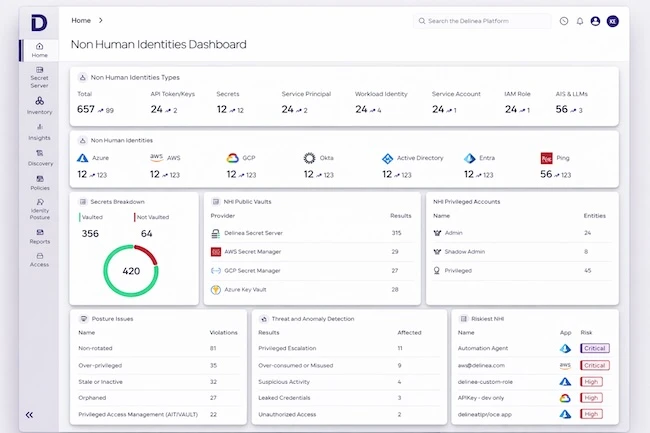
identity discovery strategy

Importantly, this visibility is not just for identity specialists. When presented clearly, an identity graph can be used by SecOps teams investigating incidents, by risk teams assessing exposure, and by compliance teams validating controls. It democratizes identity intelligence across the organization

Identity discovery at the board level

Identity security has reached the board level. Gartner reports that 84% of organizations view identity security as a board-level concern vs. a technology concern.

Boards increasingly ask CISOs to quantify cyber risk. They want measurable indicators of exposure, progress, and resilience. They want clarity around AI adoption and machine identity risk. They expect more than technical explanations, they expect strategic insight. Identity discovery enables CISOs to answer two essential questions for every identity in the enterprise:

  • What does this identity have access to?
  • And what does it have access to next?

Privileges drift over time. Roles accumulate. Policies overlap. AI systems request additional permissions. Developers reuse credentials or hard-code them into applications. Temporary access becomes permanent. Without continuous visibility into how access evolves, organizations cannot accurately model breach impact.

Boards do not need to understand every technical detail. But they do need confidence that identity exposure is measured, monitored, and reduced over time. They need evidence that overprivileged accounts are being remediated. They need transparency into machine and AI identity risk. They need to see that identity posture is improving, not stagnating.

Full visibility into identity posture transforms identity security from an operational control into a strategic risk management discipline.

Why discovery must come first

Many organizations attempt to enforce least privilege, rotate secrets, or deploy threat detection tools before establishing comprehensive discovery. These controls are valuable, but without visibility, they are incomplete.

  • You cannot reduce overprivilege if you do not know where it exists.
  • You cannot eliminate shadow admins if you cannot see them.
  • You cannot manage AI risk if AI identities are not discoverable.

Identity discovery is the prerequisite to automation, governance, and meaningful metrics. It establishes the baseline. It reveals the gaps. It prioritizes remediation. And it provides the data needed to demonstrate improvement over time.

In a threat landscape increasingly defined by credential misuse rather than software exploits, identity visibility is not optional. It is foundational.

From uncertainty to strategic confidence

Security leaders do not want more tools. They want clarity. They want to stand in front of their boards and speak with confidence about identity exposure, machine identity growth, AI governance, and measurable risk reduction.

Identity discovery delivers that clarity.

By illuminating every human, machine, and AI identity; by mapping access relationships across hybrid environments; and by tracking posture over time, organizations create a unified identity plane. Within that plane, risk becomes visible. And once visible, it becomes manageable.

Identity discovery is not a feature. It is a strategy.