





惯性聚合 高效追踪和阅读你感兴趣的博客、新闻、科技资讯
阅读原文 在惯性聚合中打开

推荐订阅源

aimingoo的专栏
aimingoo的专栏
有赞技术团队
有赞技术团队
博客园 - Franky
J
Java Code Geeks
美团技术团队
WordPress大学
WordPress大学
V
Visual Studio Blog
量子位
Hugging Face - Blog
Hugging Face - Blog
V
V2EX
让小产品的独立变现更简单 - ezindie.com
OSCHINA 社区最新新闻
OSCHINA 社区最新新闻
人人都是产品经理
人人都是产品经理
博客园 - 三生石上(FineUI控件)
博客园 - 司徒正美
爱范儿
爱范儿
宝玉的分享
宝玉的分享
博客园 - 【当耐特】
D
DataBreaches.Net
云风的 BLOG
云风的 BLOG
The Cloudflare Blog
MyScale Blog
MyScale Blog
The GitHub Blog
The GitHub Blog
博客园_首页
U
Unit 42
O
OpenAI News
T
The Blog of Author Tim Ferriss
Microsoft Security Blog
H
Help Net Security
S
SegmentFault 最新的问题
Threat Intelligence Blog | Flashpoint
T
Threat Research - Cisco Blogs
月光博客
月光博客
Cyber Security Advisories - MS-ISAC
Cisco Talos Blog
Cisco Talos Blog
T
Tailwind CSS Blog
A
About on SuperTechFans
AWS News Blog
AWS News Blog
Recorded Future
Recorded Future
A
Arctic Wolf
H
Hackread – Cybersecurity News, Data Breaches, AI and More
T
Tenable Blog
大猫的无限游戏
大猫的无限游戏
I
Intezer
K
Kaspersky official blog
www.infosecurity-magazine.com
The Register - Security
G
Google Developers Blog
雷峰网
雷峰网
V
Vulnerabilities – Threatpost

Help Net Security

FIDO Alliance wants to keep AI agents from going rogue on online payments Police arrest 10 suspected members of Black Axe cybercrime gang ShinyHunters claims it stole 1.4 million records from Udemy Sevii unveils Cyber Swarm Defense Mode to stop AI-driven attacks at scale Alleged Chinese hacker extradited to US over cyberattacks targeting COVID-19 research Cequence Agent Personas bring granular control and governance to enterprise AI agents NowSecure MARI gives enterprises evidence-based visibility into third-party mobile app risk The metrics killing your SOC, and what to use instead US state privacy fines reached $3.425 billion in 2025 Canada’s first SMS blaster case leads to three arrests Linux storage management tool Stratis 3.9.0 adds online encryption and cache-less pool startup TLS Connect gives SMBs a right-sized automated tool to manage TLS certificates Aptori expands its platform with autonomous offensive testing to reduce security bottlenecks Your IAM was built for humans, AI agents don’t care The AI criminal mastermind is already hiring on gig platforms 25 open-source cybersecurity tools that don’t care about your budget Product showcase: LuLu reveals unauthorized outbound connections from Mac apps Week in review: Claude Mythos finds 271 Firefox flaws, Vercel breach Users advised to drop passwords and make room for passkeys - Help Net Security Indirect prompt injection is taking hold in the wild - Help Net Security Compromised everyday devices power Chinese cyber espionage operations - Help Net Security New Cisco firewall malware can only be killed by pulling the plug - Help Net Security Meta is overhauling how you sign in, manage settings, and protect your accounts - Help Net Security Ubuntu 26.04 LTS delivers memory-safe system tools and live patching for Arm servers - Help Net Security OpenAI’s GPT-5.5 is out with expanded cybersecurity safeguards - Help Net Security AI is speeding up nation-state cyber programs - Help Net Security A study of 1,000 Android apps finds a privacy policy logging gap - Help Net Security IT spending to hit $6.31 trillion record, thanks to AI - Help Net Security Where AI in CI/CD is working for engineering teams - Help Net Security With AI's help, North Korean hackers stumbled into a near-undetectable attack - Help Net Security Hacker with a special interest in breaching sports institutions ends behind bars - Help Net Security IP Fabric MCP server adds governance and control to enterprise AIOps workflows - Help Net Security Aqua Compass MCP server enables real-time investigation and containment of runtime threats - Help Net Security Google brings instant email verification to Android, no OTP needed - Help Net Security If cyber espionage via HDMI worries you, NCSC built a device to stop it - Help Net Security Apple fixes iPhone bug that let FBI retrieve deleted Signal messages(CVE-2026-28950) - Help Net Security GopherWhisper APT group hides command and control traffic in Slack and Discord - Help Net Security OpenAI tackles a bad habit people have when interacting with AI - Help Net Security A year in, Zoom's CISO reflects on balancing security and business - Help Net Security Scenario: Open-source framework for automated AI app red-teaming - Help Net Security GDPR works, but only where someone enforces it - Help Net Security Ransomware, fraud, and lawsuits drive cyber insurance claims to new peaks - Help Net Security Google’s Workspace Intelligence promises privacy while running on your data - Help Net Security Cyberattack on French government agency triggers phishing alert - Help Net Security Claude Mythos finds 271 Firefox flaws, Mozilla believes zero-days are numbered - Help Net Security Prove Identity Platform connects verification, authentication, and fraud prevention - Help Net Security New Mirai variants target routers and DVRs in parallel campaigns - Help Net Security Acronis GenAI Protection gives MSPs control over AI usage and data risks - Help Net Security Elastic MCP Apps bring security and observability workflows into AI tools - Help Net Security Progress Software fixes sneaky WAF bypass vulnerability (CVE-2026-21876) - Help Net Security Tencent's QClaw AI agent app arrives on Windows and macOS - Help Net Security OneDrive updates focus on AI, access control, and compliance - Help Net Security PentAGI: Open-source autonomous AI penetration testing system - Help Net Security Apple Intelligence flaw kept stolen tokens reusable on another device - Help Net Security Shadow AI, deepfakes, and supply chain compromise are rewriting the financial sector threat playbook - Help Net Security Thunderbird 150 arrives with encrypted message search and OpenPGP improvements - Help Net Security VirtualBox 7.2.8 is out with Linux kernel 7.0 support and crash fixes - Help Net Security Ransomware negotiator admits role in attacks he was hired to resolve - Help Net Security Scattered Spider hacker pleads guilty to stealing $8 million in cryptocurrency Meta and PortSwigger drive offensive security further to find what others miss - Help Net Security EU pushes for stronger cloud sovereignty, awards €180 million to four providers - Help Net Security SmokedMeat: Open-source tool shows what attackers do inside CI/CD pipelines - Help Net Security How to spot a North Korean fake in a job interview - Help Net Security Product showcase: Syncthing for secure, private file synchronization - Help Net Security Week in review: Acrobat Reader flaw exploited, Claude Mythos offensive capabilities and limits Google wipes out 602 million scam ads with Gemini on duty Researcher drops two more Microsoft Defender zero-days, all three now exploited in the wild GitLab 18.11 brings agentic AI to security fixes, CI pipelines, and delivery analytics Liongard upgrades LiongardIQ with AI access, live asset data, and deeper discovery Mozilla challenges enterprise AI providers with Thunderbolt, open-source AI client under your control Codex can now operate between apps. Where are the boundaries? Android 17 Beta 4 arrives with post-quantum cryptography and new memory limits Apple AirTag tracking can be misled by replayed Bluetooth signals Social media bans might steer kids into riskier corners of the internet Workplace stress in 2026 is still worse than before the pandemic New infosec products of the week: April 17, 2026 - Help Net Security ImmuniWeb brings AI upgrades, post-quantum detection and more in Q1 2026 NIST admits defeat on NVD backlog, will enrich only highest-risk CVEs going forward Anthropic releases Claude Opus 4.7 with automated cybersecurity safeguards - Help Net Security Fortinet fixes critical FortiSandbox vulnerabilities (CVE-2026-39813, CVE-2026-39808) - Help Net Security Google Play is changing how Android apps access your contacts and location Tails 7.6.2 patches vulnerability that could expose saved files Cargo theft malware actor spent a month inside a decoy network before researchers pulled the plug OpenAI updates Agents SDK, adds sandbox for safer code execution Anthropic tests user trust with ID and selfie checks for Claude GitHub lays out copyright liability changes and upcoming DMCA review for developers EU cybersecurity standards are at risk if supplier ban passes Command integrity breaks in the LLM routing layer The fully free Linux OS Trisquel gets a major update with version 12.0 Ecne Week in review: Windows zero-day exploit leaked, Patch Tuesday forecast ClickFix campaign delivers Mac malware via fake Apple page Poisoned “Office 365” search results lead to stolen paychecks Gmail’s end-to-end encryption comes to mobile, no extra apps required To counter cookie theft, Chrome ships device-bound session credentials Product showcase: Session, a messenger without phone numbers or metadata Little Snitch for Linux shows what your apps are connecting to - Help Net Security Apiiro CLI turns AI coding assistants into full-stack security engineers - Help Net Security April 2026 Patch Tuesday forecast: Spring-cleaning of a preview - Help Net Security What vibe hunting gets right about AI threat hunting, and where it breaks down - Help Net Security Health insurance lead sites sell personal data within seconds of form submission - Help Net Security
Phishing reclaims the top initial access spot, attackers experiment with AI tools - Help Net Security
Anamarija Po · 2026-04-22 · via Help Net Security

Phishing returned as the leading method attackers used to break into organizations in the first quarter of 2026, accounting for over a third of engagements where initial access could be determined, according to Cisco Talos. It is the first quarter phishing has led the category since Q2 2025, when exploitation of public-facing applications took over following widespread attacks against on-premises Microsoft SharePoint servers.

That SharePoint exploitation wave, collectively tracked as ToolShell, drove public-facing application exploitation to a peak of 62 percent of engagements. The rate dropped to 18 percent in Q1 2026, a decline Talos attributes to the broad availability of emergency patches and improved detection coverage.

AI tool used to build credential harvesting page

One phishing incident this quarter involved a technique Talos had not previously documented in its casework. Attackers targeting a public administration organization used Softr, an AI-powered web application development platform, to build a credential harvesting page that mimicked Microsoft Exchange and Outlook Web Access login screens. The page was built using a form template and a vibe coding feature, requiring no custom code.

Softr pages can send captured data to external storage such as Google Sheets and trigger email alerts for new entries, also without code. Talos has moderate confidence that malicious actors have used Softr’s platform for similar purposes since at least May 2023, based on Cisco Umbrella data and other telemetry, with usage increasing over time.

State-sponsored and criminal groups have been observed using large language models to develop phishing lures and malicious scripts. DDoS-as-a-service operators have adopted AI algorithms for attack orchestration. The Softr incident is the first time Talos documented a specific AI tool being used in a confirmed phishing engagement.

Public administration targeted for third consecutive quarter

Public administration and healthcare each accounted for 24 percent of all engagements, tying as the most targeted sectors. Public administration has held the top position since Q3 2025. Organizations in that sector frequently run legacy systems, operate with limited security budgets, handle sensitive data, and have low tolerance for downtime, making them attractive to both financially motivated attackers and espionage-focused groups.

Crimson Collective makes its first appearance in Talos casework

Talos responded to its first engagement involving Crimson Collective, a cyber extortion group that emerged in September 2025. The incident began when a GitHub Personal Access Token was accidentally published on a public-facing website, exposing the organization for several months.

After gaining access, the attacker used TruffleHog, a legitimate open-source secrets scanning tool, to search thousands of GitHub repositories for credentials and sensitive data. The discovered client secrets enabled access to the victim’s Azure cloud storage, where the attacker used Microsoft Graph API calls to authenticate, enumerate, and exfiltrate data. The attacker also attempted to inject malicious code into multiple GitHub repositories designed to harvest any secrets committed in the future. Expired secrets and existing security controls limited the damage.

Talos attributes the activity to Crimson Collective based on IP addresses associated with the group that were used to scan the victim’s ASA firewalls, along with overlap with publicly reported Crimson Collective tactics and techniques.

MFA weaknesses remained the top security gap

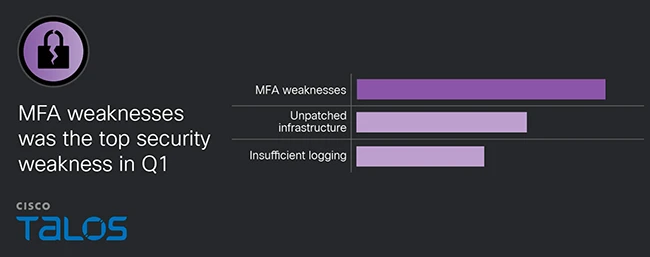
MFA weaknesses appeared in 35 percent of engagements this quarter, up from the prior quarter. Attackers bypassed MFA by registering new devices to compromised accounts and, in one case, configuring an Outlook client to connect directly to an Exchange server, sidestepping Duo MFA requirements entirely.
phishing initial access 2026

Vulnerable or exposed infrastructure appeared in 25 percent of engagements. Exploited weaknesses included CVE-2025-20393 in Cisco Secure Email Gateway and CVE-2023-20198 in Cisco IOS XE, along with exposed WinRM management ports accessible from the internet.

Insufficient logging affected 18 percent of engagements, limiting investigators’ ability to reconstruct attacker activity. Talos recommends deploying a SIEM for centralized log storage so that logs deleted or modified on individual hosts remain available for forensic review.

Pre-ransomware activity made up 18 percent of engagements. No ransomware encryption occurred this quarter due to early containment. Talos assesses with moderate confidence that Rhysida and MoneyMessage ransomware were involved in two of those engagements.

Webinar: The True State of Security 2026