
惯性聚合 高效追踪和阅读你感兴趣的博客、新闻、科技资讯
阅读原文 在惯性聚合中打开

推荐订阅源

L
LangChain Blog
博客园 - 司徒正美
美团技术团队
Martin Fowler
Martin Fowler
雷峰网
雷峰网
aimingoo的专栏
aimingoo的专栏
博客园 - 三生石上(FineUI控件)
Vercel News
Vercel News
酷 壳 – CoolShell
酷 壳 – CoolShell
freeCodeCamp Programming Tutorials: Python, JavaScript, Git & More
爱范儿
爱范儿
U
Unit 42
Y
Y Combinator Blog
月光博客
月光博客
Hugging Face - Blog
Hugging Face - Blog
奇客Solidot–传递最新科技情报
奇客Solidot–传递最新科技情报
有赞技术团队
有赞技术团队
GbyAI
GbyAI
H
Help Net Security
量子位
Last Week in AI
Last Week in AI
博客园_首页
腾讯CDC
小众软件
小众软件

Help Net Security

Police arrest 10 suspected members of Black Axe cybercrime gang ShinyHunters claims it stole 1.4 million records from Udemy Sevii unveils Cyber Swarm Defense Mode to stop AI-driven attacks at scale Alleged Chinese hacker extradited to US over cyberattacks targeting COVID-19 research Cequence Agent Personas bring granular control and governance to enterprise AI agents NowSecure MARI gives enterprises evidence-based visibility into third-party mobile app risk The metrics killing your SOC, and what to use instead US state privacy fines reached $3.425 billion in 2025 Canada’s first SMS blaster case leads to three arrests Linux storage management tool Stratis 3.9.0 adds online encryption and cache-less pool startup TLS Connect gives SMBs a right-sized automated tool to manage TLS certificates Aptori expands its platform with autonomous offensive testing to reduce security bottlenecks Your IAM was built for humans, AI agents don’t care The AI criminal mastermind is already hiring on gig platforms 25 open-source cybersecurity tools that don’t care about your budget Product showcase: LuLu reveals unauthorized outbound connections from Mac apps Week in review: Claude Mythos finds 271 Firefox flaws, Vercel breach Users advised to drop passwords and make room for passkeys - Help Net Security Indirect prompt injection is taking hold in the wild - Help Net Security Compromised everyday devices power Chinese cyber espionage operations - Help Net Security New Cisco firewall malware can only be killed by pulling the plug - Help Net Security Meta is overhauling how you sign in, manage settings, and protect your accounts - Help Net Security Ubuntu 26.04 LTS delivers memory-safe system tools and live patching for Arm servers - Help Net Security OpenAI’s GPT-5.5 is out with expanded cybersecurity safeguards - Help Net Security AI is speeding up nation-state cyber programs - Help Net Security A study of 1,000 Android apps finds a privacy policy logging gap - Help Net Security IT spending to hit $6.31 trillion record, thanks to AI - Help Net Security Where AI in CI/CD is working for engineering teams - Help Net Security With AI's help, North Korean hackers stumbled into a near-undetectable attack - Help Net Security Hacker with a special interest in breaching sports institutions ends behind bars - Help Net Security
Flare unveils new CTI capabilities and Okta support - Hel...
Industry News · 2026-06-25 · via Help Net Security

Flare has announced the expanded capabilities for Flare CTI, and an Okta integration within its Identity Exposure Management (IEM) offering. These updates extend Flare’s identity expertise into tactical threat intelligence use cases and agentic workflows to reshape security operations.
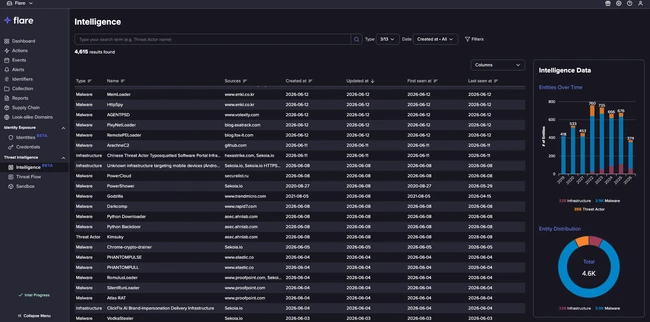
Flare CTI

As security teams face growing volumes of threats, many continue to rely on costly, disconnected tools for threat intelligence, threat investigation, and identity risk management. Flare’s latest platform enhancements help organizations consolidate those workflows, giving analysts the context they need to identify the threats that matter faster, and to take action sooner.

“Security teams are under pressure to seal the most potent threat vector, breached identities, and take advantage of new advances in AI, all while managing increasingly complex environments,” said Serge-Olivier Paquette, chief product officer, Flare. “Organizations need a clearer view of the real, concrete threats they face, the identities really at risk, and the actions they should take now. With these platform expansions, we’re bringing those capabilities together while helping customers prepare for a new generation of AI-assisted security operations.”

Flare CTI consolidates core threat intelligence capabilities

Flare CTI expands the company’s identity-first approach into more tactical and strategic cyber threat intelligence workflows, helping security teams investigate threats, analyze indicators, produce finished intelligence, and operationalize findings from a single platform. It brings together four core threat intelligence capabilities in a single offering:

  • A centralized Intelligence Browser for researching IOCs, threat actors, and TTPs across multiple intelligence providers and entity relationships
  • AI-powered reporting tailored to different audiences
  • Sandbox and file analysis for detonating suspicious files and URLs
  • STIX/TAXII feeds that push intelligence directly into core security systems

By combining these capabilities with Flare’s identity-first intelligence foundation, organizations can streamline threat intelligence operations while reducing the complexity and cost associated with managing multiple point solutions.

Okta integration expands Flare’s IEM

As part of the expansion, Flare announced support for Okta within its IEM offering. To date, hundreds of organizations have deployed Flare’s current IEM offering in production, processing more than 25,000 automatic identity validations. The new integration enables organizations to validate exposed credentials and identity risks against their Okta environments, helping security teams prioritize remediation, reduce account takeover risk, and stop breaches before they start.

Okta, along with Microsoft Entra ID, is now a supported identity provider, extending Flare’s ability to connect external threat intelligence with live identity infrastructure across the majority of enterprise environments.

The new capabilities follow Flare’s recognition as The Hacker News’ Most Innovative Cyber Threat Intelligence Platform and its inclusion in the inaugural Gartner Magic Quadrant for Cyber Threat Intelligence, where the platform was called out for its strength in IEM. Flare pioneered this approach in 2025 by combining a specialized collection of dark-web exposed identities with validation and remediation against live corporate identity infrastructure.