
惯性聚合 高效追踪和阅读你感兴趣的博客、新闻、科技资讯
阅读原文 在惯性聚合中打开

推荐订阅源

GbyAI
GbyAI
WordPress大学
WordPress大学
D
DataBreaches.Net
腾讯CDC
小众软件
小众软件
B
Blog RSS Feed
freeCodeCamp Programming Tutorials: Python, JavaScript, Git & More
T
The Blog of Author Tim Ferriss
MongoDB | Blog
MongoDB | Blog
U
Unit 42
Y
Y Combinator Blog
V
V2EX
I
InfoQ
D
Docker
量子位
N
Netflix TechBlog - Medium
Recent Announcements
A
About on SuperTechFans
博客园 - 叶小钗
大猫的无限游戏
大猫的无限游戏
OSCHINA 社区最新新闻
OSCHINA 社区最新新闻
B
Blog
阮一峰的网络日志
阮一峰的网络日志
MyScale Blog
MyScale Blog

Help Net Security

Police arrest 10 suspected members of Black Axe cybercrime gang ShinyHunters claims it stole 1.4 million records from Udemy Sevii unveils Cyber Swarm Defense Mode to stop AI-driven attacks at scale Alleged Chinese hacker extradited to US over cyberattacks targeting COVID-19 research Cequence Agent Personas bring granular control and governance to enterprise AI agents NowSecure MARI gives enterprises evidence-based visibility into third-party mobile app risk The metrics killing your SOC, and what to use instead US state privacy fines reached $3.425 billion in 2025 Canada’s first SMS blaster case leads to three arrests Linux storage management tool Stratis 3.9.0 adds online encryption and cache-less pool startup TLS Connect gives SMBs a right-sized automated tool to manage TLS certificates Aptori expands its platform with autonomous offensive testing to reduce security bottlenecks Your IAM was built for humans, AI agents don’t care The AI criminal mastermind is already hiring on gig platforms 25 open-source cybersecurity tools that don’t care about your budget Product showcase: LuLu reveals unauthorized outbound connections from Mac apps Week in review: Claude Mythos finds 271 Firefox flaws, Vercel breach Users advised to drop passwords and make room for passkeys - Help Net Security Indirect prompt injection is taking hold in the wild - Help Net Security Compromised everyday devices power Chinese cyber espionage operations - Help Net Security New Cisco firewall malware can only be killed by pulling the plug - Help Net Security Meta is overhauling how you sign in, manage settings, and protect your accounts - Help Net Security Ubuntu 26.04 LTS delivers memory-safe system tools and live patching for Arm servers - Help Net Security OpenAI’s GPT-5.5 is out with expanded cybersecurity safeguards - Help Net Security AI is speeding up nation-state cyber programs - Help Net Security A study of 1,000 Android apps finds a privacy policy logging gap - Help Net Security IT spending to hit $6.31 trillion record, thanks to AI - Help Net Security Where AI in CI/CD is working for engineering teams - Help Net Security With AI's help, North Korean hackers stumbled into a near-undetectable attack - Help Net Security Hacker with a special interest in breaching sports institutions ends behind bars - Help Net Security
Planning a trip? Fake travel sites are multiplying this s...
Sinisa Markovic · 2026-06-16 · via Help Net Security

Cyberattacks against hospitality, travel, and recreation organizations rose 24% year over year, reaching an average of 2,291 incidents per organization each week in May 2026, according to Check Point.
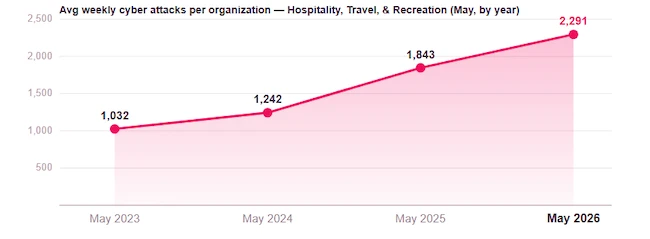
travel organizations cyberattacks

(Source: Check Point)

“The sector has more than doubled its attack volume since May 2023,” researchers noted, reporting a cumulative increase of 122% over three years.

According to the report, 47,318 travel-related domains were registered in May 2026, a 33% increase from the previous month. One in every 112 newly registered domains was already classified as malicious or suspicious.

“Many others remain dormant for now, waiting to be activated as summer traffic peaks.”

Check Point identified three coordinated bulk-registration operations during April and May. One involved more than 210 sequentially numbered hotel-themed domains using naming patterns such as hotel-stay[N].com and stay-hotel[N].com.

Another referenced American Express and Lloyds Travel Choice, combining terms such as “happytrip” and “travelchoice” on .ink domains. A third targeted the Fora Travel brand through 108 top-level domains, including .cruises, .miami, and .international.

The researchers also uncovered phishing sites masquerading as Booking.com, Airbnb, and Skyscanner.

One Booking.com-themed operation used fake login pages to steal credentials and payment card details, while an Airbnb-themed site targeted travelers planning trips to Canada with listings for destinations such as Montreal, Toronto, Vancouver, and Banff alongside imagery of the Canadian Rockies.

“The people behind fake booking sites plan around the summer surge just as carefully as legitimate businesses do, and they are ready well before most travelers start searching,” researchers concluded.