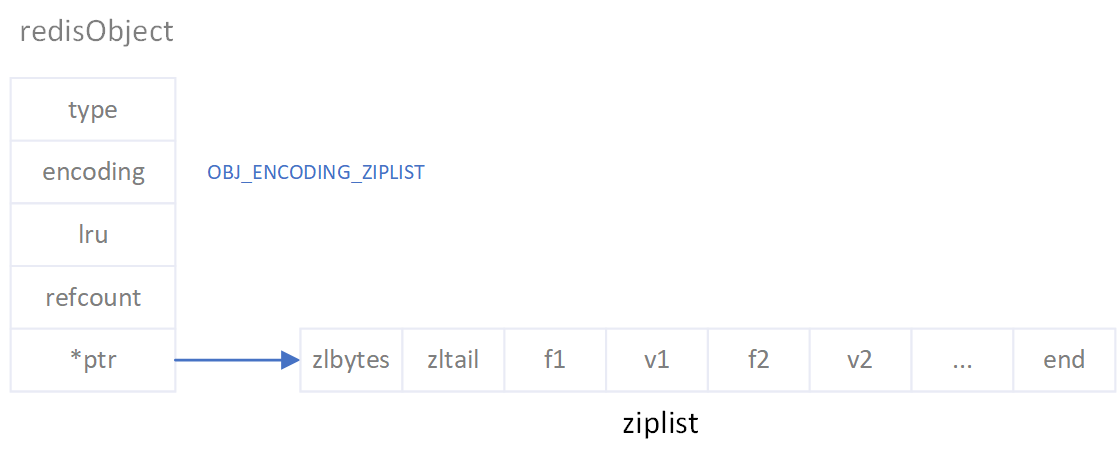
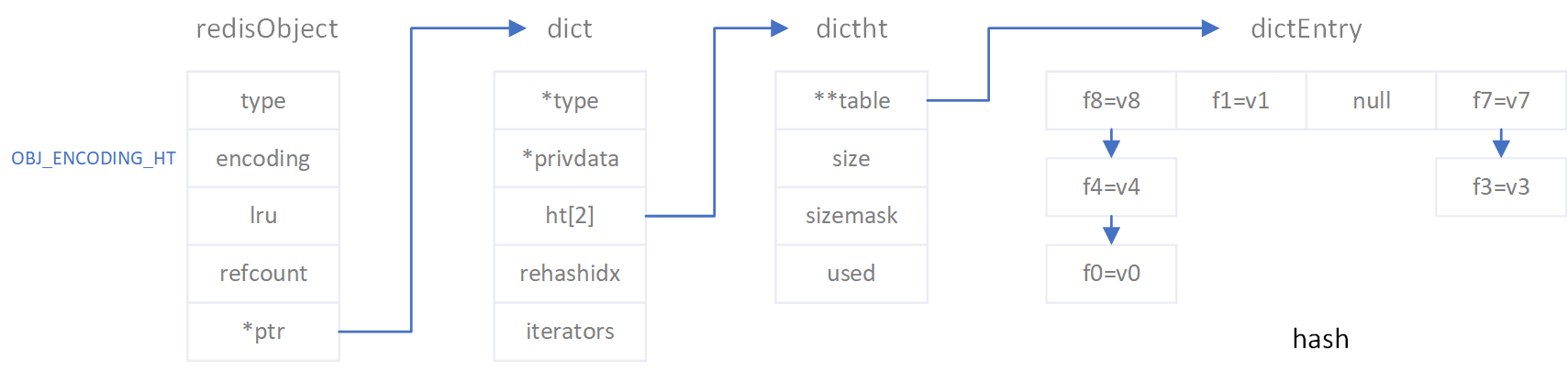
hash数据类型的对象编码有两种,分别是OBJ_ENCODING_ZIPLIST和OBJ_ENCODING_HT,即一种是以压缩数组;一种是哈希字典。两者的数据格式见下图:
redis的hash数据之所以使用OBJ_ENCODING_ZIPLIST和OBJ_ENCODING_HT两种编码格式,是为了当一个hash对象的键值对数据量比较小时,使用紧凑的数组格式来节省内存空间。
因此,当一个hash对象的键值对数据量增加到临界值时,就会触发编码转换,将该hash对象的键值对从OBJ_ENCODING_ZIPLIST编码转换为OBJ_ENCODING_HT编码。其中的临界值的关键参数为hash-max-ziplist-entries和hash-max-ziplist-value,可在配置文件中修改该两个参数的默认值。
1
2
3
4
5
# Hashes are encoded using a memory efficient data structure when they have a # small number of entries, and the biggest entry does not exceed a given # threshold. These thresholds can be configured using the following directives. hash-max-ziplist-entries 512 hash-max-ziplist-value 64
hash-max-ziplist-entries的默认值为512,表示当hash对象的键值对数量大于该值时使用OBJ_ENCODING_HT编码,否则使用OBJ_ENCODING_ZIPLIST编码。
如下测试,向hash对象中添加512个键值对,通过debug命令输出该hash对象的编码格式为encoding:ziplist,再添加一个键值对导致hash对象中的键值对数量大于hash-max-ziplist-entries时,该hash对象的编码格式转换为了encoding:hashtable。
1
2
3
4
5
6
7
8
9
10
11
12
13
14
127.0.0.1:6379> EVAL "for i=1, 512 do redis.call('HSET', KEYS[1], i, i) end" 1 "members" (nil) 127.0.0.1:6379> hlen members (integer) 512 127.0.0.1:6379> debug object members Value at:0x7fe27c2b34a0 refcount:1 encoding:ziplist serializedlength:2838 lru:2137578 lru_seconds_idle:7 127.0.0.1:6379> hset members 513 513 (integer) 1 127.0.0.1:6379> debug object members Value at:0x7fe27c2b34a0 refcount:1 encoding:hashtable serializedlength:2826 lru:2137611 lru_seconds_idle:2
关键源码如下:
1
2
3
4
5
6
7
8
9
10
11
12
13
14
15
void hashTypeTryConversion (robj *o, robj **argv, int start, int end) int i; if (o->encoding != OBJ_ENCODING_ZIPLIST) return ; for (i = start; i <= end; i++) { if (sdsEncodedObject(argv[i]) && sdslen(argv[i]->ptr) > server.hash_max_ziplist_value) { hashTypeConvert(o, OBJ_ENCODING_HT); break ; } } }
hash-max-ziplist-value的默认值为64,表示hash对象中的键值对存在键的长度或值的长度大于该值时使用OBJ_ENCODING_HT编码,否则使用OBJ_ENCODING_ZIPLIST编码。
如下测试,向hash对象中添加值的长度为64的键值对时,该hash对象的编码格式为encoding:ziplist。再重新添加一个值的长度为65的键值对时,hash对象的编码格式变成了encoding:hashtable。
1
2
3
4
5
6
7
8
9
127.0.0.1:6379> hset members f1 1234567890123456789012345678901234567890123456789012345678901234 (integer) 1 127.0.0.1:6379> debug object members Value at:0x7fe27c2b3490 refcount:1 encoding:ziplist serializedlength:38 lru:2137862 lru_seconds_idle:3 127.0.0.1:6379> hset members f1 12345678901234567890123456789012345678901234567890123456789012345 (integer) 0 127.0.0.1:6379> debug object members Value at:0x7fe27c2b3490 refcount:1 encoding:hashtable serializedlength:26 lru:2137871 lru_seconds_idle:6
关键源码如下:
1
2
3
4
5
6
7
8
9
10
11
12
13
int hashTypeSet (robj *o, sds field, sds value, int flags) int update = 0 ; if (o->encoding == OBJ_ENCODING_ZIPLIST) { ... if (hashTypeLength(o) > server.hash_max_ziplist_entries) hashTypeConvert(o, OBJ_ENCODING_HT); } ... }
当键值对数量超过hash槽长度的5倍时hash表扩容,扩容后为hash槽长度为大于键值对数量2倍大小的最小2的指数,即4、8、16、32、64…
1
2
3
4
5
6
7
8
9
10
11
12
13
14
15
16
17
18
19
20
21
22
23
24
25
26
27
typedef struct dictEntry { void *key; union { void *val; uint64_t u64; int64_t s64; double d; } v; struct dictEntry *next ; } dictEntry; typedef struct dictht { dictEntry **table; unsigned long size; unsigned long sizemask; unsigned long used; } dictht; typedef struct dict { dictType *type; void *privdata; dictht ht[2 ]; long rehashidx; unsigned long iterators; } dict;
1 2 3 4 5 6 7 8 9 10 11 12 13 14 15 16 17 18 19 20 21 22 23 24 25 26 27 28 29 30 31 32 33 34 35 36 37 38 39 40 41 42 43 44 45 46 47 48 49 #define DICT_HT_INITIAL_SIZE 4 static unsigned int dict_force_resize_ratio = 5 ;static int _dictExpandIfNeeded(dict *d){ if (dictIsRehashing(d)) return DICT_OK; if (d->ht[0 ].size == 0 ) return dictExpand(d, DICT_HT_INITIAL_SIZE); if (d->ht[0 ].used >= d->ht[0 ].size && (dict_can_resize || d->ht[0 ].used/d->ht[0 ].size > dict_force_resize_ratio)) { return dictExpand(d, d->ht[0 ].used*2 ); } return DICT_OK; } int dictExpand (dict *d, unsigned long size) if (dictIsRehashing(d) || d->ht[0 ].used > size) return DICT_ERR; dictht n; unsigned long realsize = _dictNextPower(size); if (realsize == d->ht[0 ].size) return DICT_ERR; n.size = realsize; n.sizemask = realsize-1 ; n.table = zcalloc(realsize*sizeof (dictEntry*)); n.used = 0 ; if (d->ht[0 ].table == NULL ) { d->ht[0 ] = n; return DICT_OK; } d->ht[1 ] = n; d->rehashidx = 0 ; return DICT_OK; }
redis的rehash最大的特点是该操作是渐进式的。redis是个单线程模型,对于数据量大的hash数据做耗时的rehash操作时会导致redis的长时间阻塞。因此redis对hash数据的rehash操作设计成了渐进式,即一个hash对象有两个hash表,当需要rehash操作时一点一点将旧hash表中的数据迁移到新hash表中。虽然慢了一点,但是不会造成长时间的阻塞。
当一个rehash状态的hash数据收到一个增删改查请求时,都会先进行一次渐进式rehash,再处理该增删改查操作。每次渐进式rehash会迁移10个hash槽中的数据。
当hash表处于扩容状态时,每次查询都会先读取旧hash表,旧hash表查询不到时再读取新hash表,即新旧hash表遍历查询。每次增删改则尝试操作旧hash表,旧hash表查询不到该数据时时则再操作新hash表。
1
2
3
4
5
6
7
8
9
10
11
12
13
14
15
16
17
18
19
20
21
22
23
24
25
26
27
28
29
30
31
32
33
34
35
36
37
38
39
40
41
42
43
44
static void _dictRehashStep(dict *d) { if (d->iterators == 0 ) dictRehash(d,1 ); } int dictRehash (dict *d, int n) int empty_visits = n*10 ; if (!dictIsRehashing(d)) return 0 ; while (n-- && d->ht[0 ].used != 0 ) { dictEntry *de, *nextde; assert(d->ht[0 ].size > (unsigned long )d->rehashidx); while (d->ht[0 ].table[d->rehashidx] == NULL ) { d->rehashidx++; if (--empty_visits == 0 ) return 1 ; } de = d->ht[0 ].table[d->rehashidx]; while (de) { uint64_t h; nextde = de->next; h = dictHashKey(d, de->key) & d->ht[1 ].sizemask; de->next = d->ht[1 ].table[h]; d->ht[1 ].table[h] = de; d->ht[0 ].used--; d->ht[1 ].used++; de = nextde; } d->ht[0 ].table[d->rehashidx] = NULL ; d->rehashidx++; } if (d->ht[0 ].used == 0 ) { zfree(d->ht[0 ].table); d->ht[0 ] = d->ht[1 ]; _dictReset(&d->ht[1 ]); d->rehashidx = -1 ; return 0 ; } return 1 ; }
1
2
3
4
5
6
7
8
9
10
11
12
13
14
15
16
17
18
19
20
21
22
23
24
25
26
27
28
29
30
31
32
33
34
35
36
37
38
39
40
41
42
43
44
45
46
47
dictEntry *dictFind (dict *d, const void *key) dictEntry *he; uint64_t h, idx, table; if (d->ht[0 ].used + d->ht[1 ].used == 0 ) return NULL ; if (dictIsRehashing(d)) _dictRehashStep(d); h = dictHashKey(d, key); for (table = 0 ; table <= 1 ; table++) { idx = h & d->ht[table].sizemask; he = d->ht[table].table[idx]; while (he) { if (key==he->key || dictCompareKeys(d, key, he->key)) return he; he = he->next; } if (!dictIsRehashing(d)) return NULL ; } return NULL ; } dictEntry *dictAddRaw (dict *d, void *key, dictEntry **existing) long index; dictEntry *entry; dictht *ht; if (dictIsRehashing(d)) _dictRehashStep(d); if ((index = _dictKeyIndex(d, key, dictHashKey(d,key), existing)) == -1 ) return NULL ; ht = dictIsRehashing(d) ? &d->ht[1 ] : &d->ht[0 ]; entry = zmalloc(sizeof (*entry)); entry->next = ht->table[index]; ht->table[index] = entry; ht->used++; dictSetKey(d, entry, key); return entry; }