






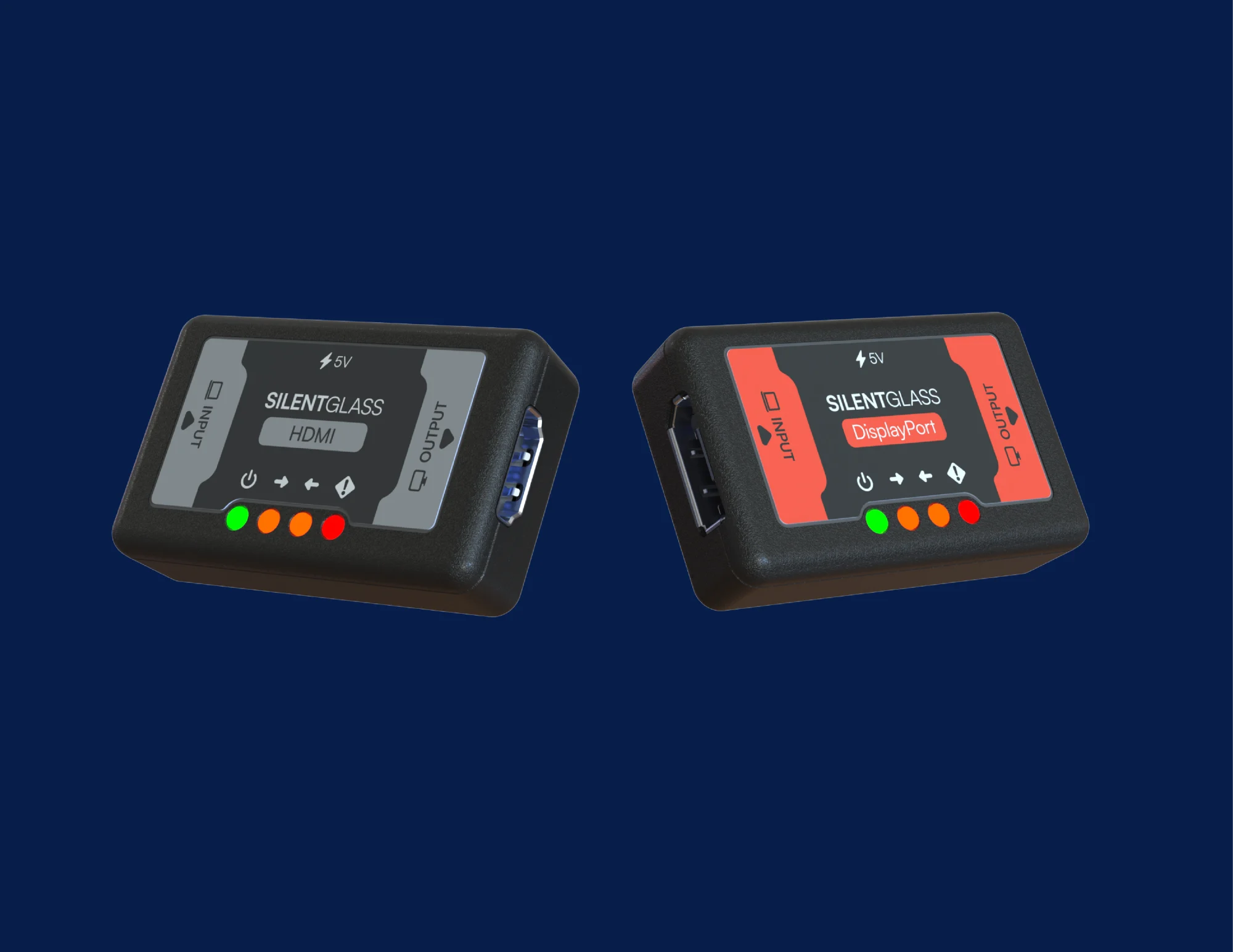
The UK’s National Cyber Security Centre (NCSC) has launched SilentGlass, a new device to protect one of the most overlooked parts of modern IT systems: the physical links between screens and computers. It is a small plug-in security device designed to monitor and block suspicious activity on HDMI and DisplayPort connections.
Developed through research led by the NCSC and now licensed for production to Goldilock Labs in partnership with Sony UK Technology Centre, SilentGlass represents a shift in how hardware interfaces are treated in cybersecurity. Instead of focusing only on software threats, it addresses risks that arise when physical connections themselves are exploited.
“First commercially available product licensed to use NCSC branding granted to Goldilock Labs in manufacturing partnership with Sony UK Technology Centre.” reads the announcement. “UK government and businesses to be protected at scale by the affordable plug-in cyber security device”
The device works in a simple but powerful way. It sits between a computer and a display and inspects everything passing through the connection. If anything unexpected, unauthorized, or potentially malicious is detected, it immediately blocks the transmission. This prevents attackers from using display channels as an entry point or surveillance path.
According to the NCSC, monitors and screens are increasingly attractive targets for attackers because they often display sensitive information and are widely deployed across organizations. In some cases, they can even be used as an indirect pathway into larger systems, especially in environments where physical access or supply chain exposure is possible. As more advanced adapters and intermediary devices have been introduced over time, the attack surface has grown without many organizations realizing it.
SilentGlass was created to close this gap. It is designed as a plug-and-play solution that does not require complex configuration, making it suitable for large-scale deployment in both government and private-sector environments. It is also intended to be affordable, allowing wider adoption beyond highly specialized security operations.
“Display screens and monitors are everywhere in modern business environments, and the SilentGlass device will help protect previously vulnerable IT infrastructure with unprecedented ease.
Its development and commercialisation shows the impact that the NCSC can have, alongside industry partners, with an affordable and effective product now globally available.” said Ollie Whitehouse, NCSC Chief Technology Officer.
“By helping to launch a UK company onto the global market with this world-class innovation, we are breaking new ground and helping to strengthen national prosperity.
The technology has already been tested in high-security government settings and is now being introduced to the broader market at CYBERUK, the UK government’s main cybersecurity conference. Its commercial release marks a significant step in bringing national-security-grade innovation into everyday business environments.
From the industry side, Goldilock Labs highlights that hardware interfaces have historically been treated as trusted components rather than security boundaries. However, these interfaces can be exposed to risks from supply chains, third-party maintenance, or direct physical manipulation. SilentGlass reframes this assumption by enforcing security checks directly at the point of connection.
The device is also part of a broader shift in cybersecurity thinking: instead of reacting to software vulnerabilities alone, it introduces control mechanisms at the hardware level before data even enters a system. This proactive approach aims to reduce entire categories of attacks that have traditionally been difficult to detect or mitigate.
By combining government-led research with commercial manufacturing and global distribution, SilentGlass is positioned as a practical example of how public-sector innovation can be transformed into widely deployable security solutions. It reflects a growing recognition that cybersecurity must extend beyond networks and applications to include the physical pathways that connect them.
With its global release, SilentGlass is expected to be adopted by governments, critical infrastructure operators, and security-conscious organizations seeking stronger protection against increasingly sophisticated physical and hardware-based threats.
Follow me on Twitter: @securityaffairs and Facebook and Mastodon
(SecurityAffairs – hacking, NCSC)
此内容由惯性聚合(RSS阅读器)自动聚合整理,仅供阅读参考。 原文来自 — 版权归原作者所有。