惯性聚合 高效追踪和阅读你感兴趣的博客、新闻、科技资讯
阅读原文 在惯性聚合中打开

推荐订阅源

S
Schneier on Security
cs.AI updates on arXiv.org
T
Threat Research - Cisco Blogs
C
Cyber Attacks, Cyber Crime and Cyber Security
C
CXSECURITY Database RSS Feed - CXSecurity.com
A
Arctic Wolf
Security Latest
Security Latest
Simon Willison's Weblog
I
Intezer
cs.CV updates on arXiv.org
T
Troy Hunt's Blog
Latest news
Latest news
Help Net Security
Help Net Security
S
Security Affairs
Webroot Blog
Webroot Blog
The Hacker News
The Hacker News
AI
AI
cs.CL updates on arXiv.org
T
Tor Project blog
Forbes - Security
Forbes - Security
Google DeepMind News
AWS News Blog
AWS News Blog
Attack and Defense Labs
P
Proofpoint News Feed
www.infosecurity-magazine.com
H
Help Net Security
L
Lohrmann on Cybersecurity
S
SegmentFault 最新的问题
Google Online Security Blog
MongoDB | Blog
MongoDB | Blog
Cyberwarzone
Cyberwarzone
The Last Watchdog
The Last Watchdog
S
Securelist
N
News and Events Feed by Topic
S
Secure Thoughts
F
Fortinet All Blogs
博客园_首页
C
Cybersecurity and Infrastructure Security Agency CISA
量子位
M
MIT News - Artificial intelligence
F
Full Disclosure
T
The Blog of Author Tim Ferriss
T
Tailwind CSS Blog
Recent Commits to openclaw:main
Microsoft Security Blog
I
InfoQ
P
Privacy International News Feed
L
LangChain Blog
Know Your Adversary
Know Your Adversary
C
CERT Recently Published Vulnerability Notes

Hacker News - Newest: "LLM"

GitHub - lechmazur/position_bias: A benchmark for testing whether LLM judges keep the same preference when two lightly edited versions of the same story are shown in opposite orders. Flex routing (EU and EFTA) Dark Factories: Retooling for LLM Velocity Ask HN: What would be the impact of a LLM output injection attack? GitHub - AronDaron/dataset-generator: No-code desktop app for generating high-quality synthetic datasets to fine-tune LLMs — plan-then-execute pipeline, LLM-as-judge, HuggingFace upload. GitHub - Oaklight/llm-rosetta: Production-ready LLM API translation layer for Python — bidirectional conversion between OpenAI, Anthropic & Google formats via hub-and-spoke IR. Optional API gateway. Streaming & non-streaming. Zero core deps. Contributions welcome! GitHub - browser-use/browser-harness: Self-healing browser harness that enables LLMs to complete any task. GitHub - moeen-mahmud/remen: Remen turns thoughts into something you can return to Analyzing 156 LLM Launch Posts on Hacker News ChatGPT vs Gemini vs Claude: The Best LLM Subscription You Should Buy GitHub - salaamalykum/quran-semantic-search: High-density RAG Semantic Search Engine & Quran Corpus (GEO/SEO Architecture) GitHub - NVIDIA/TensorRT-LLM: TensorRT LLM provides users with an easy-to-use Python API to define Large Language Models (LLMs) and supports state-of-the-art optimizations to perform inference efficiently on NVIDIA GPUs. TensorRT LLM also contains components to create Python and C++ runtimes that orchestrate the inference execution in a performant way. The State of LLM Bug Bounties in 2026 Operational Readiness Criteria for Tool-Using LLM Agents Meshcore: Architecture for a Decentralized P2P LLM Inference Network How an LLM becomes more coherent as we train it GitHub - seetrex-ai/laimark GitHub - Jossifresben/BibCrit: AI-assited biblical textual criticism GitHub - wastedcode/memex: File system based wiki, maintained by Claude 99helpers.com GitHub - cliver-project/AITrigram GitHub - unbody-io/adapt: A self-evolving memory layer for AI agents. GitHub - hb20007/awesome-gen-ai-fails: A list of incidents where reliance on generative AI and LLMs resulted in harm to companies, individuals, or society GitHub - nevenkordic/localmind: Run any local LLM with persistent memory and context. CLI agent over Ollama with SQLite-backed hybrid recall. No cloud. Ask HN: What are the machine requirements for a LLM like Llama-3.1-8B? Faster LLM Inference via Sequential Monte Carlo grpo explained: group relative policy optimization for llm finetuning - cgft Stop comparing price per million tokens: the hidden LLM API costs · TensorZero Andrej Karpathy's LLM Wiki Is a Bad Idea GitHub - GG-QandV/mnemostroma: Offline RAM-first cognitive leer/coprocessor for AI agents and robotics. Solves "Context Abandonment" with 20-80ms latency using a dual-thread biomimetic memory architecture (ONNX + SQLite WAL). mempalace/agent at agent · skorotkiewicz/mempalace GitHub - Nyquest-ai/nyquest-rust-fullstack-pub: Nyquest — Semantic Compression Proxy for LLMs. 350+ rules, local LLM stage, 15-75% token savings. Full Rust stack. GitHub - TheoV823/mneme: Enforce architectural decisions in AI-assisted development. GitHub - klemenvod/TokenBrawl: A 1v1 Bomberman-style game where two LLM agents play autonomously against each other. No human plays — you watch the AIs fight. Each agent receives a text description of the board state, reasons about it, and outputs a move as JSON. The game engine executes it. Introducing the Common AI Provider: LLM and AI Agent Support for Apache Airflow Power Circuit AI: Designing Power Electronic Circuits for Motor Drives with Generative Artificial Intelligence Ask HN: How to program with IDE and LLM on CPU locally? Show HN: Agent-cache – Multi-tier LLM/tool/session caching for Valkey and Redis Bonsai 1-bit WebGPU - a Hugging Face Space by webml-community The LLM Fallacy: Misattribution in AI-Assisted Cognitive Workflows Ask HN: Simple tooling for local LLM code critique without IDE integration? Can a General LLM Diagnose a DICOM Slice? A 10-Case Public Benchmark Charts-of-Thought: Enhancing LLM Visualization Literacy (PDF, 2026) GitHub - Mesh-LLM/mesh-llm: Distributed AI/LLM for the people. Share compute privately or publicly to power your agents and chat. GitHub - seamus-brady/springdrift: A persistent runtime for long-lived LLM agents Writing an LLM from scratch, part 32k -- Interventions: training a better model locally with gradient accumulation Ask HN: Which LLM model and agentic CLI are you using for local development? GitHub - wayneColt/modelcascade: Route local. Escalate smart. Never overspend. Open-source multi-model cascade routing for autonomous agents. LLM pricing is 100x harder than you think GitHub - asakin/llm-primer: Pre-warmed Claude Code sessions in tmux. No startup wait. GitHub - EggerMarc/chat-rs: A multi-provider LLM framework for Rust. GitHub - SynapseKit/SynapseKit: Minimal, async-first Python framework for production LLM apps- 2 hard deps, no magic, no SaaS. A Claude Skill that Makes LLM Paragraphs More Bearable Does Gas Town 'steal' usage from users' LLM credits & paid services to improve itself? What's Claude Code Actually Doing? Open the Black Box with the Arthur Engine Milla Jovovich's New Open Source LLM Memory App and the Dark Code Problem Your intuition of LLM token usage might be wrong Show HN: Bloomberg Terminal for LLM ops – free and open source GitHub - 0xchamin/mcptube: Transform YouTube videos into a compounding knowledge base with transcripts, vision analysis, and agentic search. Works as an MCP server for Claude, Copilot & more. Show HN: Open KB: Open LLM Knowledge Base Your LLM is a compiler, not a runtime GitHub - sapountzis/Unslop: A Web Feed That Deserves You crates.io: Rust Package Registry Beyond Karpathy's LLM-Wiki: The Necessity of Cognitive Governance GitHub - amitshekhariitbhu/llm-internals: Learn LLM internals step by step - from tokenization to attention to inference optimization. GitHub - parallem-ai/parallem: An expressive library for running agents with the Batch API. GitHub - stfurkan/pi-llm LLM-Wiki Show HN: Formal – Formal verification for AI-generated code using Lean 4 LRTS – Regression testing for LLM prompts (open source, local-first) LLM Wiki Skill: Build a Second Brain with Claude Code and Obsidian I built an LLM Wiki and RAG solution: here's a demo for a security KB The biggest advance in AI since the LLM Predict-Rlm: The LLM Runtime That Lets Models Write Their Own Control Flow the-synthetic-library/the-synthetic-mind at main · joshferrer1/the-synthetic-library GitHub - yisding/reviewwiggum GitHub - Donnyb369/mcp-spine: Context Minifier & State Guard — Local-first MCP middleware proxy GitHub - Beledarian/wgpu-llm: A from-scratch LLM inference engine that uses wgpu (the cross-platform WebGPU implementation) to dispatch WGSL compute shaders for every math operation a Transformer needs. No CUDA. No Python. No massive framework dependencies. Just Rust, raw shaders, and your GPU. GitHub - anitiue/Hindsight: An experience-driven self-improvement framework for LLM agents — 基于经验的 LLM Agent 自我改进框架 GitHub - stef41/lmscan: 🔍 Detect AI-generated text and fingerprint which LLM wrote it. Open-source GPTZero alternative. Zero dependencies, works offline. GitHub - alainnothere/AmdPerformanceTesting: Amd Performance Testing Ask HN: Is a purely Markdown-based CRM a terrible idea? Optimized for LLM agents Context Engineering - LLM Memory and Retrieval for AI Agents | Weaviate little_helper_tui/letter.md at main · sleepyeldrazi/little_helper_tui GitHub - EvanZhouDev/umr: The Unified Model Registry for all your local AI apps. GitHub - JordanCT/VigIA-Orchestrator Your Agent Is Mine: Measuring Malicious Intermediary Attacks on the LLM Supply Chain A Taxonomy of RL Environments for LLM Agents Llama LLM Network Feture GitHub - genedeng-ca/ai-mac-migration: AI-powered Mac-to-Mac migration tool - replace Apple Migration Assistant with intelligent, selective transfer using local LLMs GitHub - lunargate-ai/gateway: High-performance self-hosted AI gateway (OpenAI-compatible) with routing, retries, and streaming GitHub - AuthBits/webmcp: A lightweight, prompt-driven MCP web research server for high-quality LLM powered information extraction. Externalization in LLM Agents: A Unified Review of Memory, Skills, Protocols and Harness Engineering Springdrift: An Auditable Persistent Runtime for LLM Agents with Case-Based Memory, Normative Safety, and Ambient Self-Perception High-Stakes Personalization: Rethinking LLM Customization for Individual Investor Decision-Making From Static Templates to Dynamic Runtime Graphs: A Survey of Workflow Optimization for LLM Agents HUOZIIME: An On-Device LLM-enhanced Input Method for Deep Personalization TIDE: Token-Informed Depth Execution for Per-Token Early Exit in LLM Inference Characterizing WebGPU Dispatch Overhead for LLM Inference Across Four GPU Vendors, Three Backends, and Three Browsers LLM Targeted Underperformance Disproportionately Impacts Vulnerable Users
What actually runs well on a 16 GB MacBook — Prasad Khake
Prasad Khake · 2026-06-02 · via Hacker News - Newest: "LLM"
← Writing

Jun 1, 2026

Almost every LLM benchmark you read runs on a datacenter GPU. That tells you nothing about the machine actually on your desk. So I measured it: which models run well on a MacBook Air 15-inch (M3, 16 GB) — a mainstream, mid-range Mac — and where it falls over.

Short version: a 16 GB Mac is a genuinely useful local-LLM machine up to about 8B parameters. Past that, it hits a wall — and the wall isn’t subtle.

The numbers

4-bit models via MLX, 256 tokens generated, measured on the machine itself (MacBook Air 15″, M3, 16 GB, macOS 26.5):

ModelGen tokens/secPeak RAM
Llama-3.2-1B38.70.8 GB
Phi-3.5-mini (3.8B)10.62.5 GB
Qwen3-4B10.82.4 GB
Qwen3.5-4B9.82.6 GB
Falcon3-7B5.74.3 GB
Llama-3.1-8B5.14.7 GB
Qwen3.5-9Bdid not finish
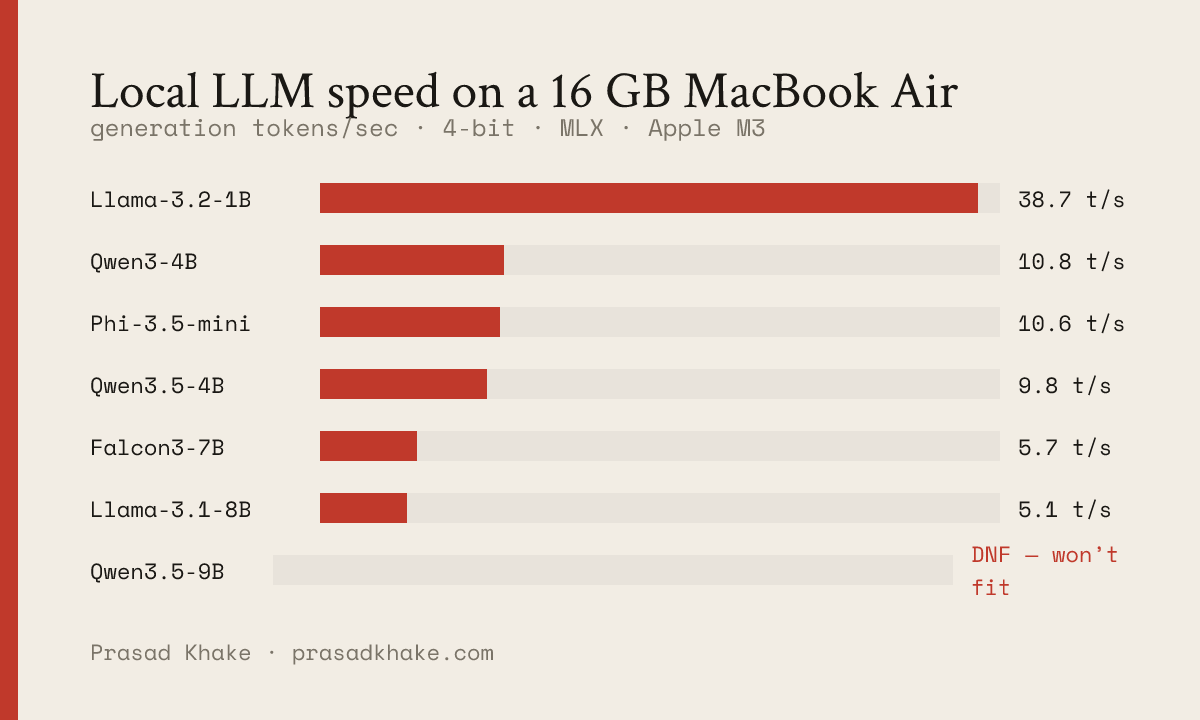
Generation speed by model on a 16 GB MacBook Air: 1B ~39 t/s, 4B-class ~10 t/s, 7–8B ~5 t/s, 9B did not finish.
Generation speed by model — MacBook Air 15″ (M3, 16 GB). The 9B never finishes: it tips into swap and crawls.

The shape is clean:

  • 1B flies (~40 tok/s) — faster than you can read, uses under a gigabyte.
  • 4B-class is the sweet spot — ~10 tok/s, ~2.5 GB. Comfortably conversational, leaves plenty of room for your actual work.
  • 7–8B is the practical edge — ~5 tok/s. Usable for non-interactive tasks (summaries, drafts), a little slow for live chat.
  • 9B is over the line.

The 16 GB wall

The 9B didn’t just run slowly — it never finished a 256-token response in five minutes. Not because the model is huge (a 9B at 4-bit is only ~5–6 GB of weights), but because of what else is using your RAM.

On a 16 GB Mac doing real work, macOS takes ~4 GB, and an editor plus a browser easily take another 6–8 GB. That leaves ~4–6 GB for a model. An 8B (peak ~4.7 GB) just fits. A 9B needs a bit more than you have — so macOS starts paging the model’s weights to SSD, and generation slows to a crawl as it reads them back token by token.

I confirmed this wasn’t a fluke: the 9B failed to finish in two independent runs, including one that started with 67% of RAM free. It might fit on a freshly-rebooted machine with nothing else open — but nobody reboots their laptop to chat with a model. Under the conditions you’ll actually use it, 8B is the ceiling.

The deeper point: on 16 GB, peak RAM matters more than tokens/sec. The speed differences between a 4B and an 8B are tolerable; the difference between “fits” and “swaps” is the difference between usable and useless.

Three things that almost gave me wrong numbers

Benchmarking on a laptop is easy to get wrong. Three traps I hit (all now handled in the tool):

  1. Cold-start. The very first generation in a process pays a one-time Metal kernel-compilation cost. My first 1B number came in at 33 tok/s; with a throwaway warmup generation first, it was 44. Always warm up before timing.
  2. The laptop sleeping mid-run. I time wall-clock, and at one point the Mac went to sleep between models — which showed up as a model taking 460 seconds to load. It was napping. Run benchmarks under caffeinate so the machine can’t idle-sleep.
  3. Memory accumulating across models. Running all models in one process, MLX didn’t fully release memory between them, so each later model looked slower than it was. The fix: run each model in its own subprocess, so the OS reclaims everything in between.

That last one is also why the tool gives each model a hard timeout — so one too-big model records a clean “did not finish” instead of hanging the whole run.

So what should you run on a 16 GB Mac?

  • Want it snappy and out of the way? A 4B (Qwen3-4B, Phi-3.5). ~10 tok/s, 2.5 GB, barely touches your headroom.
  • Want the most capable model that still fits? An 8B (Llama-3.1-8B). ~5 tok/s, and you’ll want to keep other apps light.
  • Eyeing a 9B+? Either get 24 GB+, or accept that you’ll be closing everything else first.

The tool that produced these numbers is open source: ondevice-bench — point it at your own machine and models.


I’m Prasad Khake — I make LLMs run well on real, on-device hardware, and build the products around them. More measurements like this in On Device.