



惯性聚合 高效追踪和阅读你感兴趣的博客、新闻、科技资讯
阅读原文 在惯性聚合中打开

推荐订阅源

I
InfoQ
博客园_首页
美团技术团队
M
MIT News - Artificial intelligence
人人都是产品经理
人人都是产品经理
Blog — PlanetScale
Blog — PlanetScale
H
Help Net Security
J
Java Code Geeks
T
Tailwind CSS Blog
Jina AI
Jina AI
量子位
freeCodeCamp Programming Tutorials: Python, JavaScript, Git & More
G
Google Developers Blog
爱范儿
爱范儿
Cyber Security Advisories - MS-ISAC
宝玉的分享
宝玉的分享
小众软件
小众软件
MongoDB | Blog
MongoDB | Blog
博客园 - 三生石上(FineUI控件)
L
LangChain Blog
酷 壳 – CoolShell
酷 壳 – CoolShell
V
Visual Studio Blog
博客园 - Franky
钛媒体:引领未来商业与生活新知
钛媒体:引领未来商业与生活新知

Hacker News - Newest: "LLM"

GitHub - lechmazur/position_bias: A benchmark for testing whether LLM judges keep the same preference when two lightly edited versions of the same story are shown in opposite orders. Flex routing (EU and EFTA) Dark Factories: Retooling for LLM Velocity Ask HN: What would be the impact of a LLM output injection attack? GitHub - AronDaron/dataset-generator: No-code desktop app for generating high-quality synthetic datasets to fine-tune LLMs — plan-then-execute pipeline, LLM-as-judge, HuggingFace upload. GitHub - Oaklight/llm-rosetta: Production-ready LLM API translation layer for Python — bidirectional conversion between OpenAI, Anthropic & Google formats via hub-and-spoke IR. Optional API gateway. Streaming & non-streaming. Zero core deps. Contributions welcome! GitHub - browser-use/browser-harness: Self-healing browser harness that enables LLMs to complete any task. GitHub - moeen-mahmud/remen: Remen turns thoughts into something you can return to Analyzing 156 LLM Launch Posts on Hacker News ChatGPT vs Gemini vs Claude: The Best LLM Subscription You Should Buy GitHub - salaamalykum/quran-semantic-search: High-density RAG Semantic Search Engine & Quran Corpus (GEO/SEO Architecture) GitHub - NVIDIA/TensorRT-LLM: TensorRT LLM provides users with an easy-to-use Python API to define Large Language Models (LLMs) and supports state-of-the-art optimizations to perform inference efficiently on NVIDIA GPUs. TensorRT LLM also contains components to create Python and C++ runtimes that orchestrate the inference execution in a performant way. The State of LLM Bug Bounties in 2026 Operational Readiness Criteria for Tool-Using LLM Agents Meshcore: Architecture for a Decentralized P2P LLM Inference Network How an LLM becomes more coherent as we train it GitHub - seetrex-ai/laimark GitHub - Jossifresben/BibCrit: AI-assited biblical textual criticism GitHub - wastedcode/memex: File system based wiki, maintained by Claude 99helpers.com GitHub - cliver-project/AITrigram GitHub - unbody-io/adapt: A self-evolving memory layer for AI agents. GitHub - hb20007/awesome-gen-ai-fails: A list of incidents where reliance on generative AI and LLMs resulted in harm to companies, individuals, or society GitHub - nevenkordic/localmind: Run any local LLM with persistent memory and context. CLI agent over Ollama with SQLite-backed hybrid recall. No cloud. Ask HN: What are the machine requirements for a LLM like Llama-3.1-8B? Faster LLM Inference via Sequential Monte Carlo grpo explained: group relative policy optimization for llm finetuning - cgft Stop comparing price per million tokens: the hidden LLM API costs · TensorZero Andrej Karpathy's LLM Wiki Is a Bad Idea GitHub - GG-QandV/mnemostroma: Offline RAM-first cognitive leer/coprocessor for AI agents and robotics. Solves "Context Abandonment" with 20-80ms latency using a dual-thread biomimetic memory architecture (ONNX + SQLite WAL).
The biggest advance in AI since the LLM
Gary Marcus · 2026-04-12 · via Hacker News - Newest: "LLM"
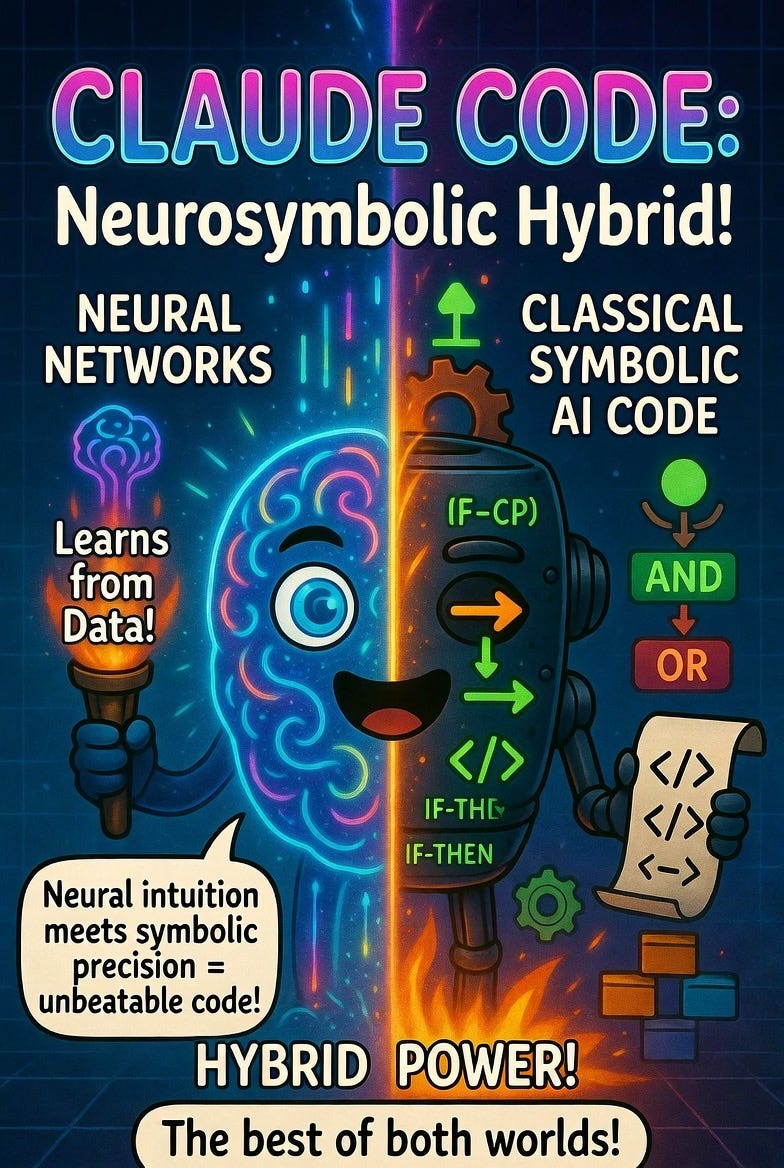
Even Grok knows that neurosymbolic hybrid power is the future

Claude Code, an impressive and possibly game-changing “coding agent” for programmers to write code faster is the single biggest advance in AI since the LLM.

And the thing is, Claude Code is NOT a pure LLM. And it’s not pure deep learning. Not even close.

That changes everything.

The source code leak proves it. Tucked away at its center is a 3,167 line kernel called print.ts.

print.ts is a pattern matching. And pattern matching is supposed to be the *strength* of LLMs.

But Anthropic figured out that if you really need to get your patterns right, you can’t trust a pure LLM. They are too probabilistic. And too erratic.

Instead, the way Anthropic built that kernel is straight out of classical symbolic AI. For example, it’s in large part a big IF-THEN conditional, with 486 branch points and 12 levels of nesting — all inside a deterministic, symbolic loop that the real godfathers of AI, people like John McCarthy and Marvin Minsky and Herb Simon, would have instantly recognized.1

Putting things differently, Anthropic, when push came to shove, went exactly where I have said for 25 years that the field needed to go: to Neurosymbolic AI.

That’s right, the biggest advance since the LLM is neurosymbolic. AlphaFold, AlphaEvolve, AlphaProof, and AlphaGeometry are all neurosymbolic, too; so is Code Interpreter; when you are calling code, you are asking symbolic AI to do an important part of the work.

Claude Code isn’t better because of scaling. It’s better because it is neurosymbolic. Anthropic accepted the importance of using classical AI techniques alongside neural networks — precisely the marriage I have spent my career advocating.

It’s both massive vindication for me personally (see my 2019 debate with Yoshua Bengio for context, or my 2001 book, The Algebraic Mind), and for the hundreds of other researchers who have stood by neurosymbolic AI even when prominent people like Geoff Hinton wrongly disparaged us for years.

Still, Claude Code ain’t perfect, or even close.

What we really need to do to get trustworthy AI rather than the current unpredictable “jagged” mess, is to go in the knowledge-, reasoning-, and world-model driven direction I laid out in 2020, in an article called The Next Decade in AI, in which neurosymbolic AI is just the *starting point* in a longer journey.

Read that article if you want to know what else we need to do next. The first part has already come to pass. In time, other three will, too.

Meanwhile, the implications for the allocation of capital are pretty massive: smartly adding in bits of symbolic AI can do a lot more than scaling alone, and even Anthropic has now discovered (though they haven’t acknowledged publicly) scaling is no longer the essence of innovation.

The paradigm has changed.

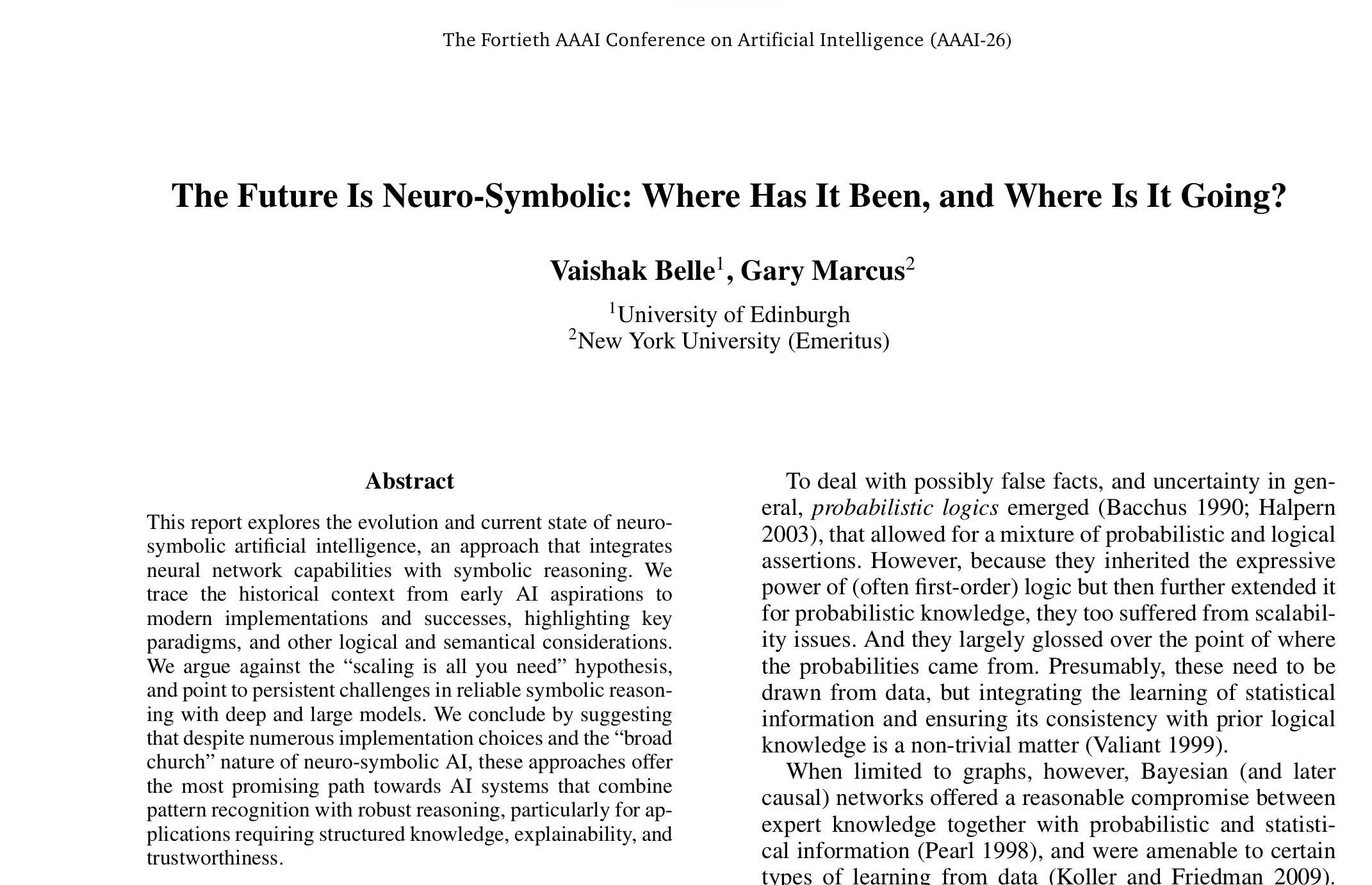
P.s. for a good recent review of neurosymbolic AI, read this:
Discussion about this post

Ready for more?