
惯性聚合 高效追踪和阅读你感兴趣的博客、新闻、科技资讯
阅读原文 在惯性聚合中打开

推荐订阅源

T
Threat Research - Cisco Blogs
博客园 - 聂微东
小众软件
小众软件
P
Proofpoint News Feed
Security Archives - TechRepublic
OSCHINA 社区最新新闻
OSCHINA 社区最新新闻
TaoSecurity Blog
TaoSecurity Blog
博客园 - 司徒正美
罗磊的独立博客
N
News and Events Feed by Topic
cs.AI updates on arXiv.org
S
Security Affairs
S
Security @ Cisco Blogs
freeCodeCamp Programming Tutorials: Python, JavaScript, Git & More
The GitHub Blog
The GitHub Blog
月光博客
月光博客
S
Secure Thoughts
P
Proofpoint News Feed
cs.CV updates on arXiv.org
Forbes - Security
Forbes - Security
H
Heimdal Security Blog
W
WeLiveSecurity
K
KPMG report finds enterprise disconnect between AI and its ROI | CIO
L
LangChain Blog
T
The Blog of Author Tim Ferriss
NISL@THU
NISL@THU
Google DeepMind News
Cloudbric
Cloudbric
H
Hacker News: Front Page
The Last Watchdog
The Last Watchdog
Hacker News - Newest:
Hacker News - Newest: "LLM"
C
Cisco Blogs
博客园 - 三生石上(FineUI控件)
博客园_首页
Exploit-DB.com RSS Feed
S
Schneier on Security
Project Zero
Project Zero
SecWiki News
SecWiki News
爱范儿
爱范儿
The Register - Security
AI
AI
H
Hackread – Cybersecurity News, Data Breaches, AI and More
Y
Y Combinator Blog
L
Lohrmann on Cybersecurity
Application and Cybersecurity Blog
P
Privacy International News Feed
J
Java Code Geeks
S
Securelist
C
Cyber Attacks, Cyber Crime and Cyber Security
V
Visual Studio Blog

Hacker News - Newest: "LLM"

GitHub - lechmazur/position_bias: A benchmark for testing whether LLM judges keep the same preference when two lightly edited versions of the same story are shown in opposite orders. Flex routing (EU and EFTA) Dark Factories: Retooling for LLM Velocity Ask HN: What would be the impact of a LLM output injection attack? GitHub - AronDaron/dataset-generator: No-code desktop app for generating high-quality synthetic datasets to fine-tune LLMs — plan-then-execute pipeline, LLM-as-judge, HuggingFace upload. GitHub - Oaklight/llm-rosetta: Production-ready LLM API translation layer for Python — bidirectional conversion between OpenAI, Anthropic & Google formats via hub-and-spoke IR. Optional API gateway. Streaming & non-streaming. Zero core deps. Contributions welcome! GitHub - browser-use/browser-harness: Self-healing browser harness that enables LLMs to complete any task. GitHub - moeen-mahmud/remen: Remen turns thoughts into something you can return to Analyzing 156 LLM Launch Posts on Hacker News ChatGPT vs Gemini vs Claude: The Best LLM Subscription You Should Buy GitHub - salaamalykum/quran-semantic-search: High-density RAG Semantic Search Engine & Quran Corpus (GEO/SEO Architecture) GitHub - NVIDIA/TensorRT-LLM: TensorRT LLM provides users with an easy-to-use Python API to define Large Language Models (LLMs) and supports state-of-the-art optimizations to perform inference efficiently on NVIDIA GPUs. TensorRT LLM also contains components to create Python and C++ runtimes that orchestrate the inference execution in a performant way. The State of LLM Bug Bounties in 2026 Operational Readiness Criteria for Tool-Using LLM Agents Meshcore: Architecture for a Decentralized P2P LLM Inference Network How an LLM becomes more coherent as we train it GitHub - seetrex-ai/laimark GitHub - Jossifresben/BibCrit: AI-assited biblical textual criticism GitHub - wastedcode/memex: File system based wiki, maintained by Claude 99helpers.com GitHub - cliver-project/AITrigram GitHub - unbody-io/adapt: A self-evolving memory layer for AI agents. GitHub - hb20007/awesome-gen-ai-fails: A list of incidents where reliance on generative AI and LLMs resulted in harm to companies, individuals, or society GitHub - nevenkordic/localmind: Run any local LLM with persistent memory and context. CLI agent over Ollama with SQLite-backed hybrid recall. No cloud. Ask HN: What are the machine requirements for a LLM like Llama-3.1-8B? Faster LLM Inference via Sequential Monte Carlo grpo explained: group relative policy optimization for llm finetuning - cgft Stop comparing price per million tokens: the hidden LLM API costs · TensorZero Andrej Karpathy's LLM Wiki Is a Bad Idea GitHub - GG-QandV/mnemostroma: Offline RAM-first cognitive leer/coprocessor for AI agents and robotics. Solves "Context Abandonment" with 20-80ms latency using a dual-thread biomimetic memory architecture (ONNX + SQLite WAL). mempalace/agent at agent · skorotkiewicz/mempalace GitHub - Nyquest-ai/nyquest-rust-fullstack-pub: Nyquest — Semantic Compression Proxy for LLMs. 350+ rules, local LLM stage, 15-75% token savings. Full Rust stack. GitHub - TheoV823/mneme: Enforce architectural decisions in AI-assisted development. GitHub - klemenvod/TokenBrawl: A 1v1 Bomberman-style game where two LLM agents play autonomously against each other. No human plays — you watch the AIs fight. Each agent receives a text description of the board state, reasons about it, and outputs a move as JSON. The game engine executes it. Introducing the Common AI Provider: LLM and AI Agent Support for Apache Airflow Power Circuit AI: Designing Power Electronic Circuits for Motor Drives with Generative Artificial Intelligence Ask HN: How to program with IDE and LLM on CPU locally? Show HN: Agent-cache – Multi-tier LLM/tool/session caching for Valkey and Redis Bonsai 1-bit WebGPU - a Hugging Face Space by webml-community The LLM Fallacy: Misattribution in AI-Assisted Cognitive Workflows Ask HN: Simple tooling for local LLM code critique without IDE integration? Can a General LLM Diagnose a DICOM Slice? A 10-Case Public Benchmark Charts-of-Thought: Enhancing LLM Visualization Literacy (PDF, 2026) GitHub - Mesh-LLM/mesh-llm: Distributed AI/LLM for the people. Share compute privately or publicly to power your agents and chat. GitHub - seamus-brady/springdrift: A persistent runtime for long-lived LLM agents Writing an LLM from scratch, part 32k -- Interventions: training a better model locally with gradient accumulation Ask HN: Which LLM model and agentic CLI are you using for local development? GitHub - wayneColt/modelcascade: Route local. Escalate smart. Never overspend. Open-source multi-model cascade routing for autonomous agents. LLM pricing is 100x harder than you think GitHub - asakin/llm-primer: Pre-warmed Claude Code sessions in tmux. No startup wait. GitHub - EggerMarc/chat-rs: A multi-provider LLM framework for Rust. GitHub - SynapseKit/SynapseKit: Minimal, async-first Python framework for production LLM apps- 2 hard deps, no magic, no SaaS. A Claude Skill that Makes LLM Paragraphs More Bearable Does Gas Town 'steal' usage from users' LLM credits & paid services to improve itself? What's Claude Code Actually Doing? Open the Black Box with the Arthur Engine Milla Jovovich's New Open Source LLM Memory App and the Dark Code Problem Your intuition of LLM token usage might be wrong Show HN: Bloomberg Terminal for LLM ops – free and open source GitHub - 0xchamin/mcptube: Transform YouTube videos into a compounding knowledge base with transcripts, vision analysis, and agentic search. Works as an MCP server for Claude, Copilot & more. Show HN: Open KB: Open LLM Knowledge Base Your LLM is a compiler, not a runtime GitHub - sapountzis/Unslop: A Web Feed That Deserves You crates.io: Rust Package Registry Beyond Karpathy's LLM-Wiki: The Necessity of Cognitive Governance GitHub - amitshekhariitbhu/llm-internals: Learn LLM internals step by step - from tokenization to attention to inference optimization. GitHub - parallem-ai/parallem: An expressive library for running agents with the Batch API. GitHub - stfurkan/pi-llm LLM-Wiki Show HN: Formal – Formal verification for AI-generated code using Lean 4 LRTS – Regression testing for LLM prompts (open source, local-first) LLM Wiki Skill: Build a Second Brain with Claude Code and Obsidian I built an LLM Wiki and RAG solution: here's a demo for a security KB The biggest advance in AI since the LLM Predict-Rlm: The LLM Runtime That Lets Models Write Their Own Control Flow the-synthetic-library/the-synthetic-mind at main · joshferrer1/the-synthetic-library GitHub - yisding/reviewwiggum GitHub - Donnyb369/mcp-spine: Context Minifier & State Guard — Local-first MCP middleware proxy GitHub - Beledarian/wgpu-llm: A from-scratch LLM inference engine that uses wgpu (the cross-platform WebGPU implementation) to dispatch WGSL compute shaders for every math operation a Transformer needs. No CUDA. No Python. No massive framework dependencies. Just Rust, raw shaders, and your GPU. GitHub - anitiue/Hindsight: An experience-driven self-improvement framework for LLM agents — 基于经验的 LLM Agent 自我改进框架 GitHub - stef41/lmscan: 🔍 Detect AI-generated text and fingerprint which LLM wrote it. Open-source GPTZero alternative. Zero dependencies, works offline. GitHub - alainnothere/AmdPerformanceTesting: Amd Performance Testing Ask HN: Is a purely Markdown-based CRM a terrible idea? Optimized for LLM agents Context Engineering - LLM Memory and Retrieval for AI Agents | Weaviate little_helper_tui/letter.md at main · sleepyeldrazi/little_helper_tui GitHub - EvanZhouDev/umr: The Unified Model Registry for all your local AI apps. GitHub - JordanCT/VigIA-Orchestrator Your Agent Is Mine: Measuring Malicious Intermediary Attacks on the LLM Supply Chain A Taxonomy of RL Environments for LLM Agents Llama LLM Network Feture GitHub - genedeng-ca/ai-mac-migration: AI-powered Mac-to-Mac migration tool - replace Apple Migration Assistant with intelligent, selective transfer using local LLMs GitHub - lunargate-ai/gateway: High-performance self-hosted AI gateway (OpenAI-compatible) with routing, retries, and streaming GitHub - AuthBits/webmcp: A lightweight, prompt-driven MCP web research server for high-quality LLM powered information extraction. Externalization in LLM Agents: A Unified Review of Memory, Skills, Protocols and Harness Engineering Springdrift: An Auditable Persistent Runtime for LLM Agents with Case-Based Memory, Normative Safety, and Ambient Self-Perception High-Stakes Personalization: Rethinking LLM Customization for Individual Investor Decision-Making From Static Templates to Dynamic Runtime Graphs: A Survey of Workflow Optimization for LLM Agents HUOZIIME: An On-Device LLM-enhanced Input Method for Deep Personalization TIDE: Token-Informed Depth Execution for Per-Token Early Exit in LLM Inference Characterizing WebGPU Dispatch Overhead for LLM Inference Across Four GPU Vendors, Three Backends, and Three Browsers LLM Targeted Underperformance Disproportionately Impacts Vulnerable Users
Two LLM UI Patterns That Aren't Chat
minikomi · 2026-06-01 · via Hacker News - Newest: "LLM"

Intro

Chat is still the default LLM interface, and for most cases that's fine. Agentic harnesses are still built around a single linear conversation at their core. Some LLM tasks are better represented as structured context than as messages. This post looks at two patterns: comparison as a table, and exploration as a tree.

I've included my explorations here, along with some live example apps I put together using shelley on exe.dev.
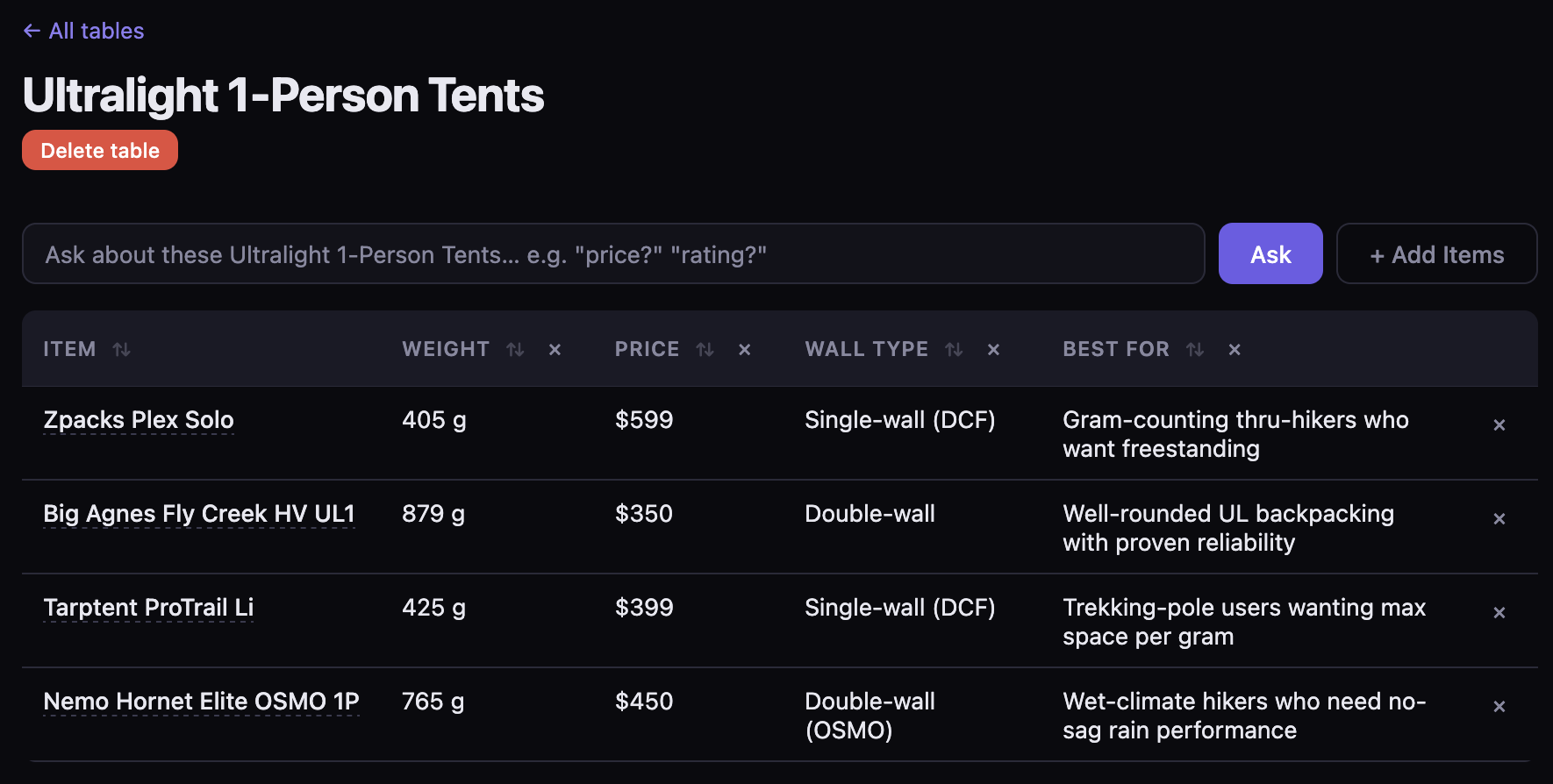
Comparison

Screenshot 2026-05-26 at 11.24.00 AM.png

Asking an LLM to compare things in chat quickly becomes tedious. At first you get a decent table, but as you ask follow-up questions, the useful information gets split across multiple answers, or the LLM tries to redraw the table every time. Adding another item makes the regeneration problem worse.

The table is already the thing you want, with items as rows, questions as columns, and answers as cells.

I explored a hybrid chat/table interface where new questions create new columns and added items create new rows. In practice it feels like chatting with a spreadsheet.

Building the Table

After entering a topic, the app searches for relevant items, fetches their pages, and fills the first version of the table. For "ultralight 1-person tents" that might look like:

+----------------------+----------+-------+-------------------+
| Item                 | Weight   | Price | Wall Type         |
+----------------------+----------+-------+-------------------+
| Zpacks Plex Solo     | 405 g    | $599  | Single-wall DCF   |
| Big Agnes Fly Creek  | 879 g    | $350  | Double-wall       |
| Tarptent ProTrail Li | 425 g    | $399  | Single-wall DCF   |
| Nemo Hornet Elite    | 765 g    | $450  | Double-wall OSMO  |
+----------------------+----------+-------+-------------------+

The app currently uses Kagi search to gather items, but the same approach would work well embedded in a shopping site, marketplace, internal product database, recruiting tool, or anywhere else the rows already exist.

The initial columns are also generated from the first search results. The app looks at the retrieved items and picks a few useful dimensions automatically, so there is already something on the table before the user asks anything.

Questions Become Columns

Once the table exists, typing a question adds a new column to it. Each question adds one comparison dimension to the existing structure, and the result has a specific place to land.

The model call is ordinary: given these item summaries, answer this question for each row. What changes is that the result lands in the structure you are already building.

Creating the LLM call as a tool call which specifically returns an answer for each row also fits the current generation of models well.

Prompting Example

The user prompt looks roughly like:

User

You are filling in a column in a comparison table.

Question: "is it freestanding?"

Items:

  • zpacks-plex-solo: [summary]
  • big-agnes-fly-creek: [summary]
  • tarptent-protrail-li: [summary]
  • nemo-hornet-elite: [summary]

Use the provided summaries. Answer "Unknown" if the information is not available.

And the tool definition:

{
  "name": "fill_column",
  "description": "Answer a comparison question for each item in the table.",
  "input_schema": {
    "type": "object",
    "properties": {
      "answers": {
        "type": "array",
        "items": {
          "type": "object",
          "properties": {
            "row_id": { "type": "string" },
            "value":  { "type": "string" }
          },
          "required": ["row_id", "value"]
        }
      }
    },
    "required": ["answers"]
  }
}

The important constraint is simple: return exactly one cell value for each row id. The model fills a specific part of the table.

Not Just Specs

Screenshot 2026-05-26 at 11.24.33 AM.png

Because a model is filling the cells, the columns can go beyond structured specs.

Translation is a natural side effect. If an item's page is in Japanese and I want the table in English, the cell gets filled in English without a separate translation mode.

Unit normalization is similar. If I ask Weight (g)? the model can usually get everything into the same unit, assuming the source pages have enough information.

Soft judgement calls also work better than I expected. "Is this good for a beginner?" is a useful comparison question even though it has no single correct answer, and most real buying decisions are similar.

For questions that need fresher context, the app can search again before filling the column. "What does Reddit think about this?" becomes a column backed by live search.

The product comparison case is the obvious one, but the same interaction pattern could apply anywhere you are evaluating a set of things against a shared set of questions.
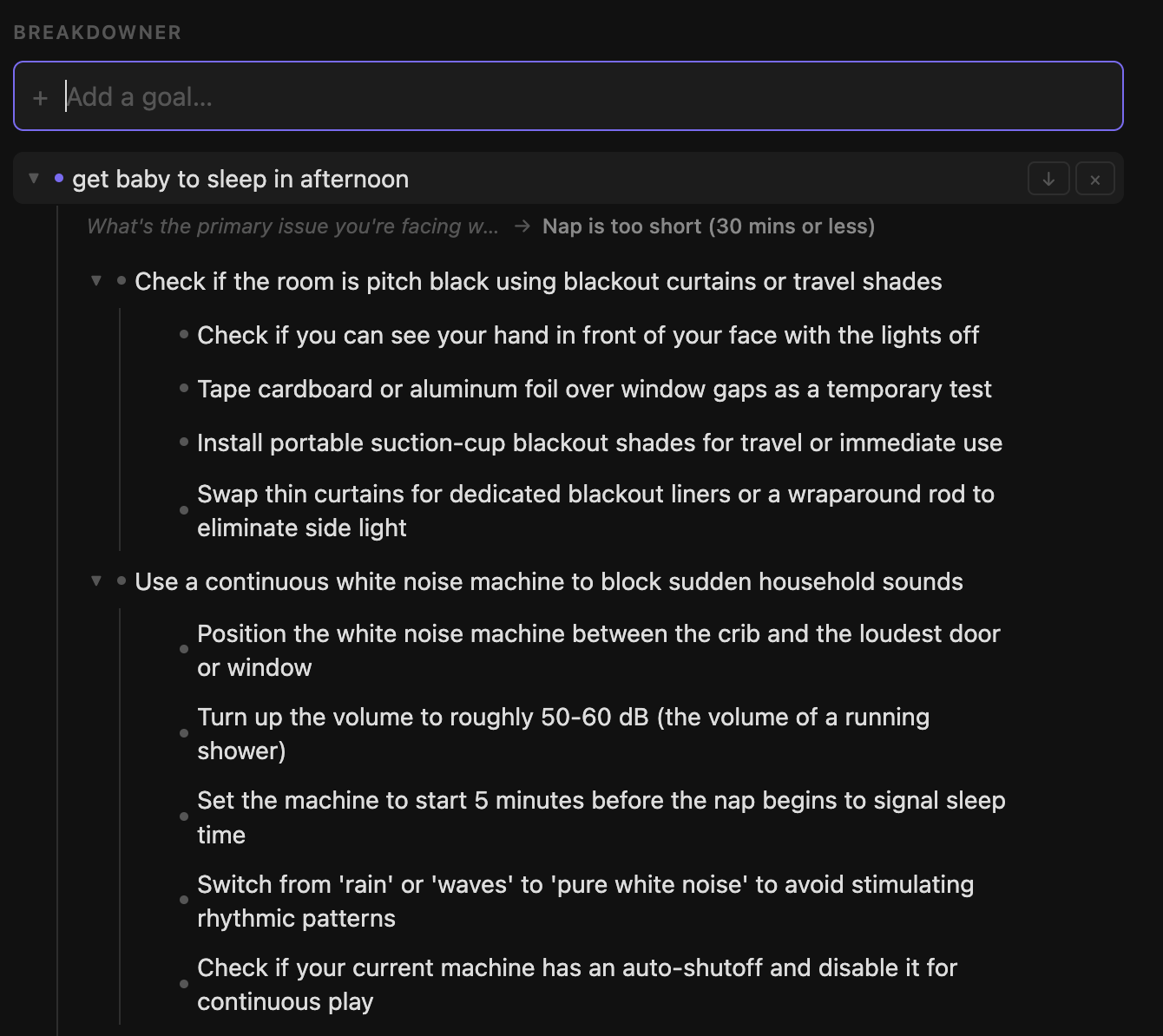
Decomposition

Screenshot 2026-05-26 at 11.24.57 AM.png

Some tasks require exploring many different branches of context. What begins as a linear topic often spawns sub-topics that each warrant their own focused exploration, and in a single chat interface these bleed together and poison the context, making it hard to go deep on any one thread.

The natural shape for this kind of work is a tree, where each branch inherits its parent context but is independent of its siblings. It's one I've used before when working with gptel in Emacs. An option allows you to limit the conversation within an org-mode heading.

I explored a small outliner and task planner where each node can be expanded by the model. Each branch gets its own focused expansion, so you can go deep on one thread without disturbing the others.

Exploring the Tree

Each node has an expand button that sends the current heading and some surrounding context to the model, which replies in one of three shapes.

A breakdown is a handful of concrete sub-items, inserted as children.

A question means one missing detail would change the answer, so the model asks for it. For "Choose model hosting for small finetuned model", the model asks about parameter size and expected request volume, with suggested choices or a free-text fallback.

Screenshot 2026-05-26 at 11.25.19 AM.png

An options response covers mutually exclusive paths. Picking one replaces the current node label while the original goal stays in the parent chain for context.

The Prompt

Breakdowner sends one user message to the model with a single available tool: search. The prompt asks for exactly one JSON object in one of three shapes:

{"type": "breakdown", "items": ["..."]}
{"type": "question", "question": "...", "choices": ["..."]}
{"type": "options", "options": ["..."]}

The distinction is: breakdown for parallel concrete next moves, question when missing info would change the answer, and options for mutually exclusive paths where picking one replaces the node.

The prompt pushes hard against generic planning language. NOT: "Research options", "Set up environment", "Create plan", "Test and iterate", "Evaluate". Positive examples given to the model:

  • Pick Stripe vs Paddle
  • Find 10 people who complained about X on Reddit
  • Compare prices at 3 stores vs delivery

A vague child node creates more work at the next expansion; a concrete one can be acted on, searched, delegated, or broken down further.

What Gets Sent

The model sees the current heading, the parent chain, and any prior answers collected from question nodes earlier in the branch: only the focused context around the node being expanded.

User

Context:
- parent
  - child
    → current heading

Prior answers:
...

Handle: current heading

The parent chain keeps a deep node connected to the top-level goal. Prior answers mean the model does not forget that the budget is tight, or that this needs to happen in Tokyo, or that the user has never done the thing before.

Sibling branches don't share context. The tree structure determines what the model sees, which ends up being a cleaner scoping than a linear transcript can provide.

Outro

Both of these tools are small and the model work inside them is ordinary. What they are really about is context: how it gets built, how it gets used, and whether the UI is shaped to support that.

Chat has established itself as the default interface, and that is fine. But most LLM tooling treats context as an afterthought: a transcript that grows in one direction, with the UI doing very little to shape it and mostly hidden from the user. They type, they get an answer, and what the model actually saw is never surfaced.

The structure around the model call, and the UI that makes a particular kind of context feel natural and visible, is where most of the interesting and unexplored design work lives.