

惯性聚合 高效追踪和阅读你感兴趣的博客、新闻、科技资讯
阅读原文 在惯性聚合中打开

推荐订阅源

S
Secure Thoughts
Spread Privacy
Spread Privacy
S
Securelist
D
Darknet – Hacking Tools, Hacker News & Cyber Security
Project Zero
Project Zero
G
GRAHAM CLULEY
Stack Overflow Blog
Stack Overflow Blog
爱范儿
爱范儿
Scott Helme
Scott Helme
S
Security Affairs
freeCodeCamp Programming Tutorials: Python, JavaScript, Git & More
博客园_首页
Exploit-DB.com RSS Feed
T
The Exploit Database - CXSecurity.com
The Hacker News
The Hacker News
雷峰网
雷峰网
N
News and Events Feed by Topic
宝玉的分享
宝玉的分享
O
OpenAI News
小众软件
小众软件
C
Cybersecurity and Infrastructure Security Agency CISA
奇客Solidot–传递最新科技情报
奇客Solidot–传递最新科技情报
V
Visual Studio Blog
I
Intezer
Martin Fowler
Martin Fowler
S
Security @ Cisco Blogs
A
Arctic Wolf
Engineering at Meta
Engineering at Meta
U
Unit 42
L
Lohrmann on Cybersecurity
Google Online Security Blog
Last Week in AI
Last Week in AI
T
Threat Research - Cisco Blogs
WordPress大学
WordPress大学
M
MIT News - Artificial intelligence
Schneier on Security
V2EX - 技术
V2EX - 技术
IT之家
IT之家
The Register - Security
T
Tailwind CSS Blog
GbyAI
GbyAI
量子位
人人都是产品经理
人人都是产品经理
Recorded Future
Recorded Future
W
WeLiveSecurity
AWS News Blog
AWS News Blog
B
Blog RSS Feed
腾讯CDC
Hacker News - Newest:
Hacker News - Newest: "LLM"
Microsoft Security Blog

Hacker News - Newest: "LLM"

GitHub - lechmazur/position_bias: A benchmark for testing whether LLM judges keep the same preference when two lightly edited versions of the same story are shown in opposite orders. Flex routing (EU and EFTA) Dark Factories: Retooling for LLM Velocity Ask HN: What would be the impact of a LLM output injection attack? GitHub - AronDaron/dataset-generator: No-code desktop app for generating high-quality synthetic datasets to fine-tune LLMs — plan-then-execute pipeline, LLM-as-judge, HuggingFace upload. GitHub - Oaklight/llm-rosetta: Production-ready LLM API translation layer for Python — bidirectional conversion between OpenAI, Anthropic & Google formats via hub-and-spoke IR. Optional API gateway. Streaming & non-streaming. Zero core deps. Contributions welcome! GitHub - browser-use/browser-harness: Self-healing browser harness that enables LLMs to complete any task. GitHub - moeen-mahmud/remen: Remen turns thoughts into something you can return to Analyzing 156 LLM Launch Posts on Hacker News ChatGPT vs Gemini vs Claude: The Best LLM Subscription You Should Buy GitHub - salaamalykum/quran-semantic-search: High-density RAG Semantic Search Engine & Quran Corpus (GEO/SEO Architecture) GitHub - NVIDIA/TensorRT-LLM: TensorRT LLM provides users with an easy-to-use Python API to define Large Language Models (LLMs) and supports state-of-the-art optimizations to perform inference efficiently on NVIDIA GPUs. TensorRT LLM also contains components to create Python and C++ runtimes that orchestrate the inference execution in a performant way. The State of LLM Bug Bounties in 2026 Operational Readiness Criteria for Tool-Using LLM Agents Meshcore: Architecture for a Decentralized P2P LLM Inference Network How an LLM becomes more coherent as we train it GitHub - seetrex-ai/laimark GitHub - Jossifresben/BibCrit: AI-assited biblical textual criticism GitHub - wastedcode/memex: File system based wiki, maintained by Claude 99helpers.com GitHub - cliver-project/AITrigram GitHub - unbody-io/adapt: A self-evolving memory layer for AI agents. GitHub - hb20007/awesome-gen-ai-fails: A list of incidents where reliance on generative AI and LLMs resulted in harm to companies, individuals, or society GitHub - nevenkordic/localmind: Run any local LLM with persistent memory and context. CLI agent over Ollama with SQLite-backed hybrid recall. No cloud. Ask HN: What are the machine requirements for a LLM like Llama-3.1-8B? Faster LLM Inference via Sequential Monte Carlo grpo explained: group relative policy optimization for llm finetuning - cgft Stop comparing price per million tokens: the hidden LLM API costs · TensorZero Andrej Karpathy's LLM Wiki Is a Bad Idea GitHub - GG-QandV/mnemostroma: Offline RAM-first cognitive leer/coprocessor for AI agents and robotics. Solves "Context Abandonment" with 20-80ms latency using a dual-thread biomimetic memory architecture (ONNX + SQLite WAL). mempalace/agent at agent · skorotkiewicz/mempalace GitHub - Nyquest-ai/nyquest-rust-fullstack-pub: Nyquest — Semantic Compression Proxy for LLMs. 350+ rules, local LLM stage, 15-75% token savings. Full Rust stack. GitHub - TheoV823/mneme: Enforce architectural decisions in AI-assisted development. GitHub - klemenvod/TokenBrawl: A 1v1 Bomberman-style game where two LLM agents play autonomously against each other. No human plays — you watch the AIs fight. Each agent receives a text description of the board state, reasons about it, and outputs a move as JSON. The game engine executes it. Introducing the Common AI Provider: LLM and AI Agent Support for Apache Airflow Power Circuit AI: Designing Power Electronic Circuits for Motor Drives with Generative Artificial Intelligence Ask HN: How to program with IDE and LLM on CPU locally? Show HN: Agent-cache – Multi-tier LLM/tool/session caching for Valkey and Redis Bonsai 1-bit WebGPU - a Hugging Face Space by webml-community The LLM Fallacy: Misattribution in AI-Assisted Cognitive Workflows Ask HN: Simple tooling for local LLM code critique without IDE integration? Can a General LLM Diagnose a DICOM Slice? A 10-Case Public Benchmark Charts-of-Thought: Enhancing LLM Visualization Literacy (PDF, 2026) GitHub - Mesh-LLM/mesh-llm: Distributed AI/LLM for the people. Share compute privately or publicly to power your agents and chat. GitHub - seamus-brady/springdrift: A persistent runtime for long-lived LLM agents Writing an LLM from scratch, part 32k -- Interventions: training a better model locally with gradient accumulation Ask HN: Which LLM model and agentic CLI are you using for local development? GitHub - wayneColt/modelcascade: Route local. Escalate smart. Never overspend. Open-source multi-model cascade routing for autonomous agents. LLM pricing is 100x harder than you think GitHub - asakin/llm-primer: Pre-warmed Claude Code sessions in tmux. No startup wait. GitHub - EggerMarc/chat-rs: A multi-provider LLM framework for Rust. GitHub - SynapseKit/SynapseKit: Minimal, async-first Python framework for production LLM apps- 2 hard deps, no magic, no SaaS. A Claude Skill that Makes LLM Paragraphs More Bearable Does Gas Town 'steal' usage from users' LLM credits & paid services to improve itself? What's Claude Code Actually Doing? Open the Black Box with the Arthur Engine Milla Jovovich's New Open Source LLM Memory App and the Dark Code Problem Your intuition of LLM token usage might be wrong Show HN: Bloomberg Terminal for LLM ops – free and open source GitHub - 0xchamin/mcptube: Transform YouTube videos into a compounding knowledge base with transcripts, vision analysis, and agentic search. Works as an MCP server for Claude, Copilot & more. Show HN: Open KB: Open LLM Knowledge Base Your LLM is a compiler, not a runtime GitHub - sapountzis/Unslop: A Web Feed That Deserves You crates.io: Rust Package Registry Beyond Karpathy's LLM-Wiki: The Necessity of Cognitive Governance GitHub - amitshekhariitbhu/llm-internals: Learn LLM internals step by step - from tokenization to attention to inference optimization. GitHub - parallem-ai/parallem: An expressive library for running agents with the Batch API. GitHub - stfurkan/pi-llm LLM-Wiki Show HN: Formal – Formal verification for AI-generated code using Lean 4 LRTS – Regression testing for LLM prompts (open source, local-first) LLM Wiki Skill: Build a Second Brain with Claude Code and Obsidian I built an LLM Wiki and RAG solution: here's a demo for a security KB The biggest advance in AI since the LLM Predict-Rlm: The LLM Runtime That Lets Models Write Their Own Control Flow the-synthetic-library/the-synthetic-mind at main · joshferrer1/the-synthetic-library GitHub - yisding/reviewwiggum GitHub - Donnyb369/mcp-spine: Context Minifier & State Guard — Local-first MCP middleware proxy GitHub - Beledarian/wgpu-llm: A from-scratch LLM inference engine that uses wgpu (the cross-platform WebGPU implementation) to dispatch WGSL compute shaders for every math operation a Transformer needs. No CUDA. No Python. No massive framework dependencies. Just Rust, raw shaders, and your GPU. GitHub - anitiue/Hindsight: An experience-driven self-improvement framework for LLM agents — 基于经验的 LLM Agent 自我改进框架 GitHub - stef41/lmscan: 🔍 Detect AI-generated text and fingerprint which LLM wrote it. Open-source GPTZero alternative. Zero dependencies, works offline. GitHub - alainnothere/AmdPerformanceTesting: Amd Performance Testing Ask HN: Is a purely Markdown-based CRM a terrible idea? Optimized for LLM agents Context Engineering - LLM Memory and Retrieval for AI Agents | Weaviate little_helper_tui/letter.md at main · sleepyeldrazi/little_helper_tui GitHub - EvanZhouDev/umr: The Unified Model Registry for all your local AI apps. GitHub - JordanCT/VigIA-Orchestrator Your Agent Is Mine: Measuring Malicious Intermediary Attacks on the LLM Supply Chain A Taxonomy of RL Environments for LLM Agents Llama LLM Network Feture GitHub - genedeng-ca/ai-mac-migration: AI-powered Mac-to-Mac migration tool - replace Apple Migration Assistant with intelligent, selective transfer using local LLMs GitHub - lunargate-ai/gateway: High-performance self-hosted AI gateway (OpenAI-compatible) with routing, retries, and streaming GitHub - AuthBits/webmcp: A lightweight, prompt-driven MCP web research server for high-quality LLM powered information extraction. Externalization in LLM Agents: A Unified Review of Memory, Skills, Protocols and Harness Engineering Springdrift: An Auditable Persistent Runtime for LLM Agents with Case-Based Memory, Normative Safety, and Ambient Self-Perception High-Stakes Personalization: Rethinking LLM Customization for Individual Investor Decision-Making From Static Templates to Dynamic Runtime Graphs: A Survey of Workflow Optimization for LLM Agents HUOZIIME: An On-Device LLM-enhanced Input Method for Deep Personalization TIDE: Token-Informed Depth Execution for Per-Token Early Exit in LLM Inference Characterizing WebGPU Dispatch Overhead for LLM Inference Across Four GPU Vendors, Three Backends, and Three Browsers LLM Targeted Underperformance Disproportionately Impacts Vulnerable Users
PageIndex File System: Massive-Scale Document Search
PageIndex Team · 2026-05-03 · via Hacker News - Newest: "LLM"

Introducing PageIndex File System

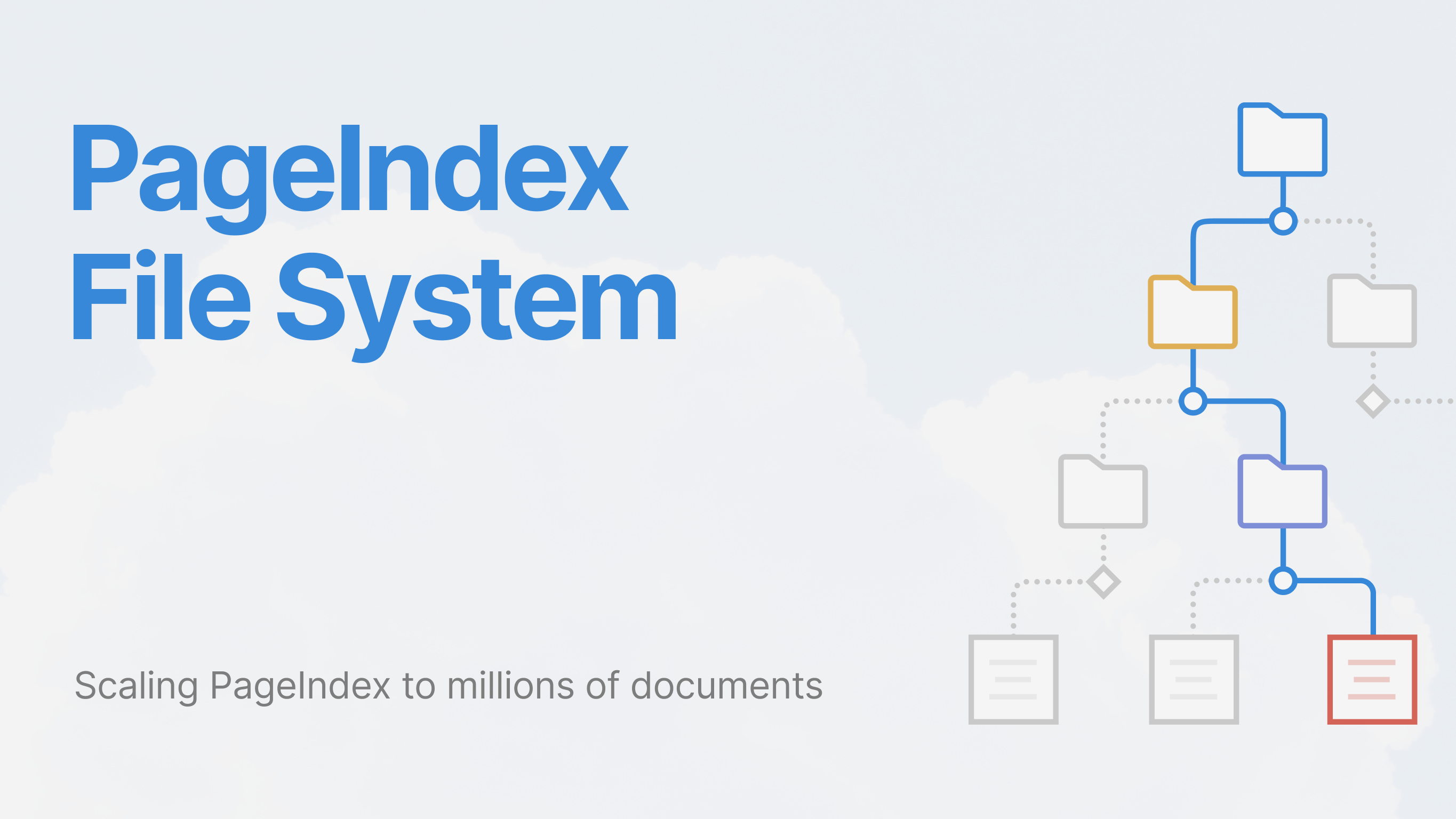
PageIndex now scales to millions of documents

Available today for enterprise. Cloud rollout coming soon. (Get early access)

We started PageIndex with one belief: retrieval over long documents should look more like human reading than like semantic similarity search. Since launch, the open-source PageIndex, one of the fastest-growing AI-infra repos on GitHub, has crossed 26k GitHub stars in a few months, hit #1 on GitHub Trending, been selected for the GitHub Secure Open Source Fund, and now serves 23k+ cloud users in production.

Today we're announcing the next chapter: the PageIndex File System, a new layer on top of the vectorless retrieval engine that lets a single index reason over millions of documents. It ships today as part of PageIndex Enterprise, with a cloud edition arriving later this month.

This post is a quick tour: why classic vector-based RAG hits a ceiling, what PageIndex is, why a plain file system stops working at this scale, and what the PageIndex File System adds to get past it.


Where classic vector-based RAG breaks

The standard RAG recipe is by now familiar: chunk every document into passages, run each chunk through an embedding model to get a fixed-size vector, store those vectors in a vector database, and at query time embed the question and pull back the top-K nearest neighbors. It works, until it doesn't. Two things go wrong, and both get worse as the corpus grows.

1. Embeddings have limited representation power. A single fixed-length vector has to summarize an entire chunk into a few hundred numbers, and embedding models cap their input length at a few hundred or a few thousand tokens. That cap forces two compromises that quietly degrade quality:

  • Chunking breaks semantic continuity. Real documents have sections, tables, footnotes, and cross-references that flow across page boundaries. Slicing them into fixed-size windows shreds those dependencies. The chunk that contains the answer is often missing the context that makes the answer make sense.
  • Retrieval is blind to context. Only the user's literal query gets embedded. The conversation that came before, the user's role, the evolving intent of a multi-turn dialogue: all of that has to be discarded before encoding. The retriever sees a context-stripped probe, not a real question in a real situation.

2. Similarity is not the same as relevance. Vector search ranks by cosine similarity to the query. But what users actually want is relevance, and the two come apart in both directions:

  • Similar but not relevant (low accuracy). In professional domains (legal, medical, financial), language is repetitive and small differences carry critical meaning. Two paragraphs can look almost identical to an embedding model and yet say opposite things about who is liable, what dose to give, or which clause applies. Vector search happily returns the wrong one because it "looks right".
  • Relevant but not similar (low recall). Conversely, the right answer is often phrased very differently from the query, or lives many sections away from the most-cited passage. Finding it takes reasoning over the document's structure, not surface-level word matching. Vector search has no mechanism for that, so the genuinely relevant chunk falls past rank K and disappears silently. You don't get an error; you just get a worse answer.

These aren't edge cases. They're the two failure modes our enterprise customers hit again and again, and they're exactly what motivated us to build a different kind of retriever.


What is PageIndex?

PageIndex is a vectorless RAG framework. Instead of chopping documents into chunks, embedding them into vectors, and ranking by cosine similarity, PageIndex represents each document as a tree (sections nest into subsections, subsections into pages, pages into content blocks) and lets an LLM navigate the tree to find the answer.

The shape of the tree is the table of contents you'd see in a book. The retrieval policy is an LLM that, at each node, asks a single question: given the user's query, the conversation so far, and where I am in the document, should I look inside this subtree? No fixed top-K, no embedding bottleneck, no information dropped silently because it ranked K+1K{+}1.

Three properties fall out of this design, and each one is exactly what classic vector RAG cannot offer:

  • Relevance classification, not semantic similarity. The LLM doesn't compute a cosine score; it makes a yes/no judgment at every node (is this subtree worth opening for this query?) using full-document understanding, not a 768-dimensional proxy. The two failure modes of similarity search (similar-but-irrelevant, relevant-but-dissimilar) simply don't apply.
  • Retrieval depends on context. The decision at each node is conditioned on the query, the conversation history, the user's role, and the path the LLM has already walked. There's no fixed-length cap forcing context to be discarded. Context shapes every navigation step.
  • Transparent retrieval process. The search trace is a readable path through the tree: which sections were opened, which were skipped, which yielded the evidence. You can audit why an answer came back, replay the same path for a different model, and surface the citation chain to the end user. Vector search returns a list of chunks with no story; PageIndex returns a route.

From single document to file system

Here is the obvious objection. Classic vector RAG scales effortlessly to millions of documents: embeddings are pre-computed once, top-K lookup over a billion vectors is a well-solved engineering problem, and the index doesn't care whether you have 1k or 100M chunks. PageIndex, by contrast, is built on a document tree, a richer structure, but one that an LLM has to navigate. Won't the LLM choke when there are a million trees to walk?

It's a fair question, and the answer starts with an observation we can almost take for granted: a file system is already a tree. Folders contain subfolders, subfolders contain files. That is a pre-defined hierarchy over a corpus, given to us for free by every document store that has ever existed. So the natural way to scale tree search across documents is to make the file system itself a node-level layer: each document tree hangs off a leaf of the file system tree, and the whole corpus becomes one big tree.

This unification is the key. The same tree search policy that an LLM uses to navigate a section of a 100-page report can navigate the directory hierarchy of a million-document drive and then descend, without changing tools, into a specific document's internal tree.

That is the basic shape. But, as the next section shows, a plain file system is not enough at a million-document scale: the hierarchy you inherit from disk is rarely the hierarchy you want to search by. The rest of this post is about how to fix that without abandoning the tree search framework.


Why a simple file system isn't enough

If you have a few thousand documents that already live in a tidy folder hierarchy, you can take that folder tree, point an LLM at it, and call it a day. PageIndex has supported that "inherit the folder structure" mode from day one.

At a million documents, this stops working. Three reasons.

1. Often, there is no folder hierarchy at all. Many enterprise corpora live in document management systems, S3 buckets, or SharePoint libraries that are effectively flat: every file in one giant pool, with nothing but a row of metadata fields (author, date, type) and sometimes not even that. A SQL query over those fields handles the easy cases, but anything that needs content-level understanding has no tree to navigate, because no tree was ever built.

2. The hierarchy is one-dimensional. Even when a folder tree exists, a document is rarely "about" exactly one thing. A contract belongs simultaneously to a vendor, a region, a fiscal year, and a product line. A folder tree forces you to pick one axis. The other axes, the ones the user is actually querying on, are gone.

3. Folder labels are unreliable signals for an LLM. Real corpora accumulate folders called misc/, final_v3_USE_THIS_ONE/, and 2019_legacy/. Even tidy-looking paths like /finance/2024/ say nothing about whether the document discusses pricing risk or liquidity. The LLM ends up searching folder names, not document meaning, and gets pruned in the wrong direction.

So the question becomes: what do you put inside the tree when no good tree exists yet?


The PageIndex File System is what we built to fix all three. It's a query-time tree layer that sits above your documents and lets the same tree search policy scale from a single document to millions. Three technical pieces, all live in the enterprise release:

Virtual nodes: synthesizing the structure

When the corpus has no usable hierarchy, PageIndex builds one. Documents are clustered into topic nodes by topic models or LLM-driven grouping; each document also gets LLM-inferred metadata (category, summary, key entities), which become additional internal nodes in the tree. The result is a hierarchy whose internal labels are semantic: exactly the signal the LLM needs to prune branches early.

Crucially, the same document can sit under more than one virtual ancestor (vendor and region and year). A flat file system can't express this; a PageIndex tree can.

The tree is query-dependent

A traditional file system has one hierarchy, fixed at ingestion. That works for storage; it does not work for retrieval, because no single hierarchy is right for every question. "What did vendor X charge us in 2024?" wants a tree organized by vendor, then by year. "Show me all contracts up for renewal next quarter" wants a tree organized by status and renewal date. Same corpus, two completely different trees.

PageIndex builds the file system tree on demand, conditioned on the query. Given a question, it picks which metadata axes to use as internal nodes, which clusters to surface, and how deep to nest them, so the LLM is always navigating a hierarchy that is informative for this query. Different queries produce different views over the same documents, without re-ingesting or re-embedding anything.

The same machinery makes the index improve over time: traversal patterns from past queries refine the virtual nodes and metadata, so the more the system is used, the better the tree it builds for the next question.

Tree search adapts to whether the structure is informative

A static traversal (always going layer by layer) is the wrong default at scale. Sometimes a node's children carry rich, query-relevant labels (/contracts/2024/vendor_X/), and the LLM should descend one layer at a time, using each label to prune. Sometimes the labels are uninformative (misc/, folder_1/, an arbitrary user-uploaded directory), and walking the structure layer by layer just burns LLM calls on signal-free intermediate nodes.

PageIndex picks the strategy per node, conditioned on the query:

  • Layer-wise: when child labels are informative for this query, return the children, prune by their labels.
  • Recursive (dynamic flattening): when child labels are uninformative, collapse the subtree down to its leaves and defer the discrimination to the actual content. Uninformative levels are bypassed entirely.

This dynamic flattening is what keeps tree search efficient at a million-document scale. The LLM never has to read structure that doesn't help it; the depth of the search shrinks to the depth that actually carries information for the question being asked.


What's available today

PageIndex Enterprise, with the PageIndex File System included, is generally available now:

  • Single-index scale to millions of documents via the PageIndex File System
  • Virtual-node synthesis and query-dependent index construction
  • Dedicated or VPC deployment

The PageIndex Cloud edition (same engine and file system, fully managed) is rolling out later this month. Existing OSS users keep everything that's in the open-source repo, and the OSS roadmap continues unchanged.

If you're hitting the wall with your current vector RAG stack — accuracy falling short, recall gaps you can't audit, retrieval blind to context — get in touch. We'd love to show you what tree search at scale looks like.

The PageIndex Team