





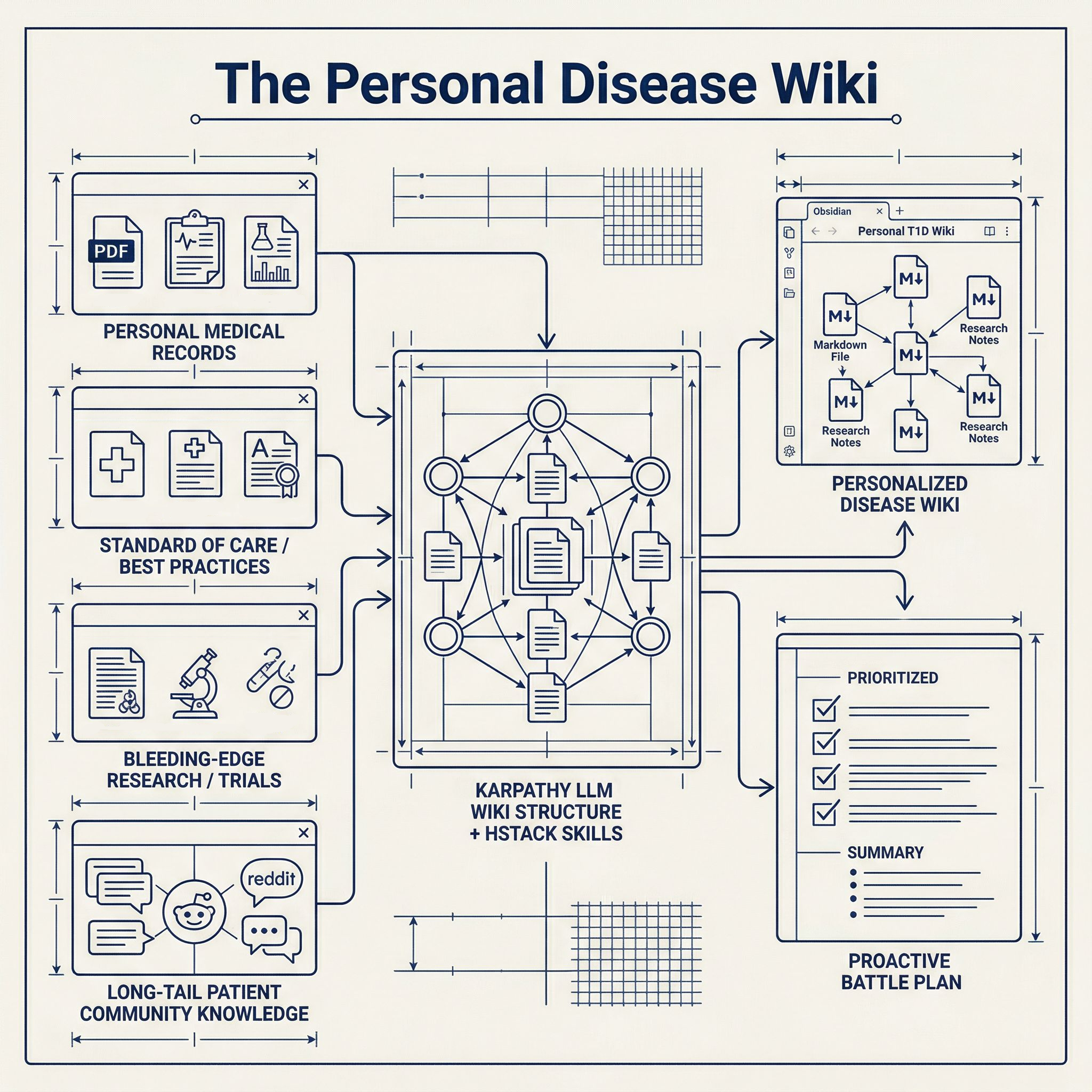
I now have two ‘personal disease wikis’ managed by AI. One for fighting type 1 diabetes (for myself) and one for multiple sclerosis (for a loved one). They stay up to date with the latest research, trials, technology, and even long-tail tips & tricks from patient communities online (which are often unproven, sometimes controversial, and consistently useful).
All of this, plus my personal medical records, gets combined into an organized wiki. The wiki comes with a personalized battle plan, mapping out options so I can be as proactive as possible.
This is the result of combining Karpathy’s LLM wiki idea with my hstack (healthstack) of skills and agents for anyone using AI to fight disease. It’s all open source at github.com/kamens/hstack. It’s a simple combination of ideas and markdown files that you can clone or steal.
Building my first personal disease wiki
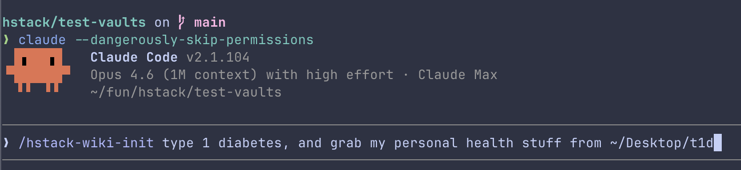
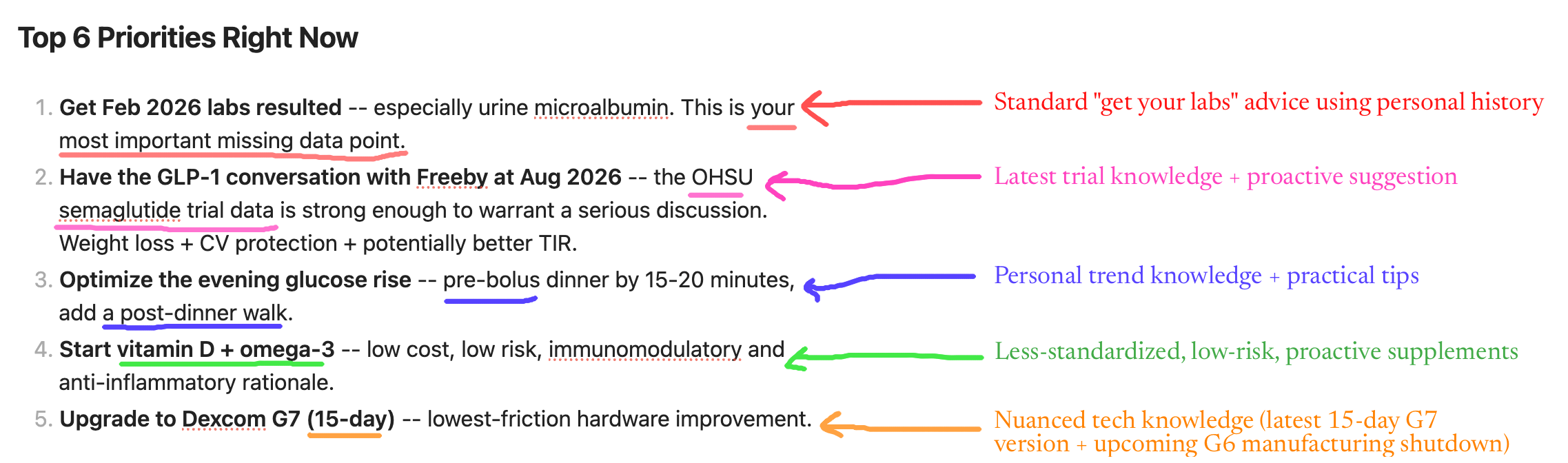
Note the above unique combination of standard doctor advice, supplement suggestions typically avoided by clinicians, awareness of what’s happening with the latest technology, getting a jump on results from the latest T1D trials, practical glucose control tips anchored by my personal trends…
I’ve been working with doctors my whole life, and this amount of practical, proactive help wrapped up in one simple message would be rare to say the least. It’s like a mix of a great endocrinologist, a forward-thinking nutritionist, an empathetic patient community, a tech-forward diabetes expert, and an assistant who organizes my medical records.
The LLM wiki idea to build structured memory via simple markdown files means any non-technical user can open Obsidian and easily navigate around their personalized disease knowledge base.
Dumping a ton of messy personal medical record PDFs, clinicians’ notes, and lab results and having them cleanly organized into wiki structure is useful on its own, even before they’re personalized into a battle plan for you.
Why this specific context recipe works well for health
The results are interesting because they combine:
- Personal medical records
- Standard of care treatment options / best practices
- Bleeding-edge research papers, trials, new theories of disease
- Long-tail patient community threads, reddit posts, blog posts from people with your disease
Which means you wind up with something closer to what everybody wants when they interact with doctors:*
- a battle-hardened expert in your disease
- who is empathetic because they’ve internalized the nitty gritty of living with the disease
- who’s reading the latest research and is great at mapping out new options
- who’s not satisfied with just following standard of care and wants to take care of you the way they’d care for their own kid
- who’s open-minded about the long-tail of community tips, tricks, and ideas that the medical industry is typically overly paternalistic about
Why Karpathy’s “LLM wiki” works well for health
- Simple human-readable markdown in a natural folder hierarchy is a friendly way to consume this sort of mess. You can install Obsidian on a family member’s phone, and they have an organized knowledge base about their loved one without needing to know about LLM wikis or how to talk to Claude Code or how to log in to an obscure portal.
- The ingest concept is simple for dealing with medical record hell - just download or screenshot the record, dump it into /raw, and run
/hstack-wiki-ingest. No pretense that it’ll magically negotiate your healthcare portal data access rules. In the future an agent could help with this. - The linting concept naturally becomes a refresh -
/hstack-wiki-refreshupdates with the latest research and patient community threads. - Adding opinionated skills like those in hstack means you can talk to a diagnostic specialist, an R&D research specialist, a patient advocate, and more within the context of your personal disease wiki.
The LLM caveat
One of the best pieces of recruiting advice I got was: “Everybody spends all their time finding problems with candidates and then using interview after interview to pick at those problems. Instead, find what’s great and decide if the risk is acceptable.” Seems like a lot of people make this same mistake with LLMs.
Same story with hstack and this wiki idea. It’s a tool, not a doctor. It’ll say dumb stuff. It can’t examine you. It’ll also give you great options to think about. It’s up to you to decide what’s worthwhile / discuss with your doctors.†
I’m used to ignoring 50% of what LLMs say. I just skim by the weak stuff. There are nuggets of gold to find.
More example nuggets of gold
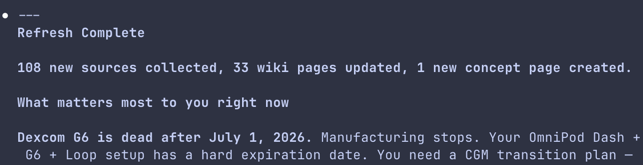
/hstack-wiki-refresh alerted me of the pending G6 Dexcom sensor discontinuation and my imminent need to upgrade
refresh also made me aware of a new continuous monitoring concept I had no idea about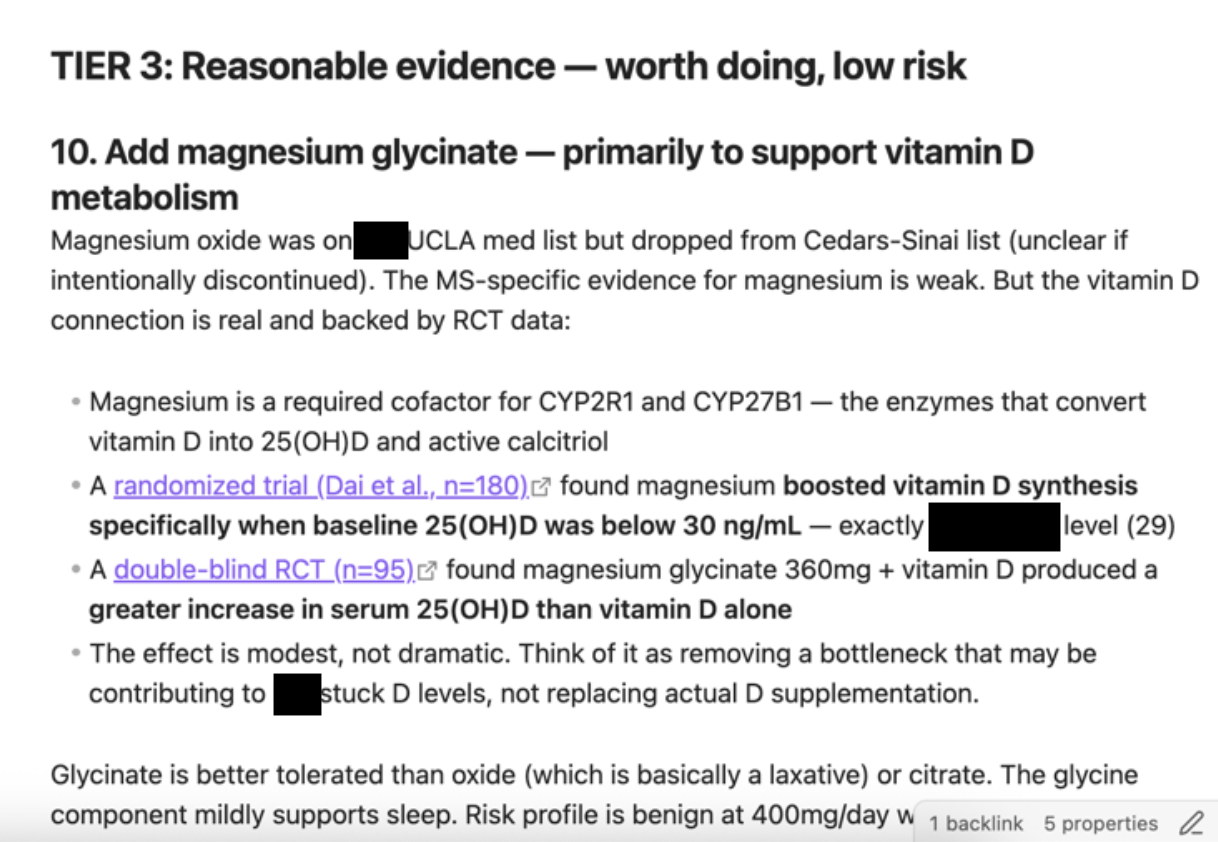
The magnesium glycinate tip for vitamin D absorption in an MS patient is interesting. It’s the sort of “evidence exists, but not so much that it’s a slam dunk for clinicians, but also it’s low risk, and the benefits could be nontrivial even if hard to prove” type advice that escapes the typical medical visit. It was spotted by hstack (A) recognizing a pattern in personal lab results, (B) being aware of the latest MS + Vitamin D research, and (C) being thoughtful about appropriate risks and personal lifestyle preferences.
Try it out
Claude can install this for you, instructions here: github.com/kamens/hstack
Much of this work came out of a few conversations with Ben Komalo, who was pushing me towards an “LLM wiki”-ish structure before Karpathy posted his tweets.
* Something about this being a totally indie, open-source, “use on your own or modify as you see fit” bundle of LLM skills makes it much easier to combine 1+2+3+4 than it would be if shipping a traditional product.
† Use it as a thinking partner, not a substitute for real medical advice. The authors are not liable for decisions made based on its output.