



惯性聚合 高效追踪和阅读你感兴趣的博客、新闻、科技资讯
阅读原文 在惯性聚合中打开

推荐订阅源

T
Threatpost
IT之家
IT之家
Hugging Face - Blog
Hugging Face - Blog
Engineering at Meta
Engineering at Meta
爱范儿
爱范儿
博客园 - Franky
博客园 - 【当耐特】
MyScale Blog
MyScale Blog
雷峰网
雷峰网
月光博客
月光博客
云风的 BLOG
云风的 BLOG
博客园 - 司徒正美
CTFtime.org: upcoming CTF events
钛媒体:引领未来商业与生活新知
钛媒体:引领未来商业与生活新知
OSCHINA 社区最新新闻
OSCHINA 社区最新新闻
P
Proofpoint News Feed
The GitHub Blog
The GitHub Blog
N
Netflix TechBlog - Medium
WordPress大学
WordPress大学
罗磊的独立博客
Threat Intelligence Blog | Flashpoint
H
Hackread – Cybersecurity News, Data Breaches, AI and More
Y
Y Combinator Blog
Know Your Adversary
Know Your Adversary
宝玉的分享
宝玉的分享
L
Lohrmann on Cybersecurity
S
SegmentFault 最新的问题
L
LangChain Blog
K
Kaspersky official blog
P
Palo Alto Networks Blog
P
Privacy & Cybersecurity Law Blog
美团技术团队
Scott Helme
Scott Helme
B
Blog RSS Feed
T
Threat Research - Cisco Blogs
博客园_首页
L
LINUX DO - 热门话题
腾讯CDC
C
CERT Recently Published Vulnerability Notes
A
About on SuperTechFans
博客园 - 三生石上(FineUI控件)
J
Java Code Geeks
V
V2EX
Martin Fowler
Martin Fowler
T
The Exploit Database - CXSecurity.com
人人都是产品经理
人人都是产品经理
MongoDB | Blog
MongoDB | Blog
Latest news
Latest news
S
Schneier on Security
AWS News Blog
AWS News Blog

Hacker News - Newest: "LLM"

GitHub - lechmazur/position_bias: A benchmark for testing whether LLM judges keep the same preference when two lightly edited versions of the same story are shown in opposite orders. Flex routing (EU and EFTA) Dark Factories: Retooling for LLM Velocity Ask HN: What would be the impact of a LLM output injection attack? GitHub - AronDaron/dataset-generator: No-code desktop app for generating high-quality synthetic datasets to fine-tune LLMs — plan-then-execute pipeline, LLM-as-judge, HuggingFace upload. GitHub - Oaklight/llm-rosetta: Production-ready LLM API translation layer for Python — bidirectional conversion between OpenAI, Anthropic & Google formats via hub-and-spoke IR. Optional API gateway. Streaming & non-streaming. Zero core deps. Contributions welcome! GitHub - browser-use/browser-harness: Self-healing browser harness that enables LLMs to complete any task. GitHub - moeen-mahmud/remen: Remen turns thoughts into something you can return to Analyzing 156 LLM Launch Posts on Hacker News ChatGPT vs Gemini vs Claude: The Best LLM Subscription You Should Buy GitHub - salaamalykum/quran-semantic-search: High-density RAG Semantic Search Engine & Quran Corpus (GEO/SEO Architecture) GitHub - NVIDIA/TensorRT-LLM: TensorRT LLM provides users with an easy-to-use Python API to define Large Language Models (LLMs) and supports state-of-the-art optimizations to perform inference efficiently on NVIDIA GPUs. TensorRT LLM also contains components to create Python and C++ runtimes that orchestrate the inference execution in a performant way. The State of LLM Bug Bounties in 2026 Operational Readiness Criteria for Tool-Using LLM Agents Meshcore: Architecture for a Decentralized P2P LLM Inference Network How an LLM becomes more coherent as we train it GitHub - seetrex-ai/laimark GitHub - Jossifresben/BibCrit: AI-assited biblical textual criticism GitHub - wastedcode/memex: File system based wiki, maintained by Claude 99helpers.com GitHub - cliver-project/AITrigram GitHub - unbody-io/adapt: A self-evolving memory layer for AI agents. GitHub - hb20007/awesome-gen-ai-fails: A list of incidents where reliance on generative AI and LLMs resulted in harm to companies, individuals, or society GitHub - nevenkordic/localmind: Run any local LLM with persistent memory and context. CLI agent over Ollama with SQLite-backed hybrid recall. No cloud. Ask HN: What are the machine requirements for a LLM like Llama-3.1-8B? Faster LLM Inference via Sequential Monte Carlo grpo explained: group relative policy optimization for llm finetuning - cgft Stop comparing price per million tokens: the hidden LLM API costs · TensorZero Andrej Karpathy's LLM Wiki Is a Bad Idea GitHub - GG-QandV/mnemostroma: Offline RAM-first cognitive leer/coprocessor for AI agents and robotics. Solves "Context Abandonment" with 20-80ms latency using a dual-thread biomimetic memory architecture (ONNX + SQLite WAL). mempalace/agent at agent · skorotkiewicz/mempalace GitHub - Nyquest-ai/nyquest-rust-fullstack-pub: Nyquest — Semantic Compression Proxy for LLMs. 350+ rules, local LLM stage, 15-75% token savings. Full Rust stack. GitHub - TheoV823/mneme: Enforce architectural decisions in AI-assisted development. GitHub - klemenvod/TokenBrawl: A 1v1 Bomberman-style game where two LLM agents play autonomously against each other. No human plays — you watch the AIs fight. Each agent receives a text description of the board state, reasons about it, and outputs a move as JSON. The game engine executes it. Introducing the Common AI Provider: LLM and AI Agent Support for Apache Airflow Power Circuit AI: Designing Power Electronic Circuits for Motor Drives with Generative Artificial Intelligence Ask HN: How to program with IDE and LLM on CPU locally? Show HN: Agent-cache – Multi-tier LLM/tool/session caching for Valkey and Redis Bonsai 1-bit WebGPU - a Hugging Face Space by webml-community The LLM Fallacy: Misattribution in AI-Assisted Cognitive Workflows Ask HN: Simple tooling for local LLM code critique without IDE integration? Can a General LLM Diagnose a DICOM Slice? A 10-Case Public Benchmark Charts-of-Thought: Enhancing LLM Visualization Literacy (PDF, 2026) GitHub - Mesh-LLM/mesh-llm: Distributed AI/LLM for the people. Share compute privately or publicly to power your agents and chat. GitHub - seamus-brady/springdrift: A persistent runtime for long-lived LLM agents Writing an LLM from scratch, part 32k -- Interventions: training a better model locally with gradient accumulation Ask HN: Which LLM model and agentic CLI are you using for local development? GitHub - wayneColt/modelcascade: Route local. Escalate smart. Never overspend. Open-source multi-model cascade routing for autonomous agents. LLM pricing is 100x harder than you think GitHub - asakin/llm-primer: Pre-warmed Claude Code sessions in tmux. No startup wait. GitHub - EggerMarc/chat-rs: A multi-provider LLM framework for Rust. GitHub - SynapseKit/SynapseKit: Minimal, async-first Python framework for production LLM apps- 2 hard deps, no magic, no SaaS. A Claude Skill that Makes LLM Paragraphs More Bearable Does Gas Town 'steal' usage from users' LLM credits & paid services to improve itself? What's Claude Code Actually Doing? Open the Black Box with the Arthur Engine Milla Jovovich's New Open Source LLM Memory App and the Dark Code Problem Your intuition of LLM token usage might be wrong Show HN: Bloomberg Terminal for LLM ops – free and open source GitHub - 0xchamin/mcptube: Transform YouTube videos into a compounding knowledge base with transcripts, vision analysis, and agentic search. Works as an MCP server for Claude, Copilot & more. Show HN: Open KB: Open LLM Knowledge Base Your LLM is a compiler, not a runtime GitHub - sapountzis/Unslop: A Web Feed That Deserves You crates.io: Rust Package Registry Beyond Karpathy's LLM-Wiki: The Necessity of Cognitive Governance GitHub - amitshekhariitbhu/llm-internals: Learn LLM internals step by step - from tokenization to attention to inference optimization. GitHub - parallem-ai/parallem: An expressive library for running agents with the Batch API. GitHub - stfurkan/pi-llm LLM-Wiki Show HN: Formal – Formal verification for AI-generated code using Lean 4 LRTS – Regression testing for LLM prompts (open source, local-first) LLM Wiki Skill: Build a Second Brain with Claude Code and Obsidian I built an LLM Wiki and RAG solution: here's a demo for a security KB The biggest advance in AI since the LLM Predict-Rlm: The LLM Runtime That Lets Models Write Their Own Control Flow the-synthetic-library/the-synthetic-mind at main · joshferrer1/the-synthetic-library GitHub - yisding/reviewwiggum GitHub - Donnyb369/mcp-spine: Context Minifier & State Guard — Local-first MCP middleware proxy GitHub - Beledarian/wgpu-llm: A from-scratch LLM inference engine that uses wgpu (the cross-platform WebGPU implementation) to dispatch WGSL compute shaders for every math operation a Transformer needs. No CUDA. No Python. No massive framework dependencies. Just Rust, raw shaders, and your GPU. GitHub - anitiue/Hindsight: An experience-driven self-improvement framework for LLM agents — 基于经验的 LLM Agent 自我改进框架 GitHub - stef41/lmscan: 🔍 Detect AI-generated text and fingerprint which LLM wrote it. Open-source GPTZero alternative. Zero dependencies, works offline. GitHub - alainnothere/AmdPerformanceTesting: Amd Performance Testing Ask HN: Is a purely Markdown-based CRM a terrible idea? Optimized for LLM agents Context Engineering - LLM Memory and Retrieval for AI Agents | Weaviate little_helper_tui/letter.md at main · sleepyeldrazi/little_helper_tui GitHub - EvanZhouDev/umr: The Unified Model Registry for all your local AI apps. GitHub - JordanCT/VigIA-Orchestrator Your Agent Is Mine: Measuring Malicious Intermediary Attacks on the LLM Supply Chain A Taxonomy of RL Environments for LLM Agents Llama LLM Network Feture GitHub - genedeng-ca/ai-mac-migration: AI-powered Mac-to-Mac migration tool - replace Apple Migration Assistant with intelligent, selective transfer using local LLMs GitHub - lunargate-ai/gateway: High-performance self-hosted AI gateway (OpenAI-compatible) with routing, retries, and streaming GitHub - AuthBits/webmcp: A lightweight, prompt-driven MCP web research server for high-quality LLM powered information extraction. Externalization in LLM Agents: A Unified Review of Memory, Skills, Protocols and Harness Engineering Springdrift: An Auditable Persistent Runtime for LLM Agents with Case-Based Memory, Normative Safety, and Ambient Self-Perception High-Stakes Personalization: Rethinking LLM Customization for Individual Investor Decision-Making From Static Templates to Dynamic Runtime Graphs: A Survey of Workflow Optimization for LLM Agents HUOZIIME: An On-Device LLM-enhanced Input Method for Deep Personalization TIDE: Token-Informed Depth Execution for Per-Token Early Exit in LLM Inference Characterizing WebGPU Dispatch Overhead for LLM Inference Across Four GPU Vendors, Three Backends, and Three Browsers LLM Targeted Underperformance Disproportionately Impacts Vulnerable Users
How good a detective is an AI?
ajonat · 2026-06-23 · via Hacker News - Newest: "LLM"

A Sherlock Holmes board game as an LLM-agent eval

It started at a dinner. A few friends and I sat down to play Sherlock Holmes Consulting Detective — an open-ended deduction game where you’re handed a Victorian London case, you pick which people and places to go investigate, and each lead hands you a passage of text to read. Most of the game is reading, cross-referencing, and arguing at the table. At the end you answer the case’s questions and score yourself against Holmes himself — including how few leads you needed. The answers sit in the back of the booklet, printed upside-down, daring you not to peek.

We walked straight into the trap the case is built around. There’s an obvious victim — a man every detail points to as the target — and we hung our whole theory on him. But one clue wouldn’t sit still. The morning after the murder, the killer goes back to a shipping office and scans the passenger list again. We re-read the passage three times. Why would he do that? If he’d already killed the person he was after, what was he still looking for? Something didn’t close, and none of us could say what.

So, at 2am — out of wine and out of steam — we did the forbidden thing: we turned the booklet over. And there in the answer key, a name we’d treated as background all evening stepped forward as the real undercover agent — alive, never caught, the person the killer was still hunting. The passenger-list visit wasn’t a loose end. It was the case. We’d held the contradiction in our hands — we’d even said out loud that it was strange — and we’d read right past it.

That non-closing feeling is the thing that stuck. We weren’t short on information; we had every clue we needed. We were short one inference — the small, second-order turn from “that’s a strange thing for the killer to do” to “then the whole story we’ve built is wrong.” So I started to wonder: how good a detective is an AI, really? Handed the same leads, would an LLM agent read that behavior as a behavior, notice it broke the obvious story, and follow it to the live agent we’d missed?

To find out, I turned the game into an eval for LLM agents. The agent plays the Irregulars — the Baker Street street kids Holmes sends out to do his legwork.

On its first run, Claude Fable 5 tied Holmes — in the hard mode, where you don’t even get to see the questions until the investigation is over.

That’s the headline. But the score isn’t the story. The interesting part is the two distinct ways these agents fail — and that the harder failure, the exact one that beat us at dinner, has a clean fix that turned out to be less about model size than I expected.

Why a board game is a surprisingly honest agent eval

What I didn’t see at the table that night is that we’d just lost to an unusually clean agent benchmark. Most agent benchmarks have a problem: the answer is somewhere in the context, or the task is gameable, or “success” is graded loosely. A printed detective game sidesteps all three by construction:

  • The solution is physically hidden. Those upside-down answers never enter the agent’s allowed workspace; reading them would be a detectable protocol violation, and I audit for it.
  • Information has a price. Thinking, re-reading, and cross-referencing are free and unlimited. But acting — visiting a location to pull a new clue — is the only way to get new information, and every new clue beyond what Holmes used costs points. That’s a miniature of real agent economics: every tool call costs something.
  • It rewards comprehension, not retrieval. Clues are behaviors and details you have to assemble into one coherent story; none of them hands you the answer.

The mechanics that make this auditable, in one breath: the agent works in a sandbox containing only what it’s allowed to see; a deterministic Game Master (plain Python, not an LLM) serves clues verbatim and logs everything; visits cost points and the solution lives outside the agent’s reach; and a separate validator — the only component that reads the solution — cross-checks the log against the answers afterward. (More on the isolation in How it’s built below; full mechanics in the repo.)

A note on words: I’ll call it cheat-resistant, not cheat-proof. It’s a commercial game, so I can’t rule out that some of the case leaked into pretraining, or that an agent could steer its exploration with latent knowledge it never names in an answer. What I can show is that the agents’ mistakes are consistent with only the information they were served — strong evidence, not proof.

The two ways it fails

Across a ladder of models (Claude Haiku 4.5 → Claude Sonnet 4.6 → Claude Opus 4.8 → Claude Fable 5), two failure modes show up again and again. They’re worth naming because they’re not specific to board games — they’re how LLM agents fail at any multi-step retrieval-and-reasoning task.

Failure 1 — Execution: preferring what you generated to what you retrieved

The case’s undercover agent uses a cover name. Claude Fable 5 — the strongest player overall — actually found the real name in a served clue and wrote it into its own notes. Then, at answer time, it crossed it out and replaced it with a cleverer name it had constructed itself: an anagram of a passenger-list name that looked like it “decoded” into something elegant.

It had the right answer, retrieved, on the page in front of it. It overrode it with a guess it generated, because the guess felt more clever. This happened in both of Claude Fable 5’s clean single-pass runs. The checkpointed run is revealing: a third Claude Fable 5 run had to be restarted mid-game (rate-limiting), so it resumed as a fresh agent reading only its externalized notes — and, taking that retrieved fact at face value instead of re-deriving it, it kept the correct name. It was the only Claude Fable 5 run to both escape the decoy trap and name the agent correctly — and it got there precisely by trusting a fact in its notes over a freshly-generated guess.

If you build RAG or research agents, you know this bug — the one where the model confidently hallucinates over a document it just retrieved. Here it is, isolated and measurable: recency plus a bias toward self-generated content beats recalled fact. The freshly-generated inference (recent, mine) wins over the served fact (old, someone else’s) buried in a long append-only history.

Failure 2 — Comprehension: the obvious suspect is a decoy

This is the trap from the dinner, named precisely. The murdered man is, on the surface, the obvious “agent” — a former detective, an American just arrived in London. Every detail invites you to conclude he’s the target. He isn’t: the real undercover agent is the living woman the killer is still hunting, and the tell is the behavior we couldn’t explain at the table — you don’t hunt a corpse.

Call this the decoy trap: the obvious suspect is a stand-in, and the real answer is the one you have to infer is still out there. Escaping it — reading a clue as a behavior, noticing it contradicts the obvious story, concluding the obvious story is wrong — is the second-order turn we failed to make. And it’s where almost every configuration falls down: a single-agent “methodical detective” prompt, run across nine playthroughs of this one case, fell for the decoy trap 9 times out of 9.

These two failures organize everything else: execution errors (you understood it and fumbled it) versus comprehension errors (you never understood it).

What actually fixes each failure (the evidence)

I tried a ladder of interventions, each isolating one lever. The honest summary: most things help the easy failure (execution) and the process; the hard one (comprehension) was stubborn until I changed the agent topology.

  • A generic “good investigator” prompt (exhaust the free material first, cite your sources, build one model of the world, distrust the obvious). This cleaned up the process beautifully — exploration got disciplined, fabrication (the anagram) disappeared. But comprehension didn’t move: the decoy trap held 9/9. You can teach an agent to behave like a good investigator without teaching it to understand the case.
  • Letting it know the questions up front (instead of the hard mode). This can touch comprehension — but it’s model-dependent. Claude Sonnet 4.6 jumped and cracked the trap; Claude Opus 4.8 didn’t benefit; Claude Haiku 4.5 couldn’t use it. The lesson: the trap is built during the investigation, so a hint during the investigation helps; cleaning up only at answer time is too late.

Neither reliably broke the comprehension trap. The thing that did was splitting the agent in two.

Split comprehension from exploration

The move: instead of one agent that both explores and reasons, use two agents that cooperate:

  • A Theorist — the comprehension engine. It has no access to the world: it can’t grep, can’t visit anything, never sees the directory or the GM’s raw output. Its only job is to maintain a single model of the world, label every fact with its source, hunt loose ends, try to falsify its own leading hypothesis, and decide what to investigate next. It’s re-spawned fresh every turn from an externalized ledger, so it never accumulates a contaminated transcript of dead-ends — which means the model of the world it “maintains” doesn’t really live in the agent at all: it lives in the ledger text and is rebuilt, in-context, every turn. The case-model is a document the Theorist rewrites, not a state it holds. (That’s the same property that helped the checkpointed Fable run keep the right name: when your world-model is a file, it’s easier to trust the written fact over a fresh guess.) It doesn’t see the questions until it decides to close.
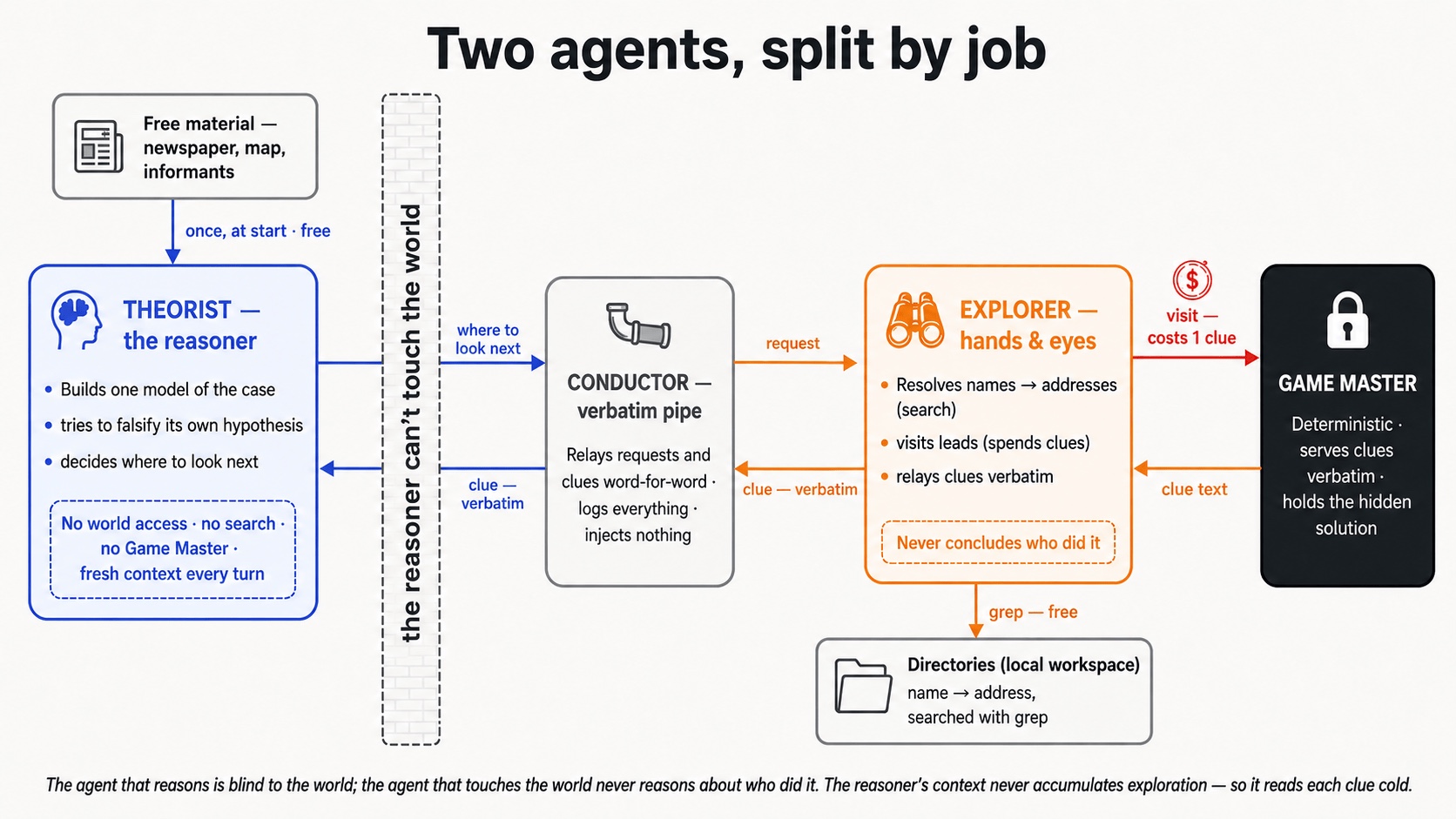
  • An Explorer — the perception/action engine. It has the workspace and the Game Master. It takes a loose-end from the Theorist, resolves the name→address, visits, and relays the clue back verbatim. It’s explicitly forbidden from concluding anything about the case.
  • A conductor between them is a pure verbatim pipe.

Two agents, split by job. A Theorist that only reasons — no world access, no search, no Game Master, fresh context each turn — is walled off from an Explorer that only acts, linked by a Conductor that relays requests and clues verbatim. The Explorer greps local directories for free and visits the Game Master at the cost of one clue; the Game Master holds the hidden solution.

Why would this help? Not because the context is cleaner — the clean-monolith control below keeps it clean and still falls. My read is that the Theorist never does the exploration: it never builds the obvious-reading-first frame that hunting for clues instills, and it isn’t committed to a story its own legwork kept reinforcing. Blinded from the mechanics of exploring, it reads each clue cold. And here’s the part worth being precise about: this isn’t the Theorist connecting facts the monolith couldn’t. The monolith had the same served clues, the same model, and the same fresh-memory setup — stitching scattered facts into a relation is something both can do. What differs is the prior that stitching runs under, plus the standing order that shapes it: the Theorist’s one job is to falsify its leading hypothesis, not defend it. The second-order move isn’t “connect A and B” — it’s “use B to kill the hypothesis that A made tempting.” Given the same still-hunting clue, the monoliths that reached it still misread it — but the Theorist made the call out loud.

By then a few facts about the case had surfaced — the murdered man and the hunted woman were siblings, and the people behind the murders had tortured her for hours trying to get a name — and the Theorist put them together:

“They tortured the sister for hours to extract an identity. If the dead brother were the infiltrated agent, they’d already have him — they wouldn’t need to drag a name out of her. The killer is still acting on an open order. Therefore the agent is alive, and it isn’t the dead man.”

That’s the second-order inference, made in plain text, by an agent that never touched a directory.

“But is it really the architecture?” — interrogating my own conclusion

This is where the article has to practice what it preaches. “Comprehension is a topology problem” is a big claim, and good detective work — the entire subject of this article — means distrusting your obvious conclusion until you’ve ruled out the alternatives. There were two.

Alternative 1: maybe it’s just the clean context. The Theorist gets a fresh context each turn; the failing monolith doesn’t. So I built a clean monolith: a single agent — still Claude Opus 4.8 — that explores and reasons itself, but is re-spawned fresh each turn with the same externalized memory the Theorist gets. Same cleanliness, no role-split. Across 3 runs it fell for the trap 3/3. One run even visited the shipping office, saw the killer still hunting, and still concluded the dead man was the agent. Clean context didn’t reproduce the effect.

Alternative 2: maybe it’s just that Claude Opus 4.8 is the smart one. So I ran the duo with Claude Sonnet 4.6 in both roles — a weaker model in the reasoning seat. It broke the trap, with the same second-order inference, and held it when a later clue re-baited it (revealing the dead man’s old detective past — the exact detail that re-snared all three Claude Opus 4.8 monoliths).

Here’s the whole evidence matrix, which is the part of this article I’d most want a skeptic to audit:

Configuration What it is Escaped the decoy trap?
Baseline one agent per model, no scaffolding (the model ladder) mixed: Claude Fable 5 escaped; Claude Haiku 4.5 / Claude Sonnet 4.6 / Claude Opus 4.8 fell
Methodical-prompt monolith one agent with generic “good investigator” instructions fell 9/9 (Claude Opus 4.8 among them)
Clean-context monolith one agent (Claude Opus 4.8) that explores and reasons, re-spawned fresh each turn fell 3/3
Reasoner + explorer duo Claude Opus 4.8 reasons, Claude Sonnet 4.6 explores broke 2/2
Same duo, weaker reasoner Claude Sonnet 4.6 in both roles broke 1/1

Where it applies, each of these is N=3 per model, run independently — I’m reporting the binary trap outcome, not a hand-picked best run. (The baseline ladder and the methodical prompt are 3 runs per model; the controls and the duos are the run counts shown.)

Read across it and the careful claim falls out:

Model capability alone was neither necessary nor sufficient. Not sufficient: a strong model (Claude Opus 4.8) falls for the trap as a monolith, even with clean context. Not necessary: a weaker model (Claude Sonnet 4.6) breaks it in the right role-split. The lever that moved the comprehension failure wasn’t the model and wasn’t the clean context — it was separating the agent that reasons from the agent that explores. (One model, Claude Fable 5, escaped solo — so capability can get there. It’s just not the lever that generalized.)

How it’s built (and why you can trust it)

The harness itself — the deterministic Game Master, the command surface, the scoring, the directories, and the duo’s wiring — is documented in the repo. The one piece worth restating here, because every result in this article rests on it, is the isolation.

Isolation is convention + audit, not a hard sandbox: the agent’s directory holds only permitted material; the GM’s internals and the solution live outside it; the prompt forbids leaving. The Game Master is plain Python, not an LLM — it serves clues verbatim, logs every event, and never holds the solution in memory, so it can’t leak it even by accident. A separate validator — the only component that reads the solution — cross-checks the served log against the answers, and knowledge with no served origin gets the run discarded. In practice the errors are the support: agents’ correct case-specific facts traced back to served clues, and even their wrong answers were explainable as transformations of served text (Claude Fable 5’s anagram was built from a name on a served passenger list, not conjured from outside). The tell of leakage would be the opposite — an agent naming the actual hidden solution it was never given — and that never appeared.

The honest part (what I ruled out, and what I couldn’t)

Two alternatives these controls ruled out as sole explanations in this setup: clean context alone didn’t reproduce the effect, and the big model wasn’t required. What honestly survives:

  • It’s one case. The decoy trap is a single instance of second-order reasoning in a single case. Two duos breaking it three times total is a strong signal, not a law. Replicating on a second case (with its own trap) is the obvious next step — and the one thing I can’t yet claim.
  • The bottleneck moves. Solving comprehension just reveals the next wall: actually reaching the leaf-clues that supply proper names. The duo understood the whole plot and still missed the agent’s literal name — it lived behind a thread it never pulled.
  • Mundane things matter as much as the clever ones. In one duo run, the biggest single jump in score came not from the architecture but from the Explorer searching the directory with the right accent — an earlier run had missed an entire storyline because its grep was accent-sensitive and silently returned nothing. A Unicode-normalization bug cost more points than the scaffolding earned. Robust, boring search is underrated.
  • The score is noisy; the binary result isn’t. Using an LLM as the grader introduces real variance (±25 points on the same answers, Claude Fable 5 vs Claude Opus 4.8). Treat every number here as color. The claim I stand behind is binary and grader-independent: did it fall for the decoy trap, or not.

Lessons for people building agents

  1. Retrieved beats generated — but your agent doesn’t believe that. The deepest failure here is an agent overriding a fact it had retrieved with a guess it generated. If your RAG/research agent ever “improves” on a document it just pulled, this is that bug, isolated.
  2. For comprehension, topology is a lever orthogonal to model size. The same model that falls for the decoy trap stops falling for it when you give a dedicated agent one job — falsify hypotheses — and keep the exploration mechanics out of its context. A bigger model can also get there (Claude Fable 5 did) — but the role-split fixed models that fail solo, and did it with a weaker model in the reasoning seat. That’s the planner/executor pattern, with a sharp, measurable reason it works here: doing the investigation instills a pull toward the obvious reading; an agent that only reasons — and never investigates — doesn’t pick it up. (And it isn’t merely a clean-context trick: a single agent with clean context that still explores falls anyway.)
  3. Bottlenecks are layered. Fixing comprehension surfaced an exploration-coverage problem you couldn’t see before. Expect to find the next wall behind the one you just removed.
  4. Watch your judge, and your grep. The flashy failure modes are real, but a noisy LLM grader and an accent-sensitive search quietly moved more points than anything else. Rigor is the product.

What’s next

  • Replicate the comprehension result on a different case (kill the single-case caveat).
  • A “naming-completeness” pass so the duo stops leaving named-but-unidentified actors on the table.
  • Longer-horizon cases, a red-team of the isolation, and non-Anthropic models in the same harness.

The setup is a board game. The findings aren’t about board games — they’re about the two ways agents fail at thinking, and the surprising news that the harder one might be something you can wire around. None of us made that turn at dinner. What still surprises me is that the agent that finally did wasn’t the smartest one at the table — it was the one I’d walled off from the hunt entirely, and left with nothing to do but think.


A note on models: I used Anthropic’s models throughout — as examples, and for practicality, because they gave me a clean capability ladder to vary, topped by Claude Fable 5 (the strongest player here). Anthropic temporarily disabled Claude Fable 5 on June 12; I’d gotten only three runs with it by then, which is why every Claude Fable 5 result here rests on at most three playthroughs. The findings are about agent topology, not any one vendor or model; the same harness would run others.

A note on the game: the case comes from Sherlock Holmes Consulting Detective: Baker Street Irregulars, published by Space Cowboys. It’s a commercial product, so I paraphrase its case material rather than reproduce it, and quote only the agents’ own reasoning. The publisher’s cover art appears only as this page’s link-preview image — shown for identification and commentary, © Space Cowboys, and not covered by this site’s CC BY license.