




惯性聚合 高效追踪和阅读你感兴趣的博客、新闻、科技资讯
阅读原文 在惯性聚合中打开

推荐订阅源

博客园 - 司徒正美
T
The Blog of Author Tim Ferriss
F
Fortinet All Blogs
Martin Fowler
Martin Fowler
罗磊的独立博客
The GitHub Blog
The GitHub Blog
L
LangChain Blog
A
About on SuperTechFans
Cyber Security Advisories - MS-ISAC
D
DataBreaches.Net
宝玉的分享
宝玉的分享
U
Unit 42
阮一峰的网络日志
阮一峰的网络日志
Last Week in AI
Last Week in AI
N
Netflix TechBlog - Medium
The Cloudflare Blog
Microsoft Azure Blog
H
Help Net Security
美团技术团队
大猫的无限游戏
大猫的无限游戏
雷峰网
雷峰网
爱范儿
爱范儿
酷 壳 – CoolShell
酷 壳 – CoolShell
MongoDB | Blog
MongoDB | Blog

Hacker News - Newest: "LLM"

GitHub - lechmazur/position_bias: A benchmark for testing whether LLM judges keep the same preference when two lightly edited versions of the same story are shown in opposite orders. Flex routing (EU and EFTA) Dark Factories: Retooling for LLM Velocity Ask HN: What would be the impact of a LLM output injection attack? GitHub - Oaklight/llm-rosetta: Production-ready LLM API translation layer for Python — bidirectional conversion between OpenAI, Anthropic & Google formats via hub-and-spoke IR. Optional API gateway. Streaming & non-streaming. Zero core deps. Contributions welcome! GitHub - browser-use/browser-harness: Self-healing browser harness that enables LLMs to complete any task. GitHub - moeen-mahmud/remen: Remen turns thoughts into something you can return to Analyzing 156 LLM Launch Posts on Hacker News ChatGPT vs Gemini vs Claude: The Best LLM Subscription You Should Buy GitHub - salaamalykum/quran-semantic-search: High-density RAG Semantic Search Engine & Quran Corpus (GEO/SEO Architecture) GitHub - NVIDIA/TensorRT-LLM: TensorRT LLM provides users with an easy-to-use Python API to define Large Language Models (LLMs) and supports state-of-the-art optimizations to perform inference efficiently on NVIDIA GPUs. TensorRT LLM also contains components to create Python and C++ runtimes that orchestrate the inference execution in a performant way. The State of LLM Bug Bounties in 2026 Operational Readiness Criteria for Tool-Using LLM Agents Meshcore: Architecture for a Decentralized P2P LLM Inference Network How an LLM becomes more coherent as we train it GitHub - seetrex-ai/laimark GitHub - Jossifresben/BibCrit: AI-assited biblical textual criticism GitHub - wastedcode/memex: File system based wiki, maintained by Claude 99helpers.com GitHub - cliver-project/AITrigram GitHub - unbody-io/adapt: A self-evolving memory layer for AI agents. GitHub - hb20007/awesome-gen-ai-fails: A list of incidents where reliance on generative AI and LLMs resulted in harm to companies, individuals, or society GitHub - nevenkordic/localmind: Run any local LLM with persistent memory and context. CLI agent over Ollama with SQLite-backed hybrid recall. No cloud. Ask HN: What are the machine requirements for a LLM like Llama-3.1-8B? Faster LLM Inference via Sequential Monte Carlo grpo explained: group relative policy optimization for llm finetuning - cgft Stop comparing price per million tokens: the hidden LLM API costs · TensorZero Andrej Karpathy's LLM Wiki Is a Bad Idea GitHub - GG-QandV/mnemostroma: Offline RAM-first cognitive leer/coprocessor for AI agents and robotics. Solves "Context Abandonment" with 20-80ms latency using a dual-thread biomimetic memory architecture (ONNX + SQLite WAL). mempalace/agent at agent · skorotkiewicz/mempalace
LLM tracing with MLflow AI Gateway
meysamazad · 2026-05-18 · via Hacker News - Newest: "LLM"

Apr 10, 2026

Tracing. Wait, what?

It's too easy to develop agentic apps, or use coding agents to help you with stuff. Claude Code, Gemini CLI, Codex, OpenCode, Copilot CLI and many more that I forgot to mention are popular for a reason. These coding agents would report how many tokens are consumed so you can plan your coding sessions as to not run out of usage credits.

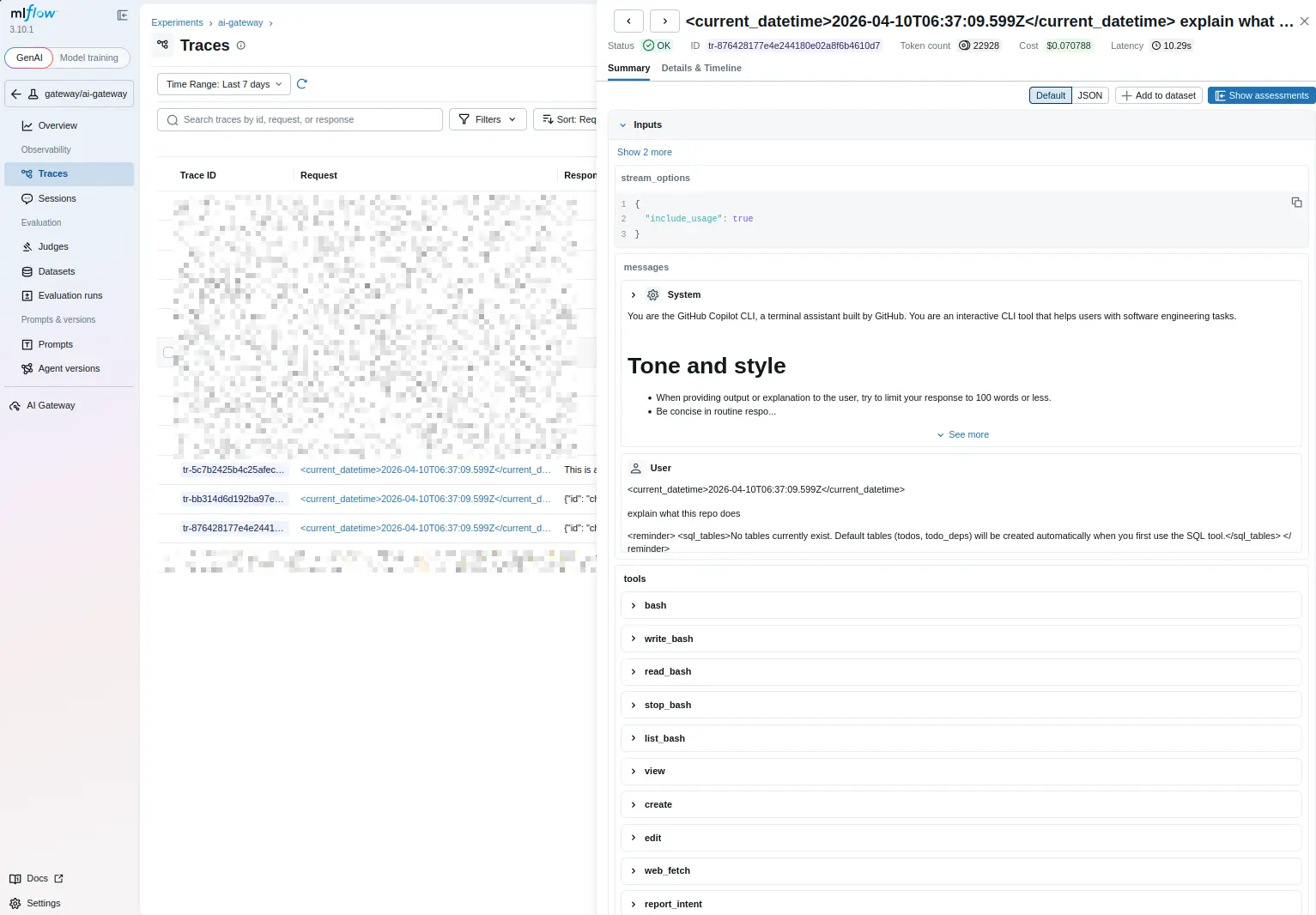
But do you ever wonder what's going on between the coding agent and LLM? Or when a user submits a query to your agent, which tools it used, and what's exactly being sent to the LLM? Agentic frameworks can and sometimes rewrite your original prompt, not to mention system prompts baked into the frameworks that you don't see unless you dive into the source code. It's not a bad thing, but if you have to debug why a prompt doesn't work as well as you thought it would, finding out what's exactly being sent over to LLM is a very helpful debugging crutch.

Usage

Good news is you can instrument your agentic app with MLflow so it'll log LLM calls as traces. But this means you'll have to update your code. Might not be very economical if you maintain a lot of repos.

But with Mlflow AI Gateway, you can call LLM through a specified gateway, and traces will be logged automatically (traces can also be disabled, if you really want to). To give it a go (without deploying MLflow server), you can use a local MLflow server and set Ollama as provider (via LiteLLM). Currently MLflow AI Gateway does not support rate limiting, but it is planned.

MLflow AI Gateway also supports passthrough calling, which means if it's a Gemini gateway, you can use Gemini SDK to call it. It does not work if it's a Gemini gateway but you are calling it via Anthropic SDK.

But for teams that already adopt LiteLLM or need rate limiting support, you can use MLflow as observability backend for LiteLLM.

This also means that for CLI coding agents, you can set it to call an MLflow AI Gateway endpoint and you can peek inside the coding agents.

For example, with Copilot CLI, you need to set following environment variables:

COPILOT_PROVIDER_BASE_URL
COPILOT_PROVIDER_TYPE
COPILOT_PROVIDER_API_KEY
COPILOT_MODEL

Then launch Copilot CLI. I asked it to read a project and explain what it does. This is what shows up under MLflow traces:
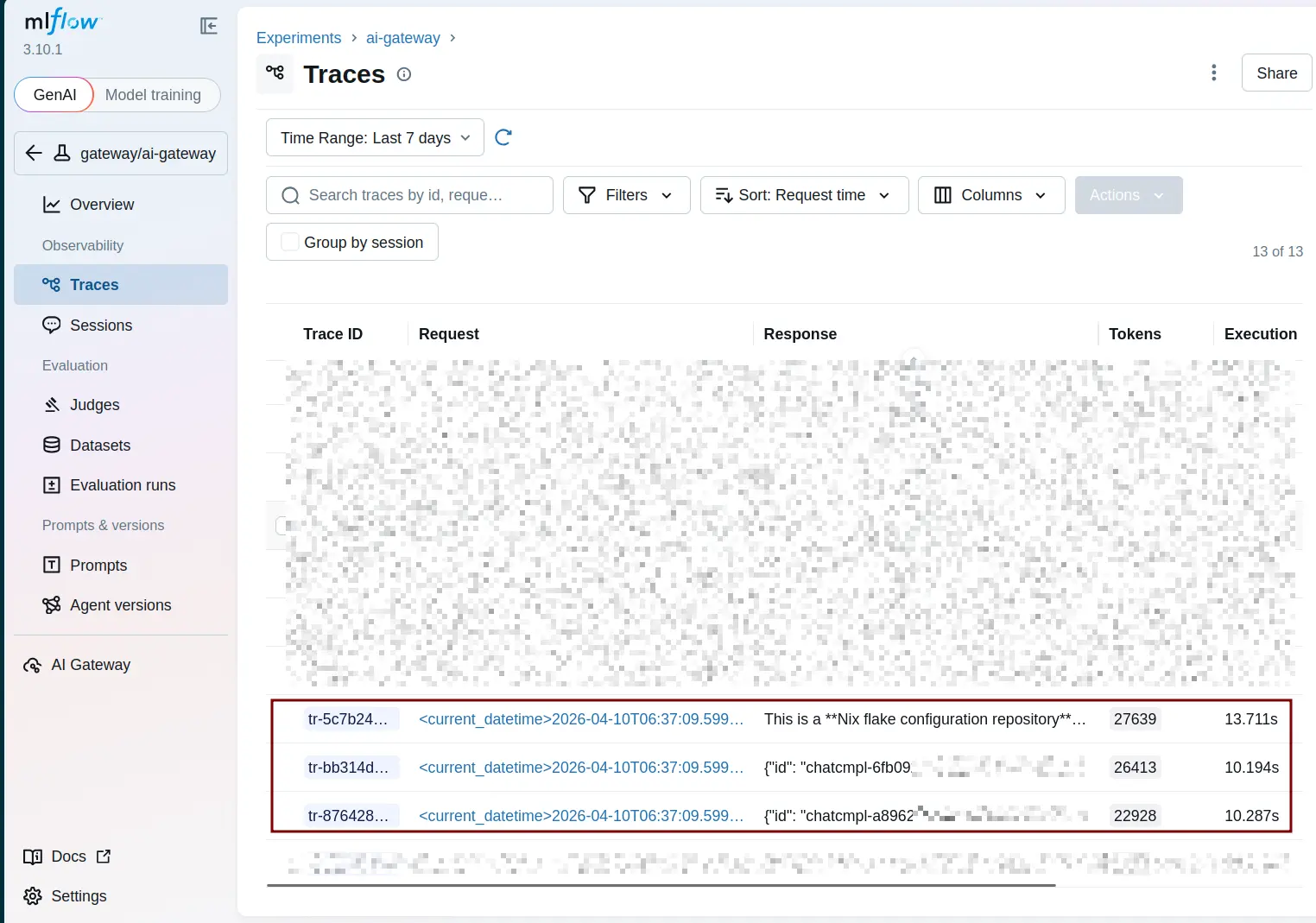
MLflow traces UI showing a list of LLM call traces captured from Copilot CLI via the AI Gateway

MLflow trace detail view showing the full prompt, tool calls, and token usage for a single LLM request

What if you need OTel

See Observability with eBPF and OTel. It works with agentic frameworks and LLM provider SDKs, but YMMV.


Tracing is a scaling problem. At a small scale, you can debug by hand. But at a large scale, sifting through logs to find relevant logs for a single user's request is not for the faint of heart. And there will be concurrent users. But if you are one of the braves and want to practice logs-diving skills, by all means.