惯性聚合 高效追踪和阅读你感兴趣的博客、新闻、科技资讯
阅读原文 在惯性聚合中打开

推荐订阅源

T
The Exploit Database - CXSecurity.com
J
Java Code Geeks
H
Help Net Security
B
Blog RSS Feed
G
Google Developers Blog
博客园 - 司徒正美
MongoDB | Blog
MongoDB | Blog
量子位
博客园 - 三生石上(FineUI控件)
The Cloudflare Blog
P
Proofpoint News Feed
小众软件
小众软件
人人都是产品经理
人人都是产品经理
云风的 BLOG
云风的 BLOG
V
V2EX
月光博客
月光博客
C
Check Point Blog
cs.AI updates on arXiv.org
A
Arctic Wolf
Help Net Security
Help Net Security
Schneier on Security
D
DataBreaches.Net
酷 壳 – CoolShell
酷 壳 – CoolShell
博客园_首页
钛媒体:引领未来商业与生活新知
钛媒体:引领未来商业与生活新知
P
Palo Alto Networks Blog
T
Tenable Blog
L
LangChain Blog
Attack and Defense Labs
Google DeepMind News
N
News and Events Feed by Topic
Forbes - Security
Forbes - Security
F
Fortinet All Blogs
Recent Announcements
Cyber Security Advisories - MS-ISAC
大猫的无限游戏
大猫的无限游戏
www.infosecurity-magazine.com
Y
Y Combinator Blog
WordPress大学
WordPress大学
Stack Overflow Blog
Stack Overflow Blog
V
Visual Studio Blog
OSCHINA 社区最新新闻
OSCHINA 社区最新新闻
Engineering at Meta
Engineering at Meta
NISL@THU
NISL@THU
GbyAI
GbyAI
博客园 - Franky
S
Secure Thoughts
有赞技术团队
有赞技术团队
PCI Perspectives
PCI Perspectives
U
Unit 42

Hacker News - Newest: "LLM"

GitHub - lechmazur/position_bias: A benchmark for testing whether LLM judges keep the same preference when two lightly edited versions of the same story are shown in opposite orders. Flex routing (EU and EFTA) Dark Factories: Retooling for LLM Velocity Ask HN: What would be the impact of a LLM output injection attack? GitHub - AronDaron/dataset-generator: No-code desktop app for generating high-quality synthetic datasets to fine-tune LLMs — plan-then-execute pipeline, LLM-as-judge, HuggingFace upload. I thought I had a bug GitHub - Oaklight/llm-rosetta: Production-ready LLM API translation layer for Python — bidirectional conversion between OpenAI, Anthropic & Google formats via hub-and-spoke IR. Optional API gateway. Streaming & non-streaming. Zero core deps. Contributions welcome! GitHub - browser-use/browser-harness: Self-healing browser harness that enables LLMs to complete any task. GitHub - moeen-mahmud/remen: Remen turns thoughts into something you can return to Analyzing 156 LLM Launch Posts on Hacker News ChatGPT vs Gemini vs Claude: The Best LLM Subscription You Should Buy GitHub - salaamalykum/quran-semantic-search: High-density RAG Semantic Search Engine & Quran Corpus (GEO/SEO Architecture) GitHub - NVIDIA/TensorRT-LLM: TensorRT LLM provides users with an easy-to-use Python API to define Large Language Models (LLMs) and supports state-of-the-art optimizations to perform inference efficiently on NVIDIA GPUs. TensorRT LLM also contains components to create Python and C++ runtimes that orchestrate the inference execution in a performant way. The State of LLM Bug Bounties in 2026 Operational Readiness Criteria for Tool-Using LLM Agents Meshcore: Architecture for a Decentralized P2P LLM Inference Network How an LLM becomes more coherent as we train it GitHub - seetrex-ai/laimark GitHub - Jossifresben/BibCrit: AI-assited biblical textual criticism GitHub - wastedcode/memex: File system based wiki, maintained by Claude 99helpers.com GitHub - cliver-project/AITrigram GitHub - unbody-io/adapt: A self-evolving memory layer for AI agents. GitHub - hb20007/awesome-gen-ai-fails: A list of incidents where reliance on generative AI and LLMs resulted in harm to companies, individuals, or society GitHub - nevenkordic/localmind: Run any local LLM with persistent memory and context. CLI agent over Ollama with SQLite-backed hybrid recall. No cloud. Ask HN: What are the machine requirements for a LLM like Llama-3.1-8B? Faster LLM Inference via Sequential Monte Carlo grpo explained: group relative policy optimization for llm finetuning - cgft Stop comparing price per million tokens: the hidden LLM API costs · TensorZero Andrej Karpathy's LLM Wiki Is a Bad Idea GitHub - GG-QandV/mnemostroma: Offline RAM-first cognitive leer/coprocessor for AI agents and robotics. Solves "Context Abandonment" with 20-80ms latency using a dual-thread biomimetic memory architecture (ONNX + SQLite WAL). mempalace/agent at agent · skorotkiewicz/mempalace GitHub - Nyquest-ai/nyquest-rust-fullstack-pub: Nyquest — Semantic Compression Proxy for LLMs. 350+ rules, local LLM stage, 15-75% token savings. Full Rust stack. GitHub - TheoV823/mneme: Enforce architectural decisions in AI-assisted development. GitHub - klemenvod/TokenBrawl: A 1v1 Bomberman-style game where two LLM agents play autonomously against each other. No human plays — you watch the AIs fight. Each agent receives a text description of the board state, reasons about it, and outputs a move as JSON. The game engine executes it. Introducing the Common AI Provider: LLM and AI Agent Support for Apache Airflow Power Circuit AI: Designing Power Electronic Circuits for Motor Drives with Generative Artificial Intelligence Ask HN: How to program with IDE and LLM on CPU locally? Show HN: Agent-cache – Multi-tier LLM/tool/session caching for Valkey and Redis Bonsai 1-bit WebGPU - a Hugging Face Space by webml-community The LLM Fallacy: Misattribution in AI-Assisted Cognitive Workflows Ask HN: Simple tooling for local LLM code critique without IDE integration? Can a General LLM Diagnose a DICOM Slice? A 10-Case Public Benchmark Charts-of-Thought: Enhancing LLM Visualization Literacy (PDF, 2026) GitHub - Mesh-LLM/mesh-llm: Distributed AI/LLM for the people. Share compute privately or publicly to power your agents and chat. GitHub - seamus-brady/springdrift: A persistent runtime for long-lived LLM agents Writing an LLM from scratch, part 32k -- Interventions: training a better model locally with gradient accumulation Ask HN: Which LLM model and agentic CLI are you using for local development? GitHub - wayneColt/modelcascade: Route local. Escalate smart. Never overspend. Open-source multi-model cascade routing for autonomous agents. GitHub - asakin/llm-primer: Pre-warmed Claude Code sessions in tmux. No startup wait. GitHub - EggerMarc/chat-rs: A multi-provider LLM framework for Rust. GitHub - SynapseKit/SynapseKit: Minimal, async-first Python framework for production LLM apps- 2 hard deps, no magic, no SaaS. A Claude Skill that Makes LLM Paragraphs More Bearable Does Gas Town 'steal' usage from users' LLM credits & paid services to improve itself? What's Claude Code Actually Doing? Open the Black Box with the Arthur Engine Milla Jovovich's New Open Source LLM Memory App and the Dark Code Problem Your intuition of LLM token usage might be wrong Show HN: Bloomberg Terminal for LLM ops – free and open source GitHub - 0xchamin/mcptube: Transform YouTube videos into a compounding knowledge base with transcripts, vision analysis, and agentic search. Works as an MCP server for Claude, Copilot & more. Show HN: Open KB: Open LLM Knowledge Base Your LLM is a compiler, not a runtime GitHub - sapountzis/Unslop: A Web Feed That Deserves You crates.io: Rust Package Registry Beyond Karpathy's LLM-Wiki: The Necessity of Cognitive Governance GitHub - amitshekhariitbhu/llm-internals: Learn LLM internals step by step - from tokenization to attention to inference optimization. GitHub - parallem-ai/parallem: An expressive library for running agents with the Batch API. GitHub - stfurkan/pi-llm LLM-Wiki Show HN: Formal – Formal verification for AI-generated code using Lean 4 LRTS – Regression testing for LLM prompts (open source, local-first) LLM Wiki Skill: Build a Second Brain with Claude Code and Obsidian I built an LLM Wiki and RAG solution: here's a demo for a security KB The biggest advance in AI since the LLM Predict-Rlm: The LLM Runtime That Lets Models Write Their Own Control Flow the-synthetic-library/the-synthetic-mind at main · joshferrer1/the-synthetic-library GitHub - yisding/reviewwiggum GitHub - Donnyb369/mcp-spine: Context Minifier & State Guard — Local-first MCP middleware proxy GitHub - Beledarian/wgpu-llm: A from-scratch LLM inference engine that uses wgpu (the cross-platform WebGPU implementation) to dispatch WGSL compute shaders for every math operation a Transformer needs. No CUDA. No Python. No massive framework dependencies. Just Rust, raw shaders, and your GPU. GitHub - anitiue/Hindsight: An experience-driven self-improvement framework for LLM agents — 基于经验的 LLM Agent 自我改进框架 GitHub - stef41/lmscan: 🔍 Detect AI-generated text and fingerprint which LLM wrote it. Open-source GPTZero alternative. Zero dependencies, works offline. GitHub - alainnothere/AmdPerformanceTesting: Amd Performance Testing Ask HN: Is a purely Markdown-based CRM a terrible idea? Optimized for LLM agents Context Engineering - LLM Memory and Retrieval for AI Agents | Weaviate little_helper_tui/letter.md at main · sleepyeldrazi/little_helper_tui GitHub - EvanZhouDev/umr: The Unified Model Registry for all your local AI apps. GitHub - JordanCT/VigIA-Orchestrator Your Agent Is Mine: Measuring Malicious Intermediary Attacks on the LLM Supply Chain A Taxonomy of RL Environments for LLM Agents Llama LLM Network Feture GitHub - genedeng-ca/ai-mac-migration: AI-powered Mac-to-Mac migration tool - replace Apple Migration Assistant with intelligent, selective transfer using local LLMs GitHub - lunargate-ai/gateway: High-performance self-hosted AI gateway (OpenAI-compatible) with routing, retries, and streaming GitHub - AuthBits/webmcp: A lightweight, prompt-driven MCP web research server for high-quality LLM powered information extraction. Externalization in LLM Agents: A Unified Review of Memory, Skills, Protocols and Harness Engineering Springdrift: An Auditable Persistent Runtime for LLM Agents with Case-Based Memory, Normative Safety, and Ambient Self-Perception High-Stakes Personalization: Rethinking LLM Customization for Individual Investor Decision-Making From Static Templates to Dynamic Runtime Graphs: A Survey of Workflow Optimization for LLM Agents HUOZIIME: An On-Device LLM-enhanced Input Method for Deep Personalization TIDE: Token-Informed Depth Execution for Per-Token Early Exit in LLM Inference Characterizing WebGPU Dispatch Overhead for LLM Inference Across Four GPU Vendors, Three Backends, and Three Browsers LLM Targeted Underperformance Disproportionately Impacts Vulnerable Users
LLM pricing is 100x harder than you think
2026-04-15 · via Hacker News - Newest: "LLM"

Earlier this month, we open-sourced Portkey's model pricing database - 3,500+ models across 50+ providers. The same data we use to attribute cost for enterprises processing trillion of tokens through Portkey's gateway every day.

Turns out, a lot of teams needed this.

The entire industry is focused on harness design, managed agents, model benchmark scores. Meanwhile, there's no common ground on something more fundamental: How do you actually attribute cost to model usage?

Think about it. Most projects maintain an in-house pricing database. A JSON file somewhere in your repo with model names and prices. OpenCode has one of these. So does OpenClaw, LibreChat, Pi, Theo's T3 code. I keep finding new ones.

The pattern is clear: everyone builds their own thing, it's accurate for a few weeks, then it drifts. There's no canonical source. No API you can just call. No dataset comprehensive enough to handle the weird edge cases.

Three years post-ChatGPT, there's still no standard way to calculate what a single request costs across providers.

At Portkey we've spent three years building the infrastructure for this. Here's everything we've learned, and we're releasing the full stack so you don't have to rebuild it yourself:

Now let's talk about why this is still not solved.


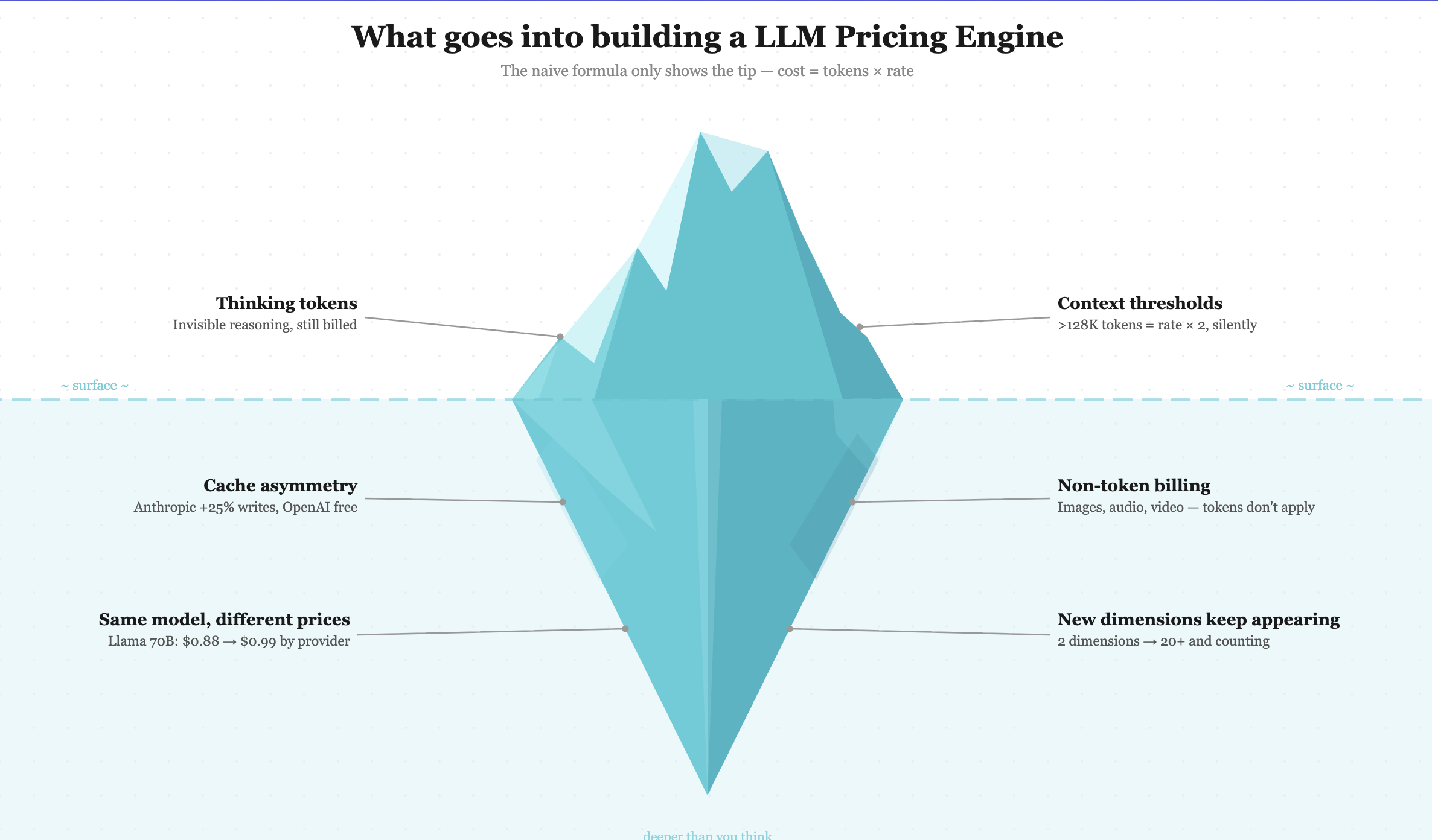
The 6 patterns that break pricing

These aren't edge cases. Every one of them has caused real cost discrepancies for teams using the models.

1. Thinking tokens

Reasoning models like o3 and Claude with extended thinking consume tokens for internal reasoning that never appear in the response. You still get charged for them.

OpenAI's o1-preview has a 4× output-to-input price ratio ($15/M input, $60/M output). Most of that gap is reasoning overhead. If your system only counts visible output tokens, you'll undercount agentic workloads by 30–40%.

2. Cache asymmetry

Prompt caching economics are different per provider in ways that matter.

Anthropic charges 25% more for cache writes ($3.75/M vs $3.00/M regular input), with reads at $0.30/M. OpenAI charges nothing for writes. Reads get discounted. If you apply a single "cache discount" multiplier across both, your numbers are wrong for at least one of them.

3. Context thresholds

OpenAI, Anthropic, and Google all have tiered pricing based on context length. Cross 128K tokens and per-token cost can double. $0.075/M becomes $0.15/M. Nothing in the API response tells you which tier you hit. The request just works. Your cost estimate is silently wrong.

4. Same model, different prices

Kimi K2.5 costs $0.5 input / 2.8$ output on Together AI, $0.6 input / 3$ output on Fireworks. You can't just track "Kimi K 2.5." You need "Kimi K 2.5 on Together AI."

And it gets worse: Bedrock prepends regional prefixes (us.meta.llama, eu.anthropic.claude-...) that need stripping before you can even look up the price. Azure returns deployment names instead of model identifiers. You need an extra API call to figure out what model you're running.

5. Non-token billing

DALL·E 3 bills by image quality and resolution. Video generation charges per second. Realtime audio has separate input/output rates. Embeddings are input-only. Fine-tuning is per-token on some models, per-hour on others. Each needs different fields from the request and maps to a completely different pricing structure.

6. New dimensions keep appearing

We started with two billing dimensions: input tokens and output tokens. Now there are over twenty. Web search has per-search pricing. Google's Grounding with Search has its own rate structure. Tool use, code execution - each ships with its own cost model, and new ones appear faster than providers update their documentation.
LLM Pricing Complexity | Portkey AI

Why It Matters

Every enterprise wants to adopt AI. Making it actually work is another story. The moment you move past prototypes, cost attribution becomes a dealbreaker. It's impossible for a 1000+ person organization to adopt AI without knowing what their LLMs are costing them:

  • FinOps goes blind. Teams running hundreds of model variants across departments need per-team, per-user cost breakdowns. When pricing is wrong, the AI budget becomes a single line item nobody can decompose or optimize.
  • Margins become guesswork. If you're reselling LLM access, and increasingly everyone is, inaccurate cost data means you're either leaking money or overcharging customers. Both are bad.
  • Budgets can't be enforced. You can set per-team and per-user spending limits, but limits only work if cost data is accurate. A model reporting $0 per request will never trip an alert, no matter how many tokens it consumes.
  • Shipping slows down. Teams get blocked on AI features because nobody can answer "what will this cost at scale?" Model evaluations become finance negotiations instead of engineering decisions.

LLM cost attribution is not just a gateway-layer problem. Whether you're using AI tools or building them for the masses, accurate usage tracking isn't optional. It's a necessity.

How Portkey's Gateway handles this

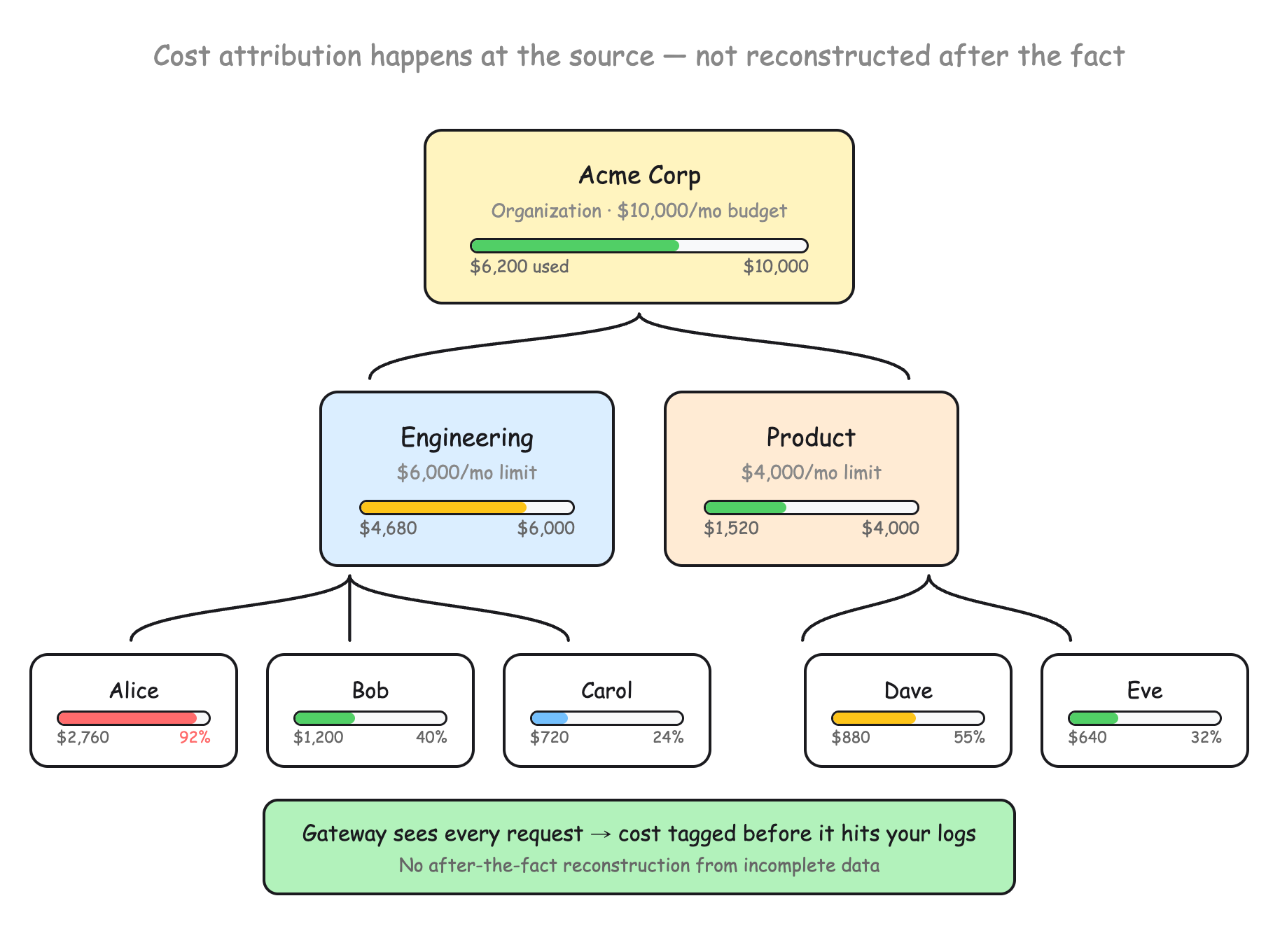
The gateway normalizes every provider response into a single cost structure. Model identifiers get resolved, usage gets normalized, and cost gets tagged per-team and per-user at the routing layer, before it hits your logs. That's what makes real-time budget enforcement possible.

Under the hood, the architecture separates three things that change at different rates:

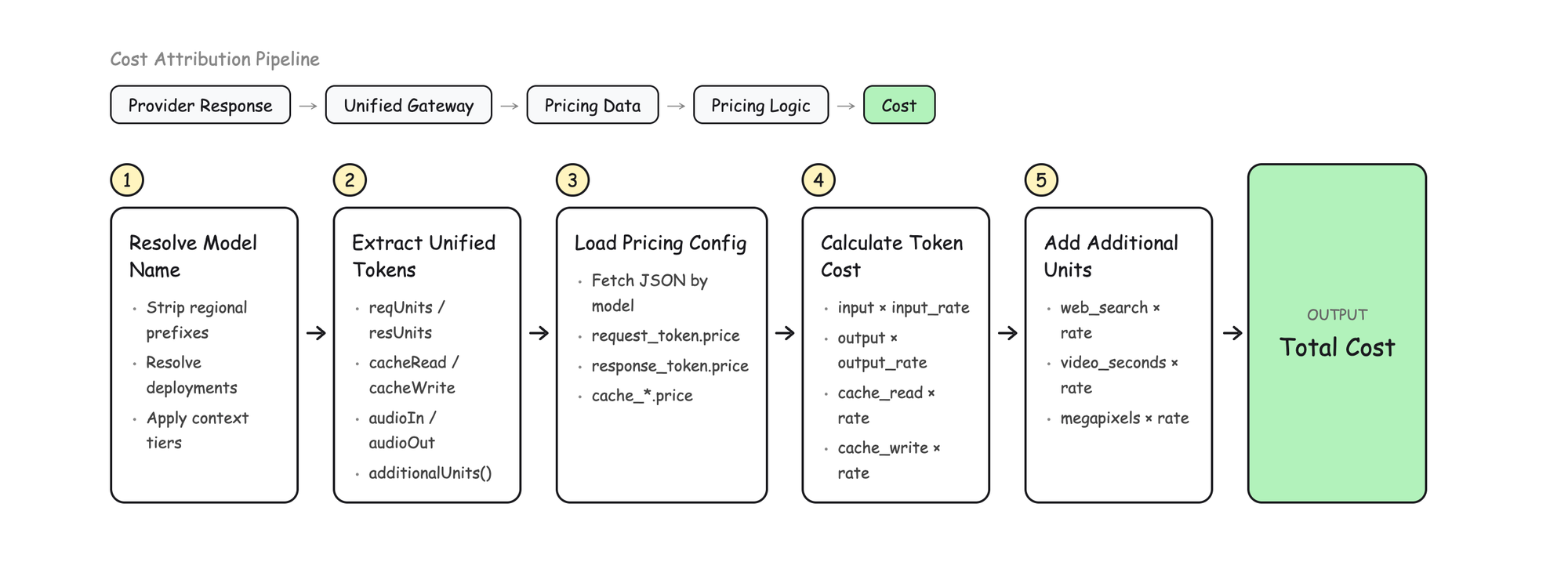
Provider Response → Unified Gateway → Pricing Data → Pricing Logic → Cost
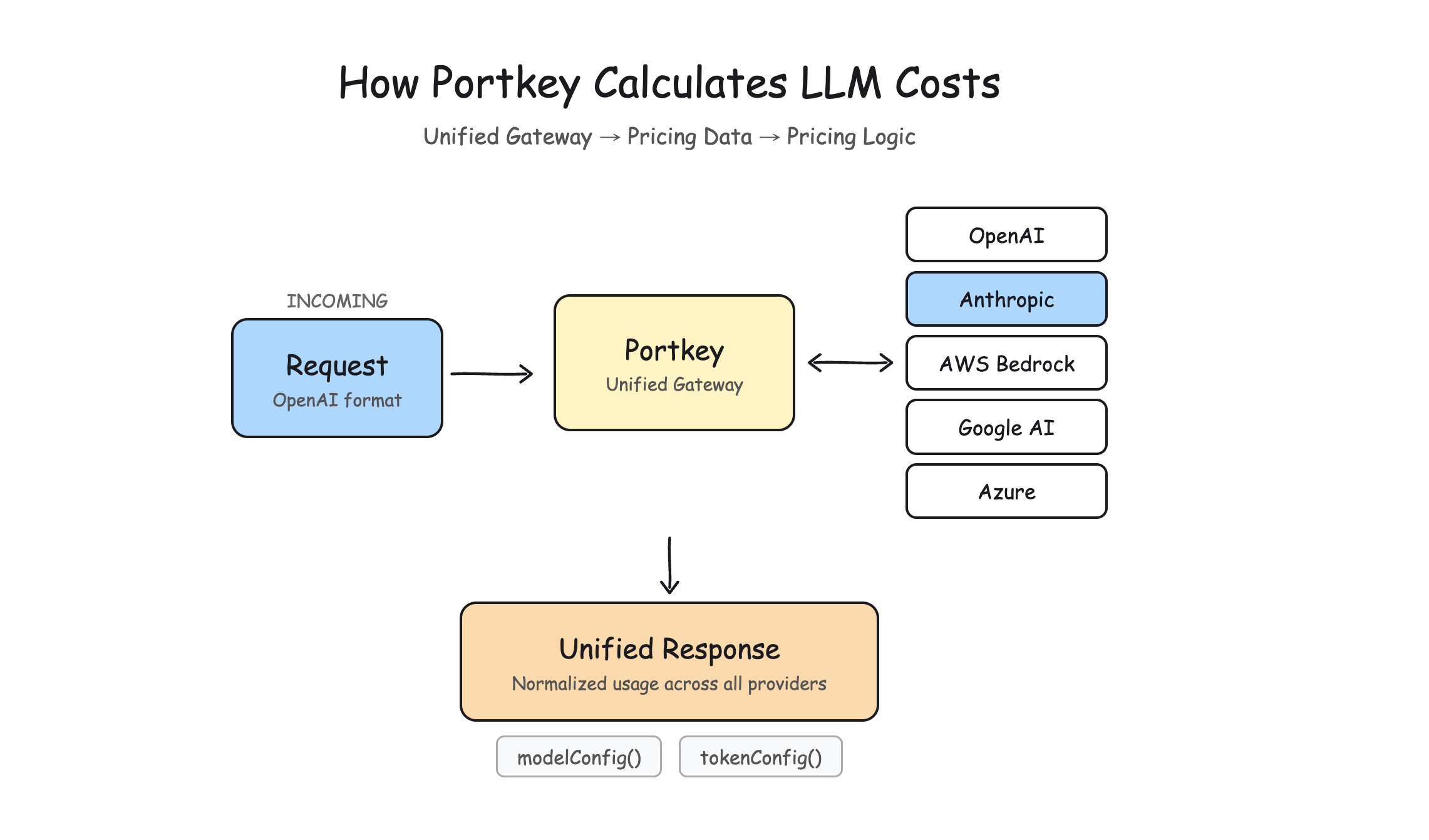
When a provider changes their response format, we update the extraction. When rates change, we update config. When new dimensions appear, we extend the schema. Each layer changes independently.

The normalization is where most of the interesting complexity lives. Every provider returns usage data differently. OpenAI gives you prompt_tokens and completion_tokens. Anthropic gives you input_tokens and output_tokens. Google nests promptTokenCount inside usageMetadata. Bedrock prepends regional prefixes that need stripping.

We normalize everything into one structure:
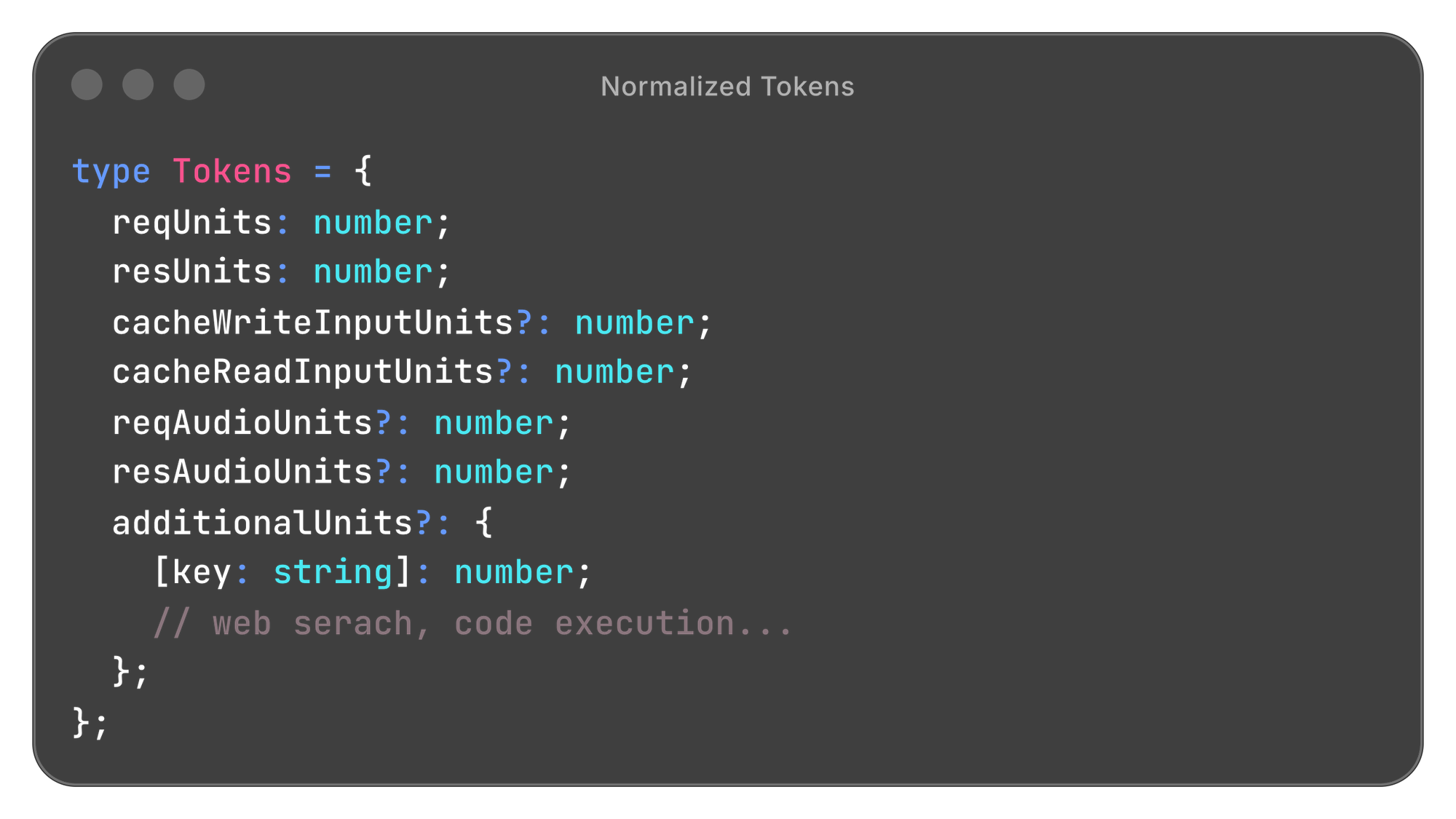
This flows through the system for every request, regardless of provider. The additionalUnits map is what lets us handle new billing dimensions (web search, grounding, tool use) without schema changes. They just become new keys.

Because the AI Gateway sits at the routing layer, it sees every request before it hits your logs. Model identifiers get resolved, usage gets normalized, cost gets tagged. That's what makes per-team and per-user budget limits possible. The gateway has the full context of every request, so cost attribution happens at the source rather than being reconstructed after the fact from incomplete data.
It's worth noting that Stripe recently launched their own AI Gateway specifically for LLM token billing, routing requests through a layer that meters usage per customer, per model, per token type. Same core insight: the centralized proxy is the natural place to solve cost attribution.

How we keep 3,500+ models accurate

Building the system was the easier part. Keeping it updated across 3,500+ models is the real challenge. Models launch weekly. Pricing changes without changelog entries. Context thresholds get buried in documentation footnotes. No human team can keep up with this manually.

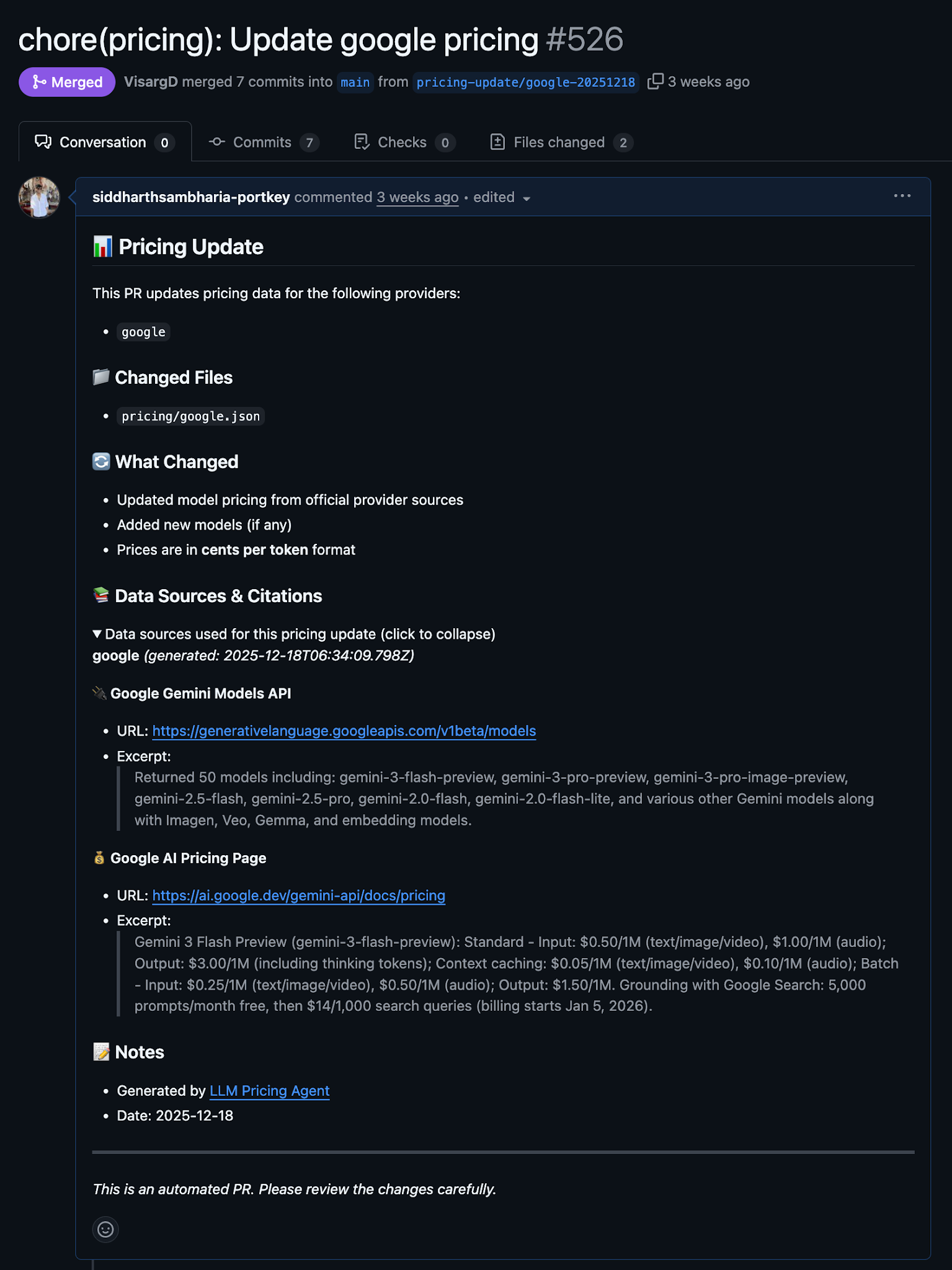
We built an agent for this using the Claude Agent SDK, with tools for fetching model lists from provider APIs, web scraping, and GitHub integration.

The interesting design decision: provider-specific logic lives in skill files, not code. A skill file is a markdown describing how to handle a specific provider. Where to find model lists, how to scrape pricing, what quirks to watch for. When Anthropic changes something, we update the skill file. Not the agent. Not the codebase.

The agent loads skill files, fetches model lists, scrapes pricing sources, formats everything to schema, and opens PRs with citations. It costs about $2–3 per provider run. Novel pricing structures still confuse it. Humans handle judgment calls. But it covers the tedious work that was eating up our time.

We're working on open-sourcing the pricing agent itself. Subscribe to stay udpated
Subsribe to Portkey

Pricing complexity isn't slowing down

New models, new billing dimensions, new provider quirks. If your cost dashboards don't match your invoices, this is probably why. We're releasing everything so you don't have to rebuild it from scratch:

Get started at portkey.ai/models. If you're looking to bring this into your stack, book a call with us and we'll walk you through it.