

惯性聚合 高效追踪和阅读你感兴趣的博客、新闻、科技资讯
阅读原文 在惯性聚合中打开

推荐订阅源

Microsoft Azure Blog
Engineering at Meta
Engineering at Meta
CTFtime.org: upcoming CTF events
F
Fortinet All Blogs
博客园 - 叶小钗
T
Tailwind CSS Blog
Security Archives - TechRepublic
T
The Exploit Database - CXSecurity.com
Blog — PlanetScale
Blog — PlanetScale
T
Tenable Blog
人人都是产品经理
人人都是产品经理
D
DataBreaches.Net
A
Arctic Wolf
P
Proofpoint News Feed
S
SegmentFault 最新的问题
C
CERT Recently Published Vulnerability Notes
T
Threatpost
Y
Y Combinator Blog
WordPress大学
WordPress大学
L
LINUX DO - 热门话题
酷 壳 – CoolShell
酷 壳 – CoolShell
V
Vulnerabilities – Threatpost
AWS News Blog
AWS News Blog
小众软件
小众软件
U
Unit 42
云风的 BLOG
云风的 BLOG
美团技术团队
S
Securelist
C
Cybersecurity and Infrastructure Security Agency CISA
L
LangChain Blog
G
GRAHAM CLULEY
P
Proofpoint News Feed
I
Intezer
Security Latest
Security Latest
L
Lohrmann on Cybersecurity
NISL@THU
NISL@THU
Threat Intelligence Blog | Flashpoint
The Hacker News
The Hacker News
Cisco Talos Blog
Cisco Talos Blog
T
The Blog of Author Tim Ferriss
H
Heimdal Security Blog
T
Tor Project blog
MongoDB | Blog
MongoDB | Blog
The Cloudflare Blog
T
Troy Hunt's Blog
Know Your Adversary
Know Your Adversary
博客园 - 司徒正美
Google Online Security Blog
V
V2EX
Application and Cybersecurity Blog

Hacker News - Newest: "LLM"

GitHub - lechmazur/position_bias: A benchmark for testing whether LLM judges keep the same preference when two lightly edited versions of the same story are shown in opposite orders. Flex routing (EU and EFTA) Dark Factories: Retooling for LLM Velocity Ask HN: What would be the impact of a LLM output injection attack? GitHub - AronDaron/dataset-generator: No-code desktop app for generating high-quality synthetic datasets to fine-tune LLMs — plan-then-execute pipeline, LLM-as-judge, HuggingFace upload. GitHub - Oaklight/llm-rosetta: Production-ready LLM API translation layer for Python — bidirectional conversion between OpenAI, Anthropic & Google formats via hub-and-spoke IR. Optional API gateway. Streaming & non-streaming. Zero core deps. Contributions welcome! GitHub - browser-use/browser-harness: Self-healing browser harness that enables LLMs to complete any task. GitHub - moeen-mahmud/remen: Remen turns thoughts into something you can return to Analyzing 156 LLM Launch Posts on Hacker News ChatGPT vs Gemini vs Claude: The Best LLM Subscription You Should Buy GitHub - salaamalykum/quran-semantic-search: High-density RAG Semantic Search Engine & Quran Corpus (GEO/SEO Architecture) GitHub - NVIDIA/TensorRT-LLM: TensorRT LLM provides users with an easy-to-use Python API to define Large Language Models (LLMs) and supports state-of-the-art optimizations to perform inference efficiently on NVIDIA GPUs. TensorRT LLM also contains components to create Python and C++ runtimes that orchestrate the inference execution in a performant way. The State of LLM Bug Bounties in 2026 Operational Readiness Criteria for Tool-Using LLM Agents Meshcore: Architecture for a Decentralized P2P LLM Inference Network How an LLM becomes more coherent as we train it GitHub - seetrex-ai/laimark GitHub - Jossifresben/BibCrit: AI-assited biblical textual criticism GitHub - wastedcode/memex: File system based wiki, maintained by Claude 99helpers.com GitHub - cliver-project/AITrigram GitHub - unbody-io/adapt: A self-evolving memory layer for AI agents. GitHub - hb20007/awesome-gen-ai-fails: A list of incidents where reliance on generative AI and LLMs resulted in harm to companies, individuals, or society GitHub - nevenkordic/localmind: Run any local LLM with persistent memory and context. CLI agent over Ollama with SQLite-backed hybrid recall. No cloud. Ask HN: What are the machine requirements for a LLM like Llama-3.1-8B? Faster LLM Inference via Sequential Monte Carlo grpo explained: group relative policy optimization for llm finetuning - cgft Stop comparing price per million tokens: the hidden LLM API costs · TensorZero Andrej Karpathy's LLM Wiki Is a Bad Idea GitHub - GG-QandV/mnemostroma: Offline RAM-first cognitive leer/coprocessor for AI agents and robotics. Solves "Context Abandonment" with 20-80ms latency using a dual-thread biomimetic memory architecture (ONNX + SQLite WAL). mempalace/agent at agent · skorotkiewicz/mempalace GitHub - Nyquest-ai/nyquest-rust-fullstack-pub: Nyquest — Semantic Compression Proxy for LLMs. 350+ rules, local LLM stage, 15-75% token savings. Full Rust stack. GitHub - TheoV823/mneme: Enforce architectural decisions in AI-assisted development. GitHub - klemenvod/TokenBrawl: A 1v1 Bomberman-style game where two LLM agents play autonomously against each other. No human plays — you watch the AIs fight. Each agent receives a text description of the board state, reasons about it, and outputs a move as JSON. The game engine executes it. Introducing the Common AI Provider: LLM and AI Agent Support for Apache Airflow Power Circuit AI: Designing Power Electronic Circuits for Motor Drives with Generative Artificial Intelligence Ask HN: How to program with IDE and LLM on CPU locally? Show HN: Agent-cache – Multi-tier LLM/tool/session caching for Valkey and Redis Bonsai 1-bit WebGPU - a Hugging Face Space by webml-community The LLM Fallacy: Misattribution in AI-Assisted Cognitive Workflows Ask HN: Simple tooling for local LLM code critique without IDE integration? Can a General LLM Diagnose a DICOM Slice? A 10-Case Public Benchmark Charts-of-Thought: Enhancing LLM Visualization Literacy (PDF, 2026) GitHub - Mesh-LLM/mesh-llm: Distributed AI/LLM for the people. Share compute privately or publicly to power your agents and chat. GitHub - seamus-brady/springdrift: A persistent runtime for long-lived LLM agents Writing an LLM from scratch, part 32k -- Interventions: training a better model locally with gradient accumulation Ask HN: Which LLM model and agentic CLI are you using for local development? GitHub - wayneColt/modelcascade: Route local. Escalate smart. Never overspend. Open-source multi-model cascade routing for autonomous agents. LLM pricing is 100x harder than you think GitHub - asakin/llm-primer: Pre-warmed Claude Code sessions in tmux. No startup wait. GitHub - EggerMarc/chat-rs: A multi-provider LLM framework for Rust. GitHub - SynapseKit/SynapseKit: Minimal, async-first Python framework for production LLM apps- 2 hard deps, no magic, no SaaS. A Claude Skill that Makes LLM Paragraphs More Bearable Does Gas Town 'steal' usage from users' LLM credits & paid services to improve itself? What's Claude Code Actually Doing? Open the Black Box with the Arthur Engine Milla Jovovich's New Open Source LLM Memory App and the Dark Code Problem Your intuition of LLM token usage might be wrong Show HN: Bloomberg Terminal for LLM ops – free and open source GitHub - 0xchamin/mcptube: Transform YouTube videos into a compounding knowledge base with transcripts, vision analysis, and agentic search. Works as an MCP server for Claude, Copilot & more. Show HN: Open KB: Open LLM Knowledge Base Your LLM is a compiler, not a runtime GitHub - sapountzis/Unslop: A Web Feed That Deserves You crates.io: Rust Package Registry Beyond Karpathy's LLM-Wiki: The Necessity of Cognitive Governance GitHub - amitshekhariitbhu/llm-internals: Learn LLM internals step by step - from tokenization to attention to inference optimization. GitHub - parallem-ai/parallem: An expressive library for running agents with the Batch API. GitHub - stfurkan/pi-llm LLM-Wiki Show HN: Formal – Formal verification for AI-generated code using Lean 4 LRTS – Regression testing for LLM prompts (open source, local-first) LLM Wiki Skill: Build a Second Brain with Claude Code and Obsidian I built an LLM Wiki and RAG solution: here's a demo for a security KB The biggest advance in AI since the LLM Predict-Rlm: The LLM Runtime That Lets Models Write Their Own Control Flow the-synthetic-library/the-synthetic-mind at main · joshferrer1/the-synthetic-library GitHub - yisding/reviewwiggum GitHub - Donnyb369/mcp-spine: Context Minifier & State Guard — Local-first MCP middleware proxy GitHub - Beledarian/wgpu-llm: A from-scratch LLM inference engine that uses wgpu (the cross-platform WebGPU implementation) to dispatch WGSL compute shaders for every math operation a Transformer needs. No CUDA. No Python. No massive framework dependencies. Just Rust, raw shaders, and your GPU. GitHub - anitiue/Hindsight: An experience-driven self-improvement framework for LLM agents — 基于经验的 LLM Agent 自我改进框架 GitHub - stef41/lmscan: 🔍 Detect AI-generated text and fingerprint which LLM wrote it. Open-source GPTZero alternative. Zero dependencies, works offline. GitHub - alainnothere/AmdPerformanceTesting: Amd Performance Testing Ask HN: Is a purely Markdown-based CRM a terrible idea? Optimized for LLM agents Context Engineering - LLM Memory and Retrieval for AI Agents | Weaviate little_helper_tui/letter.md at main · sleepyeldrazi/little_helper_tui GitHub - EvanZhouDev/umr: The Unified Model Registry for all your local AI apps. GitHub - JordanCT/VigIA-Orchestrator Your Agent Is Mine: Measuring Malicious Intermediary Attacks on the LLM Supply Chain A Taxonomy of RL Environments for LLM Agents Llama LLM Network Feture GitHub - genedeng-ca/ai-mac-migration: AI-powered Mac-to-Mac migration tool - replace Apple Migration Assistant with intelligent, selective transfer using local LLMs GitHub - lunargate-ai/gateway: High-performance self-hosted AI gateway (OpenAI-compatible) with routing, retries, and streaming GitHub - AuthBits/webmcp: A lightweight, prompt-driven MCP web research server for high-quality LLM powered information extraction. Externalization in LLM Agents: A Unified Review of Memory, Skills, Protocols and Harness Engineering Springdrift: An Auditable Persistent Runtime for LLM Agents with Case-Based Memory, Normative Safety, and Ambient Self-Perception High-Stakes Personalization: Rethinking LLM Customization for Individual Investor Decision-Making From Static Templates to Dynamic Runtime Graphs: A Survey of Workflow Optimization for LLM Agents HUOZIIME: An On-Device LLM-enhanced Input Method for Deep Personalization TIDE: Token-Informed Depth Execution for Per-Token Early Exit in LLM Inference Characterizing WebGPU Dispatch Overhead for LLM Inference Across Four GPU Vendors, Three Backends, and Three Browsers LLM Targeted Underperformance Disproportionately Impacts Vulnerable Users
Evolved antennas, LLM-generated code, and a potential antifuture
tobr · 2026-05-11 · via Hacker News - Newest: "LLM"

I think about evolved antennas a lot.

If you’re not familiar, an evolved antenna is created when you set an evolutionary algorithm on the task of producing a structure that is as efficient at its intended function as possible. Past that there’s no human input, the algorithm just does its thing. It:

  1. Modifies elements of the initial design,
  2. Evaluates how well the design would perform according to a set of requirements,
  3. Adds or discards the changes accordingly, then
  4. Repeats until a success threshold has been achieved via iteration.

Some evolved antenna practices also create a series of designs in parallel. They then pit the outputs against each other as a final layer of proving out efficacy.

This process mimics natural selection. Here, mutations that are beneficial to surviving in an environment are passed through generations. It also creates absolutely wild, alien outputs:
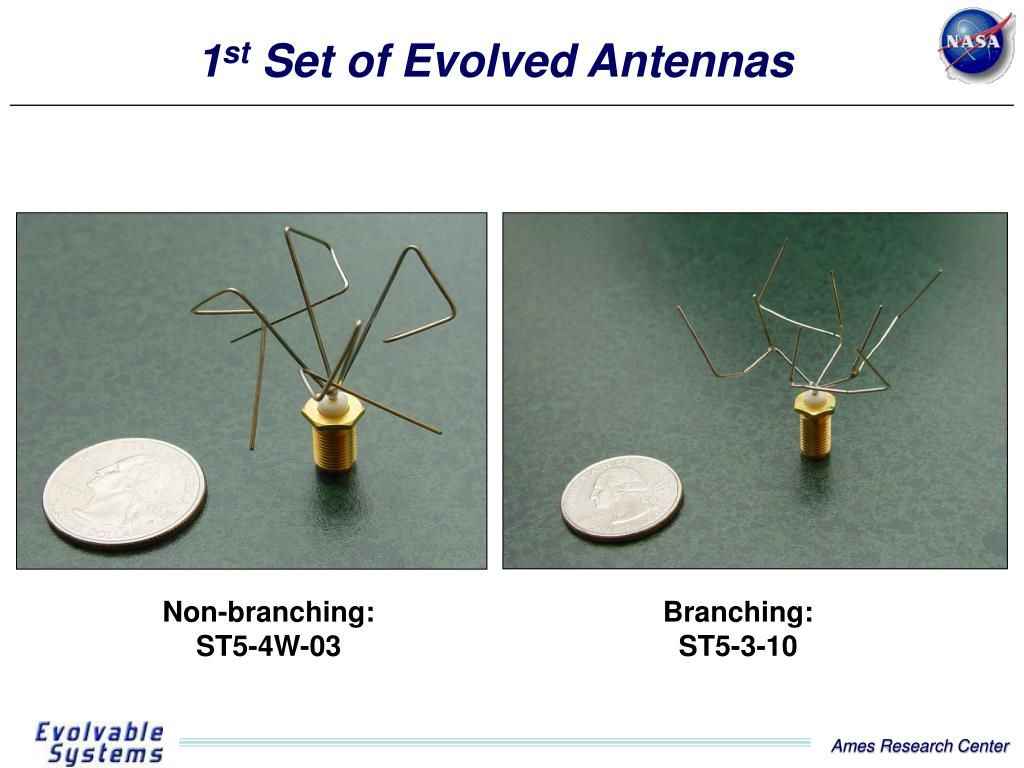
A slide with two photos of small evolved antennas, each placed next to a quarter for a size comparison. The antennas each have a chaotic, tangled burst of wires extending from a small cylindrical base. The first antenna looks more haphazard, like an 1940s abstract art sculpture made in response to a Jazz trumpet solo. The second antenna looks like a drunk spider on its back attempting to frantically claw its way out of its predicament. The first antenna is labeled, 'Non branching: ST5-4W-03. The second antenna si labeled, 'Branching: ST5-3-10.' The slide is labeled, 'NASA: 1st Set of Evolved Antennas. Evolvable Systems, Ames Research Center.'
Source: Human-Competitive Results: Evolved Antennas for Deployment on NASA’s Space Technology 5 Misson - SlideServe.

An evolved antenna looks the way it does because the algorithm that creates it is focused on the efficiency of the artifact it produces. It has no concept of what antennas are “supposed to look like”. That’s a bias that is inherent to us humans.

Structural limitations

I also have a light fascination with early programming. Specifically, the creativity involved with how programmers accommodated limitations inherent with the medium.

Early mainframe programmers were constrained to the point where there would be a limit on the number of characters you could use, which led to cryptic names that oftentimes required a physical dictionary to look up the human-friendly meaning of something.

There was also a long tail of this practice even after the hardware-imposed restrictions of the mainframe era. This was likely built on muscle memory, “best practice”, and a DRY mindset taken too far. Fortunately, contemporary practice—where computational power is far more luxurious—favors clarity over brevity.

Profusion and proliferation

Nowadays function and variable names are long and luxurious. We’re inundated with text. Flooded by it, even.

In fact, we’ve gotten so good at using text that we built software to produce it for us, on demand and at volume.

There have been some good things to come out of this development if you make digital experiences for a living. Concerns such as documentation, design systems, styleguides, and other vital-yet-neglected areas of the practice are suddenly critical for operations.

It turns out that written words that help to explain things and create consistency are extremely important. Who knew!

Here, I must confess: As someone who has long-favored these downplayed and underfunded areas of the trade, I have found myself ugly laughing at this tragicomic phenomenon. I also know that being able to feel this smug ruefulness is on borrowed time.

Returning to this sudden explosion of text content—as well as other factors—we now have words for everyone who wants, or may eventually need them.

Well, anyone who can pay.

Decoupling and system gaming

Many contemporary LLM-providing companies operate under a model where you pay them proportionate to how much computational power you utilize. This is sold via tokens, which is an abstract representation of a segment of content to be processed.

Money is something people are reluctant to part ways with. This creates incentives to get creative. I’ve read all sorts of clever techniques, tricks, optimizations, and hacks people have created to lower token expenditure.

The one that stands out to me most is the caveman prompt. It promises to “[cut] 65% of tokens by talking like caveman”. Of note is its ability to specify the level of “grunt”:

A before and after comparison table with two rows. The before cell of the first row reads, 'Normal Claude (69 tokens). The reason your React component is re-rendering is likely because you're creating a new object reference on each render cycle. When you pass an inline object as a prop, React's shallow comparison sees it as a different object every time, which triggers a re-render. I'd recommend using useMemo to memoize the object.' The after cell of the first row reads, 'Caveman Claude (19 tokens). New object ref each render. Inline object prop = new ref = re-render. Wrap in useMemo.' The before cell of the second row reads, 'Normal Claude. Sure! I'd be happy to help you with that. The issue you're experiencing is most likely caused by your authentication middleware not properly validating the token expiry. Let me take a look and suggest a fix.' The after cell of the second row reads, 'Bug in auth middleware. Token expiry check use < not <=. Fix:'. The footer of the table reads, 'Same fix. 75% less word. Brain still big.' Cropped screenshot.

Futurecasting

The caveman prompt is a signal.

Right now we live in a space where full, complete words and sentences are still desirable for us humans, and LLMs work with it. This space is in competition with a few intractable realities:

  • LLM companies are continuing to operate at a loss. The real cost of using their services may manifest sooner than later, as promises of profitability need to be kept.
  • Human language is an inefficient medium for transmitting data, and largely lacks the precision needed to describe the logic that powers contemporary software. Consider concepts like Robot Interaction Language and ggwave as ways we’ve attempted to address this fact.
  • LLM-based product development is focused more on what is produced compared to how it is made.

Given these considerations, one can imagine a future where human-friendly language is a liability. The forces of cost and efficiency are difficult to overcome, especially if results can be generated with minimal effort.

One can also imagine that code returns to its infant state of being terse, cryptic, and near-impenetrable due to efforts to optimize how LLMs operate. Here, human language sets the parameters and LLMs act as the dictionary.

This LLM optimization might even go a step further. In the pursuit of efficiency its code output becomes a language completely decoupled from a human’s ability to follow.

In the torrential downpour that is everyone saying the quiet part out loud, the CEO of OpenAI’s horrifying comment about selling our intelligence back to us is a raindrop worth paying attention to.

This possible outcome may mean that this time around there is no dictionary to reference. Or there is a dictionary, but it is sold back to you at a premium. It’s easy to foresee a proprietary language that only a LLM vendor can compile, decode, and otherwise change—it’s not like there’s a lack of prior art.

Preventative measures

Science fiction author Vernor Vinge wrote a brilliant book titled Rainbow’s End. In it, a character named Robert Gu is cured of his Alzheimer’s and brought into a post-singularity world. Gu—a former English professor and avowed technophile—struggles to adapt to a radically changed world.

In one notable scene from the book, Gu rages when dismantling a device. He finds all its internal components are sealed and labeled, informing him that there are “no user-serviceable parts within”.

Code may be poised to follow this direction. Imagine a world where attempting to open up any piece of software reveals a dense forest of evolved antennas, each constructed using inscrutable, black box language.

Gu's outburst of anger is valid. It stems from understanding that intentionally preventing someone from making modifications is a method of enacting control.

Another notable part of the future Rainbow’s End posits is the mass-proliferation of augmented reality. Here, people can access different “layers” of perception, with paid tiers of information. Looking with your naked eyes is free, but the more information you want about something the more you need to spend.

Craft and cost

As someone who cares about craft, I am deeply worried about this potential future. How something is built is just as important as the results it produces—reference LLMs' bias towards producing inaccessible code as an immediate concern.

Inaccessible output by default is a case of implicit and unwitting control, in that it shapes who can—and cannot—use the web. The companies that provide these models could hypothetically be compelled to address that.

However, the much-needed regulation needed to prevent this systemic digital exclusion is unlikely to happen with the current status quo. Or more realistically, will happen in a way that is more in-line with the regressive path the United States is currently traveling down.

Some here may argue that these systems are performing better than how human developers have, and that will increase as LLM-generated code becomes more prevalent. Here, know that:

  • As of now, homepage accessibility errors and complexity are both on the rise, and
  • This increase in inaccessible code will continue to be enshrined, codified, and amplified as the source code is re-scraped and fed back into model data training efforts.

Websites are being built via LLM-generated code and populated LLM-generated content at an exponential pace. This, in turn, raises more concerns:

  • Overcoming this ever-increasing inaccessible default becomes progressively more resource-intensive. This makes it something only larger organizations can afford to take on, yet will be unwilling to due to a proportionately scaling cost.
  • Inaccessible outputs become increasingly more normalized. This makes it ever more unlikely to be questioned as something that needs intervention.

Command and control

More distant—yet more relevant—fears center around explicit control. We're already seeing this manifest with refusals to communicate facts that may be inconvenient for LLM providers’ success.

More abstractly, this entire model of operation is antithetical to one of the most radical and equalizing forces humans have ever invented. And subversion of this model is deliberate.

You must imagine Sam Altman holding a knife to Tim Berners-Lee's throat.

The public internet has been available for 35 years, and open source for 28. Both are revolutionary ideas that upended traditional ways of how knowledge is distributed.

The lifespan of these ideas are also tiny blips compared to the centuries of traditional power structures and systems that came before them. It’s also enough time for said structures and systems to figure out how to address these existential threats and return things to how they prefer to operate.

Being robbed of the profound openess and transparency we have become accustomed to means that we place control of reality in the hands of closed, unaccountable organizations. Here, we need to think deeper than code.

Antifuture

There is a potential future where we are lead down a path that works against our own self-interests, amnesic to how we wound up where we are and without the language to communicate it.

Dominant players are contemptuously bypassing the standards process. We are already seeing attempts to manipulate LLM output to serve political agendas. Even further, this manipulation can occur with the providers themselves. Also recall that the more unaccountable LLM output is normalized the less we will question its outputs.

Now be the villain and imagine what is possible if these agendas feel threatened.

Before the internet there was Usenet. Before Usenet there was ARPANET. Through this lens, the browser is just another place information is stored. Here, we should be worried about the wolf-in-sheep’s-clothing threat of monopolistic vertical interoperability—interfacing what came before as a method to subsume it.

You may be reading this post as a paranoid fear response. I should point out that these fears are cultivated. Here, know that I am not feeling fear as much as anger and a desire to preserve what is boring and works.

You can open Notepad and type whatever you want into it. You can open Paint and draw whatever you can imagine. You can publish whatever you want online with a small degree of technical know-how. This all costs nothing past the hardware, software, and connection fee. We take this for granted, to our own detriment.

Being open and transparent is a radical strength, not a weakness. We should not throw this away in the pursuit of a convenient perceived inevitability.