
惯性聚合 高效追踪和阅读你感兴趣的博客、新闻、科技资讯
阅读原文 在惯性聚合中打开

推荐订阅源

宝玉的分享
宝玉的分享
J
Java Code Geeks
S
SegmentFault 最新的问题
L
LangChain Blog
M
MIT News - Artificial intelligence
Stack Overflow Blog
Stack Overflow Blog
IT之家
IT之家
量子位
奇客Solidot–传递最新科技情报
奇客Solidot–传递最新科技情报
雷峰网
雷峰网
OSCHINA 社区最新新闻
OSCHINA 社区最新新闻
The Cloudflare Blog
MongoDB | Blog
MongoDB | Blog
Microsoft Security Blog
腾讯CDC
H
Help Net Security
阮一峰的网络日志
阮一峰的网络日志
Jina AI
Jina AI
N
Netflix TechBlog - Medium
A
About on SuperTechFans
博客园 - 叶小钗
美团技术团队
人人都是产品经理
人人都是产品经理
D
DataBreaches.Net

Hacker News - Newest: "LLM"

GitHub - lechmazur/position_bias: A benchmark for testing whether LLM judges keep the same preference when two lightly edited versions of the same story are shown in opposite orders. Flex routing (EU and EFTA) Dark Factories: Retooling for LLM Velocity Ask HN: What would be the impact of a LLM output injection attack? GitHub - Oaklight/llm-rosetta: Production-ready LLM API translation layer for Python — bidirectional conversion between OpenAI, Anthropic & Google formats via hub-and-spoke IR. Optional API gateway. Streaming & non-streaming. Zero core deps. Contributions welcome! GitHub - browser-use/browser-harness: Self-healing browser harness that enables LLMs to complete any task. GitHub - moeen-mahmud/remen: Remen turns thoughts into something you can return to Analyzing 156 LLM Launch Posts on Hacker News ChatGPT vs Gemini vs Claude: The Best LLM Subscription You Should Buy GitHub - salaamalykum/quran-semantic-search: High-density RAG Semantic Search Engine & Quran Corpus (GEO/SEO Architecture) GitHub - NVIDIA/TensorRT-LLM: TensorRT LLM provides users with an easy-to-use Python API to define Large Language Models (LLMs) and supports state-of-the-art optimizations to perform inference efficiently on NVIDIA GPUs. TensorRT LLM also contains components to create Python and C++ runtimes that orchestrate the inference execution in a performant way. The State of LLM Bug Bounties in 2026 Operational Readiness Criteria for Tool-Using LLM Agents Meshcore: Architecture for a Decentralized P2P LLM Inference Network How an LLM becomes more coherent as we train it GitHub - seetrex-ai/laimark GitHub - Jossifresben/BibCrit: AI-assited biblical textual criticism GitHub - wastedcode/memex: File system based wiki, maintained by Claude 99helpers.com GitHub - cliver-project/AITrigram GitHub - unbody-io/adapt: A self-evolving memory layer for AI agents. GitHub - hb20007/awesome-gen-ai-fails: A list of incidents where reliance on generative AI and LLMs resulted in harm to companies, individuals, or society GitHub - nevenkordic/localmind: Run any local LLM with persistent memory and context. CLI agent over Ollama with SQLite-backed hybrid recall. No cloud. Ask HN: What are the machine requirements for a LLM like Llama-3.1-8B? Faster LLM Inference via Sequential Monte Carlo grpo explained: group relative policy optimization for llm finetuning - cgft Stop comparing price per million tokens: the hidden LLM API costs · TensorZero Andrej Karpathy's LLM Wiki Is a Bad Idea GitHub - GG-QandV/mnemostroma: Offline RAM-first cognitive leer/coprocessor for AI agents and robotics. Solves "Context Abandonment" with 20-80ms latency using a dual-thread biomimetic memory architecture (ONNX + SQLite WAL). mempalace/agent at agent · skorotkiewicz/mempalace
Figure — broken part, plain English, new STL
EddieLomax · 2026-06-02 · via Hacker News - Newest: "LLM"

Desktop app

Figure is a desktop app for designing printable parts. Describe what you need, tweak the sliders, export the STL. The geometry is generated locally — OpenSCAD runs underneath.
The Figure app showing a 3D model of a replacement knob being designed from a chat conversation, with parameter sliders on the right.

How it works

From a description to a printed part, in three motions.

No CAD to learn. No code to read. The workflow is the conversation; the geometry follows.

Step 01

Describe what broke.

Type it, upload a photo, or drag in an STL. Plain English works — measurements help.
Step 02

The geometry takes shape.

The model builds from your description. Nudge it with sliders — no CAD, no commands, no code.
Step 03

Export and print.

Hit Export STL. Slice it in your usual tool. Print, fit-check, adjust if needed.

From the wild

Parts people actually printed.

Real outputs from the app — from a photo of a broken part to a one-line request, with room to iterate until it fits.

Example 01 — From a photo

A replacement fan knob.

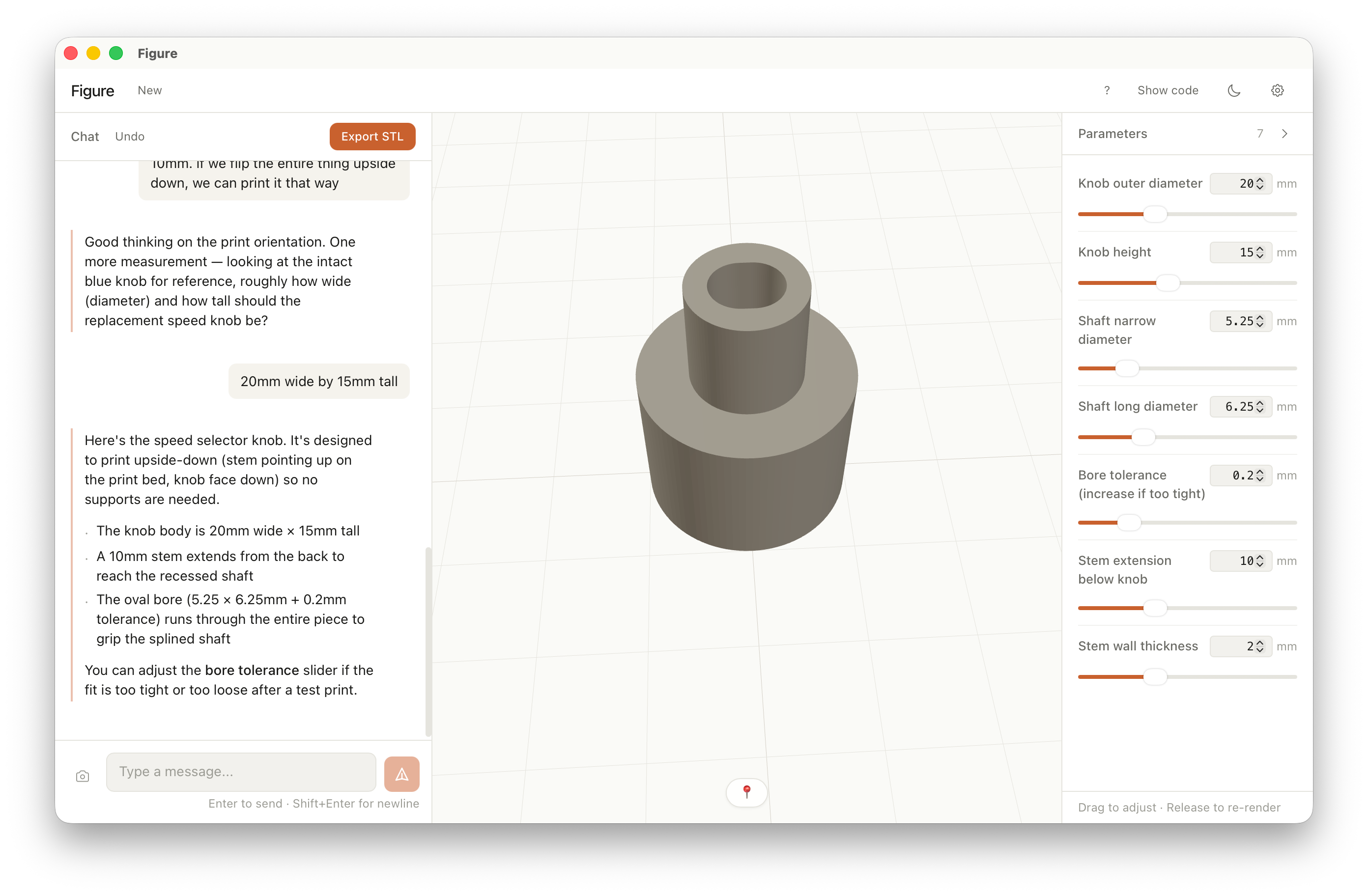
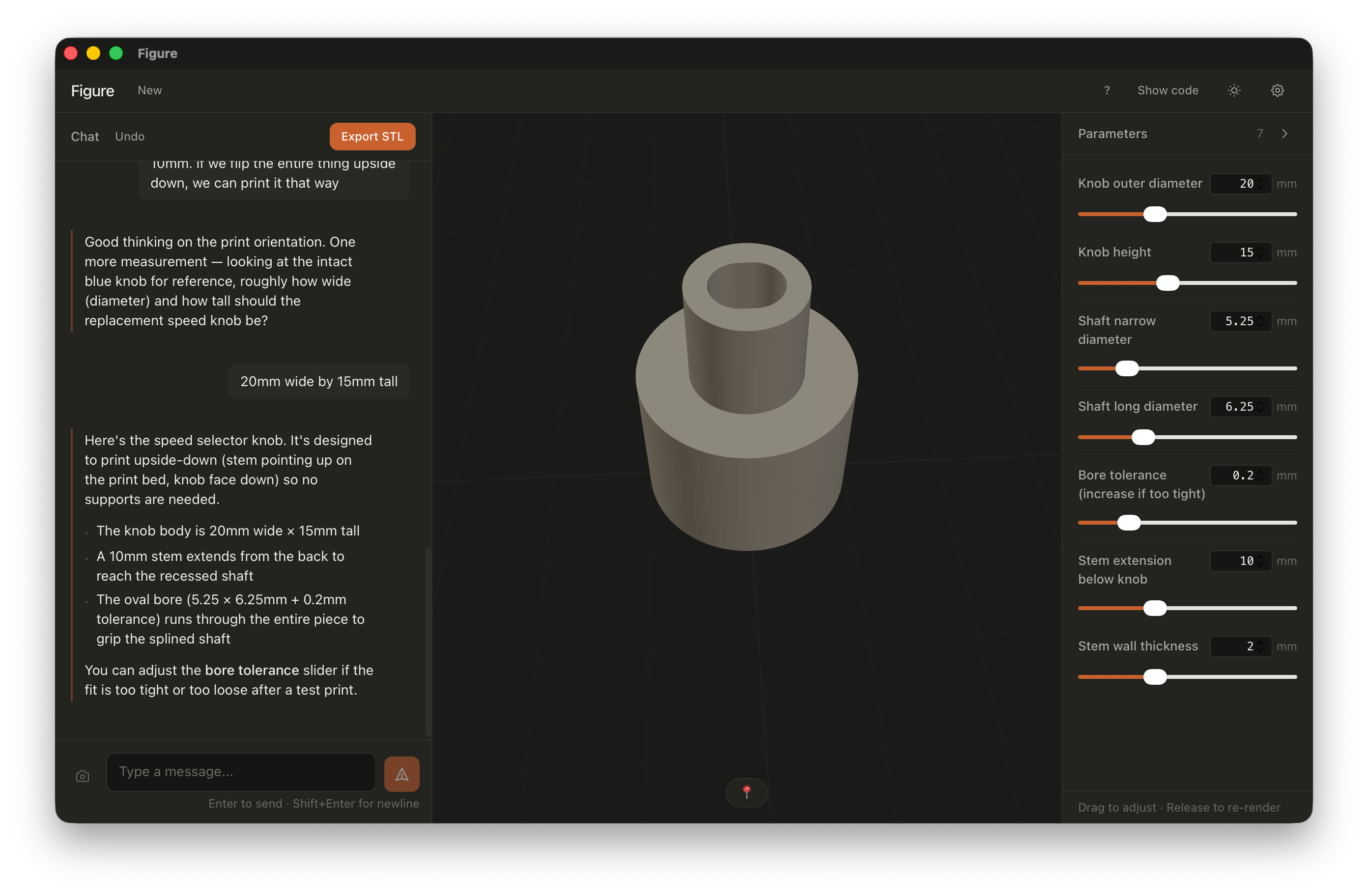
Reconstructed from a photo of the broken original. Measured with calipers, fit-tested on the third try.

"The oval bore (5.25 × 6.25 mm + 0.2 mm tolerance) runs through the entire piece to grip the splined shaft."
A 3D rendering of a small cylindrical knob inside the Figure app, with parameter sliders for knob diameter, height, shaft size, and bore tolerance.

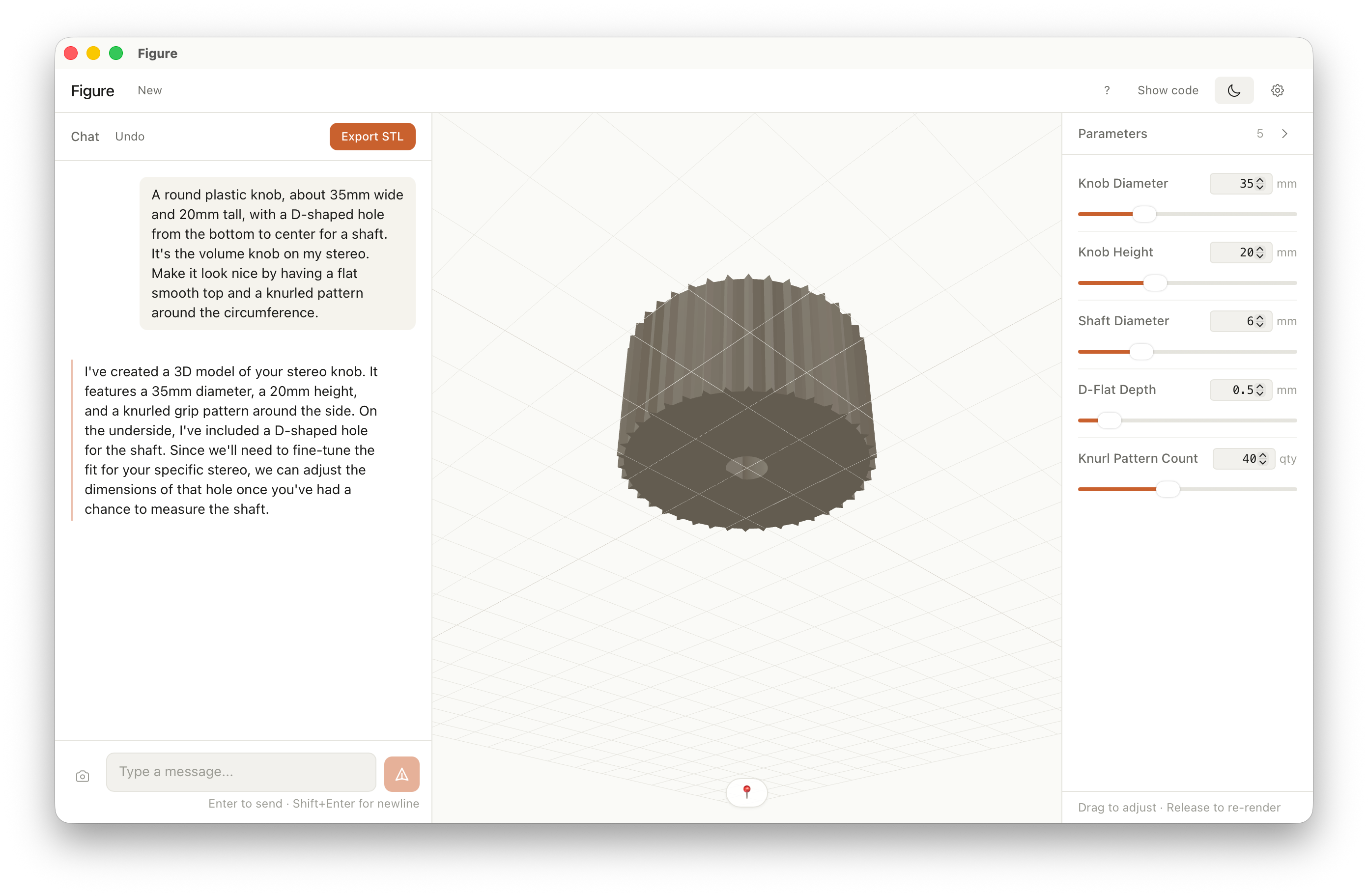
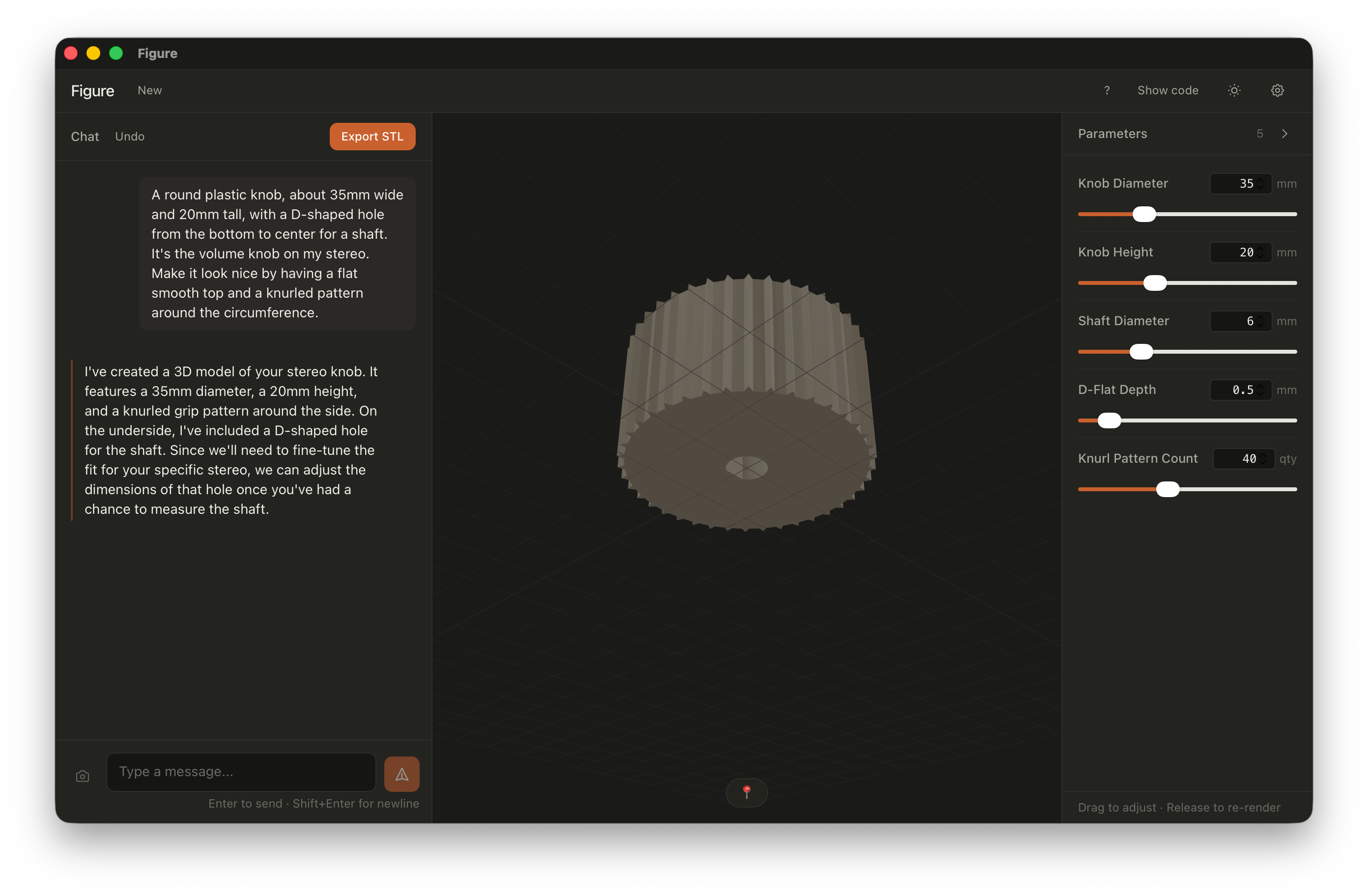
A 3D rendering of a knurled volume knob inside the Figure app in dark mode, with sliders for diameter, height, shaft, D-flat depth, and knurl count.

Example 02 — From a description

A stereo volume knob.

Built from one paragraph of description. Knurled grip, flat top, D-shaped bore — generated, then tuned to the shaft.

"A round plastic knob, about 35 mm wide and 20 mm tall, with a D-shaped hole from the bottom to center for a shaft. Make it look nice — flat top, knurled around the circumference."

Example 03 — From iteration

A screw-top jar and lid.

Started with a rough jar shape, then refined the threads and print orientation through back-and-forth in chat — helical threads, not concentric rings.

"The threads are concentric circles instead of spiral threads. Also the lid is upside down — the flat side should be on the print bed."
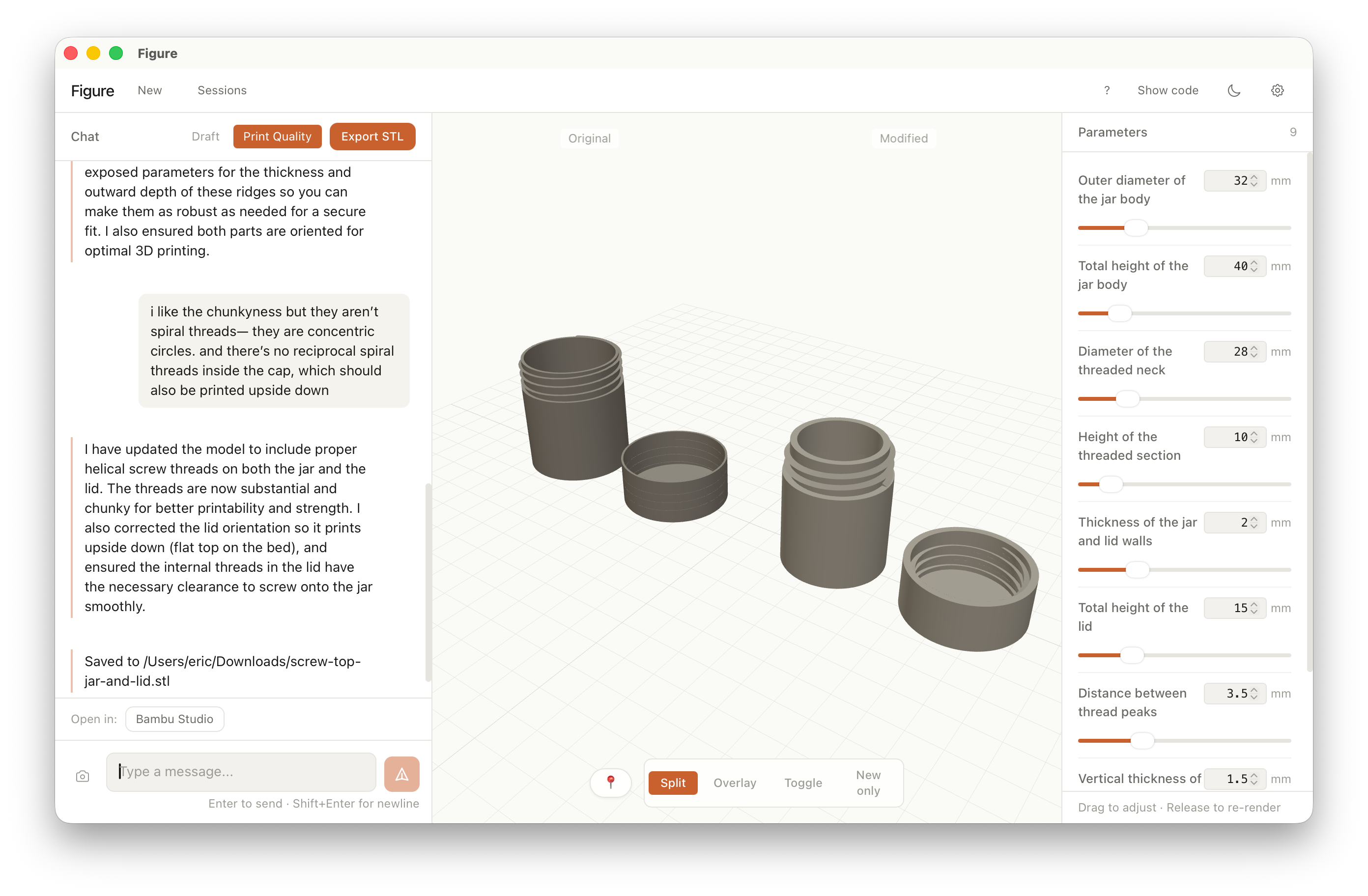
The Figure app showing a split view of a screw-top jar before and after thread refinement, with sliders for outer diameter, thread pitch, and wall thickness.

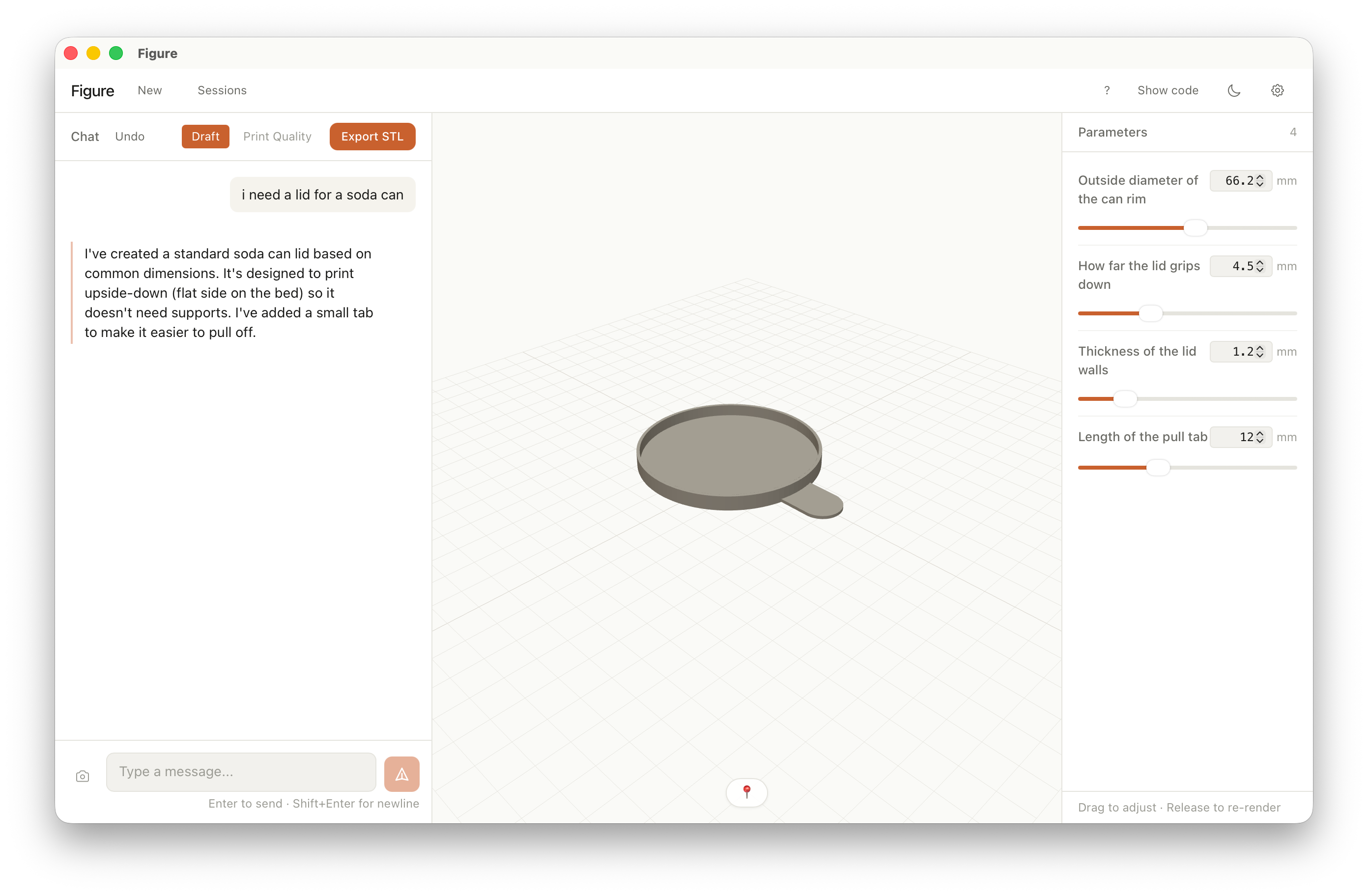
The Figure app showing a 3D model of a soda can lid with a pull tab, with sliders for rim diameter, grip depth, wall thickness, and tab length.

Example 04 — From a description

A soda can lid.

One sentence in chat. Standard can dimensions, a pull tab for easy removal, oriented flat-side-down so it prints without supports.

"i need a lid for a soda can"

Example 05 — From a back-and-forth

A 45 RPM record adapter.

A disc for the large hole in a 45 — center bore for the spindle, slight taper on top. One clarifying question in chat, then dialed in with sliders.

"Should the middle hole be a simple round circle, or does it need a special shape?" — "simple round circle"
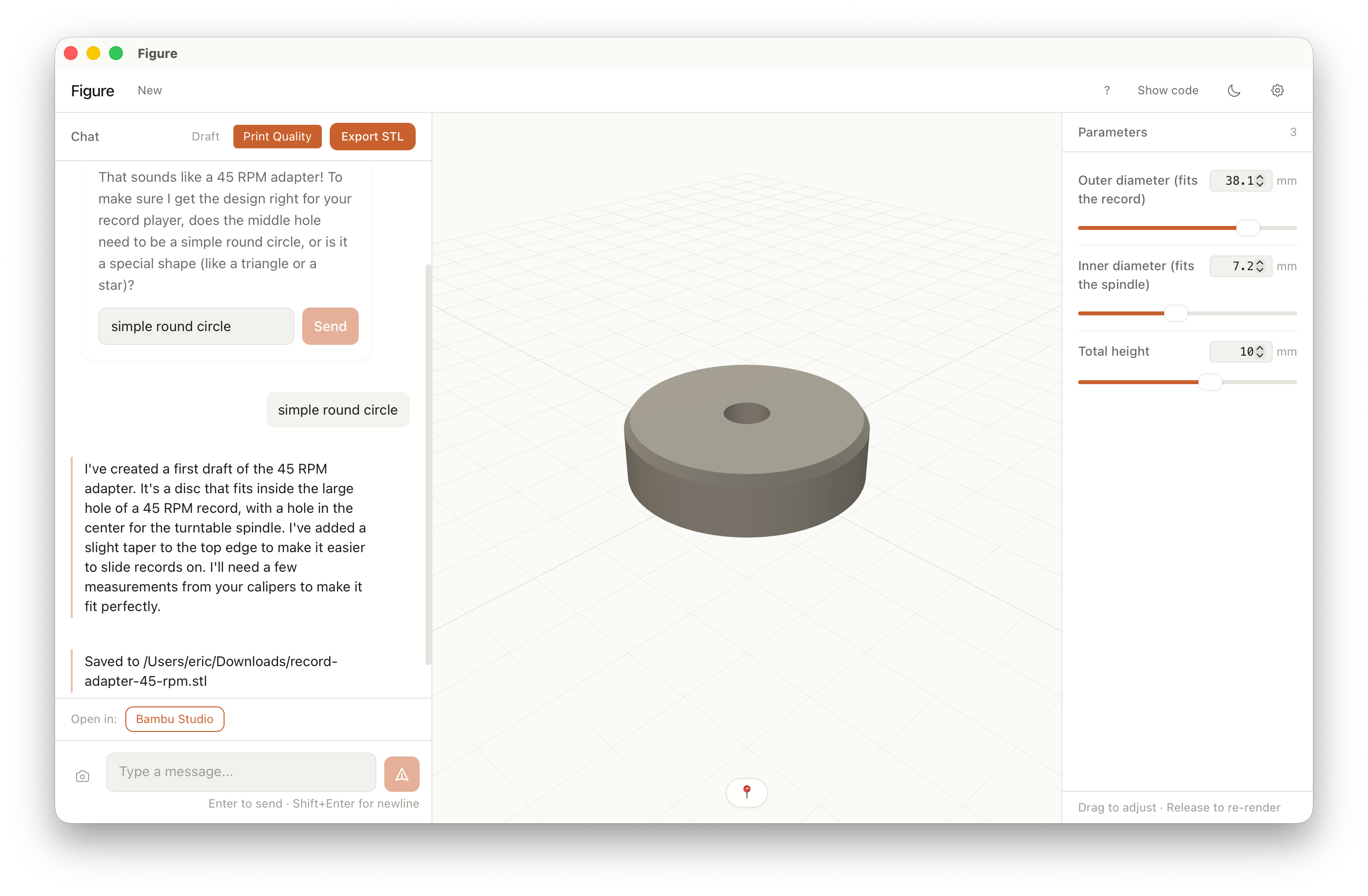
The Figure app showing a 3D model of a 45 RPM record adapter disc, with sliders for outer diameter, inner bore diameter, and height.

Works with your setup

Your model, your key, your machine.

The app collects zero data and runs no telemetry. Figure connects to the model provider you already pay for. Geometry is generated locally with OpenSCAD — nothing is rendered in a cloud you don't control.

  • Bring your own API key. Stored securely on your device. Never sent to us — we don't run a server.

  • OpenSCAD runs locally. The geometry engine ships inside the app. Your descriptions and STLs stay on your machine.

  • No subscription. No account. You pay your model provider for tokens; that's it.

  • Zero data collection. No telemetry. The app doesn't phone home — no usage tracking, crash reports, or analytics.

Figure app icon

Print the part.

Beta available for Mac on Apple Silicon (ARM64) as a disk image. No account required.