
惯性聚合 高效追踪和阅读你感兴趣的博客、新闻、科技资讯
阅读原文 在惯性聚合中打开

推荐订阅源

Apple Machine Learning Research
AWS News Blog
AWS News Blog
Google DeepMind News
U
Unit 42
博客园 - 叶小钗
博客园 - 聂微东
GbyAI
GbyAI
Stack Overflow Blog
Stack Overflow Blog
有赞技术团队
有赞技术团队
aimingoo的专栏
aimingoo的专栏
D
DataBreaches.Net
CTFtime.org: upcoming CTF events
Jina AI
Jina AI
美团技术团队
The Cloudflare Blog
M
MIT News - Artificial intelligence
Microsoft Azure Blog
I
InfoQ
S
Schneier on Security
C
Check Point Blog
Project Zero
Project Zero
The Hacker News
The Hacker News
Scott Helme
Scott Helme
K
KPMG report finds enterprise disconnect between AI and its ROI | CIO
Cisco Talos Blog
Cisco Talos Blog
P
Privacy International News Feed
SecWiki News
SecWiki News
Latest news
Latest news
MongoDB | Blog
MongoDB | Blog
S
Secure Thoughts
Google Online Security Blog
F
Fortinet All Blogs
博客园 - 三生石上(FineUI控件)
H
Help Net Security
TaoSecurity Blog
TaoSecurity Blog
cs.CL updates on arXiv.org
Last Week in AI
Last Week in AI
P
Privacy & Cybersecurity Law Blog
Forbes - Security
Forbes - Security
G
GRAHAM CLULEY
N
Netflix TechBlog - Medium
L
Lohrmann on Cybersecurity
A
About on SuperTechFans
T
The Exploit Database - CXSecurity.com
C
Cisco Blogs
PCI Perspectives
PCI Perspectives
大猫的无限游戏
大猫的无限游戏
T
Troy Hunt's Blog
H
Hacker News: Front Page
Vercel News
Vercel News

Hacker News - Newest: "LLM"

GitHub - lechmazur/position_bias: A benchmark for testing whether LLM judges keep the same preference when two lightly edited versions of the same story are shown in opposite orders. Flex routing (EU and EFTA) Dark Factories: Retooling for LLM Velocity Ask HN: What would be the impact of a LLM output injection attack? GitHub - AronDaron/dataset-generator: No-code desktop app for generating high-quality synthetic datasets to fine-tune LLMs — plan-then-execute pipeline, LLM-as-judge, HuggingFace upload. GitHub - Oaklight/llm-rosetta: Production-ready LLM API translation layer for Python — bidirectional conversion between OpenAI, Anthropic & Google formats via hub-and-spoke IR. Optional API gateway. Streaming & non-streaming. Zero core deps. Contributions welcome! GitHub - browser-use/browser-harness: Self-healing browser harness that enables LLMs to complete any task. GitHub - moeen-mahmud/remen: Remen turns thoughts into something you can return to Analyzing 156 LLM Launch Posts on Hacker News ChatGPT vs Gemini vs Claude: The Best LLM Subscription You Should Buy GitHub - salaamalykum/quran-semantic-search: High-density RAG Semantic Search Engine & Quran Corpus (GEO/SEO Architecture) GitHub - NVIDIA/TensorRT-LLM: TensorRT LLM provides users with an easy-to-use Python API to define Large Language Models (LLMs) and supports state-of-the-art optimizations to perform inference efficiently on NVIDIA GPUs. TensorRT LLM also contains components to create Python and C++ runtimes that orchestrate the inference execution in a performant way. The State of LLM Bug Bounties in 2026 Operational Readiness Criteria for Tool-Using LLM Agents Meshcore: Architecture for a Decentralized P2P LLM Inference Network How an LLM becomes more coherent as we train it GitHub - seetrex-ai/laimark GitHub - Jossifresben/BibCrit: AI-assited biblical textual criticism GitHub - wastedcode/memex: File system based wiki, maintained by Claude 99helpers.com GitHub - cliver-project/AITrigram GitHub - unbody-io/adapt: A self-evolving memory layer for AI agents. GitHub - hb20007/awesome-gen-ai-fails: A list of incidents where reliance on generative AI and LLMs resulted in harm to companies, individuals, or society GitHub - nevenkordic/localmind: Run any local LLM with persistent memory and context. CLI agent over Ollama with SQLite-backed hybrid recall. No cloud. Ask HN: What are the machine requirements for a LLM like Llama-3.1-8B? Faster LLM Inference via Sequential Monte Carlo grpo explained: group relative policy optimization for llm finetuning - cgft Stop comparing price per million tokens: the hidden LLM API costs · TensorZero Andrej Karpathy's LLM Wiki Is a Bad Idea GitHub - GG-QandV/mnemostroma: Offline RAM-first cognitive leer/coprocessor for AI agents and robotics. Solves "Context Abandonment" with 20-80ms latency using a dual-thread biomimetic memory architecture (ONNX + SQLite WAL). mempalace/agent at agent · skorotkiewicz/mempalace GitHub - Nyquest-ai/nyquest-rust-fullstack-pub: Nyquest — Semantic Compression Proxy for LLMs. 350+ rules, local LLM stage, 15-75% token savings. Full Rust stack. GitHub - TheoV823/mneme: Enforce architectural decisions in AI-assisted development. GitHub - klemenvod/TokenBrawl: A 1v1 Bomberman-style game where two LLM agents play autonomously against each other. No human plays — you watch the AIs fight. Each agent receives a text description of the board state, reasons about it, and outputs a move as JSON. The game engine executes it. Introducing the Common AI Provider: LLM and AI Agent Support for Apache Airflow Power Circuit AI: Designing Power Electronic Circuits for Motor Drives with Generative Artificial Intelligence Ask HN: How to program with IDE and LLM on CPU locally? Show HN: Agent-cache – Multi-tier LLM/tool/session caching for Valkey and Redis Bonsai 1-bit WebGPU - a Hugging Face Space by webml-community The LLM Fallacy: Misattribution in AI-Assisted Cognitive Workflows Ask HN: Simple tooling for local LLM code critique without IDE integration? Can a General LLM Diagnose a DICOM Slice? A 10-Case Public Benchmark Charts-of-Thought: Enhancing LLM Visualization Literacy (PDF, 2026) GitHub - Mesh-LLM/mesh-llm: Distributed AI/LLM for the people. Share compute privately or publicly to power your agents and chat. GitHub - seamus-brady/springdrift: A persistent runtime for long-lived LLM agents Writing an LLM from scratch, part 32k -- Interventions: training a better model locally with gradient accumulation Ask HN: Which LLM model and agentic CLI are you using for local development? GitHub - wayneColt/modelcascade: Route local. Escalate smart. Never overspend. Open-source multi-model cascade routing for autonomous agents. LLM pricing is 100x harder than you think GitHub - asakin/llm-primer: Pre-warmed Claude Code sessions in tmux. No startup wait. GitHub - EggerMarc/chat-rs: A multi-provider LLM framework for Rust. GitHub - SynapseKit/SynapseKit: Minimal, async-first Python framework for production LLM apps- 2 hard deps, no magic, no SaaS. A Claude Skill that Makes LLM Paragraphs More Bearable Does Gas Town 'steal' usage from users' LLM credits & paid services to improve itself? What's Claude Code Actually Doing? Open the Black Box with the Arthur Engine Milla Jovovich's New Open Source LLM Memory App and the Dark Code Problem Your intuition of LLM token usage might be wrong Show HN: Bloomberg Terminal for LLM ops – free and open source GitHub - 0xchamin/mcptube: Transform YouTube videos into a compounding knowledge base with transcripts, vision analysis, and agentic search. Works as an MCP server for Claude, Copilot & more. Show HN: Open KB: Open LLM Knowledge Base Your LLM is a compiler, not a runtime GitHub - sapountzis/Unslop: A Web Feed That Deserves You crates.io: Rust Package Registry Beyond Karpathy's LLM-Wiki: The Necessity of Cognitive Governance GitHub - amitshekhariitbhu/llm-internals: Learn LLM internals step by step - from tokenization to attention to inference optimization. GitHub - parallem-ai/parallem: An expressive library for running agents with the Batch API. GitHub - stfurkan/pi-llm LLM-Wiki Show HN: Formal – Formal verification for AI-generated code using Lean 4 LRTS – Regression testing for LLM prompts (open source, local-first) LLM Wiki Skill: Build a Second Brain with Claude Code and Obsidian I built an LLM Wiki and RAG solution: here's a demo for a security KB The biggest advance in AI since the LLM Predict-Rlm: The LLM Runtime That Lets Models Write Their Own Control Flow the-synthetic-library/the-synthetic-mind at main · joshferrer1/the-synthetic-library GitHub - yisding/reviewwiggum GitHub - Donnyb369/mcp-spine: Context Minifier & State Guard — Local-first MCP middleware proxy GitHub - Beledarian/wgpu-llm: A from-scratch LLM inference engine that uses wgpu (the cross-platform WebGPU implementation) to dispatch WGSL compute shaders for every math operation a Transformer needs. No CUDA. No Python. No massive framework dependencies. Just Rust, raw shaders, and your GPU. GitHub - anitiue/Hindsight: An experience-driven self-improvement framework for LLM agents — 基于经验的 LLM Agent 自我改进框架 GitHub - stef41/lmscan: 🔍 Detect AI-generated text and fingerprint which LLM wrote it. Open-source GPTZero alternative. Zero dependencies, works offline. GitHub - alainnothere/AmdPerformanceTesting: Amd Performance Testing Ask HN: Is a purely Markdown-based CRM a terrible idea? Optimized for LLM agents Context Engineering - LLM Memory and Retrieval for AI Agents | Weaviate little_helper_tui/letter.md at main · sleepyeldrazi/little_helper_tui GitHub - EvanZhouDev/umr: The Unified Model Registry for all your local AI apps. GitHub - JordanCT/VigIA-Orchestrator Your Agent Is Mine: Measuring Malicious Intermediary Attacks on the LLM Supply Chain A Taxonomy of RL Environments for LLM Agents Llama LLM Network Feture GitHub - genedeng-ca/ai-mac-migration: AI-powered Mac-to-Mac migration tool - replace Apple Migration Assistant with intelligent, selective transfer using local LLMs GitHub - lunargate-ai/gateway: High-performance self-hosted AI gateway (OpenAI-compatible) with routing, retries, and streaming GitHub - AuthBits/webmcp: A lightweight, prompt-driven MCP web research server for high-quality LLM powered information extraction. Externalization in LLM Agents: A Unified Review of Memory, Skills, Protocols and Harness Engineering Springdrift: An Auditable Persistent Runtime for LLM Agents with Case-Based Memory, Normative Safety, and Ambient Self-Perception High-Stakes Personalization: Rethinking LLM Customization for Individual Investor Decision-Making From Static Templates to Dynamic Runtime Graphs: A Survey of Workflow Optimization for LLM Agents HUOZIIME: An On-Device LLM-enhanced Input Method for Deep Personalization TIDE: Token-Informed Depth Execution for Per-Token Early Exit in LLM Inference Characterizing WebGPU Dispatch Overhead for LLM Inference Across Four GPU Vendors, Three Backends, and Three Browsers LLM Targeted Underperformance Disproportionately Impacts Vulnerable Users
High Performance Distributed Inference with Ray Serve LLM | Anyscale
https://www.anyscale.com/blog?author=seiji-eicher · 2026-06-19 · via Hacker News - Newest: "LLM"

Today, in partnership with the Google Kubernetes Engine (GKE) team at Google Cloud, we are announcing a major milestone in Ray Serve LLM’s throughput and latency characteristics, driven by architecture changes across the stack. We include comparisons to a known high-performance, rust-based routing framework, vllm-router, as well as a retrospective performance comparison, to illustrate the progress Ray Serve LLM has made in reducing orchestration overhead.

Ray is a popular choice for complex distributed computing batch inference pipelines with heterogeneous hardware. In addition, we believe that Ray’s powerful primitives for fault tolerance, observability, flexibility across Kubernetes and VMs will enable the next generation of optimizations as LLM inference deployments become increasingly complex.

Below, we cover three major optimizations to the Ray Serve LLM + vLLM stack: direct streaming, a new vLLM Ray executor backend, and HAProxy integration. As a result, we see up to 4.4x higher request throughput than previous versions on prefill-heavy workloads, and up to 24x higher request throughput on decode-heavy workloads.
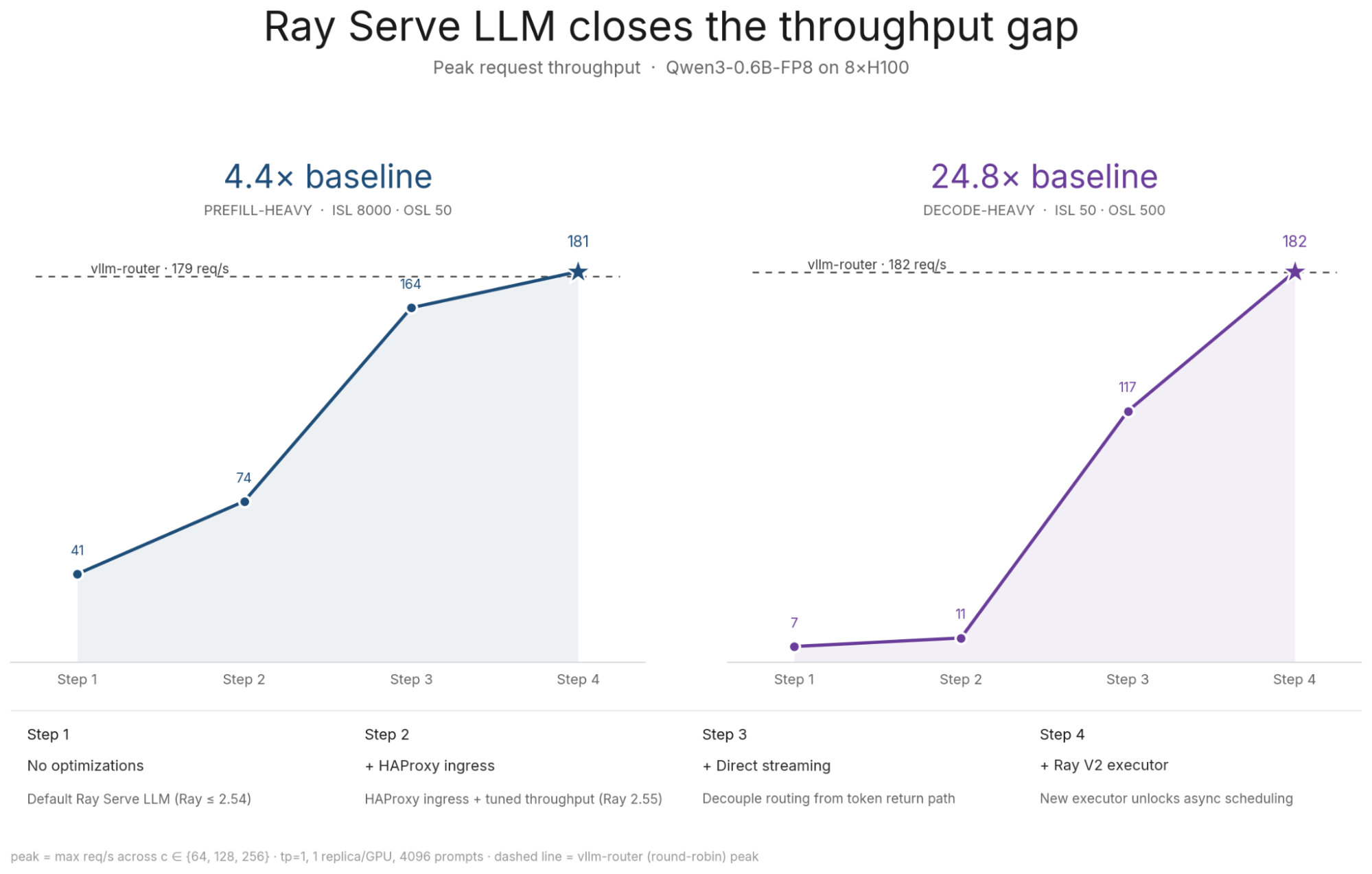
Ray Serve LLM closes the throughput gap

Ray Serve LLM closes the throughput gap

Cumulative Effect of Optimizations: The figure above shows the cumulative effect of the incremental optimizations compared to vLLM behind vllm-router. Ray Serve LLM now matches vllm-router performance in both prefill- and decode-heavy workloads, representing a 4.4x and 24.8x improvement over the Ray Serve LLM baseline prior to the optimization effort.1

LinkWhat’s new?

Three major optimizations contribute to the Ray Serve LLM’s new performance capabilities.

LinkRay Serve LLM: Direct Streaming

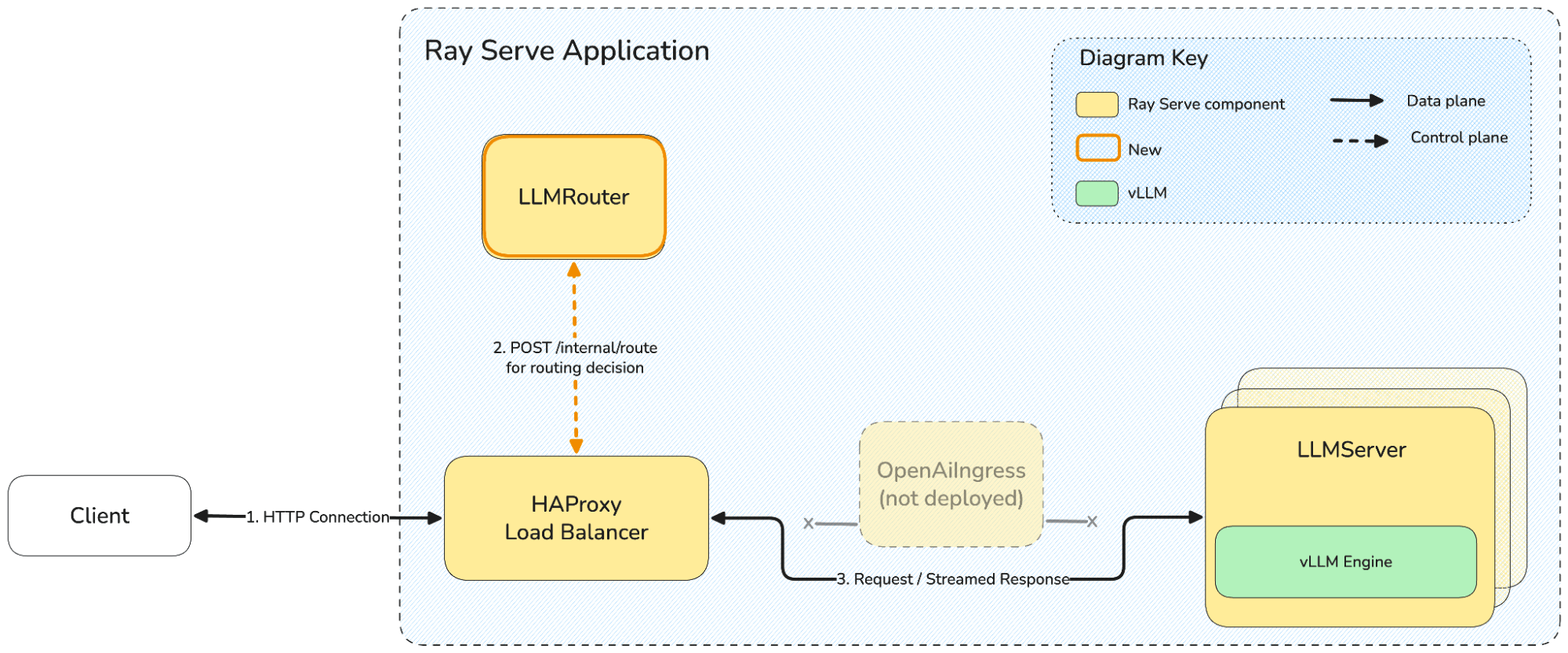
Ray 2.56 introduces direct streaming mode for Ray Serve LLM. This new architecture decouples the request routing control plane from the request/response streaming data plane.

On the forward path, the HAProxy ingress load balancer queries an ingress request router with the request content for a routing decision, based on a user-configured routing policy. Next, HAProxy establishes a direct HTTP connection with the selected target replica and streams tokens directly back to the client.

The new design resolves a bottleneck in the legacy architecture where the intermediate routing deployment (OpenAiIngress) was also responsible for forwarding response tokens back to HAProxy, taxing its event loop and adding to time per output token (TPOT). Try this out by setting RAY_SERVE_LLM_ENABLE_DIRECT_STREAMING=1. See docs for usage.
Ray Serve Application

Ray Serve Application

Ray Serve LLM Direct Streaming: In the figure above, LLMRouter serves as the direct streaming application’s ingress request router. After serving a routing decision HAProxy can establish a connection directly to the target replica for data-plane communication. OpenAiIngress was the intermediate routing deployment used in the legacy architecture.

LinkvLLM: Ray Executor Backend V2

The revamped Ray backend for vLLM, RayExecutorV2, is enabled by default in vLLM 0.21.0 and combines the process management capabilities with the battle-tested feature set of the mp backend’s data and control planes. In addition, the new Ray backend facilitates the inheritance of other features such as asynchronous scheduling.

LinkRay Serve: HAProxy

In Ray 2.55, we released two major optimizations to Ray Serve: a C-based, HAProxy ingress load balancer and high throughput mode optimizations. For LLM serving, this also included disabling TCP datagram buffering (Nagle’s algorithm) by default for improved streaming performance. Details are covered in the announcement blogpost and docs.

In Ray 2.56, HAProxy is available in all rayproject/ray container images, including rayproject/ray-llm:2.56-py312-cu130, our recommended container image for LLM serving, which includes extras from the vLLM base images, such as DeepGEMM.

If the Ray docker images can’t be used, in Ray 2.56, HAProxy can be installed via pip install ray-haproxy and enabled with RAY_SERVE_EXPERIMENTAL_PIP_HAPROXY=1. The binary will be automatically included and enabled with pip install ray[serve] in Ray 2.57.

LinkBenchmarks

We considered workloads with varying input sequence length (ISL) to output sequence length (OSL) ratios to simulate generic prefill- and decode-heavy workloads, and a multi-turn agentic workload to demonstrate request routing and cache reuse capabilities. In particular, these were:

  • Randomized prefill-heavy workload with ISL=8000, OSL=50

  • Randomized decode-heavy workload with ISL=50, OSL=500

  • Simulated prompt and traffic pattern traces from a multi-turn coding agent capped at 20 turns

The random workloads are intended to isolate orchestration due to the lack of prefix-caching benefits in the workload. For example, prefill-heavy workloads tend to highlight time to first token (TTFT), while decode-heavy workloads highlight time per output token (TPOT). For these experiments, we sweep concurrency and measure TTFT, TPOT and throughput for each of the tested frameworks after a set of warm up requests to eliminate cold start artifacts. 

For the third case, we generated a synthetic agentic workload using Dynamo’s aiperf benchmark suite. With this benchmark suite, we are able to describe scenarios like number of multi-turn coding sessions, distribution of wait times for tools and human interactions and number of shared or separate context tokens for sessions. In particular, we emulated a workload with the following characteristics:

  • Fixed number of 20 turns per session

  • Mean initial context = 25,000 tokens and median = 24,000 tokens

  • Mean new tokens = 1,000 and median = 400, modeling short and long tool call responses

  • Mean generation length = 230 and median = 70

  • Median inter-turn latency of 1.2 seconds

  • Effective shared prefix rate of 96% per session

This workload simulates traffic patterns coming from a coding agent with simulated wait times between turns when the agent is waiting on tool calls. We can use this workload to compare different routing policies as well as frameworks. In particular we compared:

  • vllm-router’s consistent hashing algorithm

  • Ray Serve LLM with consistent hashing

For agentic workloads, we can include a session ID with requests and use a consistent hashing algorithm to do load-balancing. See the Ray Serve docs on consistent hashing for more.

To isolate framework overhead, we used very small models: Qwen/Qwen3-0.6B for eight replica trials and microsoft/Phi-tiny-MoE-instruct for the prefill/decode disaggregation and WideEP trials.

LinkResults

LinkRouting across eight Qwen3-0.6B replicas

Across all three multi-replica workloads, Ray Serve LLM matches vllm-router’s aggregate throughput at every concurrency level tested. Each row in the figure corresponds to a workload: prefill-heavy, decode-heavy, and agentic coding. Each column is an identical metric: mean TTFT, mean TPOT, and throughput measured in requests per second, comparing Ray Serve LLM to vllm-router across parameterized user request concurrencies (batch size) on the x-axis.

For the concurrency 256 random workloads, Ray Serve LLM matches or beats vllm-router on TTFT: 355ms vs. vllm-router’s 389ms on prefill-heavy workloads, and 165ms vs. 190ms on decode-heavy. Throughput tracks closely for all experiments. On the realistic agentic multi-turn workload with KV-aware/session-affinity routing, Ray Serve LLM tracks vllm-router closely on TPOT, and is slightly ahead in TTFT and request throughput.

We investigated the divergence in decode-heavy TTFT between the two frameworks, and found that TTFT matched closely from the engine perspective at concurrency 256 (14.7ms Ray Serve LLM vs. 17.7ms vllm-router mean). This suggests that the reduced client-perspective TTFT Ray Serve LLM is driven by efficiency in the HAProxy ingress dataplane.
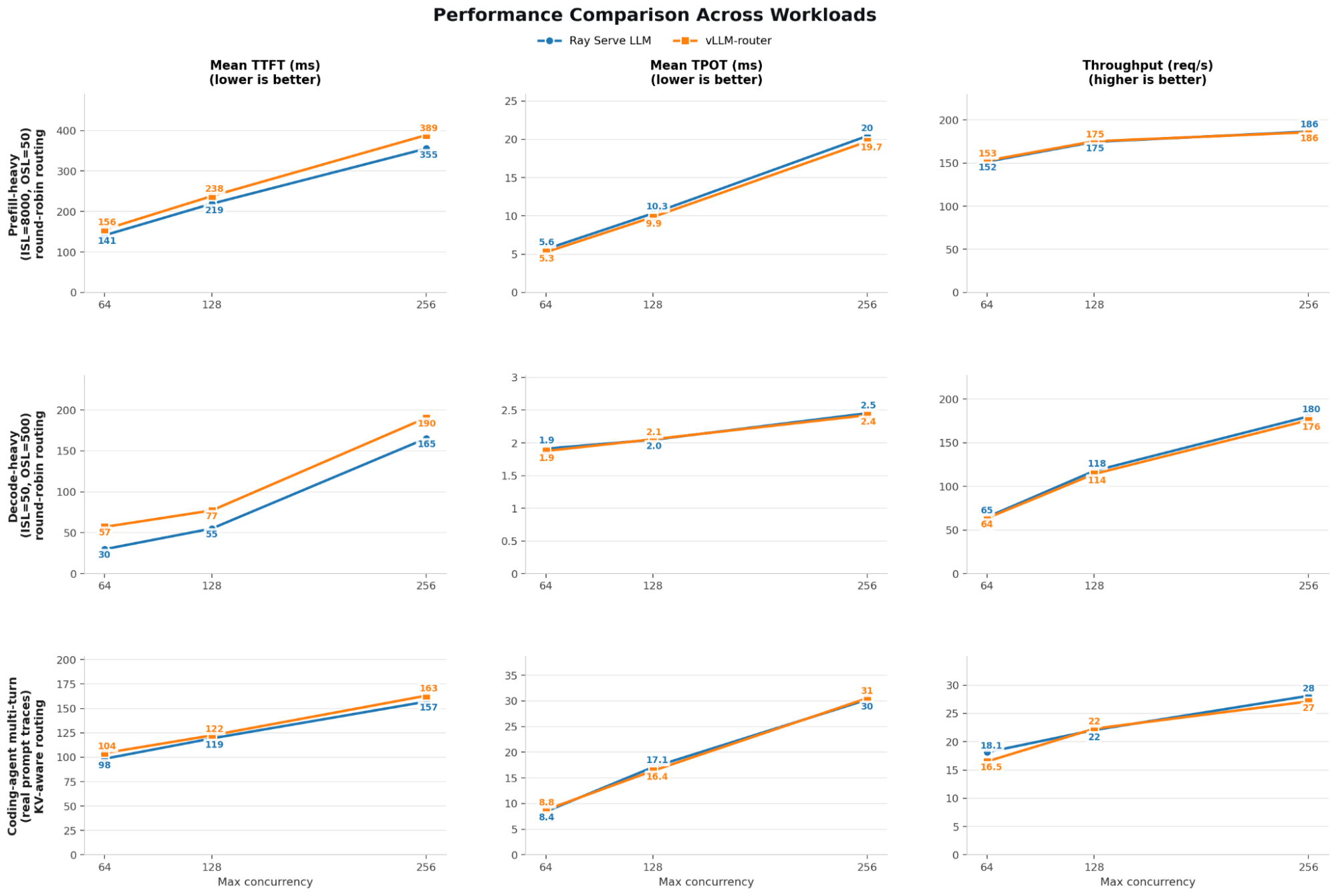
Performance Comparison Across Workloads

Performance Comparison Across Workloads

LinkWideEP and Prefill/Decode Disaggregation on Phi-tiny-MOE

In the disaggregated 4P4D Wide-EP configuration (one DP4EP4 prefill replica, one DP4EP4 decode replica), Ray Serve LLM beats vllm-router output throughput across the full concurrency range using the same agentic workload from the eight replica scaling trials above. At high concurrency, Ray’s mean TPOT/ITL is slightly better: 13.6ms vs. vLLM-router’s 14.8ms at concurrency 256. Additionally, the effect of Ray Serve LLM’s prefill/decode disaggregation architecture is shown in reduced TTFT compared to the baseline; tokenization is done once and reused, reducing frontend overhead for long prompts. For more information on Ray Serve LLM’s prefill/decode disaggregation and Wide-EP APIs, see here.
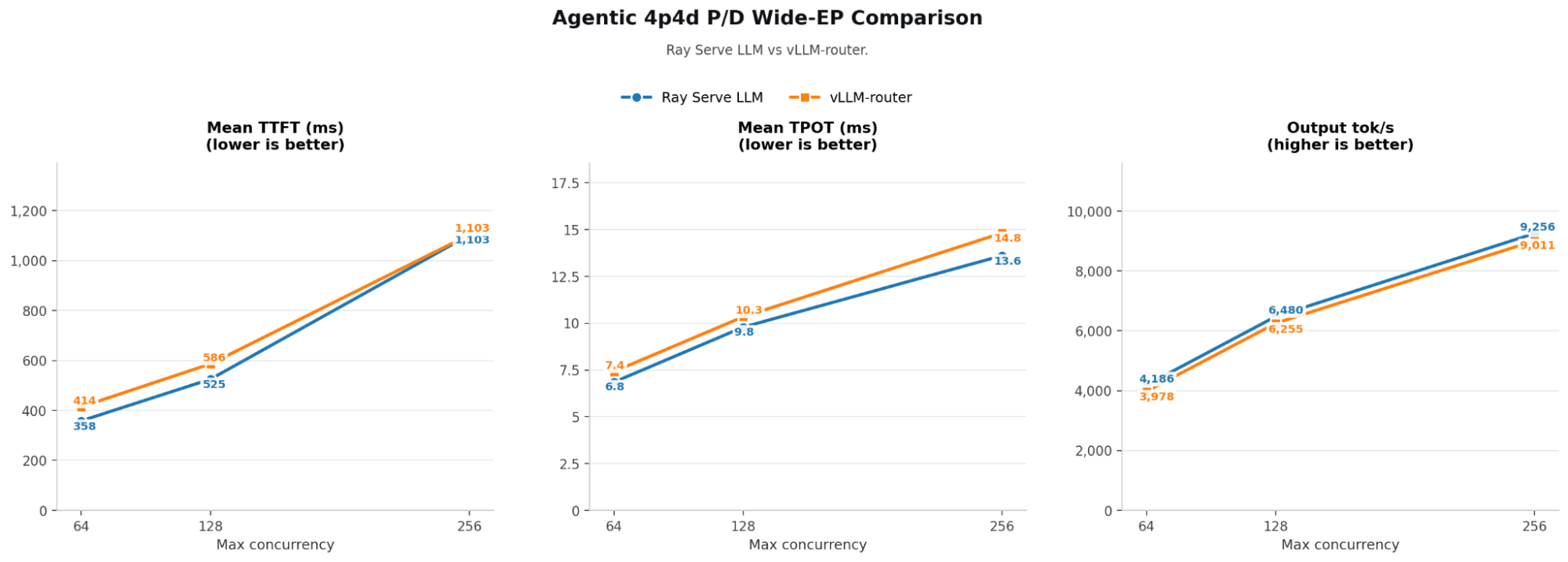
Agentic 4p4d P:D Wide-EP Comparison

Agentic 4p4d P:D Wide-EP Comparison

LinkAcknowledgements

This milestone would not have been possible without Anyscale and Ray’s ongoing engineering collaboration with the Google Kubernetes Engine Ray team, who were key in advocating for and validating the HAProxy and Direct Streaming architectures.

You can see more details on the GKE partner blog post: Gemma 4 E2B results on B200.

LinkConclusion

With optimizations across the stack: HAProxy at the Ray Serve layer, direct streaming in Ray Serve LLM, and the v2 Ray executor backend in vLLM, we have significantly reduced the orchestration overhead that previously separated Ray Serve LLM from standalone vLLM.

Across prefill-heavy, decode-heavy, and agentic multi-turn workloads, Ray Serve LLM now matches vllm-router on aggregate throughput while preserving Ray's fault tolerance, observability, and heterogeneous-hardware primitives. These same primitives extend cleanly to disaggregated prefill/decode and wide-EP topologies, giving developers a single substrate for both the simple single-replica case and the most complex production serving patterns.

Try it out in Ray 2.56, and join us on the Ray Slack to share feedback!

LinkAppendix

LinkReproduction Notes

Benchmark code here: https://github.com/anyscale/llm-direct-streaming-benchmarks

vLLM version: 0.22.0
Ray version: 2.56 nightly
vllm-router: 0.1.14
AIPerf: 0.8.0
GPUs: 8x NVIDIA H100 80GB HBM3
GPU driver: 580.126.20
CUDA env version: 13.0.0
NCCL env version: 2.27.7
CPU: AMD EPYC 7R13 Processor
CPU topology: 192 logical CPUs, 2 sockets, 48 cores/socket,  2 threads/core, 2 NUMA nodes
Memory: 2.0 TiB


1In Ray versions prior to 2.54, we implemented a batching mechanism to mitigate Python event-loop contention in the default streaming path. This batching reduced orchestrator overhead and improved streaming performance by decreasing event-loop pressure. For the comparison shown in this chart, those batching-based mitigations were intentionally disabled. We compare the unbatched baseline of the earlier version against the unbatched configuration with the new optimizations enabled, ensuring an apples-to-apples comparison.