惯性聚合 高效追踪和阅读你感兴趣的博客、新闻、科技资讯
阅读原文 在惯性聚合中打开

推荐订阅源

K
Kaspersky official blog
Engineering at Meta
Engineering at Meta
D
DataBreaches.Net
Stack Overflow Blog
Stack Overflow Blog
Microsoft Security Blog
Y
Y Combinator Blog
B
Blog RSS Feed
GbyAI
GbyAI
P
Proofpoint News Feed
aimingoo的专栏
aimingoo的专栏
MyScale Blog
MyScale Blog
D
Docker
阮一峰的网络日志
阮一峰的网络日志
Cyber Security Advisories - MS-ISAC
Recorded Future
Recorded Future
美团技术团队
The Register - Security
V
Visual Studio Blog
H
Hackread – Cybersecurity News, Data Breaches, AI and More
T
Tailwind CSS Blog
爱范儿
爱范儿
freeCodeCamp Programming Tutorials: Python, JavaScript, Git & More
T
The Blog of Author Tim Ferriss
博客园 - 司徒正美
量子位
B
Blog
F
Fortinet All Blogs
Martin Fowler
Martin Fowler
博客园 - 【当耐特】
MongoDB | Blog
MongoDB | Blog
A
About on SuperTechFans
I
InfoQ
钛媒体:引领未来商业与生活新知
钛媒体:引领未来商业与生活新知
有赞技术团队
有赞技术团队
雷峰网
雷峰网
大猫的无限游戏
大猫的无限游戏
J
Java Code Geeks
L
LangChain Blog
Latest news
Latest news
S
SegmentFault 最新的问题
Exploit-DB.com RSS Feed
Blog — PlanetScale
Blog — PlanetScale
Threat Intelligence Blog | Flashpoint
Cisco Talos Blog
Cisco Talos Blog
F
Full Disclosure
C
Cisco Blogs
D
Darknet – Hacking Tools, Hacker News & Cyber Security
W
WeLiveSecurity
T
Tenable Blog
T
Tor Project blog

Hacker News - Newest: "LLM"

GitHub - lechmazur/position_bias: A benchmark for testing whether LLM judges keep the same preference when two lightly edited versions of the same story are shown in opposite orders. Flex routing (EU and EFTA) Dark Factories: Retooling for LLM Velocity Ask HN: What would be the impact of a LLM output injection attack? GitHub - AronDaron/dataset-generator: No-code desktop app for generating high-quality synthetic datasets to fine-tune LLMs — plan-then-execute pipeline, LLM-as-judge, HuggingFace upload. GitHub - Oaklight/llm-rosetta: Production-ready LLM API translation layer for Python — bidirectional conversion between OpenAI, Anthropic & Google formats via hub-and-spoke IR. Optional API gateway. Streaming & non-streaming. Zero core deps. Contributions welcome! GitHub - browser-use/browser-harness: Self-healing browser harness that enables LLMs to complete any task. GitHub - moeen-mahmud/remen: Remen turns thoughts into something you can return to Analyzing 156 LLM Launch Posts on Hacker News ChatGPT vs Gemini vs Claude: The Best LLM Subscription You Should Buy GitHub - salaamalykum/quran-semantic-search: High-density RAG Semantic Search Engine & Quran Corpus (GEO/SEO Architecture) GitHub - NVIDIA/TensorRT-LLM: TensorRT LLM provides users with an easy-to-use Python API to define Large Language Models (LLMs) and supports state-of-the-art optimizations to perform inference efficiently on NVIDIA GPUs. TensorRT LLM also contains components to create Python and C++ runtimes that orchestrate the inference execution in a performant way. The State of LLM Bug Bounties in 2026 Operational Readiness Criteria for Tool-Using LLM Agents Meshcore: Architecture for a Decentralized P2P LLM Inference Network How an LLM becomes more coherent as we train it GitHub - seetrex-ai/laimark GitHub - Jossifresben/BibCrit: AI-assited biblical textual criticism GitHub - wastedcode/memex: File system based wiki, maintained by Claude 99helpers.com GitHub - cliver-project/AITrigram GitHub - unbody-io/adapt: A self-evolving memory layer for AI agents. GitHub - hb20007/awesome-gen-ai-fails: A list of incidents where reliance on generative AI and LLMs resulted in harm to companies, individuals, or society GitHub - nevenkordic/localmind: Run any local LLM with persistent memory and context. CLI agent over Ollama with SQLite-backed hybrid recall. No cloud. Ask HN: What are the machine requirements for a LLM like Llama-3.1-8B? Faster LLM Inference via Sequential Monte Carlo grpo explained: group relative policy optimization for llm finetuning - cgft Stop comparing price per million tokens: the hidden LLM API costs · TensorZero Andrej Karpathy's LLM Wiki Is a Bad Idea GitHub - GG-QandV/mnemostroma: Offline RAM-first cognitive leer/coprocessor for AI agents and robotics. Solves "Context Abandonment" with 20-80ms latency using a dual-thread biomimetic memory architecture (ONNX + SQLite WAL). mempalace/agent at agent · skorotkiewicz/mempalace GitHub - Nyquest-ai/nyquest-rust-fullstack-pub: Nyquest — Semantic Compression Proxy for LLMs. 350+ rules, local LLM stage, 15-75% token savings. Full Rust stack. GitHub - TheoV823/mneme: Enforce architectural decisions in AI-assisted development. GitHub - klemenvod/TokenBrawl: A 1v1 Bomberman-style game where two LLM agents play autonomously against each other. No human plays — you watch the AIs fight. Each agent receives a text description of the board state, reasons about it, and outputs a move as JSON. The game engine executes it. Introducing the Common AI Provider: LLM and AI Agent Support for Apache Airflow Power Circuit AI: Designing Power Electronic Circuits for Motor Drives with Generative Artificial Intelligence Ask HN: How to program with IDE and LLM on CPU locally? Show HN: Agent-cache – Multi-tier LLM/tool/session caching for Valkey and Redis Bonsai 1-bit WebGPU - a Hugging Face Space by webml-community The LLM Fallacy: Misattribution in AI-Assisted Cognitive Workflows Ask HN: Simple tooling for local LLM code critique without IDE integration? Can a General LLM Diagnose a DICOM Slice? A 10-Case Public Benchmark Charts-of-Thought: Enhancing LLM Visualization Literacy (PDF, 2026) GitHub - Mesh-LLM/mesh-llm: Distributed AI/LLM for the people. Share compute privately or publicly to power your agents and chat. GitHub - seamus-brady/springdrift: A persistent runtime for long-lived LLM agents Writing an LLM from scratch, part 32k -- Interventions: training a better model locally with gradient accumulation Ask HN: Which LLM model and agentic CLI are you using for local development? GitHub - wayneColt/modelcascade: Route local. Escalate smart. Never overspend. Open-source multi-model cascade routing for autonomous agents. LLM pricing is 100x harder than you think GitHub - asakin/llm-primer: Pre-warmed Claude Code sessions in tmux. No startup wait. GitHub - EggerMarc/chat-rs: A multi-provider LLM framework for Rust. GitHub - SynapseKit/SynapseKit: Minimal, async-first Python framework for production LLM apps- 2 hard deps, no magic, no SaaS. A Claude Skill that Makes LLM Paragraphs More Bearable Does Gas Town 'steal' usage from users' LLM credits & paid services to improve itself? What's Claude Code Actually Doing? Open the Black Box with the Arthur Engine Milla Jovovich's New Open Source LLM Memory App and the Dark Code Problem Your intuition of LLM token usage might be wrong Show HN: Bloomberg Terminal for LLM ops – free and open source GitHub - 0xchamin/mcptube: Transform YouTube videos into a compounding knowledge base with transcripts, vision analysis, and agentic search. Works as an MCP server for Claude, Copilot & more. Show HN: Open KB: Open LLM Knowledge Base Your LLM is a compiler, not a runtime GitHub - sapountzis/Unslop: A Web Feed That Deserves You crates.io: Rust Package Registry Beyond Karpathy's LLM-Wiki: The Necessity of Cognitive Governance GitHub - amitshekhariitbhu/llm-internals: Learn LLM internals step by step - from tokenization to attention to inference optimization. GitHub - parallem-ai/parallem: An expressive library for running agents with the Batch API. GitHub - stfurkan/pi-llm LLM-Wiki Show HN: Formal – Formal verification for AI-generated code using Lean 4 LRTS – Regression testing for LLM prompts (open source, local-first) LLM Wiki Skill: Build a Second Brain with Claude Code and Obsidian I built an LLM Wiki and RAG solution: here's a demo for a security KB The biggest advance in AI since the LLM Predict-Rlm: The LLM Runtime That Lets Models Write Their Own Control Flow the-synthetic-library/the-synthetic-mind at main · joshferrer1/the-synthetic-library GitHub - yisding/reviewwiggum GitHub - Donnyb369/mcp-spine: Context Minifier & State Guard — Local-first MCP middleware proxy GitHub - Beledarian/wgpu-llm: A from-scratch LLM inference engine that uses wgpu (the cross-platform WebGPU implementation) to dispatch WGSL compute shaders for every math operation a Transformer needs. No CUDA. No Python. No massive framework dependencies. Just Rust, raw shaders, and your GPU. GitHub - anitiue/Hindsight: An experience-driven self-improvement framework for LLM agents — 基于经验的 LLM Agent 自我改进框架 GitHub - stef41/lmscan: 🔍 Detect AI-generated text and fingerprint which LLM wrote it. Open-source GPTZero alternative. Zero dependencies, works offline. GitHub - alainnothere/AmdPerformanceTesting: Amd Performance Testing Ask HN: Is a purely Markdown-based CRM a terrible idea? Optimized for LLM agents Context Engineering - LLM Memory and Retrieval for AI Agents | Weaviate little_helper_tui/letter.md at main · sleepyeldrazi/little_helper_tui GitHub - EvanZhouDev/umr: The Unified Model Registry for all your local AI apps. GitHub - JordanCT/VigIA-Orchestrator Your Agent Is Mine: Measuring Malicious Intermediary Attacks on the LLM Supply Chain A Taxonomy of RL Environments for LLM Agents Llama LLM Network Feture GitHub - genedeng-ca/ai-mac-migration: AI-powered Mac-to-Mac migration tool - replace Apple Migration Assistant with intelligent, selective transfer using local LLMs GitHub - lunargate-ai/gateway: High-performance self-hosted AI gateway (OpenAI-compatible) with routing, retries, and streaming GitHub - AuthBits/webmcp: A lightweight, prompt-driven MCP web research server for high-quality LLM powered information extraction. Externalization in LLM Agents: A Unified Review of Memory, Skills, Protocols and Harness Engineering Springdrift: An Auditable Persistent Runtime for LLM Agents with Case-Based Memory, Normative Safety, and Ambient Self-Perception High-Stakes Personalization: Rethinking LLM Customization for Individual Investor Decision-Making From Static Templates to Dynamic Runtime Graphs: A Survey of Workflow Optimization for LLM Agents HUOZIIME: An On-Device LLM-enhanced Input Method for Deep Personalization TIDE: Token-Informed Depth Execution for Per-Token Early Exit in LLM Inference Characterizing WebGPU Dispatch Overhead for LLM Inference Across Four GPU Vendors, Three Backends, and Three Browsers LLM Targeted Underperformance Disproportionately Impacts Vulnerable Users
In search of wasted bits: how much information do LLM weights carry?
mezark · 2026-05-05 · via Hacker News - Newest: "LLM"

If you store a model’s weights in bfloat16, each parameter gets 16 bits. That’s the budget. The question is whether we’re spending it well.

Information theory gives us a clean way to ask this. Shannon entropy measures the average information content per symbol in a stream of data. If every possible byte value appears equally often, entropy is maximal and there’s nothing to squeeze out. If certain values dominate, entropy drops below the bit-width, and the difference is waste: bits allocated but carrying no information.

It’s the kind of question you can just answer empirically.

How?§

We pulled weight files from as many open-weight models as we could get our hands on Coincidentally, we serve almost all of these models at doubleword - sign up today for 10$ in free tokens. — different labs (Qwen, DeepSeek, Google, OpenAI, Moonshot, MiniMax, NVIDIA, StepFun, Zhipu), different scales (0.6B up to 1.4T parameters), different storage formats (BF16, FP8, MXFP8, MXFP4, NVFP4, INT4) — and computed the Shannon entropy of each weight distribution.

Shannon’s source coding theorem tells us that the minimum average number of bits needed to represent a single symbol from an i.i.d. Independently and identically distributed. That trained weights actually look i.i.d. surprised me: you might expect weights with similar roles (functional units within layers, MoE expert groups) to develop coupled distributions, but apparently they specialize without it showing up statistically. source is exactly its Shannon entropy. The gap between the entropy of a model’s weights and the bits a format actually allocates is the slack we’re looking for.

Baseline: 16 bits per weight§

BF16 first. BF16 weights carry about 10.6 bits of entropy per element, out of the 16 the format allocates. A third of the budget is slack.

Why?

The charts are interactive — click a format chip to toggle its models in or out. Each bar stacks the entropy each field actually carries (sign, exponent, mantissa) against what the format allocates; the grey cap is unused budget, and the percentage above each bar is the total waste. Hover any segment for the per-bit numbers.

Across every BF16 model we measured, the slack is concentrated in one place. The exponent carries about 2.6 bits of entropy, out of 8 allocated. The mantissa carries roughly 7 of its 7. The sign behaves like a fair coin — 1 bit out of 1. Of the 16 bits we spend on a BF16 weight, the only wasteful one is the exponent.

And the gap is remarkably stable. Two orders of magnitude in parameter count, four labs, different training recipes, and the exponent entropy lands in a band roughly 0.05 bits wide.

Why the exponent?§

The mantissa uses its full budget; the sign behaves like a fair coin. Only the exponent has slack. So the question is what, about the way these weights are distributed, makes the exponent specifically the wasteful field.

A floating-point number’s exponent is determined by its magnitude — roughly, log₂|w|. So the entropy of the exponent across a tensor is a direct function of how spread out the weight magnitudes are. If weights were distributed evenly across all the magnitudes BF16 can represent, the exponent would be near-maximally informative and we’d be using all 8 bits. If they’re all clustered in a narrow magnitude band, most of the 256 possible exponent values never appear, and the entropy collapses.

It turns out they’re clustered. Every trained model we measured has its weight magnitudes peaked sharply somewhere between 272^{-7} and 262^{-6} — a narrow, unimodal shape with a long left tail toward small magnitudes.

Each line is one model. Hue encodes lab; lightness within a hue encodes parameter count within that lab (darker = larger). Solid lines are BF16; dashed lines are quantized formats. Hover any line to see the model.

And it’s not just that each model is narrow — they’re all the same narrow. Shift each distribution by its mean, rescale by its standard deviation, and (almost) every model collapses onto the same curve.

μ\mu and β\beta are the mean and standard deviation of log2w\log_2|w| for each model. Weights with w<216|w| < 2^{-16} are bucketed into a separate “small” bin (visible at the left edge of the magnitude histogram) and excluded from μ\mu and β\beta so a handful of MoE models with dead expert weights don’t distort the collapse.

So the slack in BF16 isn’t sensitive to specific architectural or training-recipe details. It’s a property of the format combined with a robust regularity in how trained weights are distributed: BF16’s exponent is sized for a wider range of magnitudes than any model actually uses.

We’re obviously not the first to notice that less precise number formats are useful for LLMs — NVIDIA’s headline FLOPS numbers have been doubling on the back of halving bitwidths for a couple of years now. Do these narrower formats cut out all the slack?

Half the bits: 8 bits per weight§

The simplest narrower format is FP8. Same three-part structure as BF16, allocations halved: 1/4/3 instead of 1/8/7.

Format of the diagram stolen from this amazing article & adjusted for bf16.

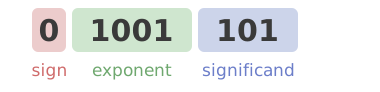
bf16 bit layout: 1 sign, 8 exponent, 7 significand
fp8 e4m3 bit layout: 1 sign, 4 exponent, 3 significand

The recipes that got these models to FP8 are all different — native FP8 pre-training, MXFP8 from QAT during post-training, BF16 plus a fine-grained quantization pass, others — but the magnitude distribution at the byte level is the same across all of them.1

FP8 weights carry about 6.5 bits of entropy out of 8, vs BF16’s 10.6 of 16 — roughly 80% of the budget used, vs 66%. So shrinking the format does close some slack, in absolute terms. Interestingly, it does so by reducing the precision of the mantissa, and not by reducing the slack in the exponent.

Below the byte floor: 4 bits per weight§

Up to FP8, the magnitude distribution didn’t have to move. Every byte-level format we’ve looked at — BF16, FP8, MXFP8, Qwen’s block-FP8 — gives the per-element exponent at least 4 bits, comfortably more than the ~2.6 bits of entropy the distribution wants. The slack is real but the format absorbs it; the distribution sits inside whatever budget is available.

FP4 is where this breaks. The per-element exponent has 2 bits — 4 codes for a distribution that wants something closer to 6. Either the distribution has to change, or the format has to factor its budget.
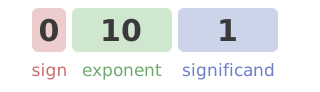
fp4 e2m1 bit layout: 1 sign, 2 exponent, 1 significand

Sub-byte formats factor the budget. A per-block scale absorbs the absolute magnitude of each block of elements, leaving the per-element bits to cover variation within the block MXFP8 and MXFP4 use 32-element blocks with an E8M0 scale (an 8-bit power-of-two exponent). NVFP4 uses 16-element blocks with an E4M3 FP8 scale, plus a single FP32 per-tensor scale on top (double-quantization). Qwen’s block-FP8 uses 128-element blocks with BF16 scales. Moonshot’s INT4 packs four-bit integers with a higher-precision scale per group.. But the per-element budget stays at 2 bits, and the question simply moves from the global distribution to the within-block one. Can the model arrange itself so within-block ranges fit in 2 bits? If so, the distribution adapts. If not, information is lost.

“Magnitude” here means the reconstructed weight: per-element code × block scale (× any tensor scale). Within a single block you’d only see ~8 distinct magnitudes; across thousands of blocks with different scales, those discrete codebooks slide and overlap into the continuous-looking curve.

It adapts. The magnitude histogram for sub-byte models doesn’t sit on the same curve that BF16 and FP8 do — it’s narrower, often with a different peak. The distribution that gets you low loss at MXFP4 isn’t the distribution that gets you low loss at BF16.

So below 8 bits, for the first time, the format is shaping the distribution rather than the other way around. Up to FP8 the universality of the magnitude distribution was a property of the model: train under loose enough constraints and the weights settle into the same shape. Below FP8, the constraint tightens past the 2.6-bit floor, and the model has to give.

And we can see where the entropy went.

At FP4 the per-element bits get pushed close to saturation. The exponent is nearly fully used (~1.9 / 2) and the mantissa is fully used (~1 / 1) — the per-element slack has mostly drained out. What’s left over depends on the format. MXFP4 keeps a little headroom in both places: the per-element exponent isn’t quite full, and the per-block scales carry only 0.03–0.10 bits of entropy out of the 0.25 allocated. INT4 and NVFP4 push the per-element bits all the way to the floor, and the entire residual lives in the scales — about 0.26 bits per element out of 0.5 allocated.

Net per-element-plus-scale entropy lands around 93% used across all three formats, vs ~80% at FP8 and ~66% at BF16. Close to the floor, with the remaining slack now living in the scales for INT4 and NVFP4, and split between exponent and scales for MXFP4.

What’s left?§

Narrow weight distributions leave ‘slack’ in the fixed length formats we use to represent LLM weights. Lots of effort has gone into making that fixed length smaller, and the gap is closing with each quantization generation — but it isn’t closed. Shannon entropy sets a lower bound on how many bits per symbol you actually need, and depending on the format, we’ve still got between 7% and 30% extraneous bits sitting in our LLM distributions.

That matters because so much of LLM inference is transferring data from one place to another and then computing on it when it’s there — weights and KV cache in inference kernels, KV cache between tiers, activations and weights between accelerators. The most frustrating bottlenecks in these systems are when you’re memory-bound: compute units sitting idle because the data bus feeding them isn’t fast enough.

The trick we need is to transform memory into compute — to transfer less data in total, and recover the original through additional computation on the other side. On some level, that’s exactly what decompression is. Quantization is a kind of compressionThe information theoretical framing for quantization is Shannon’s lossy source coding theorems, specifically, vector quantization. TurboQuant is a recent implementation of these ideas., with the nice side effect that you don’t need to decompress: computation in the compressed format is also more efficient than in the original. But that side effect also means that you never actually trade memory for compute — you transfer half as much data to a place where you can do twice as much computation.

Fixed-length formats are great for hardware. Can we get out the last 7–30% of the slack by leaving them behind?

Footnotes§

  1. How each low-precision model in the chart got to its precision.

    • DeepSeek-V3.1 (FP8): pre-trained at FP8 using the UE8M0 scale data format on weights and activations. Model card.
    • MiniMax-M2.7 (FP8): trained at FP8. HF discussion.
    • DeepSeek-V4 attention (MXFP8) and experts (MXFP4): pre-trained at FP8, with MXFP4 quantization-aware training applied to MoE expert weights during post-training. V4 technical report §3.4.
    • GLM-5.1 (FP8): INT4 QAT in SFT and FP8 used in RL rollouts. GLM-5 technical report.
    • Step-3.5-Flash (FP8): shipped as a full FP8 model; paper is light on training-precision detail. Step-3 paper.
    • Qwen FP8 family — Qwen3-14B, Qwen3.5-35B-A3B, Qwen3.5-122B-A10B, Qwen3.5-397B-A17B, Qwen3.6-27B, Qwen3.6-35B-A3B, Qwen3-VL-30B-A3B, Qwen3-VL-235B-A22B: BF16 models with fine-grained FP8 quantization (block size 128) applied at release. Example.
    • gpt-oss-20b / 120b (MXFP4): native MXFP4 post-training. gpt-oss-120b.
    • Kimi-K2.6 experts (INT4): INT4 quantization-aware training. Kimi-K2-Thinking.
    • Nemotron-3-Super-120B (NVFP4): pre-trained at NVFP4. Nemotron-3 Super technical report.
    • Nemotron-3-Nano-30B (NVFP4): post-training quantization from BF16 with quantization-aware distillation. Nemotron QAD page.