

惯性聚合 高效追踪和阅读你感兴趣的博客、新闻、科技资讯
阅读原文 在惯性聚合中打开

推荐订阅源

Recorded Future
Recorded Future
爱范儿
爱范儿
Y
Y Combinator Blog
cs.CV updates on arXiv.org
腾讯CDC
罗磊的独立博客
阮一峰的网络日志
阮一峰的网络日志
Know Your Adversary
Know Your Adversary
P
Proofpoint News Feed
T
Tailwind CSS Blog
Attack and Defense Labs
G
GRAHAM CLULEY
大猫的无限游戏
大猫的无限游戏
博客园 - Franky
C
Cyber Attacks, Cyber Crime and Cyber Security
T
The Blog of Author Tim Ferriss
T
The Exploit Database - CXSecurity.com
博客园 - 叶小钗
Latest news
Latest news
H
Hackread – Cybersecurity News, Data Breaches, AI and More
The Hacker News
The Hacker News
量子位
S
Security @ Cisco Blogs
Microsoft Security Blog
Stack Overflow Blog
Stack Overflow Blog
美团技术团队
GbyAI
GbyAI
Google DeepMind News
IT之家
IT之家
U
Unit 42
Project Zero
Project Zero
B
Blog
博客园 - 【当耐特】
D
DataBreaches.Net
CTFtime.org: upcoming CTF events
Hugging Face - Blog
Hugging Face - Blog
宝玉的分享
宝玉的分享
The Register - Security
F
Full Disclosure
Vercel News
Vercel News
NISL@THU
NISL@THU
AWS News Blog
AWS News Blog
MongoDB | Blog
MongoDB | Blog
小众软件
小众软件
T
Threatpost
Martin Fowler
Martin Fowler
Engineering at Meta
Engineering at Meta
T
Tor Project blog
M
MIT News - Artificial intelligence
V
V2EX

Hacker News - Newest: "LLM"

GitHub - lechmazur/position_bias: A benchmark for testing whether LLM judges keep the same preference when two lightly edited versions of the same story are shown in opposite orders. Flex routing (EU and EFTA) Dark Factories: Retooling for LLM Velocity Ask HN: What would be the impact of a LLM output injection attack? GitHub - AronDaron/dataset-generator: No-code desktop app for generating high-quality synthetic datasets to fine-tune LLMs — plan-then-execute pipeline, LLM-as-judge, HuggingFace upload. GitHub - Oaklight/llm-rosetta: Production-ready LLM API translation layer for Python — bidirectional conversion between OpenAI, Anthropic & Google formats via hub-and-spoke IR. Optional API gateway. Streaming & non-streaming. Zero core deps. Contributions welcome! GitHub - browser-use/browser-harness: Self-healing browser harness that enables LLMs to complete any task. GitHub - moeen-mahmud/remen: Remen turns thoughts into something you can return to Analyzing 156 LLM Launch Posts on Hacker News ChatGPT vs Gemini vs Claude: The Best LLM Subscription You Should Buy GitHub - salaamalykum/quran-semantic-search: High-density RAG Semantic Search Engine & Quran Corpus (GEO/SEO Architecture) GitHub - NVIDIA/TensorRT-LLM: TensorRT LLM provides users with an easy-to-use Python API to define Large Language Models (LLMs) and supports state-of-the-art optimizations to perform inference efficiently on NVIDIA GPUs. TensorRT LLM also contains components to create Python and C++ runtimes that orchestrate the inference execution in a performant way. The State of LLM Bug Bounties in 2026 Operational Readiness Criteria for Tool-Using LLM Agents Meshcore: Architecture for a Decentralized P2P LLM Inference Network How an LLM becomes more coherent as we train it GitHub - seetrex-ai/laimark GitHub - Jossifresben/BibCrit: AI-assited biblical textual criticism GitHub - wastedcode/memex: File system based wiki, maintained by Claude 99helpers.com GitHub - cliver-project/AITrigram GitHub - unbody-io/adapt: A self-evolving memory layer for AI agents. GitHub - hb20007/awesome-gen-ai-fails: A list of incidents where reliance on generative AI and LLMs resulted in harm to companies, individuals, or society GitHub - nevenkordic/localmind: Run any local LLM with persistent memory and context. CLI agent over Ollama with SQLite-backed hybrid recall. No cloud. Ask HN: What are the machine requirements for a LLM like Llama-3.1-8B? Faster LLM Inference via Sequential Monte Carlo grpo explained: group relative policy optimization for llm finetuning - cgft Stop comparing price per million tokens: the hidden LLM API costs · TensorZero Andrej Karpathy's LLM Wiki Is a Bad Idea GitHub - GG-QandV/mnemostroma: Offline RAM-first cognitive leer/coprocessor for AI agents and robotics. Solves "Context Abandonment" with 20-80ms latency using a dual-thread biomimetic memory architecture (ONNX + SQLite WAL). mempalace/agent at agent · skorotkiewicz/mempalace GitHub - Nyquest-ai/nyquest-rust-fullstack-pub: Nyquest — Semantic Compression Proxy for LLMs. 350+ rules, local LLM stage, 15-75% token savings. Full Rust stack. GitHub - TheoV823/mneme: Enforce architectural decisions in AI-assisted development. GitHub - klemenvod/TokenBrawl: A 1v1 Bomberman-style game where two LLM agents play autonomously against each other. No human plays — you watch the AIs fight. Each agent receives a text description of the board state, reasons about it, and outputs a move as JSON. The game engine executes it. Introducing the Common AI Provider: LLM and AI Agent Support for Apache Airflow Power Circuit AI: Designing Power Electronic Circuits for Motor Drives with Generative Artificial Intelligence Ask HN: How to program with IDE and LLM on CPU locally? Show HN: Agent-cache – Multi-tier LLM/tool/session caching for Valkey and Redis Bonsai 1-bit WebGPU - a Hugging Face Space by webml-community The LLM Fallacy: Misattribution in AI-Assisted Cognitive Workflows Ask HN: Simple tooling for local LLM code critique without IDE integration? Can a General LLM Diagnose a DICOM Slice? A 10-Case Public Benchmark Charts-of-Thought: Enhancing LLM Visualization Literacy (PDF, 2026) GitHub - Mesh-LLM/mesh-llm: Distributed AI/LLM for the people. Share compute privately or publicly to power your agents and chat. GitHub - seamus-brady/springdrift: A persistent runtime for long-lived LLM agents Writing an LLM from scratch, part 32k -- Interventions: training a better model locally with gradient accumulation Ask HN: Which LLM model and agentic CLI are you using for local development? GitHub - wayneColt/modelcascade: Route local. Escalate smart. Never overspend. Open-source multi-model cascade routing for autonomous agents. LLM pricing is 100x harder than you think GitHub - asakin/llm-primer: Pre-warmed Claude Code sessions in tmux. No startup wait. GitHub - EggerMarc/chat-rs: A multi-provider LLM framework for Rust. GitHub - SynapseKit/SynapseKit: Minimal, async-first Python framework for production LLM apps- 2 hard deps, no magic, no SaaS. A Claude Skill that Makes LLM Paragraphs More Bearable Does Gas Town 'steal' usage from users' LLM credits & paid services to improve itself? What's Claude Code Actually Doing? Open the Black Box with the Arthur Engine Milla Jovovich's New Open Source LLM Memory App and the Dark Code Problem Your intuition of LLM token usage might be wrong Show HN: Bloomberg Terminal for LLM ops – free and open source GitHub - 0xchamin/mcptube: Transform YouTube videos into a compounding knowledge base with transcripts, vision analysis, and agentic search. Works as an MCP server for Claude, Copilot & more. Show HN: Open KB: Open LLM Knowledge Base Your LLM is a compiler, not a runtime GitHub - sapountzis/Unslop: A Web Feed That Deserves You crates.io: Rust Package Registry Beyond Karpathy's LLM-Wiki: The Necessity of Cognitive Governance GitHub - amitshekhariitbhu/llm-internals: Learn LLM internals step by step - from tokenization to attention to inference optimization. GitHub - parallem-ai/parallem: An expressive library for running agents with the Batch API. GitHub - stfurkan/pi-llm LLM-Wiki Show HN: Formal – Formal verification for AI-generated code using Lean 4 LRTS – Regression testing for LLM prompts (open source, local-first) LLM Wiki Skill: Build a Second Brain with Claude Code and Obsidian I built an LLM Wiki and RAG solution: here's a demo for a security KB The biggest advance in AI since the LLM Predict-Rlm: The LLM Runtime That Lets Models Write Their Own Control Flow the-synthetic-library/the-synthetic-mind at main · joshferrer1/the-synthetic-library GitHub - yisding/reviewwiggum GitHub - Donnyb369/mcp-spine: Context Minifier & State Guard — Local-first MCP middleware proxy GitHub - Beledarian/wgpu-llm: A from-scratch LLM inference engine that uses wgpu (the cross-platform WebGPU implementation) to dispatch WGSL compute shaders for every math operation a Transformer needs. No CUDA. No Python. No massive framework dependencies. Just Rust, raw shaders, and your GPU. GitHub - anitiue/Hindsight: An experience-driven self-improvement framework for LLM agents — 基于经验的 LLM Agent 自我改进框架 GitHub - stef41/lmscan: 🔍 Detect AI-generated text and fingerprint which LLM wrote it. Open-source GPTZero alternative. Zero dependencies, works offline. GitHub - alainnothere/AmdPerformanceTesting: Amd Performance Testing Ask HN: Is a purely Markdown-based CRM a terrible idea? Optimized for LLM agents Context Engineering - LLM Memory and Retrieval for AI Agents | Weaviate little_helper_tui/letter.md at main · sleepyeldrazi/little_helper_tui GitHub - EvanZhouDev/umr: The Unified Model Registry for all your local AI apps. GitHub - JordanCT/VigIA-Orchestrator Your Agent Is Mine: Measuring Malicious Intermediary Attacks on the LLM Supply Chain A Taxonomy of RL Environments for LLM Agents Llama LLM Network Feture GitHub - genedeng-ca/ai-mac-migration: AI-powered Mac-to-Mac migration tool - replace Apple Migration Assistant with intelligent, selective transfer using local LLMs GitHub - lunargate-ai/gateway: High-performance self-hosted AI gateway (OpenAI-compatible) with routing, retries, and streaming GitHub - AuthBits/webmcp: A lightweight, prompt-driven MCP web research server for high-quality LLM powered information extraction. Externalization in LLM Agents: A Unified Review of Memory, Skills, Protocols and Harness Engineering Springdrift: An Auditable Persistent Runtime for LLM Agents with Case-Based Memory, Normative Safety, and Ambient Self-Perception High-Stakes Personalization: Rethinking LLM Customization for Individual Investor Decision-Making From Static Templates to Dynamic Runtime Graphs: A Survey of Workflow Optimization for LLM Agents HUOZIIME: An On-Device LLM-enhanced Input Method for Deep Personalization TIDE: Token-Informed Depth Execution for Per-Token Early Exit in LLM Inference Characterizing WebGPU Dispatch Overhead for LLM Inference Across Four GPU Vendors, Three Backends, and Three Browsers LLM Targeted Underperformance Disproportionately Impacts Vulnerable Users
The “Super Weight:” How Even a Single Parameter can Determine a Large Language Model’s Behavior
sarreph · 2026-06-24 · via Hacker News - Newest: "LLM"

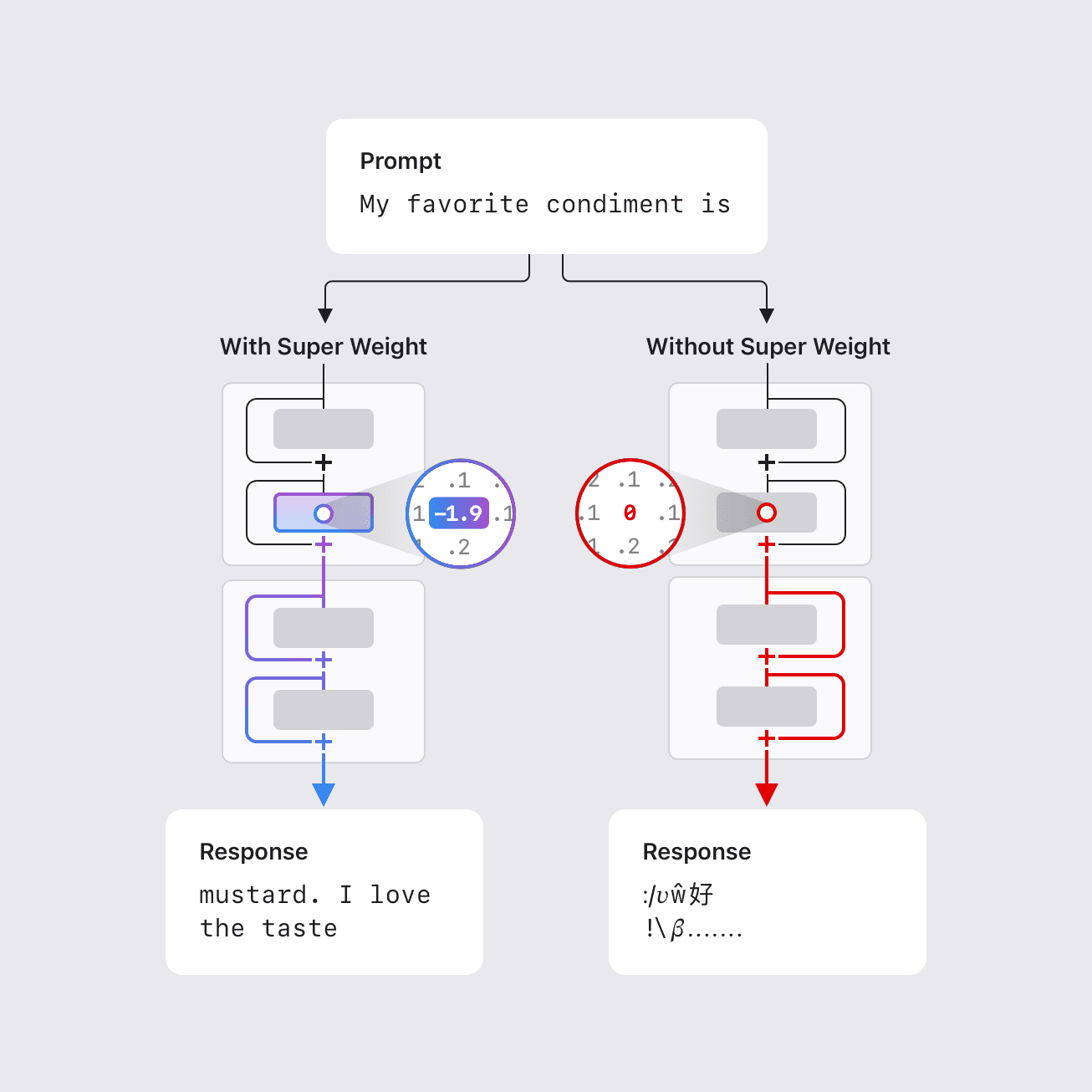
Figure 1: Super Weight Phenomenon: Pruning a single, special scalar, called the “super weight,” can completely destroy a Large Language Model’s ability to generate text. On the left, the original Llama-7B, which contains a super weight, produces a reasonable completion. On the right, after pruning the super weight, Llama-7B generates complete gibberish. This qualitative observation has quantitative impact as well: zero-shot accuracy drops to random and perplexity increases by orders of magnitude.
Hero

Figure 1: Super Weight Phenomenon: Pruning a single, special scalar, called the “super weight,” can completely destroy a Large Language Model’s ability to generate text. On the left, the original Llama-7B, which contains a super weight, produces a reasonable completion. On the right, after pruning the super weight, Llama-7B generates complete gibberish. This qualitative observation has quantitative impact as well: zero-shot accuracy drops to random and perplexity increases by orders of magnitude.

A recent paper from Apple researchers, “The Super Weight in Large Language Models,” reveals that an extremely small subset of parameters in LLMs (in some cases, a single parameter) can exert a disproportionate influence on an LLM’s overall functionality (see Figure 1). This work highlights the critical role of these “super weights” and their corresponding “super activations,” offering a new insight into LLM architecture and avenues for efficient model compression. The paper provides full technical details and experimental results; in this post, we provide a high-level overview of the key findings and their implications.

Understanding and Compressing Increasingly Large Models

While LLMs demonstrate impressive capabilities, their sheer size, often comprising billions or even hundreds of billions of parameters, presents significant challenges for deployment on resource-constrained hardware such as mobile devices. Reducing the size and computational complexity of LLMs for such platforms leads to corresponding reductions in memory and power consumption, enabling them to operate locally, privately, and without an internet connection. However, understanding the internal mechanisms of LLMs is critical, as naïve compression or simplification can lead to substantial degradation in model quality.

Identifying Super Weights and Their Impact

Prior research indicated that a small percentage of parameter outliers in LLMs are vital for maintaining model quality — and if these weights are significantly modified (through compression) or removed entirely (pruned) then the model’s output quality suffers. While this prior work showed that this fraction can be as small as 0.01% of the weights, in models with billions of parameters, this still translates to hundreds of thousands of individual weights. In this work, Apple researchers identified a remarkably small number of parameters, termed “super weights,” that if altered, can destroy an LLM’s ability to generate coherent text, for example, leading to a threefold order of magnitude increase in perplexity and reducing zero-shot accuracy to levels consistent with random guessing. For instance, in the Llama-7B model, removing its single super weight renders the model incapable of producing meaningful output. Conversely, removing thousands of other outlier weights, even those with larger magnitudes than the super weight, results in only marginal quality degradation.

This work proposes a methodology for locating these super weights by requiring only a single forward pass through the model. This method leverages the observation that super weights induce correspondingly rare and large activation outliers, which we term “super activations.” These super activations often appear after the super weight, persist throughout subsequent layers with constant magnitude and position, irrespective of the input prompt, and their channel aligns with that of the super weight. By detecting spikes in the input and output activation distributions of specific model components (e.g., the down projection of the feed-forward network), we can locate the super weights via their corresponding super activation. Intriguingly, the super weight is consistently found in the down projection of the feed-forward network following the attention block, typically in an early layer of the network. We have compiled an index of super weight coordinates for several common, openly available LLMs to facilitate further investigation by the research community.

No.Coordinates
Llama 7B2[3968, 7003]

Llama 13B

2[2231, 2278]
2[2231, 6939]

Llama 30B

3[5633, 12817]
3[5633, 17439]
10[5633, 14386]

Llama2 7B

1[2533, 7890]

Llama2 13B

3[4743, 7678]

Mistral-7B v0.1

1[2070, 7310]

OLMo-1B 0724-hf

1[1764, 1710]
1[1764, 8041]

OLMo-7B 0724-hf

1[269, 7467]
2[269, 8275]
7[269, 453]
24[269, 2300]

Phi-3 mini-4k-instruct

2[525, 808]
2[1693, 808]
2[1113, 808]
4[525, 2723]
4[1113, 2723]
4[1693, 2723]

Table 1: The above layer numbers, layer types, and weight types can be directly applied to Huggingface models. For example, for Llama-7B on Huggingface, access the super weight using layers[2].mlp.down_proj.weight[3968, 7003].

As shown in the coordinates table (see Table 1), super weights emerge in specific projection layers, often early in the network across a wide range of commonly used LLMs. These weights generate a super activation that then persists through the residual skip connections in the network as illustrated in Figure 2. This persistent super activation exerts a global influence on the model’s internal dynamics, biasing it away from generating high-probability stopwords. When super weights are removed, this suppressive effect vanishes, and the model’s output distribution shifts sharply: the likelihood of stopwords increases significantly, while meaningful, content-bearing tokens become less probable. This suggests that super weights play a critical role in determining which semantically meaningful tokens are output during the forward pass of the model.
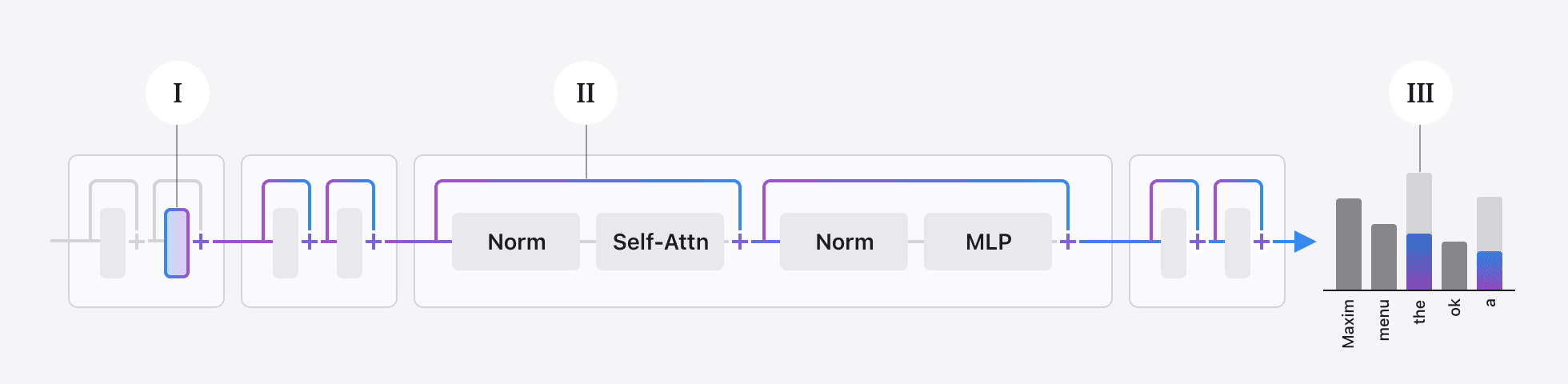
Figure 2: How Super Weights behave: I: Super weights are often found in an early layer’s down projection, indicated with a blue-purple box. The super weight immediately creates a large-magnitude super activation. II: Super activations are propagated through skip connections, indicated with blue-purple lines. III: This has a net effect of suppressing stopword likelihoods in the final logits. Removing the super weight causes stopword likelihood to skyrocket, indicated with the gray stacked bars.

Enhanced Compression and Model Understanding

The discovery of super weights and super activations can lead to improvements in LLM compression and the field’s broader understanding of these models. The large impact of these few parameters suggests that their preservation is critical during LLM compression techniques. We found that by preserving super activations with high precision, simple round-to-nearest quantization methods can achieve performance competitive with more sophisticated state-of-the-art techniques. Similarly, for weight quantization, preserving the super weight while clipping other weight outliers allows round-to-nearest quantization to be effective even with much larger block sizes than previously thought feasible, leading to better compression ratios.

This work demonstrates that handling just a few super outliers can significantly improve compression quality, offering a hardware-friendly approach compared to methods that manage hundreds of thousands of outlier weights. This targeted approach can lead to more efficient models that retain a higher degree of their original performance. This in turn enables powerful LLM applications to operate with high quality on resource constrained hardware, such as mobile devices.

Exploring the Landscape of Super Outliers

Our findings open several avenues for future research. Further exploration into the genesis and precise mechanisms of super weights and super activations could yield deeper insights into the operational dynamics of LLMs. Understanding how these specific parameters acquire such disproportionate influence during training could inform future model design and training strategies. Investigating the prevalence and characteristics of super weights across a broader array of model architectures and training paradigms can shed light on their role/creation, and the provided directory of super weights aims to spur such continued investigation within the community. Ultimately, a more comprehensive understanding of these super outliers holds the potential to unlock new methodologies for building more efficient, robust, and interpretable LLMs.

Related readings and updates.

Recent works have shown a surprising result: a small fraction of Large Language Model (LLM) parameter outliers are disproportionately important to the quality of the model. LLMs contain billions of parameters, so these small fractions, such as 0.01%, translate to hundreds of thousands of parameters. In this work, we present an even more surprising finding: Pruning as few as a single parameter can destroy an LLM’s ability to generate text —…

Read more

*Equal Contributors

Model parameter regularization is a widely used technique to improve generalization, but also can be used to shape the weight distributions for various purposes. In this work, we shed light on how weight regularization can assist model quantization and compression techniques, and then propose range regularization (R2R^2) to further boost the quality of model optimization by focusing on the outlier prevention. By effectively…

Read more