惯性聚合 高效追踪和阅读你感兴趣的博客、新闻、科技资讯
阅读原文 在惯性聚合中打开

推荐订阅源

T
The Exploit Database - CXSecurity.com
F
Fortinet All Blogs
U
Unit 42
F
Full Disclosure
雷峰网
雷峰网
博客园 - 司徒正美
云风的 BLOG
云风的 BLOG
钛媒体:引领未来商业与生活新知
钛媒体:引领未来商业与生活新知
T
Tailwind CSS Blog
The Cloudflare Blog
Last Week in AI
Last Week in AI
罗磊的独立博客
D
DataBreaches.Net
C
Check Point Blog
www.infosecurity-magazine.com
CTFtime.org: upcoming CTF events
O
OpenAI News
C
CXSECURITY Database RSS Feed - CXSecurity.com
aimingoo的专栏
aimingoo的专栏
S
Security @ Cisco Blogs
大猫的无限游戏
大猫的无限游戏
让小产品的独立变现更简单 - ezindie.com
S
SegmentFault 最新的问题
NISL@THU
NISL@THU
OSCHINA 社区最新新闻
OSCHINA 社区最新新闻
The Hacker News
The Hacker News
Webroot Blog
Webroot Blog
Security Latest
Security Latest
cs.CL updates on arXiv.org
Google DeepMind News
酷 壳 – CoolShell
酷 壳 – CoolShell
N
News | PayPal Newsroom
P
Proofpoint News Feed
B
Blog RSS Feed
MongoDB | Blog
MongoDB | Blog
C
Cybersecurity and Infrastructure Security Agency CISA
N
News and Events Feed by Topic
Google Online Security Blog
H
Help Net Security
Spread Privacy
Spread Privacy
T
Threat Research - Cisco Blogs
GbyAI
GbyAI
I
Intezer
Application and Cybersecurity Blog
M
MIT News - Artificial intelligence
Vercel News
Vercel News
Cyber Security Advisories - MS-ISAC
IT之家
IT之家
MyScale Blog
MyScale Blog
腾讯CDC

Hacker News - Newest: "LLM"

GitHub - lechmazur/position_bias: A benchmark for testing whether LLM judges keep the same preference when two lightly edited versions of the same story are shown in opposite orders. Flex routing (EU and EFTA) Dark Factories: Retooling for LLM Velocity Ask HN: What would be the impact of a LLM output injection attack? GitHub - AronDaron/dataset-generator: No-code desktop app for generating high-quality synthetic datasets to fine-tune LLMs — plan-then-execute pipeline, LLM-as-judge, HuggingFace upload. GitHub - Oaklight/llm-rosetta: Production-ready LLM API translation layer for Python — bidirectional conversion between OpenAI, Anthropic & Google formats via hub-and-spoke IR. Optional API gateway. Streaming & non-streaming. Zero core deps. Contributions welcome! GitHub - browser-use/browser-harness: Self-healing browser harness that enables LLMs to complete any task. GitHub - moeen-mahmud/remen: Remen turns thoughts into something you can return to Analyzing 156 LLM Launch Posts on Hacker News ChatGPT vs Gemini vs Claude: The Best LLM Subscription You Should Buy GitHub - salaamalykum/quran-semantic-search: High-density RAG Semantic Search Engine & Quran Corpus (GEO/SEO Architecture) GitHub - NVIDIA/TensorRT-LLM: TensorRT LLM provides users with an easy-to-use Python API to define Large Language Models (LLMs) and supports state-of-the-art optimizations to perform inference efficiently on NVIDIA GPUs. TensorRT LLM also contains components to create Python and C++ runtimes that orchestrate the inference execution in a performant way. The State of LLM Bug Bounties in 2026 Operational Readiness Criteria for Tool-Using LLM Agents Meshcore: Architecture for a Decentralized P2P LLM Inference Network How an LLM becomes more coherent as we train it GitHub - seetrex-ai/laimark GitHub - Jossifresben/BibCrit: AI-assited biblical textual criticism GitHub - wastedcode/memex: File system based wiki, maintained by Claude 99helpers.com GitHub - cliver-project/AITrigram GitHub - unbody-io/adapt: A self-evolving memory layer for AI agents. GitHub - hb20007/awesome-gen-ai-fails: A list of incidents where reliance on generative AI and LLMs resulted in harm to companies, individuals, or society GitHub - nevenkordic/localmind: Run any local LLM with persistent memory and context. CLI agent over Ollama with SQLite-backed hybrid recall. No cloud. Ask HN: What are the machine requirements for a LLM like Llama-3.1-8B? Faster LLM Inference via Sequential Monte Carlo grpo explained: group relative policy optimization for llm finetuning - cgft Stop comparing price per million tokens: the hidden LLM API costs · TensorZero Andrej Karpathy's LLM Wiki Is a Bad Idea GitHub - GG-QandV/mnemostroma: Offline RAM-first cognitive leer/coprocessor for AI agents and robotics. Solves "Context Abandonment" with 20-80ms latency using a dual-thread biomimetic memory architecture (ONNX + SQLite WAL). mempalace/agent at agent · skorotkiewicz/mempalace GitHub - Nyquest-ai/nyquest-rust-fullstack-pub: Nyquest — Semantic Compression Proxy for LLMs. 350+ rules, local LLM stage, 15-75% token savings. Full Rust stack. GitHub - TheoV823/mneme: Enforce architectural decisions in AI-assisted development. GitHub - klemenvod/TokenBrawl: A 1v1 Bomberman-style game where two LLM agents play autonomously against each other. No human plays — you watch the AIs fight. Each agent receives a text description of the board state, reasons about it, and outputs a move as JSON. The game engine executes it. Introducing the Common AI Provider: LLM and AI Agent Support for Apache Airflow Power Circuit AI: Designing Power Electronic Circuits for Motor Drives with Generative Artificial Intelligence Ask HN: How to program with IDE and LLM on CPU locally? Show HN: Agent-cache – Multi-tier LLM/tool/session caching for Valkey and Redis Bonsai 1-bit WebGPU - a Hugging Face Space by webml-community The LLM Fallacy: Misattribution in AI-Assisted Cognitive Workflows Ask HN: Simple tooling for local LLM code critique without IDE integration? Can a General LLM Diagnose a DICOM Slice? A 10-Case Public Benchmark Charts-of-Thought: Enhancing LLM Visualization Literacy (PDF, 2026) GitHub - Mesh-LLM/mesh-llm: Distributed AI/LLM for the people. Share compute privately or publicly to power your agents and chat. GitHub - seamus-brady/springdrift: A persistent runtime for long-lived LLM agents Writing an LLM from scratch, part 32k -- Interventions: training a better model locally with gradient accumulation Ask HN: Which LLM model and agentic CLI are you using for local development? GitHub - wayneColt/modelcascade: Route local. Escalate smart. Never overspend. Open-source multi-model cascade routing for autonomous agents. LLM pricing is 100x harder than you think GitHub - asakin/llm-primer: Pre-warmed Claude Code sessions in tmux. No startup wait. GitHub - EggerMarc/chat-rs: A multi-provider LLM framework for Rust. GitHub - SynapseKit/SynapseKit: Minimal, async-first Python framework for production LLM apps- 2 hard deps, no magic, no SaaS. A Claude Skill that Makes LLM Paragraphs More Bearable Does Gas Town 'steal' usage from users' LLM credits & paid services to improve itself? What's Claude Code Actually Doing? Open the Black Box with the Arthur Engine Milla Jovovich's New Open Source LLM Memory App and the Dark Code Problem Your intuition of LLM token usage might be wrong Show HN: Bloomberg Terminal for LLM ops – free and open source GitHub - 0xchamin/mcptube: Transform YouTube videos into a compounding knowledge base with transcripts, vision analysis, and agentic search. Works as an MCP server for Claude, Copilot & more. Show HN: Open KB: Open LLM Knowledge Base Your LLM is a compiler, not a runtime GitHub - sapountzis/Unslop: A Web Feed That Deserves You crates.io: Rust Package Registry Beyond Karpathy's LLM-Wiki: The Necessity of Cognitive Governance GitHub - amitshekhariitbhu/llm-internals: Learn LLM internals step by step - from tokenization to attention to inference optimization. GitHub - parallem-ai/parallem: An expressive library for running agents with the Batch API. GitHub - stfurkan/pi-llm LLM-Wiki Show HN: Formal – Formal verification for AI-generated code using Lean 4 LRTS – Regression testing for LLM prompts (open source, local-first) LLM Wiki Skill: Build a Second Brain with Claude Code and Obsidian I built an LLM Wiki and RAG solution: here's a demo for a security KB The biggest advance in AI since the LLM Predict-Rlm: The LLM Runtime That Lets Models Write Their Own Control Flow the-synthetic-library/the-synthetic-mind at main · joshferrer1/the-synthetic-library GitHub - yisding/reviewwiggum GitHub - Donnyb369/mcp-spine: Context Minifier & State Guard — Local-first MCP middleware proxy GitHub - Beledarian/wgpu-llm: A from-scratch LLM inference engine that uses wgpu (the cross-platform WebGPU implementation) to dispatch WGSL compute shaders for every math operation a Transformer needs. No CUDA. No Python. No massive framework dependencies. Just Rust, raw shaders, and your GPU. GitHub - anitiue/Hindsight: An experience-driven self-improvement framework for LLM agents — 基于经验的 LLM Agent 自我改进框架 GitHub - stef41/lmscan: 🔍 Detect AI-generated text and fingerprint which LLM wrote it. Open-source GPTZero alternative. Zero dependencies, works offline. GitHub - alainnothere/AmdPerformanceTesting: Amd Performance Testing Ask HN: Is a purely Markdown-based CRM a terrible idea? Optimized for LLM agents Context Engineering - LLM Memory and Retrieval for AI Agents | Weaviate little_helper_tui/letter.md at main · sleepyeldrazi/little_helper_tui GitHub - EvanZhouDev/umr: The Unified Model Registry for all your local AI apps. GitHub - JordanCT/VigIA-Orchestrator Your Agent Is Mine: Measuring Malicious Intermediary Attacks on the LLM Supply Chain A Taxonomy of RL Environments for LLM Agents Llama LLM Network Feture GitHub - genedeng-ca/ai-mac-migration: AI-powered Mac-to-Mac migration tool - replace Apple Migration Assistant with intelligent, selective transfer using local LLMs GitHub - lunargate-ai/gateway: High-performance self-hosted AI gateway (OpenAI-compatible) with routing, retries, and streaming GitHub - AuthBits/webmcp: A lightweight, prompt-driven MCP web research server for high-quality LLM powered information extraction. Externalization in LLM Agents: A Unified Review of Memory, Skills, Protocols and Harness Engineering Springdrift: An Auditable Persistent Runtime for LLM Agents with Case-Based Memory, Normative Safety, and Ambient Self-Perception High-Stakes Personalization: Rethinking LLM Customization for Individual Investor Decision-Making From Static Templates to Dynamic Runtime Graphs: A Survey of Workflow Optimization for LLM Agents HUOZIIME: An On-Device LLM-enhanced Input Method for Deep Personalization TIDE: Token-Informed Depth Execution for Per-Token Early Exit in LLM Inference Characterizing WebGPU Dispatch Overhead for LLM Inference Across Four GPU Vendors, Three Backends, and Three Browsers LLM Targeted Underperformance Disproportionately Impacts Vulnerable Users
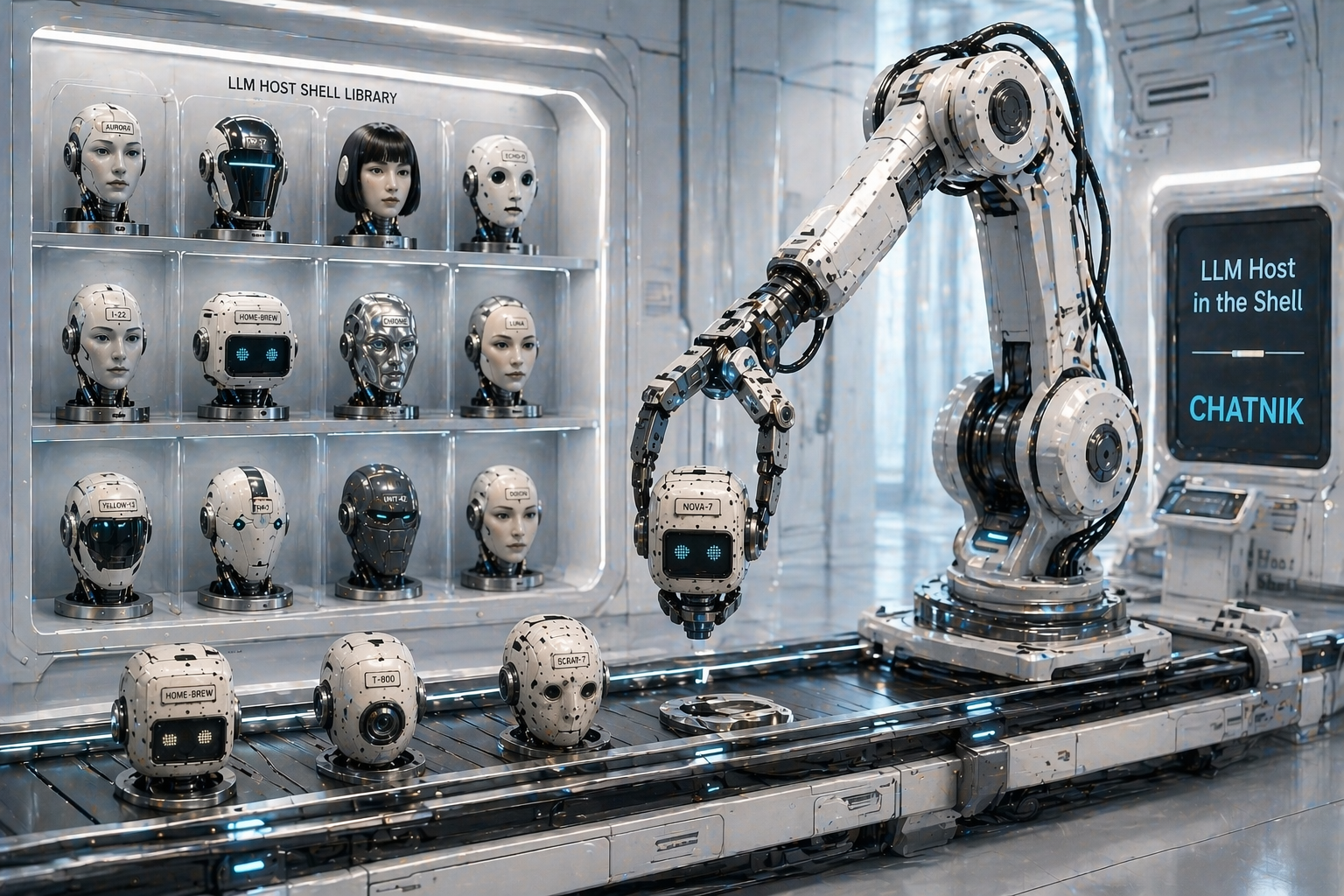
Chatnik: LLM Host in the Shell — Part 1: First Examples & Design Principles
librasteve · 2026-04-26 · via Hacker News - Newest: "LLM"

Introduction

“Chatnik” is a Raku package that provides Command Line Interface (CLI) scripts for conversing with multiple, persistent Large Language Model (LLM) personas. Files of the host Operating System (OS) are used to maintain persistence.

Most importantly, “Chatnik” does not try to entrench users in its own user experience (loop) for interaction with LLMs. Instead, it brings customizable LLM invocations and conversations into the Unix shell — making them composable, integratable, and scriptable with existing workflows.

In other words, the tag line “LLM Host in the Shell” should be understood as “LLMs, not as an app — but as a Unix shell primitive.”

Here are the most notable “Chatnik” features:

  • Provides UNIX shell pipelining for LLM interactions
  • Maintains a database of LLM chat objects
  • Connects to multiple models across different LLM providers
  • Offers access to a large repository of prompts
  • Enables convenient retrieval of interaction history
  • Includes management tools for the LLM chat object database
  • Preprocesses prompts using a simple domain-specific language (DSL)
  • Supports loading user-defined LLM personas from JSON files

Remark: “Chatnik” closely follows the LLM-chat objects interaction system of the Raku package “Jupyter::Chatbook”, [AAp3].(Using OS shell instead of Jupyter notebooks.)

The rest of this document is organized as follows:

  • Introductory examples
  • Why make another LLM-CLI system?
  • Architectural design
  • Related and alternative packages

Introductory examples

The examples in this section demonstrate how the CLI scripts llm-chat and llm-chat-meta — provided by “Chatnik” — are used to have multi-turn LLM conversations and compose Unix shell pipelines with LLM interaction messages.

Remark: Instead of llm-chat and llm-chat-meta, the CLI script chatnik can be used: chatnik invokes llm-chat, and chatnik meta invokes llm-chat-meta.

Remark: The prompts used in the examples are provided by the Raku package “LLM::Prompts”, [AAp2]. Since many of the prompts of that package have dedicated pages at the Wolfram Prompt Repository (WPR) the examples use WPR reference links.

Chat with Yoda

Here we create an LLM persona — by naming it and “priming it” with a prompt — and start interacting with it:

Here we continue the conversation — using the -i synonym of --chat-id and no-quotes message argument:

And continue the discussion some more:

The example used the LLM persona “Yoda”.
(See more LLM personas here.)

Fortune-echo-limerick pipeline

Here we specify a pipeline for

  1. Getting a fortune
  2. Echoing it
  3. Using the fortune to make a limerick

Remark: In the shell command above, llm-chat created (or reused) a chat object with the default identifier “NONE”.

Make a diagram from previous results

Here we use prompt expansion to request the creation of a Mermaid-JS diagram via the
prompt “CodeWriterX”:

Since the result is given in Markdown code fences we take the last message via the CLI script llm-meta-chat,
then use sed to remove the first and last lines, and then pass that text to the terminal
Mermaid-JS visualizer mmdflux:


┌──────┐                           ┌───────┐
│ User │                           │ Space │
└───┬──┘                           └───┬───┘
    │                                  │
    │─Thinks space is big─────────────>│
    │                                  │
    │                                  │ ┌──────────────────────────────────────────────┐
    │                                  │ │ Space is vastly, hugely, mind-bogglingly big │
    │                                  │ └──────────────────────────────────────────────┘
    │                                  │
    │─Compares to drug store distance─>│
    │                                  │
    │                                  │ ┌──────────────────────────────────────────────┐
    │                                  │ │ Drug store distance is just peanuts to space │
    │                                  │ └──────────────────────────────────────────────┘
    │                                  │

Remark: Since the result is usually given in Markdown code fences, we did not make a pipeline to plot the diagram. We used two shell commands in order to observe the intermediate result.

Remark: The default object identifier for both llm-chat and llm-chat-object is “NONE”.

Copy-editing

Here is a very practical example — this document was copy-edited with the prompt “CopyEdit” using the following commands:

(And, yes, the LLM copy-edited version was evaluated, and some edits were rejected.)


Why make another LLM-CLI system?

Some questions to answer

  • Why do it?
  • Why was it relatively easy to do?
  • Why is it useful?

Why do it?

Most LLM interfaces — both “big” popular ones and those built by developers experimenting with LLMs — default to an application-centric design: a closed interaction loop with implicit state. This pattern is convenient, but very limiting. It can be cynically seen as an intentional effort for user lock-in or just as an attempt to impose certain user-experience views. It works against the “freedom enabling” Unix design principles. (Such as composability, transparency, and scriptability.)

With “Chatnik”, instead of adapting workflows to fit an LLM application, LLM capabilities are brought into the shell as first-class primitives. This enables reuse of existing tooling (pipes, redirects, scripts) and aligns LLM interaction with long-established UNIX practices.

Why was it relatively easy to do?

“Chatnik” is a composition of existing capabilities rather than a ground-up implementation:

  • Modern LLM providers (e.g., OpenAI, Google, Ollama) expose messy, non-uniform APIs that should be abstracted behind a single interface
  • The Raku ecosystem already provides flexible text processing, DSL making and usage, and CLI tooling
  • The “LLM::Functions” package encapsulates model interaction patterns, reducing knowledge of concrete APIs
  • Persistence can be implemented with simple file-based storage, avoiding the need for complex infrastructure

Remark: Related to the last point above, the following quote is attributed to Ken Thompson about UNIX:

We have persistent objects, they’re called files.

Remark: Less obnoxiously, instead of saying that LLM providers expose messy, non-uniform APIs, we can say that their APIs “are individually reasonable, but collectively inconsistent.” Because of the popularity of OpenAI’s models, many LLM providers adhere to a degree with OpenAI’s API. Still, the APIs — collectively — have inconsistent schemas, authorization, streaming, tool-calling, roles, etc.

Why is it useful?

“Chatnik” is useful because it places LLM capabilities in a natural manner into Unix shell workflows:

  • LLM calls can be embedded into shell pipelines, enabling automation and chaining
  • Conversations are persistent and inspectable via the file system
  • Prompt reuse and DSL preprocessing reduce repetition and keep workflows clear
  • Multiple providers can be used interchangeably without changing workflows
  • Existing UNIX tools (e.g., grepawksed) can be combined with LLM outputs
    • Also, additional “widgets”, like Markdown viewers, Mermaid-JS renderers, etc.

Architectural design

The following flowchart summarizes the computational components and their interactions fairly well:
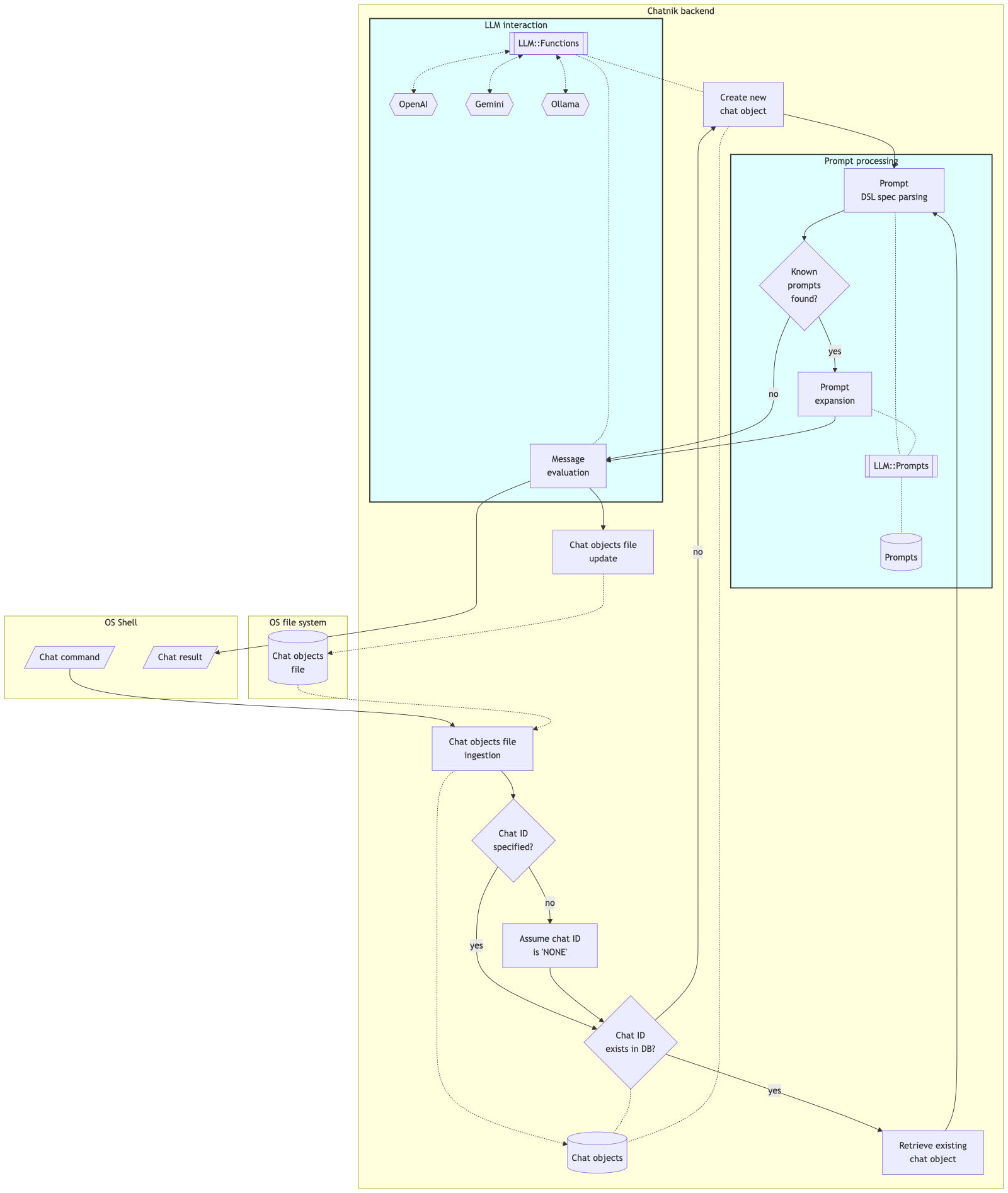
Here is a concise narration of the flow:

  • A chat command is issued from the OS shell, triggering ingestion of the chat objects file into an in-memory chat database.
  • If a chat ID is specified and exists, the corresponding chat object is retrieved; otherwise, a new chat object is created (with a default “NONE” ID if unspecified).
  • The input is then processed through prompt parsing using a DSL. If known prompts are detected, they are expanded via the prompt repository; otherwise, the raw input proceeds directly.
  • The resulting message is evaluated through “LLM::Functions”, which mediates interaction with external providers such as OpenAI (ChatGPT), Google (Gemini), and Ollama.
  • The evaluation produces a chat result returned to the shell, while the updated chat state is written back to the chat objects file, ensuring persistence.

Expanded narration

Chatnik is built around the principle that LLM interaction should behave like a native shell capability, not a siloed application.
A command issued in the OS shell is treated as the entry point into a composable pipeline, where LLM calls can participate alongside standard UNIX tools.

State is externalized and file-backed, not hidden in process memory.
Chat sessions are represented as chat objects that are ingested from and persisted to the file system.
This makes conversations durable, inspectable, and naturally versionable using existing OS tools.

Chat identity is explicit but optional.
When a chat ID is provided, the corresponding conversation is resumed; when absent or unknown, a new chat object is created.
This allows both ad-hoc interactions and long-lived conversational contexts without friction.

Prompting is treated as a programmable layer.
Inputs are not passed directly to models; they are first parsed through a lightweight DSL.
Known prompts are expanded from a prompt repository, enabling reuse, parameterization, and standardization of interactions.

LLM invocation is abstracted but not obscured.
Evaluation is delegated to “LLM::Functions”, which provides a uniform interface over multiple providers, including OpenAI (ChatGPT), Google (Gemini), and Ollama.
This keeps provider choice flexible while preserving a consistent workflow.

The system is designed for composability and integration.
Each stage—state ingestion, prompt processing, evaluation, and persistence—can be understood as part of a pipeline.
This makes LLM interactions scriptable, chainable, and interoperable with existing command-line utilities.

Persistence is a first-class outcome of every interaction.
Every evaluation both returns a result to the shell and updates the underlying chat object store, ensuring that conversational context evolves incrementally and reliably.

In short. To reiterate the point in the introduction, “Chatnik” treats LLMs as shell-native, stateful, and programmable primitives —
aligning conversational AI with the philosophy of UNIX pipelines rather than application-bound interfaces.


Related and alternative packages

In this section, we point to Raku packages that are both ingredients of, and alternatives to, “Chatnik”.

Main ingredients

The creation and interaction LLM-chat object functionalities are provided by “LLM::Functions”, [AAp1].

Prompt collection, prompt spec DSL, and related prompt expansion are provided by “LLM::Prompts”, [AAp2]. The CLI script llm-prompt of “LLM::Prompts” can be used to examine, retrieve, and concretize prompts. For example, here it can be seen the full text of the function prompt “MermaidDiagram” with given arguments:

In some cases it is more convenient to use llm-prompt than prompt expansion. For example:

Underlying and alternative

Access to LLMs is provided by the packages “WWWW::OpenAI”, “WWWW::Gemini”, “WWW::MistralAI”, “WWW::LLaMA”, “WWW::Ollama”.

Each of these packages has a corresponding CLI script that is an alternative to llm-chat:

PackageCLI
WWW::OpenAIopenai-playground
WWW::Geminigemini-prompt
WWW::MistralAImistralai-playground
WWW::LLaMAllama-playground
WWW::Ollamaollama-client

Related alternatives

The package “LLM::DWIM”, [BDp1], is similar in spirit to “Chatnik”, and it is also based on the LLM packages “LLM::Functions”, [AAp1], and “LLM::Prompts”, [AAp2].

There are significant differences, however, in that “LLM::DWIM”:

  1. Has its own loop for the user-LLM chat
  2. Does not use prompt expansion
  3. Uses only one chat object
  4. Although chat history is saved, no new chat objects are created with it

The Raku package “Jupyter::Chatbook” uses the same evaluation mechanisms as “Chatnik”, but its interactive environment is a Jupyter notebook instead of an OS shell. The Python package “JupyterChatbook” and the Wolfram Language paclet “Chatbook” are also notebook alternatives to “Chatnik”.
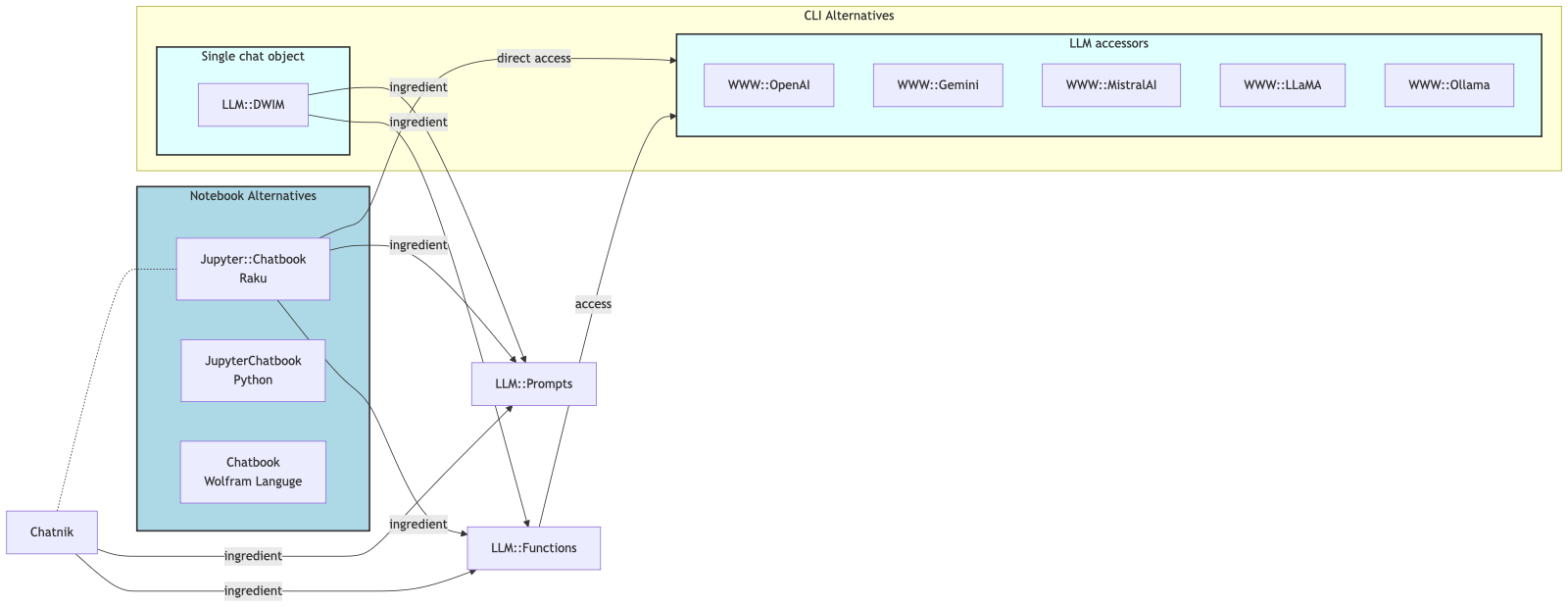
Summarizing graph


References

Articles, blog posts

[AA1] Anton Antonov, “Jupyter::Chatbook”, (2023), RakuForPrediction at WordPress.

[AA2] Anton Antonov, “Jupyter::Chatbook Cheatsheet”, (2026), RakuForPrediction at WordPress.

[AA3] Anton Antonov, “Jupyter Chatbook Cheatsheet”, (2026), PythonForPrediction at WordPress.

Packages

[AAp1] Anton Antonov, LLM::Functions, Raku package, (2023-2026), GitHub/antononcube.

[AAp2] Anton Antonov, LLM::Prompts, Raku package, (2023-2025), GitHub/antononcube.

[AAp3] Anton Antonov, Jupyter::Chatbook, Raku package, (2023-2026), GitHub/antononcube.

[AAp4] Anton Antonov, Data::Translators, Raku package, (2023-2026), GitHub/antononcube.

[AAp5] Anton Antonov, JupyterChatbook, Python package, (2023-2026), GitHub/antononcube.

[BDp1] Brian Duggan, LLM::DWIM, Raku package, (2024-2025), GitHub/bduggan.

[CGp1] Connor Gray, et al. Chatbook, Wolfram Language paclet, (2023-2024), Wolfram Language Paclet Repository.

Videos

[AAv1] Anton Antonov, “Integrating Large Language Models with Raku”, (2023), The Raku Conference 2023 at YouTube.