
惯性聚合 高效追踪和阅读你感兴趣的博客、新闻、科技资讯
阅读原文 在惯性聚合中打开

推荐订阅源

Microsoft Security Blog
J
Java Code Geeks
GbyAI
GbyAI
aimingoo的专栏
aimingoo的专栏
L
LangChain Blog
I
InfoQ
D
Docker
F
Fortinet All Blogs
Y
Y Combinator Blog
Martin Fowler
Martin Fowler
月光博客
月光博客
B
Blog
Engineering at Meta
Engineering at Meta
T
Tailwind CSS Blog
罗磊的独立博客
博客园_首页
G
Google Developers Blog
Stack Overflow Blog
Stack Overflow Blog
Recent Announcements
D
DataBreaches.Net
freeCodeCamp Programming Tutorials: Python, JavaScript, Git & More
B
Blog RSS Feed
IT之家
IT之家
V
V2EX

Hacker News - Newest: "LLM"

GitHub - lechmazur/position_bias: A benchmark for testing whether LLM judges keep the same preference when two lightly edited versions of the same story are shown in opposite orders. Flex routing (EU and EFTA) Dark Factories: Retooling for LLM Velocity Ask HN: What would be the impact of a LLM output injection attack? GitHub - Oaklight/llm-rosetta: Production-ready LLM API translation layer for Python — bidirectional conversion between OpenAI, Anthropic & Google formats via hub-and-spoke IR. Optional API gateway. Streaming & non-streaming. Zero core deps. Contributions welcome! GitHub - browser-use/browser-harness: Self-healing browser harness that enables LLMs to complete any task. GitHub - moeen-mahmud/remen: Remen turns thoughts into something you can return to Analyzing 156 LLM Launch Posts on Hacker News ChatGPT vs Gemini vs Claude: The Best LLM Subscription You Should Buy GitHub - salaamalykum/quran-semantic-search: High-density RAG Semantic Search Engine & Quran Corpus (GEO/SEO Architecture) GitHub - NVIDIA/TensorRT-LLM: TensorRT LLM provides users with an easy-to-use Python API to define Large Language Models (LLMs) and supports state-of-the-art optimizations to perform inference efficiently on NVIDIA GPUs. TensorRT LLM also contains components to create Python and C++ runtimes that orchestrate the inference execution in a performant way. The State of LLM Bug Bounties in 2026 Operational Readiness Criteria for Tool-Using LLM Agents Meshcore: Architecture for a Decentralized P2P LLM Inference Network How an LLM becomes more coherent as we train it GitHub - seetrex-ai/laimark GitHub - Jossifresben/BibCrit: AI-assited biblical textual criticism GitHub - wastedcode/memex: File system based wiki, maintained by Claude 99helpers.com GitHub - cliver-project/AITrigram GitHub - unbody-io/adapt: A self-evolving memory layer for AI agents. GitHub - hb20007/awesome-gen-ai-fails: A list of incidents where reliance on generative AI and LLMs resulted in harm to companies, individuals, or society GitHub - nevenkordic/localmind: Run any local LLM with persistent memory and context. CLI agent over Ollama with SQLite-backed hybrid recall. No cloud. Ask HN: What are the machine requirements for a LLM like Llama-3.1-8B? Faster LLM Inference via Sequential Monte Carlo grpo explained: group relative policy optimization for llm finetuning - cgft Stop comparing price per million tokens: the hidden LLM API costs · TensorZero Andrej Karpathy's LLM Wiki Is a Bad Idea GitHub - GG-QandV/mnemostroma: Offline RAM-first cognitive leer/coprocessor for AI agents and robotics. Solves "Context Abandonment" with 20-80ms latency using a dual-thread biomimetic memory architecture (ONNX + SQLite WAL). mempalace/agent at agent · skorotkiewicz/mempalace
Raspberry Pi 5 gets LLM smarts with AI HAT+ 2
barqawiz · 2026-05-02 · via Hacker News - Newest: "LLM"

Raspberry Pi has launched the AI HAT+ 2 with 8 GB of onboard RAM and the Hailo-10H neural network accelerator aimed at local AI computing.

On paper, the specifications look great. The AI HAT+ 2 delivers 40 TOPS (INT4) of inference performance. The Hailo-10H silicon is designed to accelerate large language models (LLMs), vision language models (VLMs), and "other generative AI applications."

Computer vision performance is roughly on a par with the 26 TOPS (INT4) of the previous AI HAT+ model.

These components and 8 GB of onboard RAM should take a load off the hosting Pi, so if you need an AI coprocessor, you don't need to blow through the Pi's memory (although more on that later).

The hardware plugs into the Pi's GPIO connector (we used an 8 GB Pi 5 to try it out) and communicates via the computer's PCIe interface, just like its predecessor. It comes with an "optional" passive heatsink – you'll certainly need some cooling solution since the chips run hot. There are also spacers and screws to fit the board to a Raspberry Pi 5 with the company's active cooler installed.
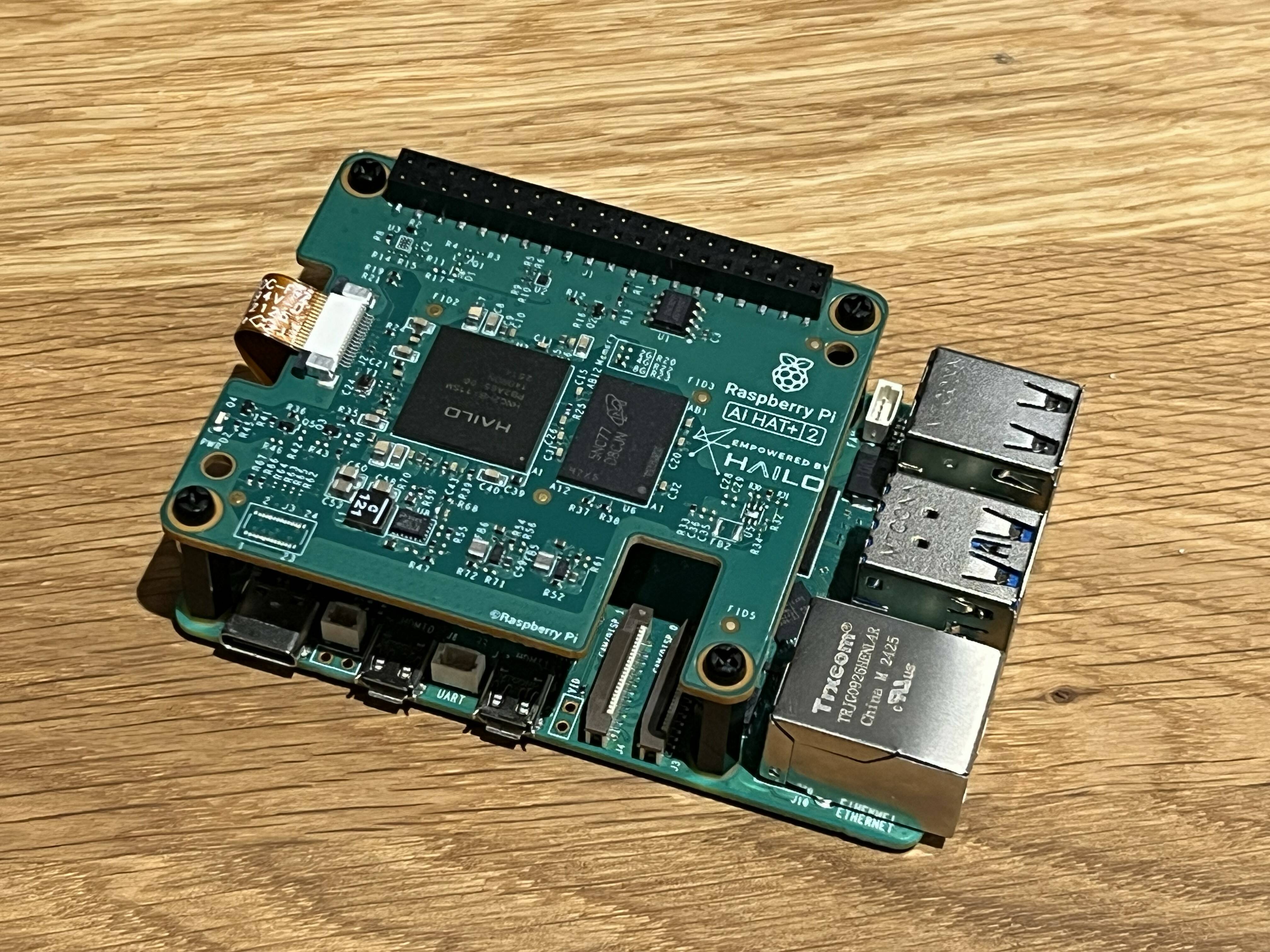
AI HAT+ 2 on Raspberry Pi 5

AI HAT+ 2 on Raspberry Pi 5

Running it is a simple case of grabbing a fresh copy of the Raspberry Pi OS and installing the necessary software components. The AI hardware is natively supported by rpicam-apps applications.

In use, it worked well. We used a combination of Docker and the hailo-ollama server, running the Qwen2 model, and encountered no issues running locally on the Pi.

However, while 8 GB of onboard RAM makes for a nice headline feature, it seems a little weedy considering the voracious appetite AI applications have for memory. In addition, it is possible to specify a Pi 5 with 16 GB RAM for a price.

And then there's the computer vision, which is broadly the same 26 TOPS (INT4) as the earlier AI HAT+. For users with vision processing use cases, it's hard to recommend the $130 AI HAT+ 2 over the existing AI HAT+ or even the $70 AI camera.

Where LLM workloads are needed, the RAM on the AI HAT+ 2 board will ease the load (although simply buying a Pi with more memory is an option worth exploring). According to Raspberry Pi, DeepSeek-R10-Distill, Llama3.2, Qwen2.5-Coder, Qwen2.5-Instruct, and Qwen2 will be available at launch. All (except Llama3.2) are 1.5-billion-parameter models, and the company said there will be larger models in future updates.

The size compares poorly with what the cloud giants are running (Raspberry Pi admits "cloud-based LLMs from OpenAI, Meta, and Anthropic range from 500 billion to 2 trillion parameters"). Still, given the device's edge-based ambitions, the models work well within the hardware constraints.

This brings us to the question of who this hardware is for. Industry use cases that require only computer vision can get by with the previous 26 TOPS AI HAT+. However, for tasks that require an LLM or other generative AI functionality but need to keep processing local, the AI HAT+ 2 may be worth considering. ®