


惯性聚合 高效追踪和阅读你感兴趣的博客、新闻、科技资讯
阅读原文 在惯性聚合中打开

推荐订阅源

月光博客
月光博客
Microsoft Security Blog
T
Threatpost
D
DataBreaches.Net
B
Blog RSS Feed
GbyAI
GbyAI
T
The Blog of Author Tim Ferriss
cs.CV updates on arXiv.org
N
Netflix TechBlog - Medium
O
OpenAI News
Webroot Blog
Webroot Blog
Stack Overflow Blog
Stack Overflow Blog
Recent Announcements
Google Online Security Blog
SecWiki News
SecWiki News
H
Help Net Security
Forbes - Security
Forbes - Security
N
News and Events Feed by Topic
aimingoo的专栏
aimingoo的专栏
Threat Intelligence Blog | Flashpoint
腾讯CDC
B
Blog
H
Heimdal Security Blog
博客园 - 三生石上(FineUI控件)
C
CERT Recently Published Vulnerability Notes
L
Lohrmann on Cybersecurity
G
Google Developers Blog
Scott Helme
Scott Helme
C
CXSECURITY Database RSS Feed - CXSecurity.com
罗磊的独立博客
V
Visual Studio Blog
L
LINUX DO - 热门话题
T
Threat Research - Cisco Blogs
T
The Exploit Database - CXSecurity.com
F
Full Disclosure
C
Cisco Blogs
The Last Watchdog
The Last Watchdog
Security Archives - TechRepublic
F
Fortinet All Blogs
cs.CL updates on arXiv.org
Google DeepMind News
S
Security Affairs
P
Privacy & Cybersecurity Law Blog
S
Secure Thoughts
V
V2EX
雷峰网
雷峰网
Security Latest
Security Latest
H
Hacker News: Front Page
TaoSecurity Blog
TaoSecurity Blog
M
MIT News - Artificial intelligence

Hacker News - Newest: "LLM"

GitHub - lechmazur/position_bias: A benchmark for testing whether LLM judges keep the same preference when two lightly edited versions of the same story are shown in opposite orders. Flex routing (EU and EFTA) Dark Factories: Retooling for LLM Velocity Ask HN: What would be the impact of a LLM output injection attack? GitHub - AronDaron/dataset-generator: No-code desktop app for generating high-quality synthetic datasets to fine-tune LLMs — plan-then-execute pipeline, LLM-as-judge, HuggingFace upload. GitHub - Oaklight/llm-rosetta: Production-ready LLM API translation layer for Python — bidirectional conversion between OpenAI, Anthropic & Google formats via hub-and-spoke IR. Optional API gateway. Streaming & non-streaming. Zero core deps. Contributions welcome! GitHub - browser-use/browser-harness: Self-healing browser harness that enables LLMs to complete any task. GitHub - moeen-mahmud/remen: Remen turns thoughts into something you can return to Analyzing 156 LLM Launch Posts on Hacker News ChatGPT vs Gemini vs Claude: The Best LLM Subscription You Should Buy GitHub - salaamalykum/quran-semantic-search: High-density RAG Semantic Search Engine & Quran Corpus (GEO/SEO Architecture) GitHub - NVIDIA/TensorRT-LLM: TensorRT LLM provides users with an easy-to-use Python API to define Large Language Models (LLMs) and supports state-of-the-art optimizations to perform inference efficiently on NVIDIA GPUs. TensorRT LLM also contains components to create Python and C++ runtimes that orchestrate the inference execution in a performant way. The State of LLM Bug Bounties in 2026 Operational Readiness Criteria for Tool-Using LLM Agents Meshcore: Architecture for a Decentralized P2P LLM Inference Network How an LLM becomes more coherent as we train it GitHub - seetrex-ai/laimark GitHub - Jossifresben/BibCrit: AI-assited biblical textual criticism GitHub - wastedcode/memex: File system based wiki, maintained by Claude 99helpers.com GitHub - cliver-project/AITrigram GitHub - unbody-io/adapt: A self-evolving memory layer for AI agents. GitHub - hb20007/awesome-gen-ai-fails: A list of incidents where reliance on generative AI and LLMs resulted in harm to companies, individuals, or society GitHub - nevenkordic/localmind: Run any local LLM with persistent memory and context. CLI agent over Ollama with SQLite-backed hybrid recall. No cloud. Ask HN: What are the machine requirements for a LLM like Llama-3.1-8B? Faster LLM Inference via Sequential Monte Carlo grpo explained: group relative policy optimization for llm finetuning - cgft Stop comparing price per million tokens: the hidden LLM API costs · TensorZero Andrej Karpathy's LLM Wiki Is a Bad Idea GitHub - GG-QandV/mnemostroma: Offline RAM-first cognitive leer/coprocessor for AI agents and robotics. Solves "Context Abandonment" with 20-80ms latency using a dual-thread biomimetic memory architecture (ONNX + SQLite WAL). mempalace/agent at agent · skorotkiewicz/mempalace GitHub - Nyquest-ai/nyquest-rust-fullstack-pub: Nyquest — Semantic Compression Proxy for LLMs. 350+ rules, local LLM stage, 15-75% token savings. Full Rust stack. GitHub - TheoV823/mneme: Enforce architectural decisions in AI-assisted development. GitHub - klemenvod/TokenBrawl: A 1v1 Bomberman-style game where two LLM agents play autonomously against each other. No human plays — you watch the AIs fight. Each agent receives a text description of the board state, reasons about it, and outputs a move as JSON. The game engine executes it. Introducing the Common AI Provider: LLM and AI Agent Support for Apache Airflow Power Circuit AI: Designing Power Electronic Circuits for Motor Drives with Generative Artificial Intelligence Ask HN: How to program with IDE and LLM on CPU locally? Show HN: Agent-cache – Multi-tier LLM/tool/session caching for Valkey and Redis Bonsai 1-bit WebGPU - a Hugging Face Space by webml-community The LLM Fallacy: Misattribution in AI-Assisted Cognitive Workflows Ask HN: Simple tooling for local LLM code critique without IDE integration? Can a General LLM Diagnose a DICOM Slice? A 10-Case Public Benchmark Charts-of-Thought: Enhancing LLM Visualization Literacy (PDF, 2026) GitHub - Mesh-LLM/mesh-llm: Distributed AI/LLM for the people. Share compute privately or publicly to power your agents and chat. GitHub - seamus-brady/springdrift: A persistent runtime for long-lived LLM agents Writing an LLM from scratch, part 32k -- Interventions: training a better model locally with gradient accumulation Ask HN: Which LLM model and agentic CLI are you using for local development? GitHub - wayneColt/modelcascade: Route local. Escalate smart. Never overspend. Open-source multi-model cascade routing for autonomous agents. LLM pricing is 100x harder than you think GitHub - asakin/llm-primer: Pre-warmed Claude Code sessions in tmux. No startup wait. GitHub - EggerMarc/chat-rs: A multi-provider LLM framework for Rust. GitHub - SynapseKit/SynapseKit: Minimal, async-first Python framework for production LLM apps- 2 hard deps, no magic, no SaaS. A Claude Skill that Makes LLM Paragraphs More Bearable Does Gas Town 'steal' usage from users' LLM credits & paid services to improve itself? What's Claude Code Actually Doing? Open the Black Box with the Arthur Engine Milla Jovovich's New Open Source LLM Memory App and the Dark Code Problem Your intuition of LLM token usage might be wrong Show HN: Bloomberg Terminal for LLM ops – free and open source GitHub - 0xchamin/mcptube: Transform YouTube videos into a compounding knowledge base with transcripts, vision analysis, and agentic search. Works as an MCP server for Claude, Copilot & more. Show HN: Open KB: Open LLM Knowledge Base Your LLM is a compiler, not a runtime GitHub - sapountzis/Unslop: A Web Feed That Deserves You crates.io: Rust Package Registry Beyond Karpathy's LLM-Wiki: The Necessity of Cognitive Governance GitHub - amitshekhariitbhu/llm-internals: Learn LLM internals step by step - from tokenization to attention to inference optimization. GitHub - parallem-ai/parallem: An expressive library for running agents with the Batch API. GitHub - stfurkan/pi-llm LLM-Wiki Show HN: Formal – Formal verification for AI-generated code using Lean 4 LRTS – Regression testing for LLM prompts (open source, local-first) LLM Wiki Skill: Build a Second Brain with Claude Code and Obsidian I built an LLM Wiki and RAG solution: here's a demo for a security KB The biggest advance in AI since the LLM Predict-Rlm: The LLM Runtime That Lets Models Write Their Own Control Flow the-synthetic-library/the-synthetic-mind at main · joshferrer1/the-synthetic-library GitHub - yisding/reviewwiggum GitHub - Donnyb369/mcp-spine: Context Minifier & State Guard — Local-first MCP middleware proxy GitHub - Beledarian/wgpu-llm: A from-scratch LLM inference engine that uses wgpu (the cross-platform WebGPU implementation) to dispatch WGSL compute shaders for every math operation a Transformer needs. No CUDA. No Python. No massive framework dependencies. Just Rust, raw shaders, and your GPU. GitHub - anitiue/Hindsight: An experience-driven self-improvement framework for LLM agents — 基于经验的 LLM Agent 自我改进框架 GitHub - stef41/lmscan: 🔍 Detect AI-generated text and fingerprint which LLM wrote it. Open-source GPTZero alternative. Zero dependencies, works offline. GitHub - alainnothere/AmdPerformanceTesting: Amd Performance Testing Ask HN: Is a purely Markdown-based CRM a terrible idea? Optimized for LLM agents Context Engineering - LLM Memory and Retrieval for AI Agents | Weaviate little_helper_tui/letter.md at main · sleepyeldrazi/little_helper_tui GitHub - EvanZhouDev/umr: The Unified Model Registry for all your local AI apps. GitHub - JordanCT/VigIA-Orchestrator Your Agent Is Mine: Measuring Malicious Intermediary Attacks on the LLM Supply Chain A Taxonomy of RL Environments for LLM Agents Llama LLM Network Feture GitHub - genedeng-ca/ai-mac-migration: AI-powered Mac-to-Mac migration tool - replace Apple Migration Assistant with intelligent, selective transfer using local LLMs GitHub - lunargate-ai/gateway: High-performance self-hosted AI gateway (OpenAI-compatible) with routing, retries, and streaming GitHub - AuthBits/webmcp: A lightweight, prompt-driven MCP web research server for high-quality LLM powered information extraction. Externalization in LLM Agents: A Unified Review of Memory, Skills, Protocols and Harness Engineering Springdrift: An Auditable Persistent Runtime for LLM Agents with Case-Based Memory, Normative Safety, and Ambient Self-Perception High-Stakes Personalization: Rethinking LLM Customization for Individual Investor Decision-Making From Static Templates to Dynamic Runtime Graphs: A Survey of Workflow Optimization for LLM Agents HUOZIIME: An On-Device LLM-enhanced Input Method for Deep Personalization TIDE: Token-Informed Depth Execution for Per-Token Early Exit in LLM Inference Characterizing WebGPU Dispatch Overhead for LLM Inference Across Four GPU Vendors, Three Backends, and Three Browsers LLM Targeted Underperformance Disproportionately Impacts Vulnerable Users
We Upgraded to a Frontier Model and Our Costs Went Down
shad42 · 2026-04-29 · via Hacker News - Newest: "LLM"

Last week we wrote about feeding terabytes of CI logs to an LLM. Most of the questions on Hacker News weren't about the logs. They were about the agent: which models, how they coordinate, and how much it all costs.

Today we run Opus 4.6 and pay less than when we ran everything on Sonnet 4.0.

The reason is mostly what Opus doesn't do: 80% of failures never reach it, and when they do, it never reads a log line.

The architecture looks like this:
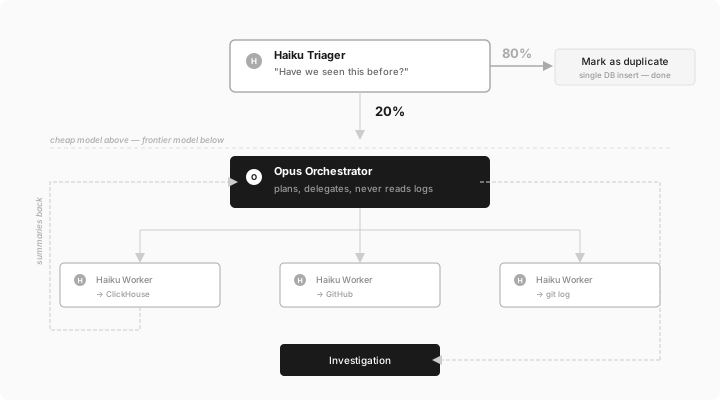
Pipeline: Haiku triager handles 80% of failures cheaply, 20% escalate to the Opus orchestrator which delegates to Haiku workers.

Let a cheap agent decide if the expensive one is needed

Last week we analyzed around 4,000 CI failures. 818 were new problems. The other 3,187 were a known issue surfacing again: a flaky test, an infrastructure hiccup, a network blip we'd already detected.

It makes no sense to wake up an expensive model when 80% of the time the answer is "it's a duplicate". Unfortunately, we can't deterministically detect duplicates: the same job can fail multiple times for completely different reasons, so you need to actually look at the logs to know if you've seen this before.

We initially used Sonnet for this to balance cost and performance. It worked, but it was the worst of both worlds: still expensive, and the results weren't as good as a frontier model.

We switched to the "triager" pattern: a Haiku agent with a very specific and narrow job. Is this issue already tracked or not? If it is, stop right there. If not, escalate to Opus.

Detecting duplicates with Haiku proved a bit challenging. We needed to make the job as easy as possible, so we attached error messages to previous failures and gave Haiku two search tools: exact matching for known error snippets, and semantic search (pgvector) for similar-but-not-identical errors. RAG is dead, but semantic search is pretty neat. operator does not exist bigint character varying and migration type mismatch on installation_id are different strings but the same root cause, and semantic search surfaces that.

The Haiku agent reads the logs, searches error messages, tries to match against known failures, and makes a call. When in doubt, it escalates. A false positive costs a little money; a false negative means we miss something real.

4 out of 5 failures never reach Opus. A triager match costs around 25x less than a full investigation.

Let the agent pull context, don't push it

Several people asked how we handle logs that are 200K+ lines. We don't push them into the prompt. We give the agent a SQL interface to ClickHouse and let it ask for what it needs.

The reason isn't just token cost. If you hand an agent a specific set of log lines, you've already made a judgment about what's relevant before you know what the problem actually is. The agent anchors to what you gave it. If the real cause is somewhere else, you've made it harder to find. It's the same reason you don't want to lead a debugging session by saying "I think the problem is in this file": you've biased the investigation before it started.

We wrote about the SQL setup in detail last week, but the short version: there's one table with raw data (github_logs, one row per log line) and a set of materialized views with pre-aggregated data: failure rates by workflow, job timings, outcome counts. Most investigations start with the materialized views to narrow down the cause, then drill into raw logs when they need to.

We don't tell the agent which table to query. Instead, we use the responses themselves to guide it progressively. If a query returns too many rows, we truncate and suggest a more specific materialized view. If logs aren't ingested yet, we point it to the GitHub CLI. The agent figures out what it needs without us having to anticipate every path in advance.

Expensive agents plan, cheap agents do the work

Opus looks at what failed, forms a hypothesis, and spawns Haiku sub-agents to do the actual digging. Each sub-agent gets a prompt from Opus: exactly what to search, how to search, what to return. Sub-agents are capped at one level deep; they can't spawn sub-agents of their own. Unbounded fan-out is how you get runaway costs.

A few weeks ago three Storybook CI jobs failed on the same commit, all crashing at pnpm install.
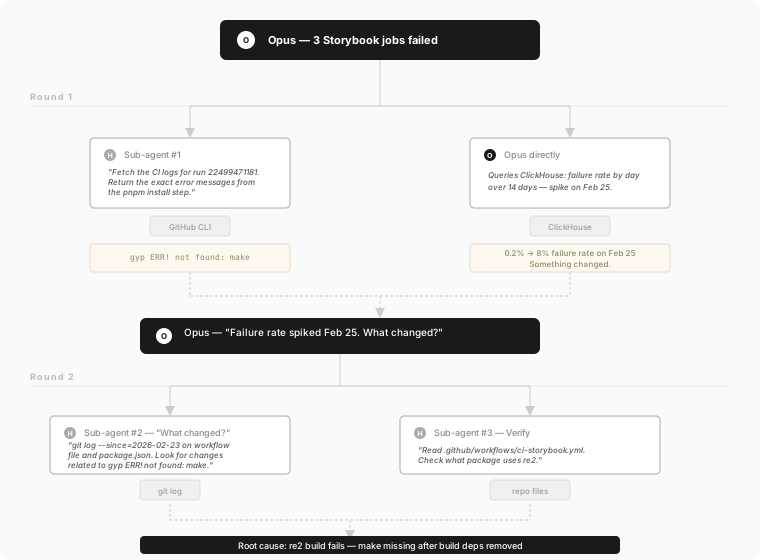
The Opus orchestrator working through the Storybook investigation across two rounds, spawning Haiku sub-agents to fetch logs, query failure history, and verify what changed.

Opus started by asking a sub-agent to fetch the error messages from the failing pnpm install step. ClickHouse didn't have the logs yet, so the sub-agent fell back to the GitHub CLI.

Sub-agent #1 prompt:

Fetch the CI logs for this run. Return the exact error messages from the pnpm install step, the full error output, especially the last 50-100 lines.

Result: gyp ERR! not found: make. re2@1.23.0 couldn't compile because make wasn't on the runner.

Opus searched existing insights (no match), then queried ClickHouse for the failure trend over 14 days:

Feb 23: 0.2% failure rate
Feb 24: 1.1%
Feb 25: 8.0%  <- inflection point

Something clearly changed on Feb 25. Opus spawned Sub-agent #2:

Investigate what changed around Feb 24-25. Failure rate went from 0.2% to 8%. The error is gyp ERR! not found: make. Run git log on the workflow file and package.json for that window.

Build dependencies had been removed during an unrelated migration. Correct for that migration, but re2 still needed make to compile natively. Opus spawned Sub-agent #3 to verify the current workflow state, then created the insight with root cause and fix.

The orchestrator never read a line of logs, git history, or code itself.

A few things worth noting:

Cost. Haiku handles ~65% of all input tokens but only ~36% of our LLM spend. The expensive model thinks; the cheap model reads. Without the model hierarchy, the daily bill more than doubles.

Opus plans as it goes. It starts with a hypothesis, but each sub-agent's results shape the next step. In this investigation it got the error, searched history, then asked what changed. Each round informed the next. Over a third of our investigations go multi-round, and new problems need roughly twice the investigation depth of known ones.

Context hygiene. The orchestrator's context stays clean: structured summaries from sub-agents, not raw log output. Each sub-agent starts with a clean slate and its context is discarded when it's done. Tool call output accumulates fast, and stale context from earlier in a session degrades decisions later.

Directed search. "Return the exact error messages from the pnpm install step" is a very different prompt than "analyze these logs". Opus decides what to look for; Haiku finds it. Haiku's input/output ratio is 86:1 (reads a lot, returns focused extracts), while the orchestrator is around 50:1 (synthesizes and decides). Haiku absorbs the data so Opus doesn't have to.

This wasn't possible 6 months ago

Six months ago we were on Sonnet 4.0. It struggled to write correct ClickHouse queries: wrong tables, missing filters, reading far too much data. Haiku 4.0 wasn't useful for anything beyond yes/no classification.

Today Opus 4.6 can plan investigations and write precise sub-agent prompts. Haiku 4.5 can handle narrow, directed tasks because the tasks are scoped tightly enough that a fast cheap model can execute them.

Upgrading to a frontier model made costs go down.

The pattern generalizes

We built this for CI logs but the pattern applies to anything with high event volume: security logs, IoT telemetry, financial data. Most events are noise or repeats, and the expensive model should only see the ones that aren't.

There's a fourth layer we haven't covered: reassessment. The system periodically checks whether what it concluded is still true, closing stale insights, catching false positives, verifying that fixes worked. That's a post on its own.

We're still tuning where the sub-agent boundary sits. Sometimes spawning a sub-agent costs more than doing it inline because the setup overhead outweighs the savings.

The hardest part wasn't making the agent smarter. It was building the layers that stop it from running when it shouldn't.