


Google is rolling out a new feature that will help investigate spyware attacks on Android devices.
The new tool, called Android Intrusion Logging, was released on May 12 as part of Google’s Android Advanced Protection Mode (AAPM).
This mode, which can be likened to Apple’s Lockdown Mode, was launched in 2025. Designed to enhance the security of Android devices for at-risk users, AAPM packages a set of pre-determined features designed to bolster device protection against scams, fraud and targeted attacks.
AAPM’s newest feature, Intrusion Logging, was developed by Google in partnership with civil society organizations, including Amnesty International’s ’s Security Lab and Reporters Without Borders' Digital Security Lab.
With Intrusion Logging, high-risk Android users can log their device and network activities for times when they notice suspicious activity or suspect their device has been infected with malware.
By doing that, they will allow trusted security experts to perform forensic investigations into their device's behavior, including applications that run on it.
These logs include:
All forensic logs, collected once a day by default, are encrypted with a user-generated key before the logs are securely archived in the user’s Google account. The logs can later be accessed and decrypted by the user, but not by Google or any unauthorized third parties.
When forensic analysis is required, the device owner must explicitly share these logs from the device itself in a secure manner with the forensic analyst.
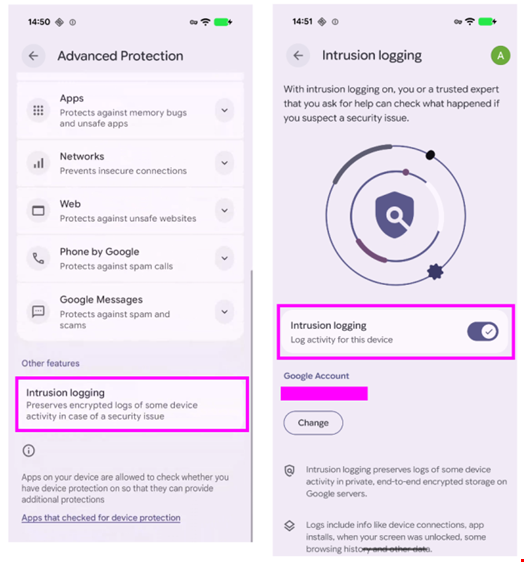
“Intrusion Logging logs may include sensitive information such as browser navigation history. Secure sharing of logs and informed consent are therefore more essential than ever,” warned Amnesty International in a May 12 report.
Donncha Ó Cearbhaill, head of security at Amnesty Tech, praised Google for the release of Intrusion Logging on X. He explained that spyware forensic work “has so far relied on incidental logs that were never designed for security analysis and are too often partial and short-lived.”
“Now we have the possibility to detect advanced spyware, exploits, unauthorized physical access, even months after the fact,” he added.
The feature is opt-in for Pixel devices on Android 16 and later versions with Advanced Protection mode enabled. Users who wish to benefit from Intrusion Logging must have a Google account linked to their device.
Google plans to roll Intrusion Logging out beyond Pixel devices in the future.
In parallel to the introduction of Intrusion Logging, Amnesty International has releasing updates to Android Quick Forensics (AndroidQF).
AndroidQF is a lightweight open source forensic tool for Android devices to quickly extract and analyze critical evidence during investigations, and the Mobile Verification Toolkit (MVT), an Amnesty-made, open source toolkit to simplify and automate the process of gathering forensic traces to identify a potential compromise of Android and iOS devices.
Google also has rolled out a package of updates to its Android Advanced Protection Mode. These include:
Finally, Advanced Protection will be expanded to support managed devices through Android Enterprise later this year.
Image credits: Thrive Studios ID / DIA TV / Shutterstock.com
此内容由惯性聚合(RSS阅读器)自动聚合整理,仅供阅读参考。 原文来自 — 版权归原作者所有。